
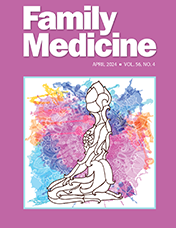
Family Medicine, an official journal of the Society of Teachers of Family Medicine, aims to publish high quality, original scholarship about education in family medicine and primary care. The journal publishes original research, systematic reviews, narrative essays, and policy analyses relevant to the discipline of family medicine, particularly focusing on primary care medical education, health workforce policy, and health services research. The journal does not publish clinical review articles.
Family Medicine is committed to advancing efforts towards inclusion and antiracism in all journal-related activities. We endeavor to eliminate bias and racism in our editorial process and published content.
Read the full diversity statement.
Submit Issue Cover Art for Family Medicine
Interested in submitting a photograph, painting, or artwork for consideration for a future Family Medicine issue cover? Send the high quality digital image to tbrazelton@stfm.org.
E-ISSN: 1938-3800


Call For Papers—
Recruit, Mentor, and Promote a Diverse Family Medicine Workforce.
Submission deadline: August 15
Family Medicine seeks submissions for a theme issue on recruiting, mentoring, and promoting a diverse family medicine workforce. Family medicine is one of the most gender and racially diverse specialties, yet the discipline lags behind the general population in diversity, particularly in academic settings. Yet a diverse workforce is paramount to the health of patients and communities and success within organizations. Therefore our goal is to collect high-quality articles on pathway programs, recruitment initiatives, and meaningful retention and promotion strategies aimed to diversify the family medicine workforce. Original research and brief reports are welcome. FM Focus submissions must have high yield, concise information that will be published as an infographic. Narrative essay submissions should share original stories from the perspective of students, residents, faculty members, or practicing physicians.
The STFM Medical Editing Fellowship: A Gateway to Scholarly Growth for Community Physicians
by Priyanka Tulshian, MD, MPH, current fellow
The path of a community physician is replete with personal patient interactions, localized health solutions, and the day-to-day fulfillment that comes from serving the immediate needs of a community. Yet, the pursuit of scholarship can sometimes seem like a distant reality, reserved for those in academia or large research-focused institutions. The Society of Teachers Family Medicine (STFM) Medical Editing fellowship presented me with a bridge between these two worlds, offering a community physician and educator a pathway to enhance my scholarly pursuits. My experience as a fellow has augmented my career in ways I had scarcely imagined.. READ MORE
Most Read (2022)
The Diabetes Code. Scherger JE. Fam Med. 2019;51(3):286-287.
Racism as Experienced by Physicians of Color in the Health Care Setting. Serafini K, Coyer C, Brown Speights J, et al. Fam Med. 2020: 52(4):282-287.
PedHITSS: A Screening Tool to Detect Childhood Abuse in Clinical Settings. Shakil A, Day PG, Chu J, Woods SB, Bridges K. Fam Med. 2018;50(10):763-769.
The Shared Principles of Primary Care: A Multistakeholder Initiative to Find a Common Voice. Epperly T, Bechtel C, Sweeney R, et al. Fam Med. 2019;51(2):179-184.
Joint Guidelines for Protected Nonclinical Time for Faculty in Family Medicine Residency Programs. Griesbach S, Theobald M, Kolman K, et al. Fam Med. 2021;53(6):443-452.
The Political Determinants of Health. Lin KW. Fam Med. 2022;54(1):65-66.
A Time-Motion Study of Primary Care Physicians’ Work in the Electronic Health Record Era. Young RA, Burge SK, Kumar KA, Wilson JM, Ortiz DF. Fam Med. 2018;50(2):91-99.
The Virginal Speculum and Its Myths. Walser SA. Fam Med. 2020;52(9):672-673.
Addressing Racism in Medical Education: An Interactive Training Module. White-Davis T, Edgoose J, Brown Speights JS, et al. Fam Med. 2018;50(5):364-368.
Family Physicians Delivering Babies? It’s Time to Decide. Winnie K, Saultz J. Fam Med. 2021;53(5):325-327.