
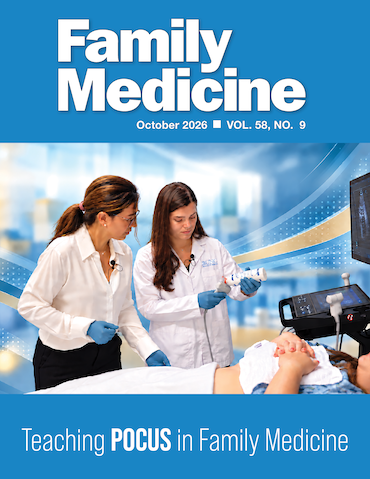
Family Medicine, an official journal of the Society of Teachers of Family Medicine, aims to publish high-quality, original scholarship about education in family medicine and primary care. The journal publishes original research, systematic reviews, narrative essays, and policy analyses relevant to the discipline of family medicine, particularly focusing on primary care medical education, health workforce policy, and health services research. The journal does not publish clinical review articles.
Family Medicine is committed to advancing efforts toward inclusion and antiracism in all journal-related activities. We endeavor to eliminate bias and racism in our editorial process and published content.
Read the full diversity statement.
Submit Issue Cover Art for Family Medicine
Interested in submitting a photograph, painting, or artwork for consideration for a future Family Medicine issue cover? Send the high-quality digital image to fmjournal@stfm.org.
E-ISSN: 1938-3800

Call for Papers: The Role of the Humanities and Narrative Medicine in Family Medicine Education
Family Medicine is pleased to announce a call for papers for an upcoming theme issue focused on exploring the role of the humanities and narrative medicine in family medicine education and training. Family medicine is more than diabetes and depression; it is a discipline of stories. We recognize the value of stories in enhancing our teaching of medical content and in professional development. We rely on our patients' stories to truly know them and understand their life context. This is why we include stories and robust storytelling in how we teach family medicine. Our faculty use the humanities (writing, visual arts, theater and improv, for example) to teach residents, students, and fellows about our patients' lives. These stories humanize the care we provide, give us the connections we desire, and keep us engaged in our discipline. We see narrative medicine as a way to use storytelling (in words, art, or language) to teach concepts related to the care of patients and communities. We welcome original research papers and brief reports about educational interventions or on observational studies examining various aspects of narrative medicine or the use of creative venues for teaching. We also welcome commentaries (with editor approval), FM Focus infographics, and narratives (personal stories) related to this topic.Potential topic areas include, but are not limited to:
- Reflective writing and storytelling in medical student, residency, or fellowship training
- Narrative approaches in K–12 or undergraduate pathway programs
- Use of narratives or visual arts in professional identity formation, equity, diversity, and inclusion, or wellness
- Patient and community narratives in teaching family medicine or community-oriented primary care, etc.
- Faculty development on writing, teaching, or using narratives in family medicine education
Specifically, we seek articles that address:
- How the use of narrative medicine affects faculty work-life integration and burnout
- How faculty use patient stories to teach learners about complex medical and social concerns
- Reading personal narratives to teach students and residents about professionalism
- How narrative medicine helps students and residents process challenging clinical scenarios
- How the use of theater or improv affects medical student or resident’s communication skills and feelings of empathy toward patients
- How narrative medicine teaches clinicians how to listen for patient stories, thereby making it easier to understand the patient’s life thereby improving care
Submit using Family Medicine's Online Manuscript Submission System. Mention the call for papers within your cover letter during the submission process. The deadline to submit is February 8, 2027.
Most-Read Research Articles Published in 2025
Young KM, Isaacs K, Jansen K. Perspectives on Quiet Quitting in Family Medicine Residency Programs. Fam Med. 2025;57(8):564-569. https://doi.org/10.22454/FamMed.2025.193586.
Tulshian P, Montgomery L, McCrory K, et al. National Recommendations for Implementation of Competency-Based Medical Education in Family Medicine. Fam Med. 2025;57(4):253-260. https://doi.org/10.22454/FamMed.2025.866091.
Ho T, Ly J, Chen M, et al. A Collaborative Reflection on the Model Minority Myth: Considerations for Recruiting, Retaining, and Promoting Asian Americans in Family Medicine. Fam Med. 2025;57(3):153-158. https://doi.org/10.22454/FamMed.2025.435358.
Shaughnessy AF, Wahid O, Fleishman J, Sokol R. What Do Residents Want From Clinical Supervision in Primary Care Practice? Identifying Desired Behaviors for Outpatient Precepting. Fam Med. 2025;57(9):622-626. https://doi.org/10.22454/FamMed.2025.122314.
Haymaker CM, Schilling J, Fraser K, et al. Best Practices for Early Intervention and Remediation of Residents in Family Medicine: Insights From an Interdisciplinary Delphi Study. Fam Med. 2025;57(2):98-106. https://doi.org/10.22454/FamMed.2025.820384
Carek PJ, Carek SM, Emerson J, et al. How Different Are Family Medicine Residents Who Desire Additional Training? Fam Med. 2025;57(2):107-112. https://doi.org/10.22454/FamMed.2024.583711.
Roper M, Malik P, Quaiattini A, Grad R. Clinical Questions Addressed by First-Year Medical Students in Primary Care: A Cross-Sectional Study. Fam Med. 2025;57(4):261-267. https://doi.org/10.22454/FamMed.2025.381934.
Umstattd Meyer M, Prochnow T, Hess B, et al. Fostering Collaborative Practice Through Interprofessional Education. Fam Med. 2025;57(2):91-97. https://doi.org/10.22454/FamMed.2024.533520.
Harriett L, Anderson L, Wheat SJ, Prunuske J, Oshman L. Signals and Preferences: Experiences of Midwest Family Medicine Residencies. Fam Med. 2025;57(2):123-131. https://doi.org/10.22454/FamMed.2025.447031.
Purkl L, Hierasimowicz K, Donner-Banzhoff N. Three Types of Uncertainty: A Qualitative Study of Family Medicine Residents. Fam Med. 2025;57(1):9-15. https://doi.org/10.22454/FamMed.2024.798978.