Background and Objectives: Point-of-care ultrasound (POCUS) use in family medicine has expanded significantly over the past decade. With POCUS training now recommended in family medicine residency education, limited evidence exists to guide curriculum development. This study aimed to establish a consensus-based tiering framework for integrating recommended POCUS applications into residency training.
Methods: Twenty-one family medicine physicians participated in a mixed-methods consensus conference. We used a modified nominal group technique to identify and weigh criteria for prioritizing the 54 family medicine POCUS applications previously defined in a 2025 Delphi study. We then used the aggregated scores for each application to generate a tiered list, which was refined through expert review.
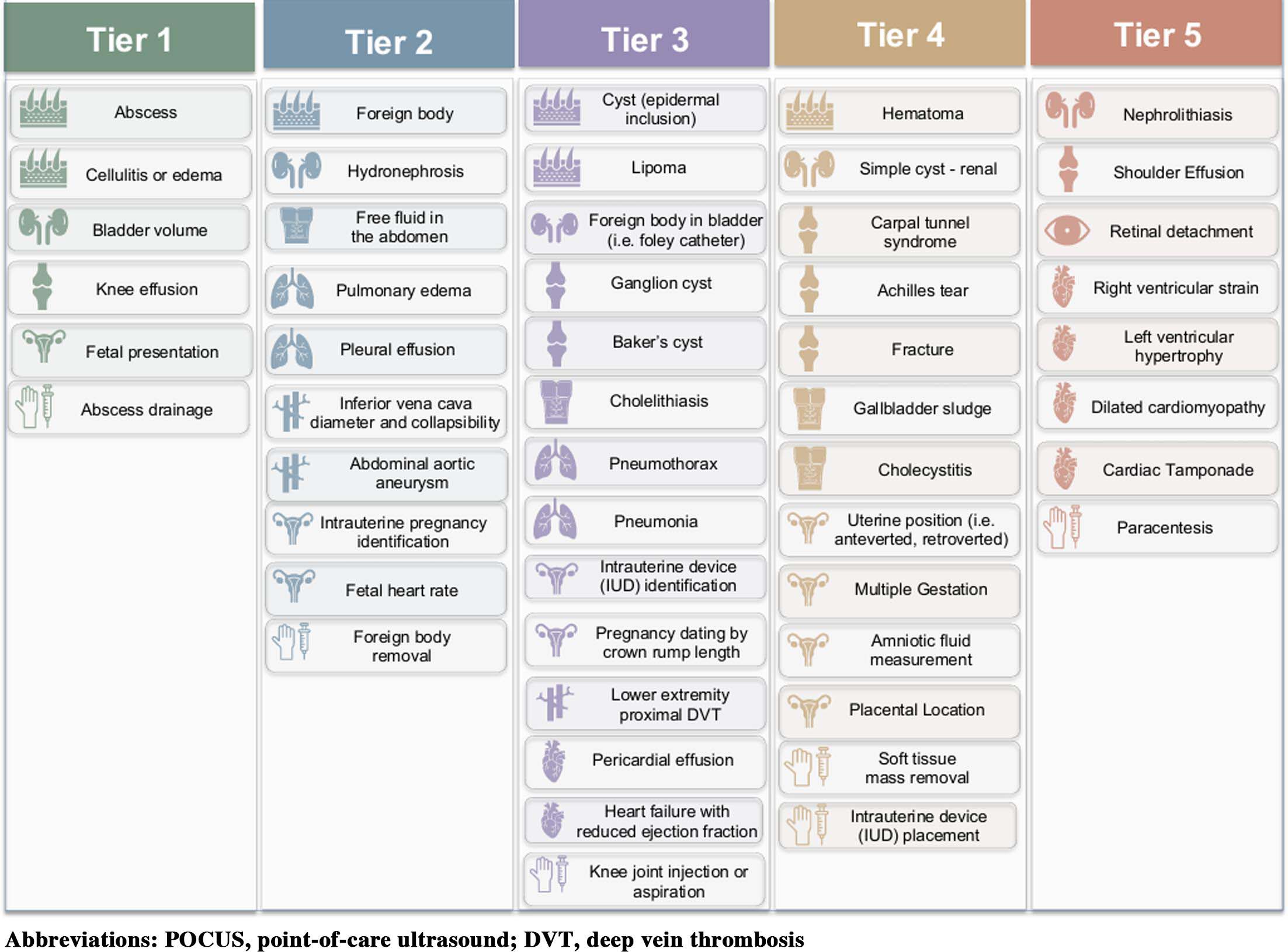
Results: We weighted for scoring the five priority criteria identified through the modified nominal group technique. These five included impact on patient management, ease of learning, ease of teaching, applicability across family medicine, and prevalence in continuity-of-care settings. We categorized the 54 POCUS applications and refined them into five tiers: Tier 1 (6 applications), Tier 2 (11), Tier 3 (14), Tier 4 (13), and Tier 5 (8); two applications were excluded for redundancy. Tier one applications—deemed highest priority—included abscess, abscess drainage, bladder volume, knee effusion, fetal presentation, and cellulitis/edema.
Conclusions: Using a mixed-methods consensus approach, we developed a five-tiered framework to guide the integration of POCUS applications into family medicine residency curricula. This framework provides a foundation for prioritizing educational content and aligning national standards for POCUS training.
Point-of-care ultrasound (POCUS) use is increasingly prevalent and can benefit patient care.1,2 POCUS use in the United States has risen steadily over the last decade,3,4,5 and several specialties (eg, emergency medicine, anesthesiology, critical care, and hospital medicine) have sought to formalize and standardize POCUS training with POCUS-specific milestones6,7 or certification pathways.8 Survey data from the Council of Academic Family Medicine Educational Research Alliance (CERA) have documented growing POCUS curriculum development.9,10 American Board of Family Medicine (ABFM) graduate surveys have similarly shown rising POCUS preparedness and use after residency. In 2025, 28% of early-career family physicians surveyed 3 years after graduation reported POCUS use.11
POCUS is well-suited to family medicine because it expands timely access to diagnostic imaging across a broad range of care settings.12 In light of this advantage, in 2023, the Accreditation Council for Graduate Medical Education began enforcing a new detailed requirement for experience in using POCUS in clinical care in US family medicine residency requirements.13 ABFM has announced a plan to require graduating residents to demonstrate competency in certain POCUS applications beginning in 2029.14 Both requirements lack detail on specific applications. In 2016, the American Academy of Family Physicians published a recommended POCUS curriculum for family physicians that lists specific POCUS applications but does not explain how they were selected or address an optimal order for instruction.15
The breadth of potential POCUS applications in family medicine presents a major challenge for curricular prioritization. Family medicine’s scope of practice is broad, and training time and resources are finite. Existing POCUS curricula from emergency medicine and hospital-based specialties are often heavily weighted toward acute inpatient or procedural applications that may not translate well to the longitudinal continuity settings in which most family medicine graduates practice.16 In contrast, family medicine requires a broader scope that may include outpatient procedures, obstetrics, musculoskeletal care, chronic disease management, screening, and preventive care. Existing primary care and specialty-specific Delphi studies have identified relevant applications but have not developed a structured, tiered implementation strategy to guide phased curricular adoption specific to US family medicine.17-22
To this end, the Society of Teachers of Family Medicine (STFM) and the ABFM Foundation sponsored Project FOCUS (Finding Consensus for POCUS Standards in Family Medicine Education and Competency-Based Assessment) and formed the STFM POCUS Task Force.23 Using a three-round traditional Delphi study completed in July 2025, the Task Force identified 54 POCUS applications in which graduating family medicine residents should be competent.24 The Task Force recognized that simultaneous implementation of all 54 applications would be unrealistic for many residency programs given variability in faculty expertise, curricular time, equipment access, and institutional infrastructure. A phased implementation framework was therefore needed to support scalable curricular adoption across programs at different stages of POCUS integration.
In selecting a method to achieve this goal, the Task Force recognized multiple competing educational and clinical priorities. Some applications, such as deep venous thrombosis evaluation or cholelithiasis assessment, may offer substantial clinical impact, yet require greater technical expertise, more advanced interpretation skills, or more complex clinical reasoning for safe integration into routine care. Other applications may be lower risk, easier to teach, or foundational for skill acquisition, but confer less immediate clinical impact. The Task Force therefore concluded that no single principle could adequately capture the complexity of prioritizing POCUS applications for family medicine residency training and that an effective implementation framework should incorporate multiple competing priorities simultaneously rather than relying on a single dimension of ranking. To achieve this aim, we designed a mixed-methods approach anchored in nominal group theory,25 which enables structured prioritization of perspectives for consensus decision-making, producing an evidence-based, stepwise framework for POCUS teaching that reflects the national landscape of US family medicine residencies at varying stages of POCUS adoption.
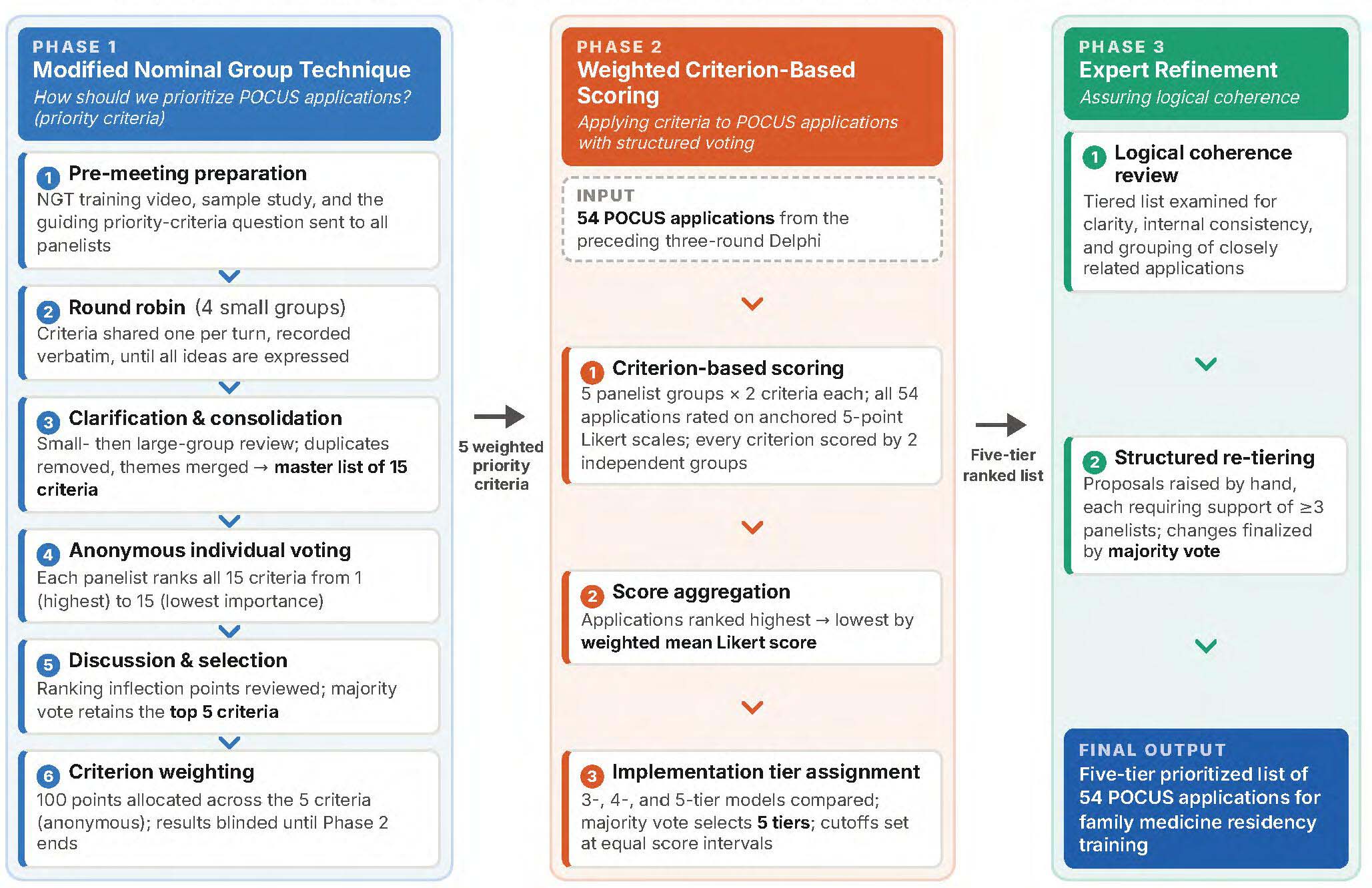
This study followed a sequential, mixed-methods approach, comprising a modified nominal group technique (mNGT) to identify priority criteria for tiering applications (Phase 1), weighted criterion-based scoring of each of the previously identified 54 clinical applications with numeric distribution into tiers (Phase 2), and expert refinement to finalize the tiers (Phase 3). Methods were determined a priori, and then each of these three phases was conducted during an in-person STFM-sponsored POCUS education summit in Chapel Hill, NC. This study was reviewed and deemed exempt by the University of North Carolina Institutional Review Board (IRB Number 24–2360).
Panelists
Panelist demographics are presented in Table 1. Voting panelists included 21of the 25 family physicians who were a part of STFM’s Project FOCUS. The selection process for each of these roles has been previously described in detail.24 In brief, each panelist was a US family medicine residency educator with expertise in POCUS, at least 0.3 full-time equivalent dedicated to patient care or resident supervision, and no significant financial conflicts of interest. To mitigate bias and ensure faithfulness to the predetermined methodology, nonvoting research team mentors (authors S.B., P.S., S.Z.) were present throughout the entire process to facilitate and were the only ones with access to raw, nonaggregated data. The process was broken into three distinct phases, summarized in Figure 1.
Characteristic |
n (%) |
Years since completing residency |
0–5 |
8 (38) |
6–10 |
9 (43) |
≥11 |
4 (19) |
Gender |
Male |
11 (52) |
Female |
10 (48) |
Race and/or ethnicity |
White |
10 (48) |
Asian |
7 (33) |
Hispanic or Latino |
2 (10) |
Other |
2 (10) |
Geographic location |
South |
9 (43) |
West |
6 (29) |
Midwest |
5 (24) |
Northeast |
1 (5) |
Years using POCUS |
0–5 |
12 (57) |
6–10 |
5 (24) |
≥11 |
4 (19) |
Primary patient care setting |
Outpatient care/clinic |
13 (62) |
Inpatient care/hospitalist |
3 (14) |
Urgent care or emergency department |
3 (14) |
Sports medicine |
1 (5) |
Obstetrical care |
1 (5) |
Patient care location(s) |
Urban (in metro areas of>250,000 people) |
7 (33) |
Micropolitan (urban population between 20,000 and 250,000) |
13 (62) |
Large rural (population of 5000 to 20,000) |
4 (19) |
Small rural (population<5,000) |
3 (14) |
Average number of POCUS scans performed weekly |
0–5 |
7 (33) |
6–10 |
5 (24) |
11–15 |
5 (24) |
≥16 |
4 (19) |
Published or presented at a national meeting about POCUS |
Yes |
18 (86) |
No |
3 (14) |
Phase 1: Modified Nominal Group Technique
The mNGT was selected to foster creative idea generation and because nominal group technique (NGT) is adaptable and can be combined with other methods.26,27 Traditionally, NGT comprises five steps: brainstorming, round robin, clarification, voting, and discussion.26 We split clarification into two stages, a small- and large-group stage.27 The mNGT Phase 1 lasted 4 hours.
Premeeting Preparation. In preparation for the summit, all panelists received an informational video on the NGT process,28 a published article about an NGT study,27 and a prerecorded overview of the session’s objectives and structure. Panelists also were given the question, “What criteria or circumstances do you consider when deciding which POCUS applications should be prioritized or taught first in family medicine residency training?” These criteria (designated “priority criteria”) served as the background construct for designing a relative order for the inclusion of an individual clinical POCUS application in a curriculum.
Summit Round Robin (Small Group). In four small, facilitated groups, each panelist shared one priority criterion per turn, with the option to pass. When a panelist shared a priority criterion, all other panelists remained silent while a facilitator recorded responses verbatim. Panelists continued to share priority criteria until all had been expressed. Each small group then reviewed its list of priority criteria. Duplicates were removed, while overlapping priority criteria were thematically consolidated. Priority criteria were iteratively clarified as needed until each panelist confirmed agreement.
Summit Clarification and Thematic Consolidation (Large Group). All 21 panelists reconvened, where a facilitator guided the group through a comparison of priority criteria from each of the four small groups. Duplicate criteria across groups were removed, similar criteria were thematically consolidated, and the wording was iteratively revised until each panelist agreed with the master list. During this stage, panelists were encouraged to advocate for and elaborate on priority criteria, ensuring that the list captured all possible priority criteria from the collective group. The master priority criteria list contained 15 items.
Summit Voting on Master Priority Criteria. Each panelist then individually ranked all master priority criteria from highest (1) to lowest importance (15) by responding to an anonymous survey. Aggregate results of the initial ranking were presented to panelists to allow visualization of natural inflection points in average scores. A priori, the group determined that the weighted voting phase would incorporate either the top three or top five priority criteria. Following a structured large-group discussion, panelists voted on the final number of criteria, with a majority supporting the inclusion of the top five criteria for subsequent weighted analysis.
Weighting of Five Priority Criteria. Recognizing that the five priority criteria identified may not carry equal importance, these criteria were subsequently weighted to determine their relative contribution in evaluating POCUS applications. Panelists completed an anonymous survey in which they allocated a total of 100 percentage points across the five criteria based on their perceived relative importance. Results of the weighting were not disclosed to panelists until after Phase 2.
Phase 2: Weighted Criterion-Based Scoring of POCUS Applications
The five weighted priority criteria identified in Phase one were subsequently applied to score the 54 POCUS applications derived from the three-round Delphi process preceding the mNGT.24 This weighted, criterion-based approach—used in prior health care studies—allows experts to evaluate and prioritize applications with greater accuracy and reduced cognitive burden by focusing on one dimension of assessment at a time.29
Criterion-Based Scoring of Applications. Panelists (N = 21) were divided into five groups. Each group completed two separate surveys, one for each of two assigned priority criteria. Within each survey, panelists independently and anonymously evaluated all 54 clinical POCUS applications through the assigned criterion on an anchored five-point Likert scale. For example, one survey item asked panelists to evaluate the extent to which bladder volume POCUS (application) has a beneficial impact on patient management (priority criterion). The assignment structure ensured that each application was evaluated across all five priority criteria, with each criterion assessed by two independent groups of panelists. Priority criteria were deliberately paired so that lower-weight criteria were grouped with higher-weight criteria, minimizing the potential for any single group of panelists to exert disproportionate influence on the final results (Supplemental Figure 1).
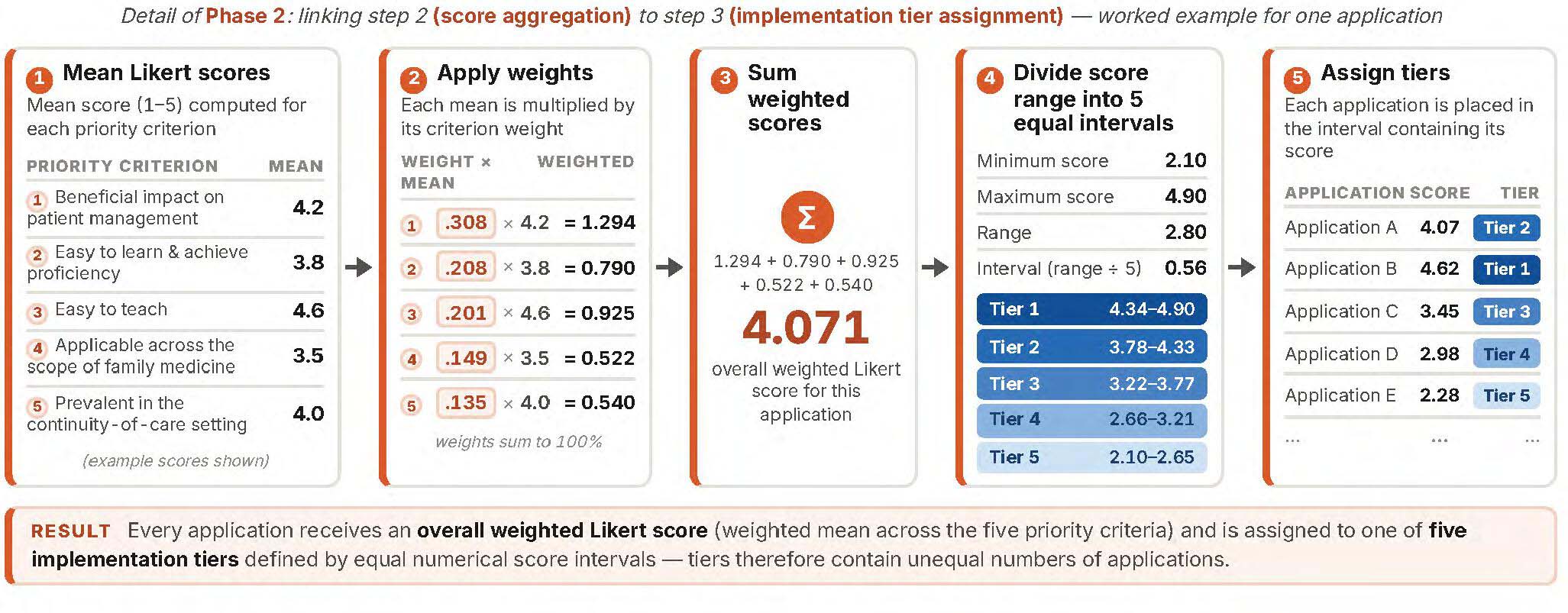
Implementation Tier Assignment. Panelists were presented with a list of 54 POCUS applications ordered from highest to lowest aggregated score, calculated as the weighted mean Likert score across two independent groups. To facilitate tier determination, panelists were shown multiple candidate tiering structures (three-, four-, and five-tier models) illustrating how applications would be divided based on score distribution. Following a structured group discussion, panelists selected the final number of implementation tiers by majority vote. Applications were then assigned to tiers using score cutoffs that divided the range of aggregated scores into equal numerical intervals, with each application assigned to a tier based on the interval in which its score fell (Figure 2).
Phase 3: Expert Refinement for Logical Coherence
Panelists were presented with the five-tiered results from the outcome of voting in the tiered assignment previously completed and were asked to review the list for clarity, internal consistency, and logical coherence. The goal of this step was not to reevaluate applications based on the priority criteria, but rather to identify instances where applications could not be logically separated across tiers or where closely related applications should be consolidated. For example, panelists considered whether conditions such as cellulitis and abscess should be tiered separately. Proposed changes were introduced via a structured hand-raising process, with each proposal requiring verbal support from at least three additional panelists before advancing to a vote. Retiering or consolidation decisions were finalized by majority vote.
Data Collection
Qualtrics (Qualtrics LLC) was used for individual surveys, and Poll Everywhere (Poll Everywhere Inc) was used for majority votes.
All 21 panelists engaged in Phases 1 and 2. One panelist was unable to participate in Phase 3. Panelists were predominantly male (52%); 62% were six or more years out of residency (43% 6–10 years; 19%≥11 years); and 43% performed 11 or more scans a week (24% 11–15; 19%≥16). The majority worked in the outpatient clinic (62%) and published and/or presented nationally on POCUS (86%). Nearly half (48%) identified as White, 33% identified as Asian, and 10% identified as Latino (Table 1).
Phase 1: Modified Nominal Group Technique
After consolidation, 15 priority criteria were identified to help determine which POCUS applications should be taught first in family medicine residency training, and these moved forward to be ranked. The top five were selected for use and underwent weighting (Table 2).
Priority criterion |
Average ranka |
Weight |
Relative ease to learn and achieve proficiency |
2.71 |
0.21 |
Beneficial impact on patient management (ie, reduce resources, narrow differential, change disposition) |
2.86 |
0.31 |
Applicability across the broad scope of family medicine (ie, inpatient, outpatient, obstetrics, musculoskeletal) |
3.95 |
0.15 |
Relative ease to teach |
5.57 |
0.20 |
Prevalence in the continuity of care setting |
5.67 |
0.14 |
Low risk to patient safety while interpreting scan (ie, and liability of missed diagnosis, quality) |
7.29 |
– |
Strong evidence-based diagnostic ability |
7.52 |
– |
Requires fewer resources and technology to adopt |
7.76 |
– |
Ease of integration into clinical workflow (ie, time to complete scan) |
8.33 |
– |
Transferable to other POCUS applications (ie, uses multiple modalities and helps build foundational knowledge) |
9.81 |
– |
Addresses health equity (ie, underserved needs, populations, gaps in care) |
10.67 |
– |
Low risk to patient safety while performing |
11.29 |
– |
Contributes to the long-term financial stability of a POCUS program (ie, higher reimbursement, coding and billing) |
11.95 |
– |
Clinical interest of family physicians and residents |
12.00 |
– |
Educational value for reinforcing medical knowledge (ie, anatomy, pathophysiology) |
12.62 |
– |
Phase 2: Weighted Criterion-Based Scoring
The results of the weighting of the five priority criteria across the 54 POCUS applications are found in Table 3. The group voted to divide the applications into five implementation tiers. The complete list, individual scores, and original implementation tier assignments are in Table 3.
POCUS applications |
Average weighted score for each priority criterion |
Weighted sum |
Prerefinement tiera |
Relative ease to learn and achieve proficiency |
Beneficial impact on patient management |
Applicability across the broad scope of family medicine |
Relative ease to teach |
Prevalence in the continuity of care setting |
Abscess |
0.96 |
1.30 |
0.75 |
0.95 |
0.52 |
4.48 |
1 |
Cellulitis |
0.93 |
1.20 |
0.75 |
0.93 |
0.52 |
4.33 |
1 |
Bladder volume |
0.91 |
1.16 |
0.69 |
0.95 |
0.49 |
4.20 |
1 |
Knee effusion |
0.85 |
1.13 |
0.63 |
0.93 |
0.57 |
4.12 |
1 |
Abscess drainage |
0.93 |
1.09 |
0.65 |
0.80 |
0.54 |
4.02 |
2 |
Fetal position and presentation |
0.96 |
1.40 |
0.39 |
0.68 |
0.52 |
3.95 |
2 |
Foreign body |
0.83 |
1.16 |
0.65 |
0.78 |
0.51 |
3.93 |
2 |
Intrauterine pregnancy identification |
0.83 |
1.33 |
0.50 |
0.60 |
0.59 |
3.86 |
2 |
Free fluid in the abdomen |
0.75 |
1.33 |
0.61 |
0.78 |
0.37 |
3.85 |
2 |
Pulmonary edema |
0.85 |
1.06 |
0.69 |
0.83 |
0.35 |
3.79 |
2 |
Hydronephrosis |
0.80 |
1.13 |
0.69 |
0.73 |
0.41 |
3.75 |
2 |
Pleural effusion |
0.85 |
0.92 |
0.63 |
0.83 |
0.41 |
3.65 |
2 |
Inferior vena cava collapsibility (central venous pressure elevation) |
0.78 |
1.13 |
0.52 |
0.78 |
0.39 |
3.59 |
2 |
Cyst (epidermal inclusion cyst) |
0.83 |
0.99 |
0.47 |
0.80 |
0.49 |
3.58 |
3 |
Abdominal aortic aneurysm |
0.67 |
1.20 |
0.50 |
0.70 |
0.49 |
3.57 |
3 |
Fetal heart rate |
0.78 |
1.09 |
0.45 |
0.68 |
0.56 |
3.55 |
3 |
Pneumonia |
0.54 |
1.16 |
0.73 |
0.53 |
0.59 |
3.55 |
3 |
Foreign body removal |
0.72 |
1.20 |
0.56 |
0.55 |
0.47 |
3.51 |
3 |
Knee joint injection/aspiration |
0.70 |
1.06 |
0.52 |
0.60 |
0.61 |
3.49 |
3 |
Cholelithiasis |
0.62 |
1.13 |
0.63 |
0.58 |
0.49 |
3.45 |
3 |
Edema |
0.83 |
0.65 |
0.58 |
0.88 |
0.51 |
3.44 |
3 |
Baker’s cyst |
0.65 |
1.16 |
0.47 |
0.65 |
0.49 |
3.42 |
3 |
Pericardial effusion |
0.80 |
1.03 |
0.52 |
0.70 |
0.35 |
3.41 |
3 |
Lower extremity proximal deep vein thrombosis |
0.57 |
1.30 |
0.61 |
0.40 |
0.51 |
3.39 |
3 |
Inferior vena cava diameter (central venous pressure elevation) |
0.70 |
1.06 |
0.52 |
0.75 |
0.35 |
3.39 |
3 |
Heart failure with reduced ejection fraction |
0.49 |
1.16 |
0.61 |
0.55 |
0.47 |
3.29 |
3 |
Lipoma |
0.72 |
0.96 |
0.45 |
0.65 |
0.51 |
3.29 |
3 |
Intrauterine device |
0.72 |
1.03 |
0.41 |
0.58 |
0.47 |
3.21 |
3 |
Ganglion cyst |
0.62 |
0.99 |
0.45 |
0.65 |
0.49 |
3.20 |
3 |
Amniotic fluid measurement |
0.67 |
1.09 |
0.34 |
0.58 |
0.51 |
3.19 |
3 |
Foreign body (Foley catheter) in bladder |
0.85 |
0.92 |
0.45 |
0.68 |
0.25 |
3.16 |
3 |
Cholecystitis |
0.47 |
1.30 |
0.54 |
0.38 |
0.35 |
3.04 |
4 |
Pregnancy dating by crown rump length |
0.57 |
1.13 |
0.30 |
0.50 |
0.52 |
3.02 |
4 |
Paracentesis |
0.67 |
1.33 |
0.32 |
0.35 |
0.30 |
2.98 |
4 |
Gallbladder sludge |
0.49 |
0.92 |
0.60 |
0.48 |
0.49 |
2.98 |
4 |
Pneumothorax |
0.75 |
0.96 |
0.45 |
0.55 |
0.27 |
2.98 |
4 |
Soft tissue mass removal |
0.67 |
0.99 |
0.39 |
0.45 |
0.46 |
2.96 |
4 |
Soft tissue mass |
0.65 |
0.89 |
0.39 |
0.48 |
0.51 |
2.93 |
4 |
Carpel tunnel syndrome |
0.52 |
1.03 |
0.39 |
0.45 |
0.51 |
2.91 |
4 |
Achilles tear |
0.60 |
0.92 |
0.37 |
0.63 |
0.35 |
2.89 |
4 |
Uterine position (ie, anteverted, retroverted) |
0.65 |
0.79 |
0.37 |
0.60 |
0.46 |
2.87 |
4 |
Placental location |
0.78 |
0.75 |
0.28 |
0.58 |
0.46 |
2.87 |
4 |
Intrauterine device placement |
0.54 |
0.79 |
0.41 |
0.55 |
0.52 |
2.84 |
4 |
Hematoma |
0.57 |
0.89 |
0.48 |
0.43 |
0.41 |
2.82 |
4 |
Multiple gestation |
0.67 |
0.85 |
0.28 |
0.55 |
0.35 |
2.78 |
4 |
Simple cyst (renal) |
0.78 |
0.62 |
0.43 |
0.75 |
0.35 |
2.71 |
4 |
Retinal detachment |
0.54 |
1.06 |
0.37 |
0.45 |
0.25 |
2.68 |
5 |
Fracture |
0.54 |
0.75 |
0.43 |
0.55 |
0.37 |
2.65 |
5 |
Shoulder effusion |
0.60 |
0.79 |
0.39 |
0.48 |
0.39 |
2.64 |
5 |
Nephrolithiasis |
0.49 |
0.75 |
0.54 |
0.48 |
0.32 |
2.58 |
5 |
Right ventricular strain |
0.36 |
0.96 |
0.47 |
0.33 |
0.29 |
2.40 |
5 |
Left ventricular hypertrophy |
0.36 |
0.72 |
0.50 |
0.40 |
0.41 |
2.39 |
5 |
Dilated cardiomyopathy |
0.39 |
0.72 |
0.45 |
0.30 |
0.39 |
2.24 |
5 |
Cardiac tamponade |
0.36 |
1.03 |
0.34 |
0.28 |
0.24 |
2.24 |
5 |
Phase 3: Expert Refinement
During the moderated expert refinement phase, a number of changes were proposed and voted on. Cellulitis and edema were considered redundant topics and were merged because they are indistinguishable sonographically. Soft tissue mass was removed because other types of soft tissue masses were present and thought to be more specific (ie, lipoma). Nine POCUS applications (abscess drainage, fetal heart rate, fetal position and presentation, foreign body removal, abdominal aortic aneurysm, inferior vena cava diameter, pregnancy dating by crown rump length, pneumothorax, and fracture) moved to a higher priority tier for reasons of logical coherence. Two POCUS applications (amniotic fluid measurement, paracentesis) moved to a lower priority implementation tier due to concerns about broad applicability. Figure 3 includes the final five implementation tiers of clinical applications.
Using validated consensus methods, this national panel of 21 experts developed recommendations for phased implementation of a group of 54 POCUS applications previously selected for US family medicine education by the STFM POCUS Task Force using Delphi methodology, distilled to 52 during expert refinement (Figure 3).24 In doing so, they aimed to support the family medicine discipline’s POCUS adoption process through manageable implementation steps.
To our knowledge, this is the first study to combine a Delphi process to generate a list of recommended POCUS applications with a subsequent mNGT to rank and tier them for phased implementation. Our approach sought to minimize individual bias by using validated consensus techniques to stratify applications.
The potential scope of POCUS in family medicine is broad, and POCUS competency contains multiple core domains (eg, image acquisition, image interpretation, and clinical integration). To enable scalable implementation, breaking down these larger lists of applications into manageable tiers is imperative. One such approach would involve tiering items by their scores and rank from the overall Delphi process, though our experience suggests significant drawbacks to that approach. In our consensus results, ranking based on average scores from the Delphi process alone would have ranked pericardial effusion, heart failure with reduced ejection fraction, free fluid in the abdomen, and pleural effusion as the top four applications, none of which ended up in Tier one after our mNGT process. The tiering process allowed us to truly prioritize POCUS applications based on an objective set of priority criteria specific to family medicine.
We chose to utilize an mNGT for this process because we wanted to be intentional and objective in creating the priority criteria list that informed the tiers. Of all the five priority criteria, beneficial impact on patient management was assigned the highest weight – a result consistent with findings from other implementation science models.30,31 Relative ease for teaching and learning was also an important consideration because of the national shortage of qualified faculty.9 Similarly, these priority criteria also influenced the results so that progressively more complex scans were tiered lower and less technical scans were tiered higher. For example, identifying cholelithiasis (Tier 3) or cholecystitis (Tier 4) is more challenging than differentiating abscess from cellulitis (Tier 1). Including the criteria of prevalence in the continuity-of-care setting and applicability across family medicine was important to reflect family medicine’s breadth and the outpatient focus of most graduates (77%–81%) practicing in continuity clinics.16
We trusted our research process that generated the implementation tier distribution through multiple individual anonymous surveys, but certain elements could not be captured in this format (eg, pairing applications to avoid redundancy in teaching). Thus, we provided space for expert refinement with the intention that all decisions would reflect the majority opinion. During expert refinement, attempts were made to combine diagnostic applications (eg, abscess) with procedural applications (eg, abscess drainage). However, doing so was not always feasible given differences in ease of learning and prevalence in continuity of care settings. For this reason, abscess drainage appears alongside abscess identification, but paracentesis does not exist alongside abdominal free fluid evaluation.
This study had several limitations. First, the typical NGT size is 5 to 12, and we had 21 panelists.25 We divided into four subgroups, with the largest group having six panelists, to enhance engagement and face-to-face interaction. Additionally, four of the 25 members of the original Delphi panel were unable to attend the consensus conference. We did not have each panelist vote on every priority criterion for every clinical application; instead, we prioritized a smaller, representative subgroup voting structure. As a result, the two groups that applied the beneficial impact on patient management priority criterion to the applications had greater influence than the other groups on the final tiering. Any expert consensus process contains bias inherent to the views of those experts. Though these biases cannot be fully eliminated, we attempted to control for them throughout with blinded data, nonvoting research team members serving as facilitators, and intentional panelist representation with attention to viewpoint diversity. These are all described further in the applications Delphi.24 Important to note is that the research question here was not “if” but “how” to implement POCUS within US family medicine.
In conclusion, the five-tier framework offers a stepwise approach to implementing a POCUS curriculum. The Task Force published a separate article outlining a multiorganizational recommendation on the use of the implementation tiers in family medicine residency education.32 Given that beneficial impact on patient management is the most important criterion identified by this study, future research must evaluate whether patient-oriented outcomes do indeed arise from POCUS integration and, if so, which outcomes benefit most from this new technology, with a particular focus on Tier one or Tier two applications. Additionally, the use of artificial intelligence will impact POCUS implementation in the coming years, requiring further research and potential reprioritizing applications. Thus, ongoing research should go hand in hand with the implementation of POCUS in family medicine education and practice.
A.R.: Conceptualization, writing–review and editing.
C.C.: Conceptualization, methodology, software, validation, formal analysis, investigation, resources, data curation, writing–original draft, writing–review and editing, visualization, supervision, project administration.
H.P.: Conceptualization, investigation, writing–review and editing.
J.T.: Resources, writing–original draft, writing–review and editing, project administration, funding acquisition.
J.S.W.: Conceptualization, writing–original draft, writing–review and editing.
J.N.C.: Conceptualization, methodology, software, validation, resources, writing–original draft, writing–review and editing.
N.N.: Conceptualization, investigation, resources, writing–original draft.
N.L.: Conceptualization, methodology, software, formal analysis, investigation, writing–review and editing, visualization.
P.D.S.: Conceptualization, investigation, writing–review and editing, supervision.
P.D.: Conceptualization, investigation, resources, writing–original draft, writing–review and editing, supervision, project administration.
R.M.T.: Writing–review and editing.
R.P.: Conceptualization, methodology, software, validation, formal analysis, investigation, resources, data curation, writing–original draft, writing–review and editing, visualization, supervision, project administration, funding acquisition.
S.H.: Methodology, software, validation, formal analysis, investigation, resources, data curation, writing–original draft, writing–review and editing, visualization, supervision, project administration.
S.Z.: Conceptualization, methodology, resources, writing–review and editing, visualization, supervision.
V.S.: Conceptualization, methodology, validation, investigation, writing–original draft, writing–review and editing, visualization, supervision.
W.H.: Conceptualization, methodology, validation, formal analysis, investigation, resources, writing–original draft, writing–review and editing.
USE OF ARTIFICIAL INTELLIGENCE
The authors used Claude (Anthropic) Opus 5 to create the figures used in this article.
CONFLICTING AND COMPETING INTERESTS
This research was funded by the American Board of Family Medicine (ABFM) Foundation and the Society of Teachers of Family Medicine (STFM)—the sponsors. This means that the research team was being paid by the sponsors for conducting the study. In addition, Dr Ryan Paulus, the principal investigator, Dr Puja Dalal, Dr Hiten Patel, and Dr J. Nicoll Capizzano received money from STFM as core faculty in the STFM Family Medicine Educator’s POCUS Certificate Program that is not part of this study. These activities may include consulting, service on advisory boards, giving speeches, or writing reports.
Dr Patel consults with GE Healthcare’s point-of-care ultrasound team, giving input and feedback on device development and functionality specific to family medicine. Dr Patel does not have stock or equity interest in GE Healthcare. Dr Patel does not have any relevant conflicts of interest from this work in relation to this article.
Thank you to the Society of Teachers of Family Medicine (STFM) for its support in this study and to the American Board of Family Medicine Foundation for funding support.
The authors thank Christy Ledford, PhD, for her consultation and guidance in methods design, and Ryan Trantham, MD, STFM POCUS Task Force member, for his support throughout the project.
The authors thank STFM Director of Strategic Priorities and Programs April Davies, MPH, for her endless support and contributions to making this project successful.
The authors thank University of North Carolina medical students Jordan Swandell, Clare Stull, and Asia Brannon for their assistance in facilitating the consensus conference.
Thank you to the following family physicians who participated in the activities described in the manuscript to develop the implementation tires:
Benjamin Bryden, MD - University of Montana
Juana Nicoll Capizzano, MD - University of Michigan
Rachel Carter, MD - Naval Medical Center Camp Lejeune
Puja Dalal, MD - Novant Health
John Doughton, MD - University of North Carolina
Kyle Flattery, MD - Brown University
Bradley Green, MD - Gadsen Regional Medical Center
William Hui, MD - Stanford University School of Medicine
Jerica Johnson, MD - University of New Mexico
Nicholas LeFevre, MD - University of Missouri
Andrea Lewis, DO - Southern Colorado Family Medicine
Daniela Lobo, MD - Indiana University
Alex McDonald, MD - Kaiser Permanente Fontana Medical Center
Natalie Nguyen, DO - Kaiser Permanente Los Angeles Medical Center
Hiten Patel, MD - The Ohio State University
Ryan Paulus, DO - The Ohio State University
Ryan Paulus, DO - University of North Carolina
Summer Scavone, MD - University of Virginia
Joy Shen-Wagner, MD - Prisma Health University of South Carolina
Varshaben Songara, MD - Cape Fear Valley Health
Johnny Tenegra, MD - Southern Illinois University
Ryan Trantham, MD - Ascension Providence Hospital
References
-
Andersen CA, Holden S, Vela J, Rathleff MS, Jensen MB. Point-of-care ultrasound in general practice: a systematic review.
Ann Fam Med. 2019;17(1):61–69. doi:10.1370/afm.2330
-
Carrera KG, Hassen G, Camacho-Leon GP, Rossitto F, Martinez F, Debele TK. The benefits and barriers of using point-of-care ultrasound in primary healthcare in the United States.
Cureus. 2022;14(8):e28373. doi:10.7759/cureus.28373
-
Gottlieb M, Cooney R, King A, et al. Trends in point-of-care ultrasound use among emergency medicine residency programs over a 10-year period.
AEM Educ Train. 2023;7(2):e10853. doi:10.1002/aet2.10853
-
Williams JP, Nathanson R, LoPresti CM, et al. Current use, training, and barriers in point-of-care ultrasound in hospital medicine: a national survey of VA hospitals.
J Hosp Med. 2022;17(8):601–608. doi:10.1002/jhm.12911
-
Schnure N, Elfadil MM, Chan W, Baston C, Shofer F, Panebianco N. Trends in point of care ultrasound familiarity among undergraduate medical clerkship educators.
POCUS J. 2024;9(1):80–86. doi:10.24908/pocus.v9i1.16678
-
-
-
-
Hall JWW, Holman H, Barreto TW, et al. Point-of-care ultrasound in family medicine residencies 5-year update: a CERA study.
Fam Med. 2020;52(7):505–511. doi:10.22454/FamMed.2020.223648
-
Capizzano JN, O’Dwyer M-C, Furst W, et al. Current state of point-of-care ultrasound use within family medicine.
J Am Board Fam Med. 2022;35(4):809–813. doi:10.3122/jabfm.2022.04.220019
-
-
Bornemann P, Barreto T. Point-of-care ultrasonography in family medicine. Am Fam Physician. 2018;98(4):200–202.
-
-
-
-
Carek PJ, Cheng Y, Bazemore AW, Peterson LE. Variation in practice patterns of early- and later-career family physicians.
J Am Board Fam Med. 2024;37(1):35–42. doi:10.3122/jabfm.2023.230176R1
-
Ma IWY, Arishenkoff S, Wiseman J, et al, Canadian Internal Medicine Ultrasound (CIMUS) Group. Internal medicine point-of-care ultrasound curriculum: consensus recommendations from the Canadian Internal Medicine Ultrasound (CIMUS) Group.
J Gen Intern Med. 2017;32(9):1052–1057. doi:10.1007/s11606-017-4071-5
-
Haidar DA, Peterson WJ, Minges PG, et al. A consensus list of ultrasound competencies for graduating emergency medicine residents.
AEM Educ Train. 2022;6(6):e10817. doi:10.1002/aet2.10817
-
LoPresti CM, Murray KJ, Dancel R, et al. Internal medicine residency point-of-care ultrasound (POCUS) consensus recommendations for core indications and applications.
Am J Med. 2025;138(12):1705–1715. doi:10.1016/j.amjmed.2025.05.033
-
Conangla-Ferrin L, Guirado-Vila P, Solanes-Cabús M, et al. Ultrasound in primary care: consensus recommendations on its applications and training. results of a 3-round Delphi study.
Eur J Gen Pract. 2022;28(1):253–259. doi:10.1080/13814788.2022.2150163
-
Andersen CA, Løkkegaard T, Nayahangan LJ, et al. A core curriculum of point-of-care ultrasound examinations for frontline physicians in primary care: results from a European Delphi study.
Ultraschall Med. 2026;47(2):160–170. doi:10.1055/a-2590-5242
-
Løkkegaard T, Todsen T, Nayahangan LJ, Andersen CA, Jensen MB, Konge L. Point-of-care ultrasound for general practitioners: a systematic needs assessment.
Scand J Prim Health Care. 2020;38(1):3–11. doi:10.1080/02813432.2020.1711572
-
Paulus R, Davies A. STFM announces new point of care ultrasound task force and initiative on POCUS family medicine education.
Ann Fam Med. 2025;23(2):173–174. doi:10.1370/afm.250093
-
LeFevre NM, Hui W, Dalal P, et al. Recommended point-of-care ultrasound (POCUS) applications for US family medicine residency training: a national Delphi study from the STFM POCUS Task Force.
Fam Med. 2026;58(9):xx–xx. doi:10.22454/FamMed.2026.396905
-
Humphrey-Murto S, Varpio L, Gonsalves C, Wood TJ. Using consensus group methods such as Delphi and nominal group in medical education research.
Med Teach. 2017;39(1):14–19. doi:10.1080/0142159X.2017.1245856
-
Wiggins ST, Colby S, Moret L, et al. A modified nominal group technique (mNGT)—finding priorities in research.
Am J Health Behav. 2020;44(3):345–352. doi:10.5993/AJHB.44.3.7
-
McMillan SS, King M, Tully MP. How to use the nominal group and Delphi techniques.
Int J Clin Pharm. 2016;38(3):655–662. doi:10.1007/s11096-016-0257-x
-
-
Ezeife DA, Dionne F, Fares AF, et al. Value assessment of oncology drugs using a weighted criterion-based approach.
Cancer. 2020;126(7):1530–1540. doi:10.1002/cncr.32639
-
Shoman H, Almeida ND, Tanzer M. Ranking decision-making criteria for early adoption of innovative surgical technologies.
JAMA Netw Open. 2023;6(11):e2343703. doi:10.1001/jamanetworkopen.2023.43703
-
Fortinguerra F, Perna S, Marini R, et al. Scientific and Technical Committee. The assessment of the innovativeness of a new medicine in Italy.
Front Med (Lausanne). 2021;8:793640. doi:10.3389/fmed.2021.793640
-
Paulus R. Multiorganizational recommendations for point-of-care ultrasound in family medicine residency education.
Fam Med. 2026;58(9):xx–xx. doi:10.22454/FamMed.2026.426882



There are no comments for this article.