Background and Objectives: The Scholars in Rural Health (SRH) program at the University of Kansas School of Medicine (KUSOM) aims to address rural physician shortages by recruiting and supporting college students from rural Kansas. This study evaluated the outcomes of the early assurance program to determine its effectiveness in increasing participation in the rural physician workforce.
Methods: We conducted a retrospective cohort study (1997–2024) to analyze data from 403 participants in the SRH program. We reviewed program and medical school records to assess completion rates, residency placements, and practice locations. Rural practice was defined using the Federal Office of Rural Health Policy (FORHP) criteria.
Results: Medical College Admission Test (MCAT) performance was a key factor in medical school matriculation, with an increase in nonmatriculation following the 2015 MCAT revision. A total of 200 people completed the SRH program and medical school. Of these, 136 (68%) matched into primary care residencies (family medicine, internal medicine, pediatrics), with 110 (55%) matching into family medicine residencies. Of those studied, a total of 150 residency graduates were in practice; 84 (56%) practiced in fully FORHP rural counties. Additionally, 122 (81%) practiced in Kansas overall.
Conclusions: The SRH program is associated with a higher proportion of graduates practicing in rural Kansas compared to the overall KUSOM cohort. Continued support, particularly in MCAT preparation, may improve retention and further enhance rural physician workforce development. Future studies should explore the impact of state loan repayment or service-obligation programs and the role of SRH alumni in academic and mentorship roles at KUSOM.
Rural communities across Kansas face persistent physician shortages, exacerbated by hospital closures, an aging workforce, and lower physician-to-population ratios.1,2 In Kansas counties, rural residents have access to 0.8 primary care physicians per 1000 residents, compared to 1.5 physicians per 1000 in metropolitan counties2—a disparity that significantly affects health care access and community well-being. To address these gaps, the University of Kansas School of Medicine (KUSOM) has a long history of offering rural programming to encourage medical students to pursue careers in rural medicine throughout the state. Medical students are required to complete a rural rotation during medical school, are exposed to issues facing rural Kansas throughout the curriculum, and have numerous student groups focused on rural medicine and primary care. KUSOM also has programs to support rural students and grow interest in primary care. Medical schools may express a desire to address rural physician shortages, but few formal rural programs for premedical students exist.3 An early assurance program for rural premedical students is not common. Early assurance is a restricted application type that guarantees an applicant admission to medical school after completion of program requirements.4
Medical education literature often uses overlapping terminology to describe premedical programming, which can obscure meaningful distinctions between program types. Pathway, pipeline, or preadmission programs typically target K–12 or early undergraduate learners. They are designed to broaden exposure to health careers, academic enrichment, application preparation, and workforce development through activities such as research experiences, hands-on health care experiences, and summer academies.5 In contrast, early assurance programs are formal admissions pathways that conditionally secure a future seat in medical school for selected undergraduate students, contingent upon completion of defined academic and professional benchmarks.4,6 Prematriculation programs, by comparison, occur after admission and immediately before matriculation; these short-term, intensive experiences are designed to support the transition into medical school by strengthening foundational knowledge, study skills, and professional readiness.7 While these program types may be complementary and at times integrated, they serve distinct roles across the medical education continuum. Table 1 summarizes key distinctions among program types.
Program type |
Timing |
Primary purpose |
Key feature |
Pathway/ pipeline program |
K–12 or early undergraduate |
Broaden exposure to health careers; academic enrichment; application preparation |
Activities may include research experiences, clinical exposure, mentoring, and summer academies |
Early assurance program |
Undergraduate (typically sophomore year) |
Conditionally secure a future seat in medical school |
Guaranteed admission contingent on defined academic and professional benchmarks |
Prematriculation program |
Postadmission, prematriculation |
Support transition into medical school |
Short-term, intensive focus on foundational knowledge and study skills |
Established in 1997, the Scholars in Rural Health (SRH) program at KUSOM is an early assurance initiative designed to identify and support undergraduate students committed to practicing medicine in rural Kansas. By focusing on students who understand the unique lifestyle and challenges of rural practice, the program connects undergraduate students with medical school to provide both academic security and professional guidance.
At the core of the program is a guaranteed admission to KUSOM for participants who successfully meet all program requirements, including maintaining a minimum grade-point average (GPA) and achieving a competitive Medical College Admission Test (MCAT) score. Students typically apply during the second semester of their sophomore year, and the program typically accepts about 20 students each year. No maximum is set for the number of applicants that can be accepted. Applicants can attend any undergraduate college or university but must be Kansas residents who graduated from high school in a rural location. During their junior and senior years, scholars complete 200 hours of clinical shadowing under the guidance of an assigned mentor, usually within a clinic or hospital in or near their home community. The mentor emphasizes rural primary care strategies to increase interest in rural medicine, including providing hands-on experience, speaking with the scholar about rural medicine, and showing the breadth of medicine practiced in a rural environment.8,9 Because scholars can attend any accredited college or university, participants in the program represent more than 40 institutions across Kansas and neighboring states. Because scholars are not centralized on a single campus, the 200 hours of clinical shadowing typically occur during summer and academic breaks, when scholars return to their home communities. Mentors are rural Kansas physicians assigned through the Office of Rural Medical Education using a mentor database. Scholars are asked whether they have an identified mentor, but all mentor assignments are approved by the office. Mentors do not receive formal training or follow a standardized shadowing curriculum; however, many already serve as preceptors for KUSOM medical students. Networking and communication among scholars and KUSOM faculty and staff occur through annual meetings and ongoing outreach from the Office of Admissions rather than on each college or university campus. The time spent with a mentor is often the highlight of the scholar’s experience in the SRH program, with many participants appreciating the opportunity to see the life of a rural physician outside of the medical setting.10 The SRH program does not include formal undergraduate coursework or an academic component during the undergraduate years; it consists of rural clinical shadowing, mentoring, and structured networking. The program is designed to prepare scholars for the rigors of medical school and help them discover the rewards and challenges of rural practice. The SRH program is one of many pathway programs offered through KUSOM.
KUSOM uses a variety of rural definitions across departments, including for SRH admissions. Most of the 105 Kansas counties are designated, wholly or partially, by one of the multiple definitions as medically underserved for primary care (family medicine, internal medicine, pediatrics) or a rural variation. The SRH program uses a definition of rural, metropolitan, and urban based on the US Census Bureau’s boundaries for the Primary Metropolitan Statistical Areas in Kansas as a part of its admission criteria.11 Only students who meet that rural definition are considered for the SRH program, although the definition of rural may vary across KUSOM, state, and national organizations. Throughout this paper, data from the Federal Office of Rural Health Policy (FORHP) on fully FORHP rural counties in 2025 are used to define rural. Using that definition, 93 of the 105 Kansas counties are considered fully FORHP rural.
As an early assurance program, the SRH program selects applicants after their sophomore year of college who have strong high school and early college academic records, meaningful rural experience, and an expressed commitment to rural practice. Applicants must exhibit characteristics likely to lead them to return to a rural area to practice medicine.12,13 An applicant must meet eligibility criteria, including a minimum American College Testing score of 24 and a high school GPA of 3.5 or higher. After acceptance to the SRH program, a scholar must maintain a college GPA of 3.5 and obtain a minimum of 500 on the MCAT to matriculate into KUSOM. Before the 2015 MCAT revision, the requirement was a score above the 50th percentile. KUSOM admits 211 students each year, with the SRH program accounting for about 10%–20% of the matriculating student class. Admission to the SRH program mirrors the traditional medical school application process but is tailored to attract students from rural backgrounds who are committed to serving rural communities. The application and interview process assesses explicitly the applicant’s intent to practice in rural Kansas and their experiences in rural communities.
The SRH program operates with relatively low direct costs. The KUSOM Office of Admissions provides meals on interview days, during orientation, and at annual meetings. Before 2020, hotel accommodations and travel reimbursement also were provided to students and faculty attending the annual meeting. Orientation typically takes place on the Salina campus, while the annual meeting is held in Wichita. A significant, though less quantifiable, investment comes from the time and commitment of faculty, staff, and rural physician mentors. These mentors offer invaluable real-world experiences to scholars, though their participation requires a meaningful time commitment. The SRH program does not include a formal MCAT preparation program and does not provide financial assistance for the MCAT exam or test-preparation materials.
Recruitment for the SRH program is led by the KUSOM Office of Admissions. Year-round outreach includes open house events, campus visits, recruitment fairs, virtual office hours, and targeted presentations to premedical student organizations. The office strives to visit every college and university in Kansas annually. Additionally, the SRH program is prominently featured at the yearly Premedical Student Conference and the Advisor Conference, helping to raise awareness and attract qualified applicants. Prehealth and premed advisors are kept informed through outreach by the admissions team.
After meeting the required academic requirements and completing the program, scholars are admitted to KUSOM. Before matriculation into medical school, scholars are invited to attend the KUSOM prematriculation program, but it is not required. The prematriculation program is a 6 week program designed to introduce and prepare entering medical students for the first year of medical school. The focus is on academic prep and study skills useful in medical school. Once a scholar enters medical school, they are considered a graduate of the SRH program and no longer have any formal program requirements. During their time in medical school, many of the scholars have become involved in the Rural Medicine Interest Group and various primary care groups.
This study evaluated whether the SRH program is meeting its primary goal of increasing the number of physicians who practice in rural Kansas by examining program data and graduate outcomes, including medical school completion, residency placement, and practice location. Findings are intended to inform future pathway program efforts and address critical physician workforce needs in Kansas.
Our retrospective cohort study evaluated the SRH program at KUSOM from 1997 to 2024. The study was a continuation of a previous study published in Family Medicine.14 This study was determined to be exempt from review by the institutional review board because it involved a retrospective analysis of data stored in institutional records. We reviewed program records from 403 program participants to assess program participation, completion, and outcomes. The program participants were categorized into the following groups: those currently in the SRH program, medical school students, current residents, those in practice, those who had been dismissed or left the program, and those who had completed the program but left medical school. The Office of Admissions is the primary holder of the application and program participation data. Still, additional data were needed from the Office of Student Affairs and the Office of Rural Medical Education. The data included application materials, program participation, and medical school admission data. We analyzed information on medical school completion, residency match results, and postresidency practice location to evaluate long-term outcomes. Medical school completion and residency match results are tracked by the Office of Student Affairs and were recorded by the Office of Admissions. The physician practice location after completion of residency was determined by SRH participants updating staff or offices at KUSOM or by staff locating the SRH student using email, the Internet, and social media. Practice location reflects the most recent location available at the time of data review. Practice locations were classified as rural if situated in counties designated by the FORHP in 2025, providing a standardized reference for rurality. Tracking relied on both institutional records and participant self-reports. The Office of Admissions added the additional information to a single database for tracking SRH program participants.
A total of 403 individuals participated in the SRH program between 1997 and 2024. Of these, 238 (59%) were female and 165 (41%) were male. As of 2024, 26 participants were junior undergraduates, 33 were senior undergraduates, 67 were enrolled in medical school, 50 were in residency training, and 150 were in clinical practice. Table 2 summarizes the participants in the SRH program.
Juniors in program |
26 |
Seniors in program |
33 |
Medical school student |
67 |
Residency |
50 |
In practice |
150 |
Dismissed or left program |
63 |
Completed program but left medical school |
14 |
Total SRH |
403 |
Overall, 77 participants (19%) did not complete the SRH program or matriculate into or complete medical school. The most documented reasons for attrition were failure to meet MCAT requirements and personal reasons for withdrawal. Since the implementation of the 2015 MCAT revision, approximately 50% of program attrition has been associated with failure to meet the minimum MCAT score requirement. There were 14 participants who completed the SRH program but did not complete medical school due to academic dismissal or personal reasons.
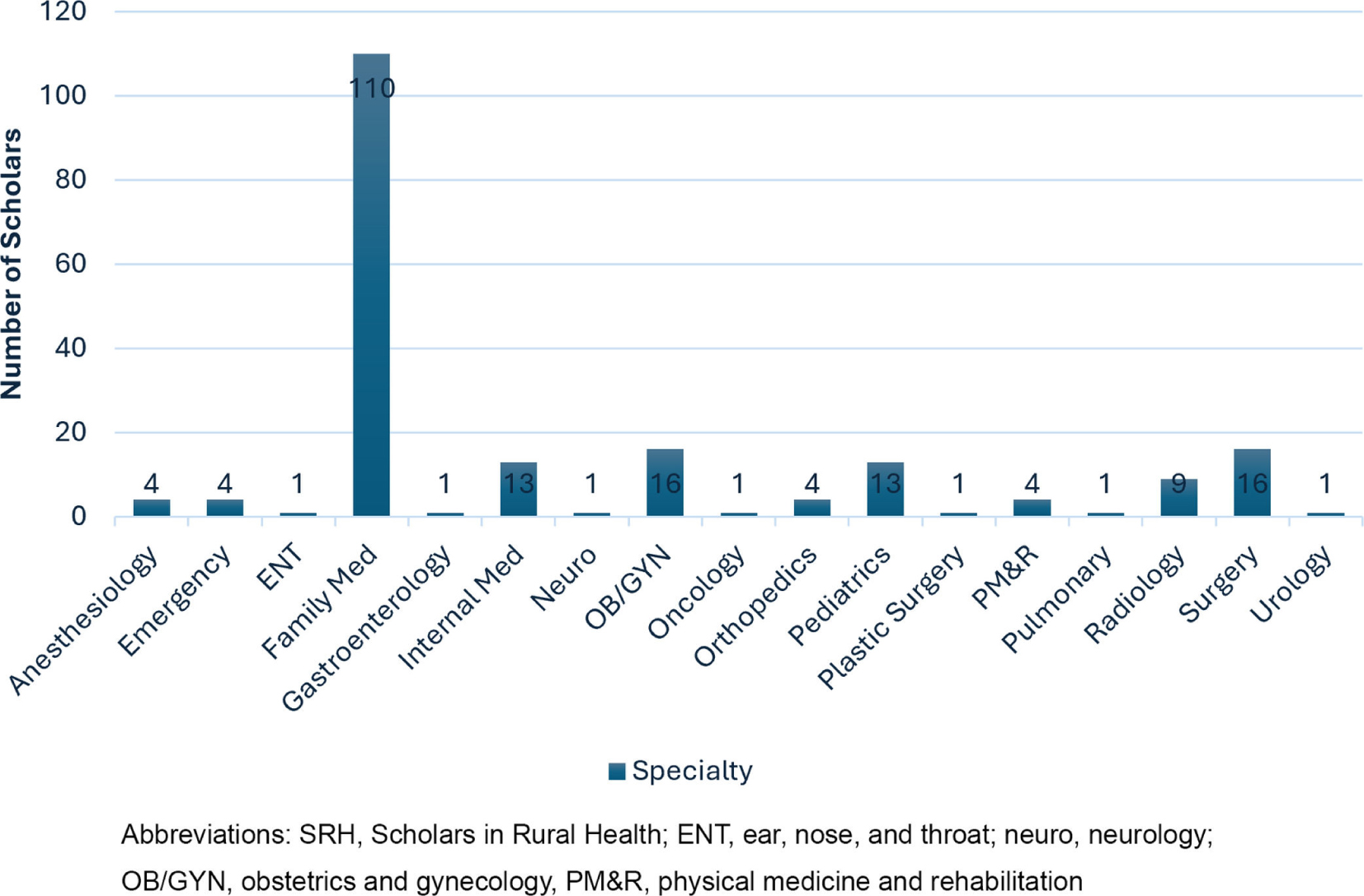
Among the 214 participants who matriculated to medical school, 200 (93%) completed their medical degree. Of these graduates, 136 (68%) matched into primary care residency programs (family medicine, internal medicine, or pediatrics), including 110 (55%) who matched into family medicine. Figure 1 shows a breakdown of the specialty types selected by the SRH students currently in residency or practice. A total of 114 graduates (57%) are completing or have completed residency training in Kansas.
Among the 150 graduates currently in clinical practice, 122 (81%) are practicing in Kansas. Overall, 84 (56%) are practicing in counties designated as fully FORHP rural. Among the 55 graduates who completed residency training outside Kansas, 37 (67%) returned to Kansas for practice.
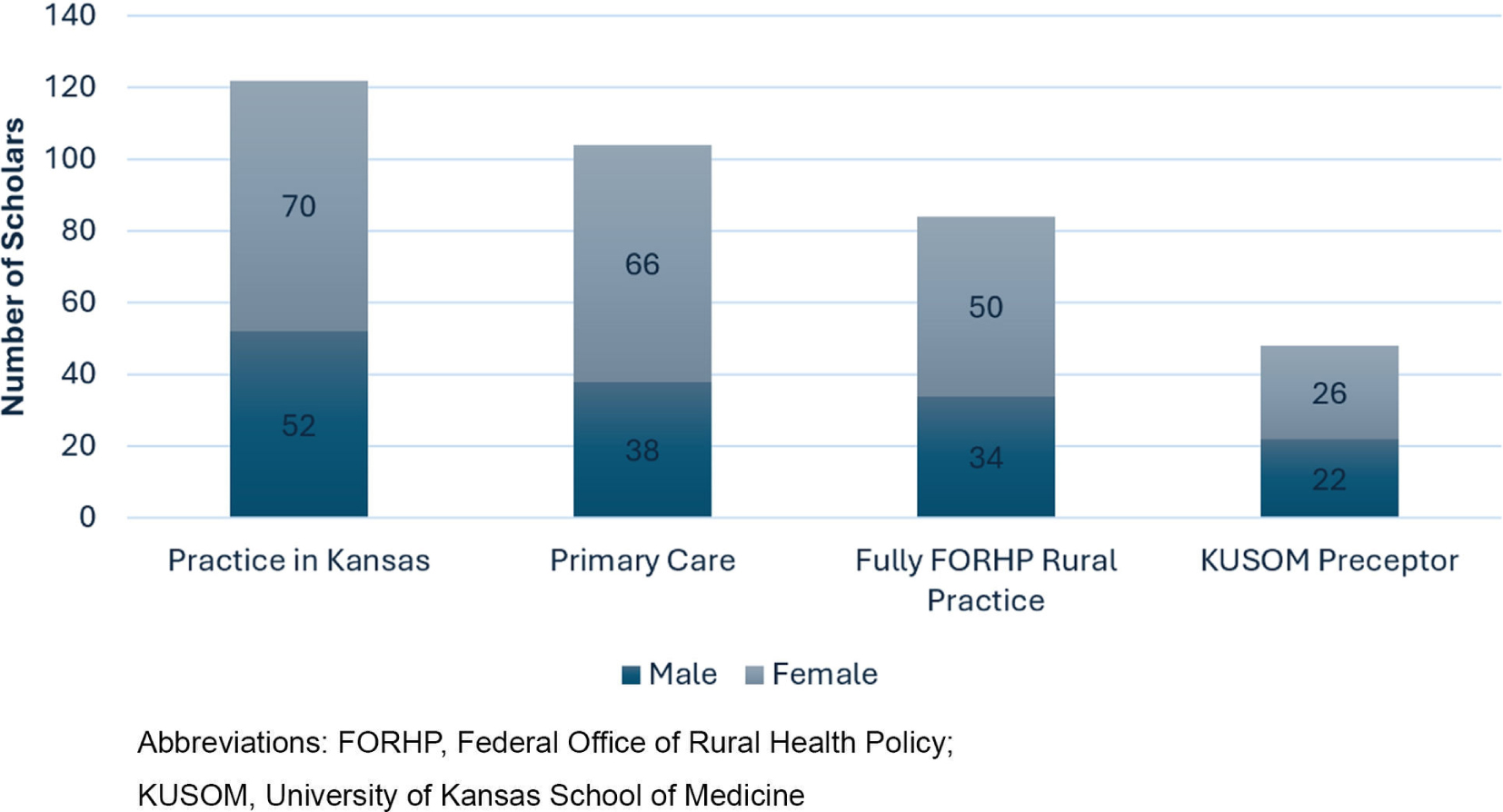
We observed gender differences among graduates in practice, as shown in Figure 2. Of the 150 practicing physicians, 86 (57%) were female. Female graduates outnumber the male graduates in those who currently practice in Kansas (70 vs 52), in primary care specialties (66 vs 38), and in fully FORHP rural counties (50 vs 34). Additionally, 49 (33%) practicing graduates are currently located in communities with a KUSOM campus (Kansas City, Salina, or Wichita), and 48 (32%) serve as preceptors for medical students.
Rural physician shortages remain a persistent challenge in Kansas and across the United States, particularly in communities with aging populations, hospital instability, and limited access to primary care.1,2,3 The SRH program at KUSOM is an early assurance pathway program designed to recruit and support students from rural backgrounds who exhibit traits and experiences that make them more likely to return to practice medicine in rural areas. In this long-term cohort of program participants, the SRH participants demonstrated significant downstream workforce outcomes with 122 practicing in Kansas, 104 practicing primary care, and 84 serving in fully FORHP rural counties. The SRH program places a higher percentage (68%) of participants into primary care residencies than the entire cohort of KUSOM graduates, which typically ranges from 43.3%–52.5% per year.15
These outcomes are notable because they suggest that a rural early assurance pathway starting before medical school can meaningfully contribute to the state workforce pipeline, even without a formal medical school curriculum embedded in the program. The number of SRH participants in primary care residencies reinforces findings from the literature that rural-background students and rural-oriented pathways are associated with primary care and rural practice outcomes.3,16-18 These findings should be interpreted as associations rather than proof of causation, given the study’s observational, single-institution design and long-term horizons.
Prior studies have shown that comprehensive rural-focused educational programs, selection of rural backgrounds, and rural clinical exposure can increase the likelihood of rural practice,16,17,19 and the SRH program findings are consistent with this pattern. Compared with the earlier report on the SRH program,14 these data extend the follow-up period and show that the program’s early promise has persisted over time. The present results also complement a study on the KUSOM prematriculation program,7 which provided an additional downstream view of residency placement and practice location. Additional research is needed to answer important questions about which specific programs at KUSOM, program elements, or curriculum aspects have the strongest effects on practice location outcomes.
Several current findings merit attention. Although not all participants return to rural practice, many scholars ultimately practice family medicine; 104 chose primary care specialties, thereby contributing directly to high-need specialties. The 48 SRH program graduates serving as preceptors suggest a return effect of the program, in which former scholars help sustain the next generation of rural physicians through mentoring and role modeling. The increasing number of women among graduates and rural physicians may reflect shifting gender patterns in rural medicine. As shown in Figure 2, female scholars outnumber male scholars among recent graduates, and more women are practicing in rural and primary care roles, suggesting a shift in long-standing patterns in rural physician demographics.20,21,22 The gender findings should be interpreted descriptively until additional statistical testing can demonstrate significant differences in gender outcomes among SRH participants.
The attrition pattern of the SRH students has programmatic implications. Some students did not progress through the pathway due to barriers posed by standardized tests, underscoring the need for targeted academic support, MCAT preparation, and advising for rural applicants. Students from rural areas often have lower MCAT scores and academic metrics than their nonrural counterparts.23,24 Because rural students may enter medical school with different academic opportunities and standardized test experiences than their peers, outcomes should be interpreted in the context of those structural differences rather than as simple measures of individual ability.
This study had important limitations. It reflected a single medical school and state early assurance pathway, and transferability elsewhere will vary. Practice location data were obtained retrospectively and may not fully capture part-time work or changes over time in where physicians lived relative to their practices. In addition, definitions of rural and program structures changed over the nearly three decades covered in this retrospective study, which limits direct comparisons across all years. Finally, because internal medicine and pediatrics residents may later subspecialize, those residency matches should be interpreted as potential rather than confirmed primary care contributions unless later practice data support that designation.
Despite these limitations, SRH offers a useful model for medical schools seeking to strengthen the rural physician workforce. Rural Kansas continues to face a physician shortage,1,2 despite strong efforts and notable primary care output from KUSOM. The SRH program demonstrates that targeted admissions, mentorship, and rural-focused programs can sustain a steady flow of committed rural physicians: 84 SRH alumni have returned to rural counties, directly addressing workforce gaps. Future work should examine the added value of medical school campus placement, residency location, state loan-repayment programs, and other state incentives to practice rural medicine, as well as compare rural students who did not participate in SRH. Multi-institution collaboration also would help determine which components of the pathway are most transferable to other rural regions. Sustained investment in selecting, preparing, and supporting rural students, coupled with data-driven refinement and longitudinal tracking, is essential for closing physician workforce gaps and meeting future health care needs.
The University of Kansas School of Medicine provided financial support for this study.
We acknowledge K.J. Kallail, PhD, and Sandra McCurdy, who envisioned creating the Scholars in Primary Care/Rural Health program to help increase the Kansas rural physician population. We are grateful to the numerous individuals who have helped shape the SRH program, including Michael Kennedy, MD, Jason Edwards, Neesa Butler, Ramon Garcia, Blair Day, and Sandra Leppin. This program would not have been possible without the numerous Kansas rural physicians who volunteered to mentor the next generation of rural physicians.
References
-
Goetz C. Rural hospital closures in Kansas, United States: can inpatient tele-consultation services improve care and hospital finances?
Lancet Reg Health Am. 2024;38:100853. doi:10.1016/j.lana.2024.100853
-
Berland H, Hughes D. Is rural Kansas prepared? an assessment of resources related to the COVID-19 pandemic.
Kans J Med. 2021;14(1):95–102. doi:10.17161/kjm.vol1414597
-
Longenecker RL, Andrilla CHA, Jopson AD, et al. Pipelines to pathways: medical school commitment to producing a rural workforce.
J Rural Health. 2021;37(4):723–733. doi:10.1111/jrh.12542
-
-
Francois P. Doing the Work: Evaluating a Pathway Program’s Reimagined Role in Preparing Premedical Students Underrepresented in Medicine. . Fordham University; 2025.
-
Moses D, Franks E, von Gruenigen VE, et al. The gap year—intentional use of early assurance improves performance in medical school curriculum.
Acad Med. 2023;98(suppl 3):S184–S185. doi:10.1097/ACM.0000000000005392
-
Scala CL. A Retrospective Study of the Pre-Matriculation Program in the School of Medicine at the University of Kansas Medical Center. Dissertation. University of Kansas; 2024. .
https://hdl.handle.net/1808/38401
-
Russell D, Mathew S, Fitts M, et al. Interventions for health workforce retention in rural and remote areas: a systematic review.
Hum Resour Health. 2021;19(1):103. doi:10.1186/s12960-021-00643-7
-
Elma A, Nasser M, Yang L, Chang I, Bakker D, Grierson L. Medical education interventions influencing physician distribution into underserved communities: a scoping review.
Hum Resour Health. 2022;20(1):31. doi:10.1186/s12960-022-00726-z
-
-
-
Rabinowitz HK, Diamond JJ, Markham FW, Wortman JR. Medical school programs to increase the rural physician supply: a systematic review and projected impact of widespread replication.
Acad Med. 2008;83(3):235–243. doi:10.1097/ACM.0b013e318163789b
-
Parlier AB, Galvin SL, Thach S, Kruidenier D, Fagan EB. The road to rural primary care: a narrative review of factors that help develop, recruit, and retain rural primary care physicians.
Acad Med. 2018;93(1):130–140. doi:10.1097/ACM.0000000000001839
-
-
Kellerman R, Ofei-Dodoo S, Rohrberg T, Fisher L, Henry C. Using the residency matched method and intent to practice method to estimate primary care workforce production.
Kans J Med. 2022;15(2):262–266. doi:10.17161/kjm.vol15.17905
-
Farmer J, Kenny A, McKinstry C, Huysmans RD. A scoping review of the association between rural medical education and rural practice location.
Hum Resour Health. 2015;13(1):27. doi:10.1186/s12960-015-0017-3
-
Wheat JR, Leeper JD, Brandon JE, Guin SM, Jackson JR. The rural medical scholars program study: data to inform rural health policy.
J Am Board Fam Med. 2011;24(1):93–101. doi:10.3122/jabfm.2011.01.100013
-
Wendling AL, Phillips J, Short W, Fahey C, Mavis B. Thirty years training rural physicians: outcomes from the Michigan State University College of Human Medicine rural physician program.
Acad Med. 2016;91(1):113–119. doi:10.1097/ACM.0000000000000885
-
Waslowski J, Paton M, Freymond M, et al. Evaluation of a pilot rural mentorship programme for and by pre-clerkship medical students.
Can J Rural Med. 2021;26(4):176–185. doi:10.4103/cjrm.cjrm_82_20
-
Doescher MP, Ellsbury KE, Hart LG. The distribution of rural female generalist physicians in the United States.
J Rural Health. 2000;16(2):111–118. doi:10.1111/j.1748-0361.2000.tb00444.x
-
-
O’Sullivan B, McGrail M, May J. Responsive policies needed to secure rural supply from increasing female doctors: a perspective.
Int J Health Plann Manage. 2022;37(1):40–49. doi:10.1002/hpm.3363
-
Longo DR, Gorman RJ, Ge B. Rural medical school applicants: do their academic credentials and admission decisions differ from those of nonrural applicants?
J Rural Health. 2005;21(4):346–350. doi:10.1111/j.1748-0361.2005.tb00105.x
-
Shipman SA, Wendling A, Jones KC, Kovar-Gough I, Orlowski JM, Phillips J. The decline in rural medical students: a growing gap in geographic diversity threatens the rural physician workforce.
Health Aff (Millwood). 2019;38(12):2011–2018. doi:10.1377/hlthaff.2019.00924



There are no comments for this article.