Last month, at the end of a morning spent caring for a complex older adult requiring coordination with three other specialty physicians, a family medicine resident inquired, “Which part are we taking care of?”
As a geriatrician and a family medicine educator, I found this inquiry surprising. On further reflection, it reveals much about how we train family physicians, especially in caring for complex older adults. As growing numbers of humans age successfully, they often require specialized geriatric care. This need continues to outpace the number of geriatricians.1 For me, these observations have accentuated the importance of incorporating geriatrics into family medicine training.
DEFINING SCOPE OF PRACTICE
Descriptions of scope rely on boundaries of care and restrictions in action; for example, defining where a physician will practice, what conditions they will treat, which procedures they will perform, and when they will refer a patient to another care specialty. While these descriptions are not wrong, they fail when we consider the care of the older adult. Complexity is routine in geriatric medicine. Issues such as polypharmacy, multimorbidity, and functional impairment do not ease into one care specialty, nor do diagnoses lie in any single organ system. Assessing an older adult patient presenting with a fall, we would be remiss in concluding that the accident was due to a simple misstep, without considering the impact of the patient’s medications, potential cardiovascular events, joint health, and functional status.
The definition of scope is longitudinal and adjusts with the patient; it is defined by context, relationships, and above all, trust. This concept is familiar in family medicine. Yet increasingly, we see residents internalize an implicit definition of scope as they set their own boundaries of care. This raises questions about whether definitions of scope and current training adequately prepare family physician trainees to care for an aging population.
GERIATRIC MEDICINE AND SCOPE OF PRACTICE
What geriatric medicine teaches us about scope of practice is that quality and integration are paramount. Since older adults rarely present with a single problem, we are asked to manage and balance competing priorities of functional status, morbidity, goals of care, quality of life, family status, and support. This requires integration, coordination, and continuity.
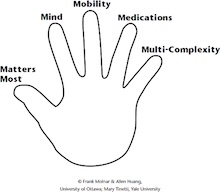
The 5 M framework,2 represented by a hand within Table 1, defines principles central to geriatric care and may challenge traditional scope definitions. These include “Matters Most,” “Mind,” “Mobility,” “Medications,” and “Multicomplexity.” Multicomplexity is the rule rather than the exception. We must recognize that polypharmacy, multimorbidity and family dynamics affect health and inform care decisions. As such, physicians must integrate and synthesize information across different medical specialties and clinical services. Care of older adults requires mindful management and reduction of medication use, which should be done with consideration for the patient’s condition and goals of care. As older adults may have many physicians on their care team, and patients who see specialists tend to take more medication,3 this management should be carried out in collaboration with other physicians. Changes in mentation, including the development of dementia, can make medication management challenging and provide an opportunity for discussion of de-escalation of medical therapy where appropriate.
|
Principle
|
Applications in family medicine residency education
|
|
Matters Most
|
-
Model asking patients about their goals for care and involving family members in decision making, when appropriate
-
Introduce hospice to residents and discuss with patient when appropriate
|
|
Mind
|
-
Recognize that memory loss is not consistent with aging
-
Teach about screening for cognitive impairment and other factors affecting cognitive functions (eg, medications, depression)
|
|
Mobility
|
-
Assess functional status and mobility
-
Become familiar with mobility devices and their use
-
Use opportunities such as the annual wellness visit to assess mobility and risk of falls
-
Teach residents to discuss with patients ways to preserve function and mobility, including regular exercise, tailored to patient ability and circumstance
|
|
Medications
|
-
Recognize polypharmacy; consider tools like Deprescribing.com or Medstopper to teach residents on how to identify polypharmacy and guide discussions with patients
-
Taper potentially harmful medications gradually
|
|
Multicomplexity
|
-
Define multi-complexity for residents: the interplay of multiple comorbid medical conditions and the psychosocial elements that affect the health of the older adult. Apply the biopsychosocial model of care
-
Model management of multi-complexity and collaborative consultation when patient needs exceed capacity or special expertise is necessary
|
Secondly, function matters—often much more than a diagnosis. For many older adults, the most important clinical question is not whether a diagnosis can be treated but whether any such intervention will preserve mobility, quality of life, independence, and cognition. Assessing mobility is crucial to discussions about care and longevity.
Third, decision-making in geriatrics is relational, requiring trust and ongoing patient-physician relationships. Goals of care are shaped by patient experience, personal values, preferences, and family context, not clinical recommendations alone. Discussing prognosis and a patient’s values are central to planning for a healthy life that prioritizes quality.
Geriatrics makes these concepts visible, but these are also foundational primary care competencies for residents to learn, as recommended by the American Geriatrics Society.4 Rather than expanding scope, geriatric medicine clarifies what primary care has always required.
FAMILY MEDICINE RESIDENTS AND WHAT THEY SEE
Family medicine residents learn scope of practice through planned curricula and implicitly through observed practice patterns and behaviors. Scope of practice perspectives are crafted as residents experience the health care landscape’s more recent emphasis on value-based care and managed care strategies, which, at best, shift the focus from volume to value, with the promise of improving outcomes and preventing unnecessary utilization of services by patients. While these strategies appear to support the goals of family medicine, managed systems inherently drive more referrals5,6 as a means of managing risk, which they do not accomplish. Quality metrics, time constraints, and system inefficiencies may encourage referrals7 as the safe path of least resistance. With time, scope of practice is redefined through workflow redesign and the effects of risk avoidance. This becomes baked into the resident experience, to their detriment. If we are to prepare family physicians for practice, we must train residents to recognize complexity and to stay engaged in managing it.
We must consider scope of practice through a geriatrics lens, where accountability, competence, and support intersect. A safe scope of practice does not have to mean practicing medicine in siloes and pushing patients from one specialty to another. We must consider that older adults with multimorbidity, including those experiencing functional and cognitive impairments, often face difficulties navigating care and receive fragmented care as a result. When this happens, much of this navigation falls to family and other caregivers, further widening the equity chasm. An opportunity to further investigate and support includes the Annual Medicare Wellness visit, which provides a framework for inquiry regarding geriatric syndromes and integrates the 5M framework.8
LOOKING AHEAD AND CALL TO ACTION
We should explore how family medicine training programs prepare residents to practice safely in a sustainable and comprehensive way. Geriatrics immersion allows residents—many of whom entered family medicine with a desire to provide comprehensive medical care—to rediscover the capacity of integration of care.
We can train residents to recognize and preliminarily manage geriatric syndromes and teach them to identify reasons to consult with a geriatrician, as noted in Table 2.
Geriatric medicine principle |
Reasons and cases where consultation with a geriatrician may be helpful |
Matters Most |
Advanced treatment without clear, observed benefit Unclear prognosis Interpersonal (family to patient to physician) conflict regarding goals of care |
Mind |
Uncertain diagnosis in new or rapidly progressive, apparent cognitive decline Severe, persistent behavioral or psychiatric symptoms related to major neurocognitive disorder refractory to first line management or standard of care Suspected early-onset (<65 year) dementia |
Mobility |
Unexplained falls or falls despite intervention Frailty with unidentified etiology Post-operative or post-hospital discharge functional or mobility decline |
Medications |
Medication regimens of more than 10–12 medications Recurrent medication related side effects (ie, protracted delirium, recurrent falls) Deprescribing in the frail adult requiring interdisciplinary expertise |
Multicomplexity |
Recurrent hospitalizations with unclear diagnosis Circumstances of competing guidelines due to comorbidity Prognostication expertise to assist in supporting family decision making |
Geriatrics expertise in advanced management of multimorbidity, deprescribing, management of behavioral and psychiatric symptoms related to dementia, advanced management of mobility and frailty, and goals-of-care navigation remains necessary. Given the rate of population aging, family physicians will continue to provide longitudinal care for most older adults. Residency training, therefore, represents an important leverage point to shape preparedness. Integrating a geriatric principles lens across training helps normalize complexity. Geriatricians can help by serving as educators, curriculum experts, and advocates for age-friendly care within health systems.
Become familiar with, teach and integrate the 5 Ms into care of the older adult, and for all patients. These principles reflect the ethos of family medicine, keeping what matters most to patients at the center of treatment decisions. |
Teach residents about the prudent use of the referral system and leveraging geriatric subspeciality consultative resources, which helps prepare them to manage multi-complexity. |
Start and continue discussions about goals of care and end-of-life planning. These evolve as patients evolve and as multicomplexity develops. Show residents the tools that you use that work for you and opportunities in your workflow, such as the Medicare Wellness Visit, to begin these conversations. |
Recognize polypharmacy (commonly described as five medications or more) and deprescribe when possible and appropriate. Show residents that they can change or adjust medications prescribed by other physicians—the key is collaboration, all in view of treating the patient. |
Acknowledge that the older adult is not a monolith: you can individualize care while applying the generalizable principles described above. |
Looking back at the resident’s question, “Which part are we taking care of?” I see it is a query about ownership and whether that patient’s multicomplexity belonged to someone else. Our response, and ultimately how we define scope of practice, will be shaped by how well we have been prepared to care for patients with complexity, whose needs require us to look beyond traditional lines of care. We should look to geriatrics for a roadmap for the future, as we have a responsibility to define and shape scope so that we can continue to care for those who need us the most.
References
-
Lester PE,
Dharmarajan TS,
Weinstein E.
The looming geriatrician shortage: ramifications and Solutions.
J Aging Health.
2020;32(9):1052–1062.
doi:10.1177/0898264319879325
-
-
Martinez KA,
Linfield DT,
Gupta NM,
et al.
Patient and physician factors contributing to polypharmacy among older patients.
Curr Med Res Opin.
2022;38(1):123–130.
doi:10.1080/03007995.2021.1982683
-
-
Forrest CB,
Nutting PA,
von Schrader S,
Rohde C,
Starfield B.
Primary care physician specialty referral decision making: patient, physician, and health care system determinants.
Med Decis Making.
2006;26(1):76–85.
doi:10.1177/0272989X05284110
-
Sarma S,
Mehta N,
Devlin RA,
Kpelitse KA,
Li L.
Family physician remuneration schemes and specialist referrals: quasi-experimental evidence from Ontario, Canada.
Health Econ.
2018;27(10):1533–1549.
doi:10.1002/hec.3783
-
Freedman S,
Golberstein E,
Huang TY,
Satin DJ,
Smith LB.
Docs with their eyes on the clock? The effect of time pressures on primary care productivity.
J Health Econ.
2021;77:.
doi:10.1016/j.jhealeco.2021.102442
-



There are no comments for this article.