Background and Objectives: Longitudinal physician-patient relationships in family medicine support early identification and management of behavioral conditions. Amid national shortages in psychiatry and psychology and limited access in underserved settings, family physicians are critical to delivering this care. This study explored demographic, training, and workplace characteristics associated with behavioral health care provision among early-career family physicians in outpatient continuity care.
Methods: We analyzed data from the 2016 to 2023 American Board of Family Medicine New Graduate Survey, administered 3 years postresidency. The primary outcome was self-reported inclusion of behavioral health care in outpatient continuity practice; the main independent variable was perceived adequacy of residency training. We used descriptive, bivariate, and multivariable logistic regression analyses to examine associations.
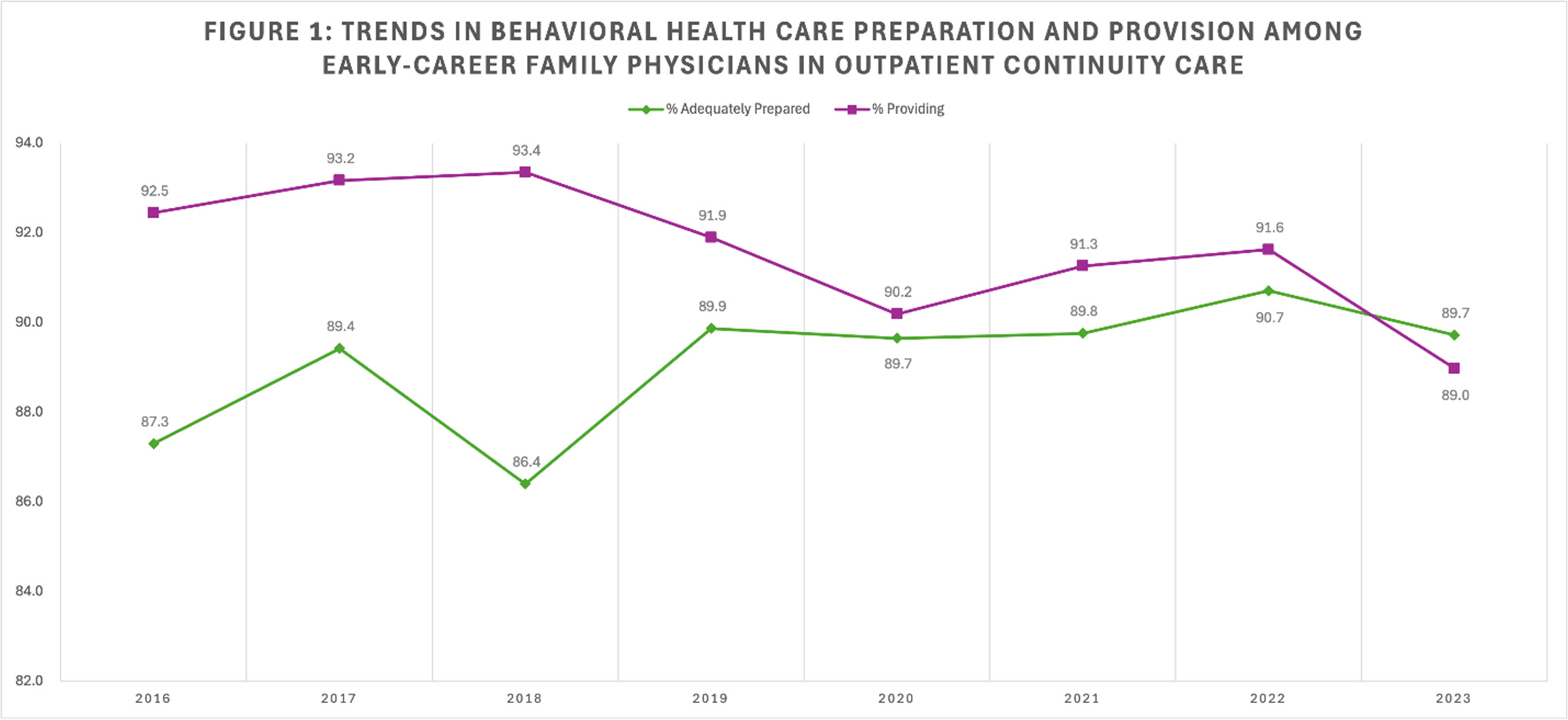
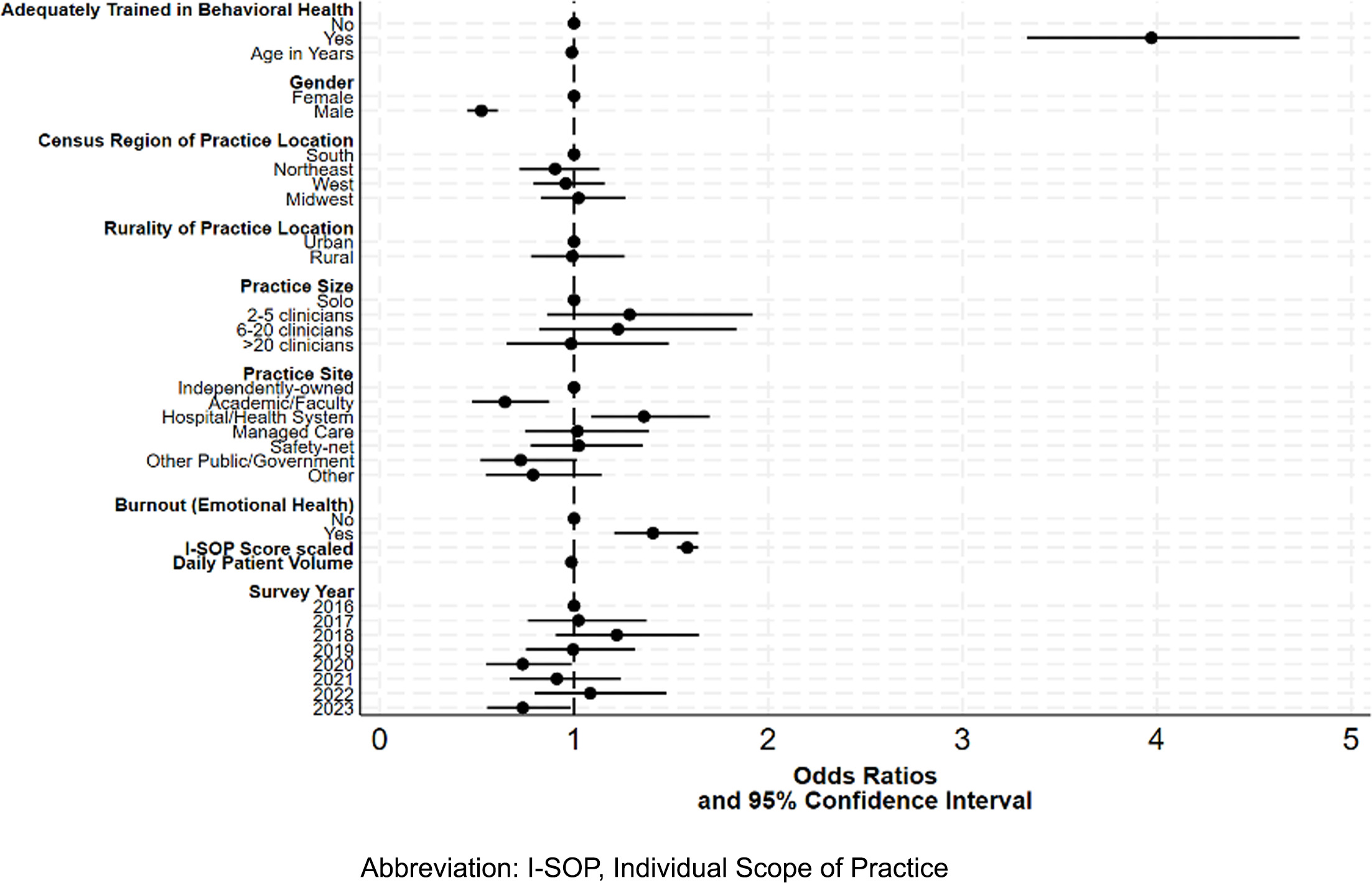
Results: Among 11,916 family physicians, 91.7% reported including behavioral health care in practice. Perceived preparation increased modestly over time (87.3% in 2016 to 89.7% in 2023, P<.01), whereas delivery decreased (92.5%–89.0%, P<.001). Adequate residency preparation was the strongest factor associated with delivery (OR, 4.0; 95% CI, 3.3–4.7). Hospital/health system practices, broader scope, and burnout were positively associated; male gender, academic practices, and patient volume were negatively associated.
Conclusions: Family physicians are essential to addressing behavioral health needs. While residency builds skills and confidence, training alone is insufficient to ensure provision in practice. Translation of training into clinical care is strongly influenced by practice environment, physician demographics, and health system design. Strengthening behavioral health care delivery in primary care requires not only enhancing training, but also parallel investments in systems-level infrastructure.
Behavioral health, including mental health, substance use, health behaviors contributing to chronic medical illnesses, life stressors and crises, and stress-related physical symptoms, is an important part of comprehensive primary care.1-3 Approximately 60% of mental health care, a component of behavioral health care focusing on emotional, psychological, and social well-being, is delivered in primary care settings.4,5 Furthermore, behavioral health concerns are addressed in nearly 70% of primary care visits.6 Primary care physicians routinely screen for and diagnose a wide range of behavioral health conditions and prescribe a variety of psychiatric medications, most commonly antidepressants for the treatment of depression and anxiety.7 Many individuals, particularly those with poorer mental health, lower income and education, and older age, seek mental health treatment exclusively from their primary care physicians, and those physicians prescribe a greater share of psychotropic medications compared to any other clinician, including psychiatrists.8,9
Primary care offices serve as hubs for interdisciplinary delivery of mental health care, with nearly 20% of the mental health workforce working in primary care.10 Integrated behavioral health (IBH), in which primary care and behavioral health clinicians work collaboratively with patients and families across coordinated, colocated, or fully integrated settings to provide behavioral health care, has been vital to addressing these growing needs effectively and efficiently.1,11 Considering national behavioral health workforce shortages and limited access in underserved areas, primary care is critical to identifying and managing behavioral needs.12 Family medicine is uniquely positioned to support early recognition, continuity, and timely intervention, while optimizing utilization of specialized resources.13
The Accreditation Council for Graduate Medical Education requires family medicine residencies to incorporate behavioral health throughout training and ensure that residents can independently address behavioral health needs and outcomes; diagnose, manage, and integrate care for common mental illnesses and behavioral issues, including substance use disorders, in patients of all ages; and apply a biopsychosocial model that incorporates behavioral, family, community, environmental, and socioeconomic influences on health.14 The curriculum must also provide integrated interprofessional behavioral health experiences, including training in cognitive behavioral therapy, motivational interviewing, and psychopharmacology. These competencies align with American Board of Family Medicine (ABFM) board eligibility requirements that family physicians must be able to diagnose and manage common mental problems in people of all ages.15
Greater exposure to behavioral health training is associated with higher perceived competence, confidence, and likelihood of providing these services in practice; this effect is especially pronounced in programs with IBH.6,16-21 However, substantial variation exists across residencies in curriculum structure, integration models, and faculty expertise, which may contribute to differences in behavioral health care delivery.19,20,22 Although greater behavioral health training in residency is associated with higher perceived competence, less is known about whether this training translates into independent practice and how it interacts with contextual factors to influence delivered scope of care.6,16-21
Using data from the ABFM New Graduate Survey (NGS), this study examined demographic, training, and workplace characteristics associated with behavioral health care provision among early-career family physicians practicing outpatient continuity care. By focusing on physicians early in practice, this analysis evaluated how residency training intersects with real-world practice environments and personal characteristics to shape subsequent scope of care. Understanding these relationships can inform residency design and workforce strategies to better prepare future family physicians to meet the behavioral health needs of their communities.
Study Design and Data Source
In this pooled, cross-sectional study, we analyzed de-identified secondary data from the ABFM NGS (2016–2023). The NGS is administered annually to family physicians 3 years after completion of residency training and collects self-reported information on physician demographics, practice characteristics, perceived adequacy of residency training across clinical domains, burnout, and current scope of clinical practice. The sample size is approximately 1,900 respondents per year, with an average response rate of 70%.23
Study Sample
Inclusion criteria were practicing outpatient continuity care and responding to both the behavioral health preparedness and practice survey items. Exclusion criteria were not practicing outpatient continuity care and having missing data. A total of 2,828 observations were excluded because the physician did not practice outpatient continuity care and 247 observations were excluded because of missing data on region, gender, or Individual Scope of Practice (I-SOP) score. The analysis was restricted to physicians practicing outpatient continuity care to ensure that measures of behavioral health care preparedness and provision reflected clinical practice within settings where longitudinal, team-based behavioral health care is most commonly delivered.
Outcome and Independent Variables
The primary outcome was self-reported inclusion of behavioral health care as part of current clinical practice. The primary exposure of interest was perceived adequacy of residency preparation for behavioral health care. Both the primary outcome and independent variables were measured using self-reported binary responses to the corresponding NGS survey items. Additional covariates included age, gender, practice size, patient volume, geographic region of practice, rurality of practice, principal practice site type, burnout, and overall scope of clinical practice.
Rurality was defined using Rural-Urban Commuting Area (RUCA) codes, a US Census tract-level classification system that incorporates population density, urbanization, and commuting patterns.24 RUCA codes range from 1 to 10; codes 1–3 are metropolitan, 4–6 micropolitan, 7–9 small town, and 10 rural. We classified codes four or greater as rural, consistent with previous literature.24
Due to a small number of responses for some practice locations, we recategorized principal practice site type as independently owned, academic/faculty practice, hospital/health system-owned, managed care/HMO practice, safety-net, government, and other. The safety-net category combined Indian Health Service, Rural Health Clinic, and Federally Qualified Health Center or look-alike; the government category combined federal and nonfederal government clinics; and the other category included work site clinics.
Burnout was defined using a single-item measure as experiencing burnout symptoms once per week or more, consistent with previous research.25 Scope of practice was measured for preparation and practice using the I-SOP score, which uses 22 self-reported clinical activities, with scaled scores ranging from 0 to 30 and higher scores indicating broader scope.26
Statistical Analysis
We used Stata 1827 to perform descriptive, bivariate, and multivariable logistic regression analyses so that we could examine associations between physician characteristics and behavioral health care provision.27 We used the χ2 test and t test to evaluate the significance of bivariate associations. To adjust for potential confounding, our multivariable model included perceived residency preparation and all demographic and practice factors as covariates. We assessed multicollinearity among covariates using variance inflation factors; no covariate exceeded commonly used thresholds. Statistical significance was set at α = 0.05.
This study was granted exemption by the American Academy of Family Physicians Institutional Review Board (Protocol #26–525). The authors used ChatGPT solely to assist with editing text for clarity, grammar, and organization; all revisions were independently reviewed by the authors to ensure accuracy.
Sample Characteristics and Bivariate Analyses
From 2016 to 2023, the NGS had a total of 14,991 respondents. Of the 11,916 early-career family physicians meeting inclusion and exclusion criteria, 10,932 (91.7%) reported providing behavioral health care. In bivariate analyses, behavioral health care provision was significantly associated with residency preparedness, scope of practice, and practice characteristics (Table 1). Physicians delivering behavioral health care were more likely to report adequate residency preparation (90.6% vs 71.2%, P<.001) and had a broader scope of current practice (scaled score 16.4 vs 12.9, P<.001). They also were more likely to work at medium-sized (39.4% vs 32.8%, P<.001), hospital/health system-owned (39.9% vs 35.6%, P<.001), safety-net (19.2% vs 12.7%, P<.001), and academic/faculty (12.2% vs 9.8%, P<.001) practices.
Characteristics |
Providing behavioral health care |
P value |
Yes |
No |
Age in years, mean (SD) |
35.0 (4.1) |
36.0 (5.0) |
<.001 |
Gender, n (%) |
|
|
|
Female |
6,514 (59.6) |
475 (48.3) |
<.001 |
Male |
4,418 (40.4) |
509 (51.7) |
|
Census region of practice location, n (%) |
|
|
|
Northeast |
1,396 (12.8) |
153 (15.5) |
<.001 |
South |
3,434 (31.4) |
383 (38.9) |
|
West |
3,362 (30.8) |
279 (28.4) |
|
Midwest |
2,740 (25.1) |
169 (17.2) |
|
Rurality of practice location, n (%) |
|
|
|
Rural |
2,082 (19.0) |
99 (10.1) |
<.001 |
Urban |
8,850 (81.0) |
885 (89.9) |
|
Practice size, n (%) |
|
|
|
Solo |
307 (2.8) |
39 (4.0) |
<.001 |
Small (2–5 clinicians) |
3,717 (34.0) |
356 (36.2) |
|
Medium (6–20 clinicians) |
4,311 (39.4) |
323 (32.8) |
|
Large (>20 clinicians) |
2,597 (23.8) |
266 (27.0) |
|
Practice site, n (%) |
|
|
|
Independently owned |
1,426 (13.0) |
166 (16.9) |
<.001 |
Academic/faculty practice |
1,338 (12.2) |
96 (9.8) |
|
Hospital/health system-owned |
4,364 (39.9) |
350 (35.6) |
|
Managed care/HMO practice |
716 (6.6) |
110 (11.2) |
|
Safety-net |
2,099 (19.2) |
125 (12.7) |
|
Government |
649 (5.9) |
79 (8.0) |
|
Other |
340 (3.1) |
58 (5.9) |
|
Daily patient volume, mean (SD) |
19.4 (6.8) |
19.9 (8.0) |
.012 |
Burnout (emotional health), n (%) |
|
|
|
No |
6,248 (57.2) |
622 (63.2) |
|
Yes |
4,684 (42.8) |
362 (36.8) |
<.001 |
I-SOP score, mean (SD) |
|
|
|
Raw practice |
8.6 (4.9) |
4.3 (3.4) |
<.001 |
Scaled practice |
16.4 (2.6) |
12.9 (4.2) |
<.001 |
Raw preparation |
13.0 (4.2) |
12.0 (5.0) |
<.001 |
Scaled preparation |
16.9 (3.8) |
16.0 (4.6) |
<.001 |
Adequately prepared in behavioral health care, n (%) |
|
|
|
No |
1,025 (9.4) |
283 (28.8) |
|
Yes |
9,907 (90.6) |
701 (71.2) |
<.001 |
Observations, n (%) |
10,932 (100.0) |
984 (100.0) |
|
Temporal Trends in Behavioral Health Care Preparation and Provision
From 2016 to 2023, the proportion of early-career family physicians in outpatient continuity care reporting adequate preparation to practice behavioral health care increased modestly (87.3%–89.7%, P<.01; Figure 1). In contrast, behavioral health care provision decreased from 92.5% in 2016 to 89.0% in 2023 (P<.001).
Multivariable Analyses
After adjusting for covariates, perceived adequate residency preparation was the strongest factor associated with behavioral health care provision (OR, 4.0; 95% CI, 3.3–4.7; P<.01; Table 2, Figure 2). Broader scope of practice also was positively associated with delivery (OR, 1.6; 95% CI, 1.5–1.6; P<.01). Compared with independently owned practices (reference category), family physicians in academic/faculty practices had lower odds of provision (OR, 0.6; 95% CI, 0.5–0.9; P<.01), while those in hospital/health system-owned practices had higher odds (OR, 1.4; 95% CI, 1.1–1.7; P<.01). Male gender was independently associated with lower odds of behavioral health care delivery (OR, 0.5; 95% CI, 0.45–0.6; P<.01), whereas presence of burnout was associated with higher odds (OR, 1.4; 95% CI, 1.2–1.6; P<.01). Higher patient volume showed a very small negative association with delivery (OR, 0.99; 95% CI, 0.98–1.0; P<.01). Age, census region, rurality, and practice size were not significantly associated with behavioral health care provision.
Characteristics |
Odds ratio |
95% confidence interval |
Adequately prepared in behavioral health care |
|
|
No |
|
|
Yes |
4.0* |
(3.3–4.7) |
Age in years |
1.0 |
(0.97–1.0) |
Gender |
|
|
Female |
|
|
Male |
0.5* |
(0.5–0.6) |
Census region of practice location |
|
|
South |
|
|
Northeast |
0.9 |
(0.7–1.1) |
West |
1.0 |
(0.8–1.7) |
Midwest |
1.0 |
(0.8–1.3) |
Rurality of practice location |
|
|
Urban |
|
|
Rural |
1.0 |
(0.8–1.3) |
Practice size |
|
|
Solo |
|
|
Small (2–5 clinicians) |
1.3 |
(0.9–1.9) |
Medium (6–20 clinicians) |
1.2 |
(0.8–1.8) |
Large (>20 clinicians) |
1.0 |
(0.7–1.5) |
Practice site |
|
|
Independently owned |
|
|
Academic/faculty practice |
0.6* |
(0.5–0.9) |
Hospital/health system-owned |
1.4* |
(1.1–1.7) |
Managed care/HMO practice |
1.0 |
(0.8–1.4) |
Safety-net |
1.0 |
(0.4–1.4) |
Government |
0.7 |
(0.5–1.0) |
Other |
0.8 |
(0.6–1.1) |
Daily patient volume |
1.0* |
(0.98–1.0) |
Burnout (emotional health) |
|
|
No |
|
|
Yes |
1.4* |
(1.2–1.6) |
I-SOP score scaled (practice) |
1.6* |
(1.5–1.6) |
Survey year |
|
|
2016 |
|
|
2017 |
1.0 |
(0.8–1.4) |
2018 |
1.2 |
(0.9–1.6) |
2019 |
1.0 |
(0.8–1.3) |
2020 |
0.7** |
(0.6–1.0) |
2021 |
0.9 |
(0.7–1.2) |
2022 |
1.1 |
(0.8–1.5) |
2023 |
0.7** |
(0.6–1.0) |
Constant |
0.01* |
(0.0–0.02) |
Observations |
11,916 |
|
In this cross-sectional study of nearly 12,000 early-career family physicians, delivery of behavioral health care—a core element of comprehensive family medicine scope—was strongly associated with perceived adequacy of residency preparation but is ultimately shaped by practice environment, personal characteristics, and scope of practice constraints. While behavioral health care is a vital element of family medicine’s clinical responsibilities, our findings suggest wide variation in perceived preparation and provision of services among early-career physicians. This variation mirrors broader debates about how family physicians choose to define their scope, whether emphasizing breadth, depth, or niche focus, and raises questions about educational preparation, practice environment limitations, and professional identity.
Considering the high prevalence of behavioral health conditions in primary care, it is not surprising that most early-career family physicians reported delivering these services. Perceived adequate residency preparation was the strongest factor associated with provision, with nearly a 20-percentage-point absolute difference (90.6% vs 71.2%), underscoring the crucial role of residency in developing the skills and confidence necessary to provide behavioral health care.28,29
However, preparation alone was insufficient. A substantial proportion of physicians who reported adequate preparation did not provide behavioral health care, while nearly one in 10 physicians who reported inadequate preparation nonetheless provided it (Table 1). Translation of training into clinical care appears strongly influenced by factors beyond residency, including personal, workplace, regional, and patient population.29
In this study, several demographic and workplace factors were independently associated with behavioral health care provision. The positive association between scope of practice and provision underscores behavioral health management as a core component of full-spectrum family medicine. Family physicians in academic/faculty practices, despite previously demonstrated wide scope, were less likely to deliver behavioral health care, possibly due to role delineation, referral availability, or workflows that rely on nonphysician clinicians for behavioral health services.30,31 Male physicians had lower odds of providing behavioral health care, consistent with prior literature, though reasons remain unclear.16 Burnout was positively associated with behavioral health care provision, potentially reflecting the additional demands of caring for complex patients. While broader scope of practice has been associated with lower rates of burnout, involvement in behavioral health care has been linked to higher burnout symptoms; our findings match these prior studies.32,33
Temporal trends illustrate changes in how early-career family physicians are practicing. While perceived preparation increased modestly from 2016 to 2023, behavioral health care provision decreased. This divergence suggests that even when training adequacy rises, personal, structural, or systems-level factors may limit delivery. The drop in both preparedness and delivery in 2023 corresponds to physicians graduating in 2020, suggesting possible cohort effects related to COVID-19-era training disruptions or pandemic-related stressors.34,35 Ongoing surveillance is necessary to determine whether these represent temporary anomalies or broader systemic trends.
Collectively, these findings highlight that behavioral health workforce capacity is shaped by training, personal factors, and practice environment. Practice constraints, including clinic models, reimbursement structures, and availability of behavioral health professionals, may influence whether early-career family physicians incorporate behavioral health services into routine care.36 IBH is increasingly being adopted within primary care practices and has been associated with better outcomes for depression and anxiety, improved physician perceptions of the quality of care provided and own personal stress level, and decreased stigma associated with mental health care.10 Strengthening behavioral health care delivery in primary care will require enhancing residency training alongside system-level supports and investments that enable comprehensive care. For residency programs, behavioral health curricula must move beyond didactic exposure to include experiential, integrated practice models and systems-based training that prepare graduates to navigate organizational restrictions. Programs also may consider tracking postgraduation behavioral health scope as a quality metric. Addressing these factors is essential to fully leveraging the family medicine workforce to meet the growing behavioral health needs of our patients and communities.
This study had limitations. Its cross-sectional design precluded causal inference, and all measures were self-reported. The NGS lacks a standardized definition of behavioral health care, potentially introducing variability in interpretation. Unmeasured confounders, including availability of behavioral health professionals, payer mix, panel complexity, institutional resources, referral workflows, visit length feasibility, payment models, and physician interest, may influence provision. Burnout was assessed using a single-item measure, and the modified scope of practice score may limit comparability with prior studies. Clustering by residency program or health system was not accounted for, possibly underestimating standard errors. Because respondents were surveyed only 3 years after residency completion, their practice patterns may more closely reflect residency training experiences, which may limit generalizability to more established physicians. However, prior work has suggested that residency experiences can exert lasting effects on physician practice patterns through professional imprinting.37
To assess how training translates into practice over time, future research should link residency training data with longitudinal practice outcomes. Qualitative studies may clarify how family physicians define and interpret providing behavioral health care, improving measurement and interpretation in future workforce research. Even with adequate training, structural or systems-level factors may constrain practice; further investigation into organizational facilitators could identify modifiable factors to support care delivery. With behavioral health concerns rising and primary care serving as the de facto avenue for treatment, understanding these influences is critical to preventing gaps in access and ensuring that family physicians can meet the needs of their communities.
References
-
-
Rao A,
Shi Z,
Ray KN,
Mehrotra A,
Ganguli I.
National trends in primary care visit use and practice capabilities, 2008-2015.
Ann Fam Med.
2019;17(6):538–544.
doi:10.1370/afm.2474
-
Rotenstein LS,
Edwards ST,
Landon BE.
Adult primary care physician visits increasingly address mental health concerns.
Health Aff (Millwood).
2023;42(2):163–171.
doi:10.1377/hlthaff.2022.00705
-
-
Park LT,
Zarate CA Jr.
Depression in the primary care setting.
N Engl J Med.
2019;380(6):559–568.
doi:10.1056/NEJMcp1712493
-
Filippi MK,
Waxmonsky JA,
Williams MD,
et al.
Integrated behavioral health implementation and training in primary care: a practice-based research network study.
J Am Board Fam Med.
2023;36(6):1008–1019.
doi:10.3122/jabfm.2023.230067R2
-
Abed Faghri NM,
Boisvert CM,
Faghri S.
Understanding the expanding role of primary care physicians (PCPs) to primary psychiatric care physicians (PPCPs): enhancing the assessment and treatment of psychiatric conditions.
Ment Health Fam Med.
2010;7(1):17–25.
https://pmc.ncbi.nlm.nih.gov/articles/PMC2925161
-
Petterson S,
Miller BF,
Payne-Murphy JC,
Phillips RL.
Mental health treatment in the primary care setting: patterns and pathways.
Fam Syst Health.
2014;32(2):157–166.
doi:10.1037/fsh0000036
-
Hughes PM,
Annis IE,
McGrath RE,
Thomas KC.
Psychotropic medication prescribing across medical providers, 2016-2019.
Psychiatr Serv.
2024;75(5):477–480.
doi:10.1176/appi.ps.20230156
-
Westfall JM,
Jabbarpour Y,
Jetty A,
et al.
The State of Integrated Primary Care and Behavioral Health in the United States 2022.
Robert Graham Center, HealthLandscape; May 31, 2022.
https://ibh.healthlandscape.org
-
-
Counts N.
Understanding the U.S. Behavioral Health Workforce Shortage.
The Commonwealth Fund; May 18, 2023.
.
doi:10.26099/5km6-8193
-
Blount A,
Schoenbaum M,
Kathol R,
et al.
The economics of behavioral health services in medical settings: a summary of the evidence.
Prof Psychol Res Pr.
2007;38(3):290–297.
doi:10.1037/0735-7028.38.3.290
-
-
-
Brandt-Kreutz RL,
Ferguson KE,
Sawyer D.
Behavioral science priorities in residency education: the perspective of practicing family physicians.
Fam Syst Health.
2015;33(4):339–348.
doi:10.1037/fsh0000144
-
Nutting R,
Ofei-Dodoo S,
Wipperman J,
Allen AD.
Assessing family medicine physicians’ perceptions of integrated behavioral health in a primary care residency.
Fam Med.
2022;54(5):389–394.
doi:10.22454/FamMed.2022.541800
-
Duggan M,
Bancroft C,
Browder C,
Gorski V.
Advancing integrated care through cotraining of residents and psychology postdoctoral fellows.
Fam Syst Health.
2022;40(4):540–551.
doi:10.1037/fsh0000754
-
Landoll RR,
Cervero RM,
Quinlan JD,
Maggio LA.
Primary care behavioral health training in family medicine residencies: a qualitative study from a large health care system.
Fam Med.
2020;52(3):174–181.
doi:10.22454/FamMed.2020.681872
-
Landoll RR,
Maggio LA,
Cervero RM,
Quinlan JD.
Training the doctors: a scoping review of interprofessional education in primary care behavioral health (PCBH).
J Clin Psychol Med Settings.
2019;26(3):243–258.
doi:10.1007/s10880-018-9582-7
-
Hill JM.
Behavioral health integration: transforming patient care, medical resident education, and physician effectiveness.
Int J Psychiatry Med.
2015;50(1):36–49.
doi:10.1177/0091217415592357
-
Waxmonsky JA,
Williams MD.
Training primary care practitioners about integrated behavioral health: how integrated is the training?
J Health Care Poor Underserved.
2020;31(4S):144–153.
doi:10.1353/hpu.2020.0146
-
Peterson LE.
Using the family medicine National Graduate Survey to improve residency education by monitoring training outcomes.
Fam Med.
2021;53(7):622–625.
doi:10.22454/FamMed.2021.719992
-
-
Maslach C,
Jackson SE,
Leiter MP.
Maslach Burnout Inventory Manual.
4th ed.
Mind Garden, Inc; 2018.
-
O’Neill T,
Peabody MR,
Blackburn BE,
Peterson LE.
Creating the Individual Scope of Practice (I-SOP) scale.
J Appl Meas.
2014;15(3):227–239.
doi:10.1037/t61476-000
-
StataCorp LLC.
Stata 18. 2023.
-
Neutze D,
Hodge B,
Steinbacher E,
Carter C,
Donahue KE,
Carek PJ.
The practice is the curriculum.
Fam Med.
2021;53(7):567–573.
doi:10.22454/FamMed.2021.154874
-
Russell A,
Fromewick J,
Macdonald B,
et al.
Drivers of scope of practice in family medicine: a conceptual model.
Ann Fam Med.
2021;19(3):217–223.
doi:10.1370/afm.2669
-
Killeen D,
Jetty A,
Peterson LE,
Bazemore A,
Jabbarpour Y.
The association of practice type and the scope of care of family physicians.
J Am Board Fam Med.
2023;36(1):79–87.
doi:10.3122/jabfm.2022.220172R1
-
Tong ST,
Morgan ZJ,
Stephens KA,
Bazemore A,
Peterson LE.
Characteristics of family physicians practicing collaboratively with behavioral health professionals.
Ann Fam Med.
2023;21(2):157–160.
doi:10.1370/afm.2947
-
Weidner AKH,
Phillips RL Jr,
Fang B,
Peterson LE.
Burnout and scope of practice in new family physicians.
Ann Fam Med.
2018;16(3):200–205.
doi:10.1370/afm.2221
-
Whitebird RR,
Solberg LI,
Crain AL,
et al.
Clinician burnout and satisfaction with resources in caring for complex patients.
Gen Hosp Psychiatry.
2017;44:91–95.
doi:10.1016/j.genhosppsych.2016.03.004
-
Awadallah NS,
Czaja AS,
Fainstad T,
et al.
The impact of the COVID-19 pandemic on family medicine residency training.
Fam Pract.
2021;38(Suppl 1):i9–i15.
doi:10.1093/fampra/cmab012
-
Titus SJ,
Badar P,
Coston Z,
Khan F,
Ogola GO,
Ahmed KW.
COVID-19’s impact on family medicine resident training and wellness.
Proc (Bayl Univ Med Cent).
2023;36(4):490–495.
doi:10.1080/08998280.2023.2204795
-
National Academies of Sciences, Engineering, and Medicine.
Designing interprofessional teams and preparing the future primary care workforce.
:
Robinson SK,
MeisnereM,
PhillipsRL,
et al, eds.
Implementing High-Quality Primary Care: Rebuilding the Foundation of Health Care.
National Academies Press; 2021
-
Phillips RL Jr,
Holmboe ES,
Bazemore AW,
George BC.
Purposeful imprinting in graduate medical education: opportunities for partnership.
Fam Med.
2021;53(7):574–577.
doi:10.22454/FamMed.2021.264013



There are no comments for this article.