Background and Objectives: Point-of-care ultrasound (POCUS) is increasingly used in family medicine within North America. To investigate current use and interests in incorporating ultrasonography into postgraduate family medicine teaching and research, we conducted a prospective quality improvement study at the University of Saskatchewan, Canada.
Methods: We sent a survey to all family physicians at eight academic sites; faculty with and without academic appointments were included.
Results: More than 90% of faculty saw a role for ultrasonography in primary care, but less than 35% conducted ultrasonography in their clinical practice. The proportion of physicians conducting ultrasound was similar between those with and without academic appointments. The proportion of physicians conducting ultrasound off-site was greater among those with academic appointments. Common themes to support the use of ultrasonography included using ultrasound imaging as an adjunct to the physical exam, to guide clinical reasoning, and to guide procedures. Family physicians in rural locations felt the use of ultrasonography for teaching and research would improve patient access to imaging. Challenges in implementing ultrasonography included having inadequate resources to acquire training, lack of time for teaching, and confusion around billing.
Conclusions: The results of this survey demonstrated that family physicians find ultrasonography useful in clinical practice and are willing to teach residents ultrasound skills. Family physicians also saw a strong role for using ultrasonography in research. The results of this study can be used to inform POCUS curriculum development in family medicine postsecondary education, thereby providing leading, evidence-based primary care delivery.
Ultrasonography is becoming widely used in primary care delivery across North America and increasingly recognized as part of the physical exam process.1,2 Advancements for medical trainees to acquire skills in ultrasonography within Canada have been based on knowledge of its safety, utility, and practicality to complement diagnostic reasoning and clinical assessments of patients presenting with common medical problems.3-8 Ultrasonography has become an important component of medical education, bedside rounds, and clinical examinations.6,9-11 Research is needed to understand the use of ultrasonography by family physicians and to expand ultrasound training for postgraduate students in family medicine.
Point-of-care ultrasound (POCUS) deviates from traditional comprehensive ultrasonography in that it acts as one part of a clinical assessment, as compared to being a comprehensive diagnostic imaging exam. Thus, POCUS is performed to visualize anatomic structures, which allows the care provider to answer a binary question based on clinical symptoms.12 POCUS does not emit ionizing radiation, requires minimal or no patient preparation, and can be completed in a timely fashion.9 Family physicians can use POCUS to make clinical decisions in real time, which does not require a radiologist to interpret and report the results as with comprehensive diagnostic sonography. Incorporating POCUS into family medicine practice has been shown to increase patient satisfaction, as well as decrease health care costs, radiation exposure, imaging wait times, and emergency room visits.4,6,9
Family physicians are known to practice a breadth of POCUS scans, the most common scans being obstetric, musculoskeletal, abdominal, cardiac, and soft tissue scans.6,13 Obstetric scans performed by family physicians include confirmation of intrauterine pregnancy; fetal lie, number, and presentation; placental location; quantity of amniotic fluid; and umbilical artery Doppler.14 Family physicians can use ultrasound to aid in diagnoses of pneumonia, heart failure, and soft tissue injuries such as complete rotator cuff tears.9,15 The College of Family Physicians of Canada (CFPC) indicates that Canadian family medicine residents must be prepared to perform certain procedures upon graduation, many of which can be performed with ultrasound assistance. Intra-articular joint injections, cyst aspirations, vascular access, needle thoracentesis and paracentesis, chest tube insertions, incision and drainage of skin abscesses, and peripheral nerve blocks have been shown to be safer when performed with ultrasound.16-18 The CFPC recognizes that using POCUS for diagnostic and procedural purposes in the office, hospital, and emergency department all fall within the scope of family practice; therefore family medicine postgraduate trainees now have the option to acquire skills in POCUS.16
Primary care physicians generally believe they should be trained in ultrasonography, but few use it in their practice. In Calgary, office-based physicians were reported to be most interested in learning obstetrical scans, such as confirmation of fetal heart rate, fetal lie, and confirmation of intrauterine pregnancy.19 Hospital-based physicians were most interested in learning ultrasound-assisted procedures such as venous access, paracentesis, thoracentesis, arterial blood gas sampling, and lumbar punctures. All family physicians across practice locations were interested in using POCUS for incision and drainage of superficial abscesses, as well as joint injections.19 Challenges related to incorporating POCUS into primary care practice and family medicine postgraduate training programs included lack of trained faculty available to teach, inadequate time for training, lack of funding for training and equipment, maintaining competency in practice, medicolegal implications for imaging archiving, and confusion surrounding billing.2,20-23 Key to the integration of POCUS into any practice is image archiving, which provides further logistical and financial barriers.24,25
A significant benefit for providers who use POCUS is increased access to imaging for their patients. In Canada, patients can expect to wait an average of 5.3 weeks for comprehensive ultrasound imaging.26 Lengthy wait times are most prevalent in resource-limited settings, such as rural and remote clinics. In Saskatchewan, more than one-third of citizens live in rural/remote areas, and significant disparities in ultrasound access have been identified in remote areas.27,28 Barriers to traveling to receive formal imaging include isolation from family, financial constraints, fear of and lack of access to air travel, and unfamiliarity with larger centers.29 Rural physicians often lack immediate access to formal imaging modalities and/or direct access to specialist care.30 Working as a family physician in a rural environment increases the odds that a physician will incorporate POCUS into their practice.13 Flynn et al, investigated rural emergency room physicians in Canada and found that the majority believe they should be trained in emergency medicine ultrasonography, but less than half knew how to perform it.30
In 2010, the CFPC introduced ultrasound into their training objectives for emergency medicine programs.31 At the University of Saskatchewan, a formal POCUS training program exists in the Department of Emergency Medicine. Interest has been emerging in the Department of Academic Family Medicine in developing a formal POCUS training curriculum. However, research to determine the interest, feasibility, and practicality of such a program has not yet been conducted. The Department of Academic Family Medicine at the University of Saskatchewan currently consists of eight training sites, including urban, regional, and rural locations. The objective of this study was to investigate the use and potential interests of family physicians in Saskatchewan to incorporate ultrasonography into their practice, as well as graduate and postgraduate primary care teaching and research.
We conducted a prospective qualitative study in the Department of Academic Family Medicine at the University of Saskatchewan in 2022. The University of Saskatchewan Behavioural Research Ethics Committee granted our study ethics exception. The survey used in this study was developed by the study team and reviewed by the postgraduate director prior to being distributed. The survey was distributed electronically via SurveyMonkey. The survey was sent to all family physicians within the Department of Academic Family Medicine, including those with and without academic (ie, teaching and/or research) appointments. The survey consisted of 13 questions, nine of which included follow-up questions in which respondents could answer in their own words. In the survey, we explored the attitudes surrounding the use and utility of ultrasonography in primary care, the level of ultrasonography training obtained by respondents, interests to acquire training, barriers to the use of ultrasonography use in primary care practice, breadth of scans used, and the interests of faculty to be involved in ultrasonography training and/or research. We analyzed data separately for faculty with, versus without, academic appointments. We conducted χ2 statistical analyses to evaluate differences in responses between the two groups using Microsoft Excel version 16.66.1. Significance was set at an α level of 0.05.
The survey was sent to 637 family physicians in Saskatchewan. In total, 138 responses were collected, resulting in a response rate of 22%. The respondents were analyzed in two categories, based on whether they held an academic appointment. Of the 138 respondents, two participants did not indicate whether they had an academic appointment; they were excluded from the analyses. Faculty with academic appointments (n = 116/136, 85%) and those without academic appointments (n = 20/136; 15%) among the eight different teaching sites, as well as family physicians within community-based clinics and emergency departments responded to the survey (Table 1).
Location |
Faculty with academic appointments
N = 116
n (%) |
Faculty without academic appointments
N = 20
n (%) |
La Ronge |
4 (3.4) |
0 |
Moose Jaw |
7 (6.0) |
0 |
Northwest |
8 (6.9) |
0 |
Prince Albert |
4 (3.4) |
0 |
Regina |
26 (22) |
5 (25) |
Saskatoon |
36 (31) |
9 (45) |
Swift Current |
12 (10) |
0 |
Southeast |
6 (5.2) |
2 (10) |
Other* |
11 (9.5) |
2 (10) |
Did not disclose |
2 (1.7) |
2 (10) |
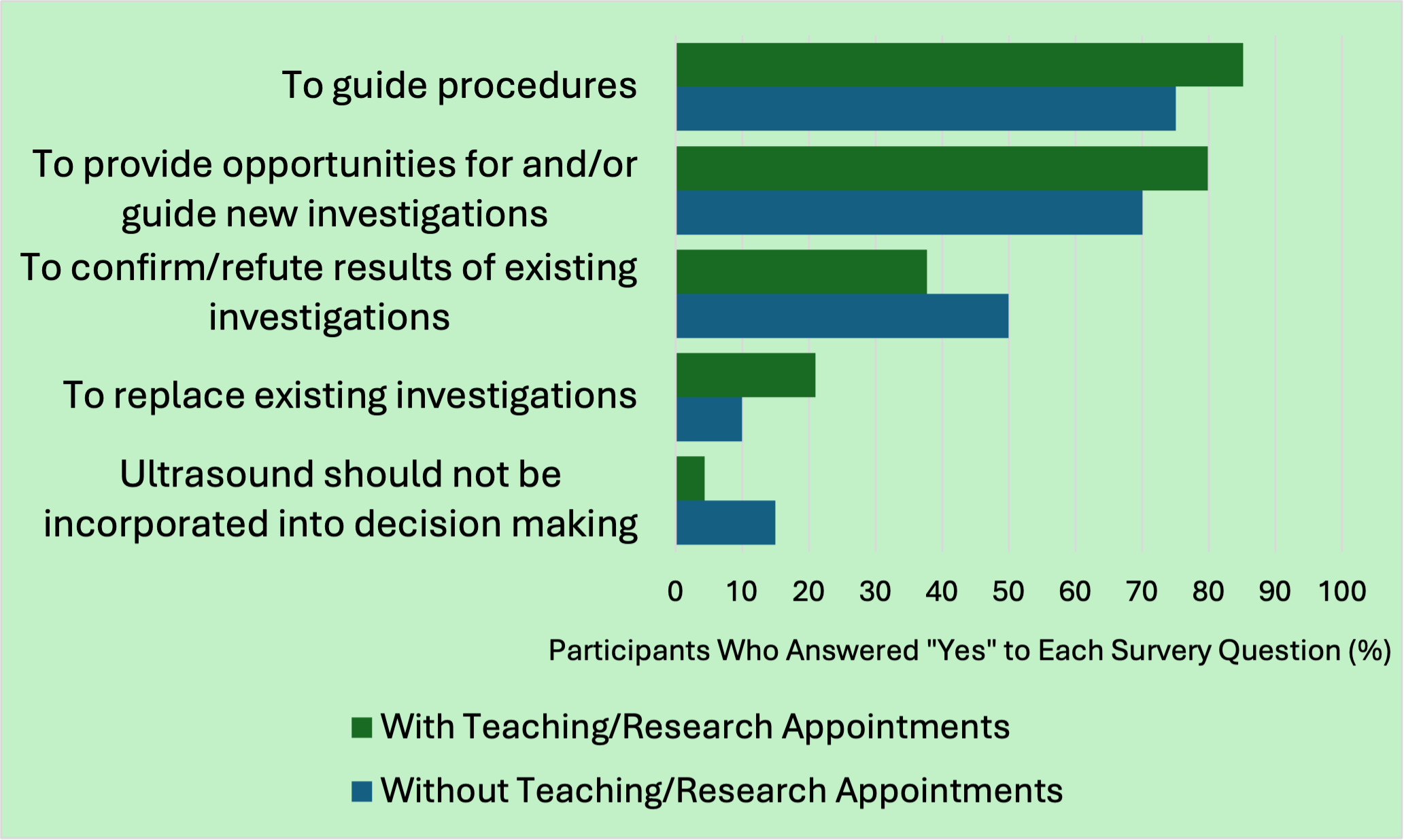
The respondents’ perceived use and utility of ultrasonography at the time of the survey are presented in Figure 1 and Table 2. In Saskatchewan, 106/115 (92%) faculty with academic appointments and 19/20 (95%) faculty without academic appointments saw a role for ultrasonography in primary care. However, only 40/116 (34%) of faculty with and 6/20 (30%) without academic appointments conducted ultrasound in their practice. The proportion of physicians who conducted ultrasound in the community, emergency room, and/or hospital was greater among those with academic appointments: 54/116 (47%) compared to those without 4/20 (20%); P=.027. More than 70% of respondents thought that ultrasound provided utility for guiding procedures or new investigations, irrespective of having a faculty appointment. Less than or equal to half of respondents felt that ultrasound could be used to confirm/refute results of exiting investigation or replace existing investigations. Only 4%–15% of physicians believed that ultrasound should not be incorporated in clinical decision-making.
Survey question |
All faculty, n/N (%) |
Faculty with academic appointments, n/N (%) |
Faculty without academic appointments, n/N (%) |
P value |
Do you see a role for the use of ultrasound in primary care? |
125/135 (93) |
Yes |
106/115 (92) |
Yes |
19/20 (95) |
.656 |
10/135 (7) |
No |
9/115 (8) |
No |
1/20 (5) |
Do you currently conduct ultrasound as a primary care physician? |
46/136 (34) |
Yes |
40/116(34) |
Yes |
6/20 (30) |
.695 |
90/136 (66) |
No |
76/116 (66) |
No |
14/20 (70) |
Do you use ultrasound equipment at your academic center? |
42/135 (31) |
Yes |
38/115 (33) |
Yes |
4/20 (20) |
.245 |
93/135 (69) |
No |
77/115 (67) |
No |
16/20 (80) |
Do you use ultrasound equipment off-site (ER, hospital, community)? |
58/136 (43) |
Yes |
54/116 (47) |
Yes |
4/20 (20) |
.027 |
78/136 (57) |
No |
62/116 (53) |
No |
16/20 (80) |
Have you received ultrasound training by a recognized certifying/ credentialing body? |
60/136 (44) |
Yes |
51/116 (44) |
Yes |
9/20 (45) |
.931 |
76/136 (56) |
No |
65/116 (56) |
No |
11/20 (55) |
If you have not already received ultrasound training, are you interested in acquiring training? |
83/116 (72) |
Yes |
69/97 (71) |
Yes |
14/19 (74) |
.822 |
33/116 (28) |
No |
28/97 (29) |
No |
5/19 (26) |
The respondents’ current involvement in teaching ultrasonography, as well as interests in teaching, research, and curriculum development are presented in Table 3. Overall, 27/116 (23%) of faculty with and 1/20 (5%) without academic appointments taught ultrasound skills to undergraduate or postgraduate medical learners. However, more than 50% of faculty with and without academic appointments (58/116 [50%] and 11/19 [58%], respectively) were interested in becoming involved in teaching ultrasonographic skills. In addition, 109/116 (94%) of faculty with teaching/research appointments and 19/19 (100%) of those without appointments supported the implementation of ultrasonographic training into the postgraduate family medicine curriculum. We further found that 33/115 (29%) of faculty with academic appointments and 5/18 (28%) of faculty without academic appointments were interested in collaborating on a grant to develop ultrasound for teaching and/or research.
Survey question |
All faculty, n/N (%) |
Faculty with academic appointments, n/N (%) |
Faculty without academic appointments, n/N (%) |
P value |
Do you currently teach ultrasound skills to undergraduate or postgraduate students in family medicine? |
28/136 (21) |
Yes |
27/116 (23) |
Yes |
1/20 (5) |
.062 |
108/136 (79) |
No |
89/116 (77) |
No |
19/20 (95) |
Are you interested in teaching ultrasound to residents within the DAFM? |
69/135 (51) |
Yes |
58/116 (50) |
Yes |
11/19 (58) |
.523 |
66/135 (49) |
No |
58/116 (50) |
No |
8/19 (42) |
Do you support the development of ultrasound training in the family medicine postgraduate curriculum at the U of S? |
128/135 (94) |
Yes |
109/116 (94) |
Yes |
19/19 (100) |
.272 |
7/135 (5) |
No |
7/116 (6) |
No |
0/19 (0) |
Are you interested in conducting ultrasound research within the DAFM? |
42/135 (31) |
Yes |
35/116 (30) |
Yes |
7/19 (37) |
.554 |
93/135 (69) |
No |
81/116 (70) |
No |
12/19 (63) |
Would you be interested in serving as a collaborator or coinvestigator on applications to secure funding for ultrasound research and teaching infrastructure within the DAFM? |
38/133 (29) |
Yes |
33/115 (29) |
Yes |
5/18 (28) |
.932 |
95/133 (71) |
No |
82/115 (71) |
No |
13/18 (72) |
Would you be interested in being contacted regarding involvement in ultrasound teaching and/or research initiatives in the DAFM at the U of S? |
48/134 (36) |
Yes |
39/116 (34) |
Yes |
9/18 (50) |
.178 |
86/134 (64) |
No |
77/116 (66) |
No |
9/18 (50) |
Obstetrical and musculoskeletal ultrasound exams were the most common types of imaging conducted among family physicians in Saskatchewan (Table 4). Less frequent examinations included assessments of abdominal aortic aneurysms, soft tissue masses, free fluid in the abdomen, foreign body location, and localization of intrauterine devices (IUDs; Table 4). We found that 51/116 (44%) of faculty with academic appointments and 9/20 (45%) of those without had received formal ultrasound training from a credentialling body. The ultrasound training received was predominantly from the Emergency Department Echo Program, and less commonly from the Canadian Society of Diagnostic Medical Sonographers.
Type of exam performed |
N = 83 respondents |
Obstetrical/gynecological scans |
75/83 |
Early pregnancy viability—fetal heart rate |
22 |
Fetal presentation/lie |
27 |
Assessment of location of pregnancy |
15 |
Pregnancy dating |
7 |
Assessment for retained point-of-care |
3 |
Placental location |
1 |
Musculoskeletal scans |
39/83 |
Joint effusion |
3 |
Ultrasound guided injection |
28 |
Fracture |
3 |
Rotator cuff pathology |
4 |
Biceps tendinosis |
1 |
Respiratory scans |
18/83 |
Pneumothorax |
2 |
Pneumonia |
10 |
Pleural effusion |
5 |
Pulmonary edema |
1 |
Abdominal scans |
25/83 |
Undifferentiated abdominal pain |
8 |
Gallbladder scan |
5 |
Abdominal free fluid/ascites |
12 |
Cardiac scans |
12/83 |
Left ventricular ejection fraction |
1 |
CHF assessment |
6 |
Pericardial effusion |
4 |
Cardiac activity in code blue |
1 |
Vascular scans |
19/83 |
Abdominal aortic aneurysm screening |
10 |
Vascular access |
4 |
Deep vein thrombosis |
4 |
IVC assessment |
1 |
Other |
37/83 |
Hernia assessment |
2 |
Confirmation of IUD placement |
10 |
Bladder scan |
3 |
Abscess/foreign body assessment |
14 |
Retinal detachment |
3 |
Assessment of infant tongue function during feeding in consideration of frenotomy |
1 |
Hydronephrosis |
2 |
Nerve block |
2 |
This research study is the first to explore the use of ultrasonography in family medicine practice and postgraduate education in Saskatchewan, Canada. Overall, we identified support for implementing ultrasound teaching and/or research in family medicine residency training at the University of Saskatchewan. Furthermore, most family physicians surveyed saw a role for ultrasound imaging in practice. Positive interests were similar for physicians with and without academic appointments. Interests to develop a program for ultrasound training and research were positive and similar for physicians working in urban, regional, and rural centers. In addition to those that currently teach ultrasound in their practices, a large proportion of family medicine physicians were interested in teaching ultrasound skills to medical learners.
The notion that family physicians can safely incorporate ultrasonography into their practice with receipt of appropriate training has been well-documented.4,6 Family physicians have demonstrated that they can perform low-to-moderate complexity scans with high diagnostic efficiency.4,5,7,8 Ultrasonography has many applications in the setting of family medicine across all body systems.3-8 Results of our research support existing literature on the utility and interest of incorporating POCUS into family medicine practice.
From this study, we determined that faculty at the University of Saskatchewan use a broad scope of ultrasonography in their practices. Applications used include diagnosis of pregnancy and early pregnancy complications, fetal lie and presentation, abdominal aortic aneurysm screening, investigation of soft tissue masses, assessment of free fluid in the abdomen, and foreign body assessment and removal. In addition, faculty reported the use of ultrasound to help guide procedures, such as joint injections and IUD placements. Faculty endorsed that ultrasonography helps improve access to care in rural communities, prevents unnecessary patient transport, and reduces the need for more invasive imaging modalities. Faculty further reported using ultrasound on the ward, in the clinic, in the emergency room, and in the operating room, as well as in fly-out communities and in the field (eg, air ambulance, sideline of sporting events and rodeos). The results of our research are consistent with previous studies in which primary care practitioners demonstrated the ability to incorporate ultrasonographic training into their practice.4,6 Ultrasonography has many applications in the setting of family medicine across all body systems. Low-to-moderate complexity scans with high diagnostic efficiency can be performed, such as abdominal aortic aneurysm screening, obstetrical evaluation, cardiac scans, and ultrasound-guided skin abscess drainage.3,5,8,19
Perceived barriers to implementing ultrasonography included inadequate time and resources to acquire training, lack of time for teaching, and confusion around billing. Challenges reported emphasized the need to advocate for protected time for physicians to obtain training. Compensation for training is currently available through the Saskatchewan Medical Association. Recent implementation of a new remuneration model for physicians in Saskatchewan and other Canadian provinces such as Manitoba and British Columbia (including salary or hybrid salary/fee for services agreements) is assisting to facilitate protected time and appropriate remuneration for teaching. In Saskatchewan, the provincial Advisory Committee on Medical Imaging is currently reviewing and overseeing practices for fee for service and shadow billing for POCUS versus diagnostic ultrasound examinations; appropriate billing practices are becoming more clear with the evolution of ultrasound use in primary care. In 2018, Micks et al, investigated the current state of POCUS in family medicine residency programs across Canada.32 The researchers reported that only 21% of respondents had an established core ultrasound curriculum. In contrast, 93% of program directors believed that ultrasound training should be included as part of the curriculum for family medicine postgraduate training programs. Consistent with the results of our study, perceived barriers included lack of equipment, funding, and time.32
In 2019, Peng et al, evaluated the quality and relevance of POCUS as perceived by family medicine residents in Canada.21 They found that 94.3% of respondents believed that formal ultrasound training should be included in family medicine residency programs, but only 18.4% reported receiving such training in their residency. Furthermore, 77.5% of family medicine residents believed that ultrasound use in primary care could enhance clinical decision-making in practice, and 77.5% endorsed that if they had the access and means to use ultrasound in their practice, they would do so regularly.21 Private POCUS training courses exist within Saskatchewan, and some postgraduate students opt to gain certification alongside the completion of their residency training. These courses are expensive, often difficult to access geographically, and can be challenging to schedule within a busy residency training program. The ability to develop an optional curriculum for postgraduate training in ultrasound would potentially increase access for students and reduce financial and time constraints. We were reassured to find that several faculty members without current teaching appointments would be interested in future opportunities to teach ultrasound skills in the postgraduate curriculum. Training the next generation of family medicine physicians to use POCUS will further help to build a critical mass of teachers and mentors for POCUS in primary care in the future.
Although our study provided perspectives on the use of ultrasound for practice, teaching, and research in primary care, it had a few limitations. The main limitation was a low email response rate. Despite repeated invitations to participate, we were able to capture a response rate of only 22%. Given current email survey burnout among physicians amid a time of unprecedented demand on primary care provider access in Canada, obtaining a high survey response rate in studies of this nature is difficult. As expected, we received a greater proportion of responses from faculty with academic positions, but also had reasonable representation from community faculty. Our findings are consistent with previous research investigating the use of ultrasonography in family medicine practice in North America.1,2,19,21,32 The results of this study may be used to guide future processes for obtaining faculty and/or resident feedback at in-person provincial or national primary care or ultrasound conferences. Sampling bias also may have been a limiting factor. Plausibly, physicians who were more likely to have interests and/or experience in ultrasound were more likely to respond to our survey invitation. Of those that responded, we found greater representation from the large urban centers compared to remote and rural centers. Despite the relatively low number of responses from rural or remote sites, the benefits of developing a postgraduate curriculum in ultrasonography for improving access to diagnostic imaging services in rural and remote areas were evident.
Family physicians in Saskatchewan see a role for ultrasound in primary care and are keen to become engaged in ultrasound teaching and research. Faculty with expertise already exist, and more physicians want to become involved. The development of an ultrasound curriculum within the postgraduate family medicine program at the University of Saskatchewan would complement training already in place in the undergraduate medical education and postgraduate emergency medicine department programs. The long-term goals of developing a program for ultrasound in primary care at our center are to (a) improve access to educational opportunities for medical trainees, (b) conduct research to optimize primary care delivery and evaluate the effectiveness of POCUS in primary care, (c) improve patient access to imaging experts and infrastructure, (d) reduce unnecessary wait times for imaging and costs to our provincial health care system, and (e) provide access to technologies that will assist to recruit and retain primary care providers in Saskatchewan. In conclusion, the results of this study can be used to inform POCUS curriculum development and research in family medicine postsecondary education in Saskatchewan and across North America, thereby providing patient-centered and evidence-based primary care delivery.
These data have been presented as a poster at the North American Primary Care Research Group Annual Meeting in San Francisco, California, October 30–November 3, 2023.
References
-
Capizzano JN, O’Dwyer MC, Furst W, et al. Current state of point-of-care ultrasound use within family medicine.
J Am Board Fam Med. 2022;35(4):809–813. doi:10.3122/jabfm.2022.04.220019
-
Hall JWW, Holman H, Barreto TW, et al. Point-of-care ultrasound in family medicine residencies 5-year update: a CERA Study.
Fam Med. 2020;52(7):505–511. doi:10.22454/FamMed.2020.223648
-
Greenlund LJS, Merry SP, Thacher TD, Ward WJ. Primary care management of skin abscesses guided by ultrasound.
Am J Med. 2017;130(5):e191–e193. doi:10.1016/j.amjmed.2016.11.040
-
Wordsworth S, Scott A. Ultrasound scanning by general practitioners: is it worthwhile?
J Public Health Med. 2002;24(2):88–94. doi:10.1093/pubmed/24.2.88
-
Evangelista A, Galuppo V, Méndez J, et al. Hand-held cardiac ultrasound screening performed by family doctors with remote expert support interpretation.
Heart. 2016;102(5):376–382. doi:10.1136/heartjnl-2015-308421
-
Andersen CA, Holden S, Vela J, Rathleff MS, Jensen MB. Point-of-care ultrasound in general practice: a systematic review.
Ann Fam Med. 2019;17(1):61–69. doi:10.1370/afm.2330
-
Lindgaard K, Riisgaard L. Validation of ultrasound examinations performed by general practitioners.
Scand J Prim Health Care. 2017;35(3):256–261. doi:10.1080/02813432.2017.1358437
-
Mjolstad OC, Snare SR, Folkvord L, et al. Assessment of left ventricular function by GPs using pocket-sized ultrasound.
Family Practice. 2012;29(5):534–540. doi:10.1093/fampra/cms009
-
-
Kobal SL, Atar S, Siegel RJ. Hand-carried ultrasound improves the bedside cardiovascular examination.
Chest. 2004;126(3):693–701. doi:10.1378/chest.126.3.693
-
Beaulieu Y, Marik PE. Bedside ultrasonography in the ICU: part 1.
Chest. 2005;128(2):881–895. doi:10.1378/chest.128.2.881
-
Løkkegaard T, Todsen T, Nayahangan LJ, Andersen CA, Jensen MB, Konge L. Point-of-care ultrasound for general practitioners: a systematic needs assessment.
Scand J Prim Health Care. 2020;38(1):3–11. doi:10.1080/02813432.2020.1711572
-
Niblock F, Byun H, Jabbarpour Y. Point-of-care ultrasound use by primary care physicians.
J Am Board Fam Med. 2021;34(4):859–860. doi:10.3122/jabfm.2021.04.200619
-
-
Abid I, Qureshi N, Lategan N, Williams S, Shahid S. Point-of-care lung ultrasound in detecting pneumonia: a systematic review.
Can J Respir Ther. 2024;60:37–48. doi:10.29390/001c.92182
-
-
Peabody CR, Mandavia D. Deep needle procedures: improving safety with ultrasound visualization.
J Patient Saf. 2017;13(2):103–108. doi:10.1097/PTS.0000000000000110
-
Taylor LA, Stenberg R, Tozer J, et al. Novel approach to ultrasound-guided thoracostomy.
J Ultrasound Med. 2022;41(3):743–747. doi:10.1002/jum.15759
-
Jalil R, Warren R, Ma IWY, Tong K. Point of care ultrasound training needs for primary care physicians: practice setting matters.
Cogent Education. 2019;6(1):1617826. doi:10.1080/2331186X.2019.1617826
-
Ng APP, Liu KSN, Wong ZCT, et al. Knowledge, attitude, practices, and perceived barriers to using point-of-care ultrasound by Asian primary care physicians - a mixed method study.
BMC Health Serv Res. 2024;24(1):1344. doi:10.1186/s12913-024-11865-5
-
-
Weemer M, Hutchins M, Beachy E, McGuire N. Considerations for implementing point-of-care ultrasound in a community-based family medicine residency program.
J Med Educ Curric Dev. 2019;6:2382120519884329. doi:10.1177/2382120519884329
-
Ludden-Schlatter A, Kruse RL, Mahan R, Stephens L. Point-of-care ultrasound attitudes, barriers, and current use among family medicine residents and practicing physicians.
PRiMER. 2023;7(7):13. doi:10.22454/PRiMER.2023.967474
-
Zeidan A, Liu EL. Practical aspects of point-of-care ultrasound: from billing and coding to documentation and image archiving.
Adv Chronic Kidney Dis. 2021;28(3):270–277. doi:10.1053/j.ackd.2021.06.004
-
Lewis D, Alrashed R, Atkinson P. Point-of-care ultrasound image archiving and quality improvement: not “If?” or “When?”…but “How?” and “What Next…?”
Can J Emerg Med. 2022;24(2):113–114. doi:10.1007/s43678-022-00281-5
-
Moir M, Barua B, Wannamaker H. Waiting Your Turn: Wait Times for Health Care in Canada. Fraser Institute; 2023.
-
-
Adams SJ, Yao S, Mondal P, Lim H, Mendez I, Babyn P. Sociodemographic and geographic disparities in obstetrical ultrasound imaging utilization: a population-based study.
Acad Radiol. 2022;29(5):650–662. doi:10.1016/j.acra.2021.07.012
-
Adams SJ, Babyn P, Burbridge B, Tang R, Mendez I. Access to ultrasound imaging: A qualitative study in two northern, remote, Indigenous communities in Canada.
Int J Circumpolar Health. 2021;80(1):1961392. doi:10.1080/22423982.2021.1961392
-
Flynn CJ, Weppler A, Theodoro D, Haney E, Milne WK. Emergency medicine ultrasonography in rural communities. Can J Rural Med. 2012;17(3):99–104.
-
Mackey DS, Steiner IP, eds. National Guidelines: Family Medicine-Emergency Medicine Residency Programs. The College of Family Physicians Canada; 2010.
-
Micks T, Braganza D, Peng S, et al. Canadian national survey of point-of-care ultrasound training in family medicine residency programs. Can Fam Physician. 2018;64(10):e462–e467.



There are no comments for this article.