Purpose: We are in a time of rapid adoption of artificial intelligence (AI) in medical care and medical education. We sought to determine the patterns of use and training in AI among family medicine (FM) residents.
Methods: The 2025 American Board of Family Medicine (ABFM) National Resident Survey (NRS) was administered in October 2025 to all FM residents who completed the In-Training Exam. Residents were asked about their use of AI in the last month and any education about AI use they received in the last 6 months. Resident demographics were obtained from ABFM administrative databases.
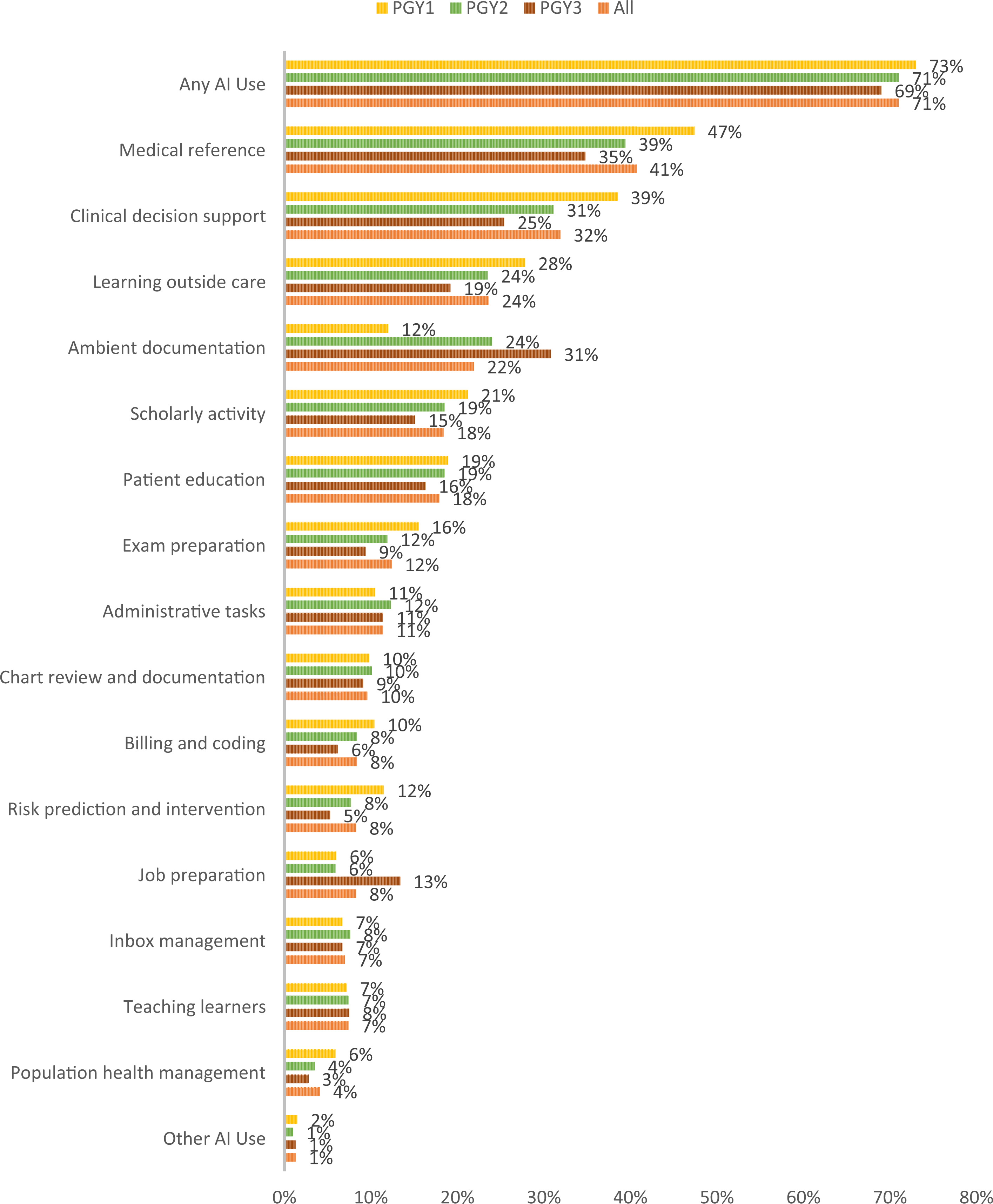
Results: A total of 15,259 residents completed the AI questions (response rate: 99.6%) with 10,858 residents (71.1%) reporting they used AI in the last month. The most common uses reported were for medical reference (40.7%), clinical decision support (31.9%), learning outside of patient care (23.6%), and ambient documentation of clinical encounters (21.9%). Only 36% reported any AI education or training in the last 6 months.
Conclusions: Most FM residents reported recent use of AI tools, reflecting integration of these technologies into routine educational and clinical activities. However, formal training on AI use appears limited, suggesting a gap between adoption and structured competency development. The widespread use of AI by family medicine trainees has risks and opportunities for our future primary care workforce that will require new critical appraisal skills and new methods for teaching and assessing clinical reasoning.
Artificial intelligence (AI) applications increasingly influence clinical practice, medical education, and administrative workflows in health care.1-3 As the largest platform for health care delivery in the United States, primary care will be particularly affected.4 Family physicians care for patients with undifferentiated problems across a broad range of conditions while managing prevention, chronic disease, documentation, and longitudinal relationships. Many of the earliest AI applications are designed to support these core functions and have the potential to strengthen relationship-centered primary care.5 Because residents represent the near-future workforce, their patterns of AI use offer an early signal of how these technologies may reshape care delivery, clinician workload, and patient experience.
Despite rapid adoption, there is little published information about how residents are adopting AI tools, if they receive formal instruction, and if adoption varies by resident demographics or program characteristics. Using a unique national resident survey, our objective was to determine the patterns of use and training in AI among family medicine residents.
The American Board of Family Medicine (ABFM) administered the National Resident Survey (NRS) to all family medicine residents in October 2025 at the end of the ABFM In-Training Exam (ITE). Residents were asked about AI use in the last month and training on AI use in the last 6 months along with multiple other measures. The outcome measures for this study were resident self-reported AI use in the last month at work for clinical care, scholarship, or learning and resident-reported education about using AI in the last 6 months. We merged NRS data with ABFM administrative data to obtain resident demographics and program characteristics. We conducted descriptive and bivariate analyses to characterize patterns of AI use across resident and program characteristics. We also conducted bivariate analyses using χ2 tests with the false discovery method to correct for multiple comparisons. This study was approved by the American Academy of Family Physicians Institutional Review Board.
The NRS was administered to 15,324 family medicine residents. Of these residents, 15,259 completed the AI questions (response rate: 99.6%). Overall, 10,858 residents (71.1%) reported using AI in the last month. The most common uses reported were for medical reference (40.7%), clinical decision support (31.9%), learning outside of patient care (23.6%) and ambient documentation of clinical encounters (21.9%; Figure 1). At the same time, only 36.3% reported receiving any education about using AI in the last 6 months (Table 1). AI use varied differentially across resident demographics, training year, and residency characteristics (Table 2, Table 1). In nearly all AI use cases except for ambient documentation and job preparation, interns (postgraduate year 1) were using AI more than senior residents (postgraduate year 3). Female residents were slightly more likely to use any AI tool, and particularly AI scribes and AI for learning outside of patient care. Younger residents were more likely to report using AI tools except for ambient documentation, and international medical graduates were less likely to report using AI tools across all categories. There were some slight variations by region and program size that were not meaningfully different. Finally, residents who reported receiving some education about AI use in the last 6 months were significantly more likely to report using any AI than those not receiving education (58.4% vs 36.3%, P<0.001) but this was driven by their use of ambient documentation (60.7%) rather than tools to support learning or clinician decisions (37%–38%).
|
Demographics and program characteristics
|
Full sample (N = 15,259)
|
Any AI use (N = 10,858)
|
P value
|
|
Resident demographics
|
|
Age (years):<30, n (%)
|
6,769 (44.4%)
|
5,045 (46.5%)
|
<0.001
|
|
Gender no. (%)
|
|
|
0.031
|
|
Female
|
7,677 (56.1%)
|
5,566 (56.9%)
|
|
Male
|
5,784 (42.2%)
|
4,091 (41.8%)
|
|
Nonbinary
|
87 (0.6%)
|
50 (0.5%)
|
|
Prefer not to answer
|
141 (1.0%)
|
78 (0.8%)
|
|
Prefer to self-describe
|
3 (0.0%)
|
2 (0.0%)
|
|
Underrepresented in medicine, n (%)
|
3,581 (27.7%)
|
2,605 (27.9%)
|
0.384
|
|
International medical graduate, n (%)
|
4,995 (32.7%)
|
3,320 (30.6%)
|
<0.001
|
|
Residency year, n (%)
|
|
|
0.031
|
|
PGY1
|
5,365 (35.2%)
|
3,924 (36.1%)
|
|
PGY2
|
5,023 (32.9%)
|
3,556 (32.8%)
|
|
PGY3 and above
|
4,871 (31.9%)
|
3,378 (31.1%)
|
|
Residency characteristics
|
|
Residency region, n (%)
|
|
|
0.135
|
|
Midwest
|
3,744 (24.7%)
|
2,631 (24.5%)
|
|
Northeast
|
2,659 (17.6%)
|
1,858 (17.3%)
|
|
South
|
5,272 (34.8%)
|
3,802 (35.3%)
|
|
West
|
3,458 (22.9%)
|
2,467 (22.9%)
|
|
Residency size, n (%)
|
|
|
0.006
|
|
<19 residents
|
4,372 (28.7%)
|
3,014 (27.8%)
|
|
19–30 residents
|
7,203 (47.2%)
|
5,203 (47.9%)
|
|
>30 residents
|
3,684 (24.1%)
|
2,641 (24.3%)
|
|
AI education in the last 6 months, n (%)
|
5,541 (36.3%)
|
6,336 (58.4%)
|
<0.001
|
|
Demographics and program characteristics
|
Full sample (N = 15,259)
|
Medical reference (N = 6,215)
|
P value
|
Clinical decision support (N = 4,868)
|
P value
|
Learning outside of patient care (N = 3,607)
|
P value
|
AI scribe (N = 3,347)
|
P value
|
|
Resident demographics
|
|
Age (years):<30, n (%)
|
6,769 (44.4%)
|
3,082 (49.6%)
|
<0.001
|
2,450 (50.3%)
|
<0.001
|
1,704 (47.2%)
|
<0.001
|
1,404 (41.9%)
|
0.184
|
|
Gender, n (%)
|
|
Female
|
7,677 (56.1%)
|
3,125 (56.1%)
|
0.911
|
2,421 (55.7%)
|
0.417
|
1,759 (54.2%)
|
0.007
|
1,712 (54.6%)
|
0.038
|
|
Male
|
5,784 (42.2%)
|
2,360 (42.4%)
|
1,866 (43.0%)
|
1,451 (44.7%)
|
1,384 (44.1%)
|
|
Nonbinary
|
87 (0.6%)
|
36 (0.6%)
|
25 (0.6%)
|
14 (0.4%)
|
14 (0.4%)
|
|
Prefer not to answer
|
141 (1.0%)
|
46 (0.8%)
|
30 (0.7%)
|
22 (0.7%)
|
26 (0.8%)
|
|
Prefer to self-describe
|
3 (0.0%)
|
1 (0.0%)
|
1 (0.0%)
|
|
|
|
Underrepresented in medicine, n (%)
|
3,581 (27.7%)
|
1,394 (26.0%)
|
0.006
|
1,116 (26.7%)
|
0.088
|
904 (29.2%)
|
0.059
|
831 (27.9%)
|
0.811
|
|
International medical graduate, n (%)
|
4,995 (32.7%)
|
1,700 (27.4%)
|
<0.001
|
1,257 (25.8%)
|
<0.001
|
1,089 (30.2%)
|
0.003
|
1,001 (29.9%)
|
<0.001
|
|
Residency year N (%)
|
|
PGY1
|
5,365 (35.2%)
|
2,543 (40.9%)
|
<0.001
|
2,067 (42.5%)
|
<0.001
|
1,490 (41.3%)
|
<0.001
|
642 (19.2%)
|
<0.001
|
|
PGY2
|
5,023 (32.9%)
|
1,979 (31.8%)
|
1,563 (32.1%)
|
1,182 (32.8%)
|
|
1,205 (36.0%)
|
|
PGY3 and above
|
4,871 (31.9%)
|
1,693 (27.2%)
|
1,238 (25.4%)
|
935 (25.9%)
|
|
1,500 (44.8%)
|
|
Residency characteristics
|
|
Residency region, n (%)
|
|
Midwest
|
3,744 (24.7%)
|
1,546 (25.1%)
|
0.035
|
1,159 (24.0%)
|
0.276
|
835 (23.4%)
|
0.016
|
852 (25.7%)
|
0.017
|
|
Northeast
|
2,659 (17.6%)
|
1,018 (16.5%)
|
827 (17.1%)
|
600 (16.8%)
|
506 (15.2%)
|
|
South
|
5,272 (34.8%)
|
2,188 (35.6%)
|
1,701 (35.2%)
|
1,305 (36.5%)
|
1,187 (35.8%)
|
|
West
|
3,458 (22.9%)
|
1,401 (22.8%)
|
1,141 (23.6%)
|
834 (23.3%)
|
774 (23.3%)
|
|
Residency size, n (%)
|
|
<19 residents
|
4,372 (28.7%)
|
1,688 (27.2%)
|
0.017
|
1,318 (27.1%)
|
0.080
|
1,069 (29.6%)
|
0.016
|
885 (26.4%)
|
0.017
|
|
19–30 residents
|
7,203 (47.2%)
|
2,998 (48.2%)
|
2,378 (48.8%)
|
1,682 (46.6%)
|
1,601 (47.8%)
|
|
>30 residents
|
3,684 (24.1%)
|
1,529 (24.6%)
|
1,172 (24.1%)
|
856 (23.7%)
|
861 (25.7%)
|
|
AI education in the last 6 months, n (%)
|
5,541 (36.3%)
|
2,378 (38.3%)
|
<0.001
|
1,830 (37.6%)
|
0.038
|
1,378 (38.2%)
|
0.025
|
2,033 (60.7%)
|
<0.001
|
Most FM residents reported recent use of AI tools, primarily for medical reference and clinical decision support, reflecting integration of these technologies into routine educational and clinical activities. However, formal training on AI use appears limited, suggesting a gap between adoption and structured competency development. The significantly higher rates of adoption for medical learning, medical reference, and clinical decision support by first-year residents suggests a rapid adoption of these new tools by our early learners. The reverse trend in ambient documentation use with nearly one-third of postgraduate year-3 and later residents reporting using this in the last month reflects the practice in many systems of delaying offering this tool to residents until later in training. Our national survey of over 15,000 US FM residents in October 2025 found a similar rate of recent use of AI at 71% as the recent American Medical Association (AMA) clinician survey.6 Regarding training to use AI, our findings are consistent with a 2025 meta-analysis of studies assessing physician and trainee AI knowledge,7 but lower than what was found in the 2026 AMA survey.6 This difference is surprising given there are likely more opportunities for training in residency versus in practice. This difference may reflect selection bias of the AMA survey where more engaged physicians are more likely to complete the survey versus the near national sample for the NRS. All these surveys are cross-sectional snapshots that capture a moment in time in an area that is rapidly evolving. We plan to repeat this survey for family medicine residents in October 2026 as part of the 2026 NRS.
High rates of AI use for clinical decision support and medical reference suggest that AI is already influencing real-time clinical reasoning in primary care settings. The potential impact on medical learning, trainee well-being, and patient outcomes of the rapid use of these tools during medical education is unknown.8 The medical education community is still developing competencies and strategies on how best to integrate these tools into training.9-11 Widespread resident-driven adoption of AI in the absence of formal instruction risks never-skilling, mis-skilling, and inappropriate clinical use.10 “Never-skilling” is a term used to describe when a learner substitutes AI-generated outputs for the cognitive effort needed to develop foundational clinical reasoning skills, whereas mis-skilling is when a learner does not use critical appraisal and accepts AI errors as facts that leads to flawed clinical knowledge or reasoning. This underscores the need for deliberate curricular and faculty development to ensure safe, equitable integration of AI in medical training.7 If unstructured, this situation may introduce variability in care quality, amplification of bias, or overreliance on tools with uncertain validity.12 Conversely, thoughtful integration could reduce cognitive burden, improve documentation efficiency, and expand access to evidence at the point of care, potentially enhancing both clinician experience and patient outcomes.1 The lower reported use among international medical graduates raises concerns about unequal access to emerging tools and the potential for widening gaps in training and practice readiness. A traditional way that clinical decision making and medical reasoning has been taught and assessed is through the practice of medical documentation and presentations. The growing use of AI by our learners necessitates us to thoughtfully and deliberately teach these skills in new ways that will require faculty development and potentially additional faculty time and resources.
The widespread use of AI by family medicine trainees has risks and opportunities for our future primary care workforce. Without adequate and thoughtful training and instruction, there are risks that future family physicians will become dependent on these tools for clinical decision-making in a way that does not improve care. Conversely, a highly-engaged workforce who are comfortable with the technology can lead early AI design and develop the tools and workflows so that the technology can enhance relationship-centered care.
The ABFM Foundation provided financial support for Dr Barr.
This study was presented at the AAFP 2026 Residency Leadership Summit, in Dallas, Texas, March 4, 2026; and the 2026 Society of Teachers of Family Medicine (STFM) Annual Spring Conference in New Orleans, Louisiana, May 5, 2026.
References
-
Lin S.
A clinician’s guide to artificial intelligence (AI): why and how primary care should lead the health care ai revolution.
J Am Board Fam Med.
2022;35(1):175–184.
doi:10.3122/jabfm.2022.01.210226
-
Waldren S,
Gerhart J,
Liaw W,
et al.
A family medicine shared vision and road map for ai in primary care.
Ann Fam Med.
2025;23(5):481–483.
doi:10.1370/afm.250510
-
Wolthusen RPF,
El-Tohami M,
Hendler RA,
Riordan PA,
Stoklosa JB.
A framework for artificial intelligence in medical education: could i, would i, should i?
J Grad Med Educ.
2025;17(4):430–433.
doi:10.4300/JGME-D-25-00009.1
-
-
-
Hwang G,
Hejazian SS,
Vafaei Sadr A,
et al.
Translating AI to the bedside with physician buy-in: recommendations from a meta-analysis and systematic review of the literature.
Bioengineering (Basel).
2025;12(12):1363.
doi:10.3390/bioengineering12121363
-
Rampton V,
Mittelman M,
Goldhahn J.
Implications of artificial intelligence for medical education.
Lancet Digit Health.
2020;2(3):e111–e112.
doi:10.1016/S2589-7500(20)30023-6
-
Liaw W,
Kueper JK,
Lin S,
Bazemore A,
Kakadiaris I.
Competencies for the use of artificial intelligence in primary care.
Ann Fam Med.
2022;20(6):559–563.
doi:10.1370/afm.2887
-
Abdulnour REE,
Gin B,
Boscardin CK.
Educational strategies for clinical supervision of artificial intelligence use.
N Engl J Med.
2025;393(8):786–797.
doi:10.1056/NEJMra2503232
-
Russell RG,
Lovett Novak L,
Patel M,
et al.
Competencies for the use of artificial intelligence-based tools by health care professionals.
Acad Med.
2023;98(3):348–356.
doi:10.1097/ACM.0000000000004963
-
Obermeyer Z,
Powers B,
Vogeli C,
Mullainathan S.
Dissecting racial bias in an algorithm used to manage the health of populations.
Science.
2019;366(6464):447–453.
doi:10.1126/science.aax2342
-
Rotenstein LS,
Holmgren AJ,
Thombley R,
et al.
Changes in clinician time expenditure and visit quantity with adoption of artificial intelligence-powered scribes: a multisite study.
JAMA.
2026;335(16):1408–1417.
doi:10.1001/jama.2026.2253



There are no comments for this article.