Background and Objectives: Financial well-being is a key contributor to overall resident well-being and is, arguably, one of the most amenable to improvement. Residents consistently report a desire for this education. However, most residencies rely on outside financial planners with dual and sometimes self-interested motives to fill this educational need, if they address it at all. This report describes a financial well-being curriculum that is adaptable to various time constraints and applicable to residents and attendings of all levels, developed by a faculty physician who is also a Certified Financial Education Instructor.
Methods: The curriculum consists of several lectures and workshops, including two 90 minute sessions: one primarily for graduating medical students and early residents; the other delivered during a residency rotation as a small-group activity. The curriculum was evaluated using pre- and postsession surveys, including validated financial literacy questions and Likert-scale items assessing comfort and financial anxiety. Data were collected March 2022 to July 2025, with the primary analysis conducted in May 2024.
Results: Feedback from several large-group deliveries of the first session was positive. Pre and postsurveys also demonstrated significant positive shifts in the knowledge, beliefs, and attitudes of residents who participated in the rotational course.
Conclusions: A personal finance curriculum can improve resident knowledge and well-being and is an important, often overlooked, component of the education provided to residents as they prepare for the next steps in their careers.
Medical educators are tasked with preparing residents for independent practice by equipping them with the knowledge and skills necessary to deliver high-quality patient care while maintaining personal well-being. Financial well-being represents an important yet often overlooked component of physician wellness.
More than 70% of US medical students graduate with educational debt, with a median debt burden of approximately $205,000.1 Studies consistently have demonstrated limited financial literacy among residents and early-career physicians.2 At the same time, trainees have reported a strong interest in receiving personal finance education during graduate medical education. Surveys have indicated that 79%–90% of residents would like formal instruction on topics such as debt management, insurance, and home purchasing.3,4
Financial stress also has been identified as a contributor to physician burnout and reduced well-being during training.5 Providing structured financial education may help residents manage debt, make informed financial decisions, and reduce anxiety related to personal finances. Despite these potential benefits, financial literacy education is rarely incorporated into residency curricula, and relatively few structured programs have been described in the graduate medical education literature.6
Prior studies have demonstrated that targeted interventions improve financial knowledge and confidence among trainees, but most of these studies consisted of isolated workshops rather than longitudinal curricula integrated across training.5 Family medicine residents may particularly benefit from this training given the breadth of career pathways available after graduation. This study describes and evaluates a longitudinal personal finance curriculum in a family medicine residency program, assessing its association with improvements in financial knowledge, confidence, and self-reported financial anxiety.
A longitudinal personal finance curriculum was implemented within a family medicine residency program beginning in June 2020. The curriculum was designed to address major financial transitions encountered during training and early career development. Content was developed and delivered by a physician educator with formal financial education training and certification as a Certified Financial Education Instructor.
Curriculum Components
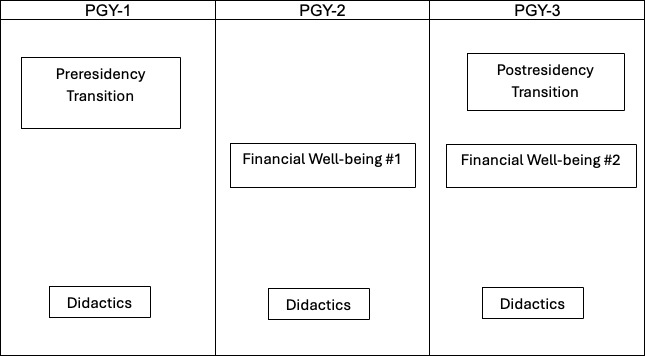
The curriculum consisted of four core components (Figure 1). Over the 3-year evaluation period (2022–2025), approximately 10 to 12 learners attended each annual cohort orientation, 20 to 24 postgraduate year 1 (PGY-1) and PGY-2s per year participated in small-group sessions, 20 to 40 attended the annual conference session, and 7 to 10 graduating residents participated in the transition session each year.
Medical Student-to-Resident Transition Workshop. A 90 minute workshop, Financial Well-Being: Navigating the Transition From Medical Student to Resident, is delivered to fourth-year students interested in family medicine or incoming PGY-1 residents during orientation, introducing foundational concepts including loan repayment, budgeting, investing, and early retirement planning.
Resident Small-Group Sessions. Two 90 minute small-group sessions occur during the Health Systems Management rotation: PGY-2 residents attend Financial Well-Being I, and PGY-3 residents attend Financial Well-Being II. Conducted with two to three residents, content is partially resident-driven, allowing participants to select topics most relevant to their current financial concerns.
Residency Annual Conference Session. An annual 120 minute session open to rotating medical students, residents, fellows, and faculty is structured as a lecture with discussion points and audience response questions, covering the full curriculum.
Resident-to-Attending Transition Session. A 60 minute discussion titled Financial Well-Being: Navigating the Postresidency Transition is offered as an optional capstone to graduating residents each May, addressing income increase, house buying, insurance, and retirement planning.
Sessions also have been adapted for fellows, pharmacists, doctoral students, and premedical students.
Evaluation
Participants completed pre- and postsession assessments evaluating financial knowledge, beliefs, and satisfaction with the curriculum. The widely used Big Five financial literacy questions—covering compound interest, inflation, portfolio diversification, bond pricing, and mortgage comparisons—provided a validated knowledge measure with established national normative data.7 Additional Likert-scale items assessed comfort across seven topic areas (budgeting, savings, student loans, disability insurance, home buying, investing, and retirement planning), self-reported financial anxiety, and current financial behaviors including retirement contributions and emergency savings. While the comfort and anxiety items have not been independently validated against burnout instruments, they capture affective dimensions not addressed by the knowledge-based Big Five questions.
Data Collection and Analysis
Evaluation data were collected between March 2022 and July 2025. The primary evaluation reported here was conducted in May 2024; earlier evaluations were informal and not systematically analyzed for this report. We compared pre- and postsession responses using the Wilcoxon signed rank test and McNemar’s test, as appropriate.
The curriculum has been delivered to a diverse group of learners, including premedical students, medical students, residents, fellows, attending physicians, pharmacists, and doctoral students. The May 2024 evaluation assessed participant outcomes following the resident annual conference session and resident small-group sessions. Of 65 participants, 62 completed the presession survey and 59 completed the postsession survey. Participants demonstrated increased subjective comfort with financial topics after the intervention. Overall, 97% of participants agreed that personal finance education should be included in residency training. Participants also reported a statistically significant reduction in financial anxiety, and knowledge scores improved on the financial literacy assessment (Table 1).
|
Precurriculum |
Postcurriculum |
Pre–post change |
95% confidence interval |
P value |
Q3: Training level (N = 62) |
Med student: 2 (3.2%)
PGY-1:14 (22.6%)
PGY-2:23 (37.1%)
PGY-3:18 (29.0%)
PGY-4:0 (0%)
PGY-5:1 (1.6%)
Fellow: 1 (1.6%)
Attending: 3 (4.8%) |
– |
– |
– |
Q4: Earliest financial training exposure (N = 65) |
Self study: 17 (26.2%)
high school: 10 (15.4%)
college: 6 (9.2%)
med school: 16 (24.6%)
residency: 9 (13.9%)
other: 7 (10.8%) |
– |
– |
– |
Q5: Level of comfort with:
0: Very uncomfortable
1: Somewhat uncomfortable
2: Neutral
3: Somewhat comfortable
4: Very comfortable |
Wilcoxon signed rank test
H0: No change pre to post
Ha: Change pre to post
N = 54 (Positive mean indicates increased comfort.)
Post–pre mean ± standard deviation; range 95% confidence interval of mean |
Q5_1: Budgeting |
– |
– |
0.8±0.9 (–1.0–3.0) |
(0.5–1.0) |
<0.0001 |
Q5_2: Savings options |
– |
– |
1.2±1.1 (–1.0–4.0) |
(0.9–1.5) |
<0.0001 |
Q5_3: Student loan repayment |
– |
– |
1.±1.2 (–2.0–3.0) |
(0.7–1.3) |
<0.0001 |
Q5_4: Disability insurance |
– |
– |
1.2±1.2 (–1.0–4.0) |
(0.9–1.5) |
<0.0001 |
Q5_5: Home buying |
– |
– |
1.1±1.2 (–1.0–4.0) |
(0.8–1.4) |
<0.0001 |
Q5_6: Investing |
– |
– |
1.2±1.0 (–1.0–3.0) |
(0.9–1.5) |
<0.0001 |
Q5_7: Retirement planning |
– |
– |
1.5±1.1(0–4.0) |
(1.2–1.8) |
<0.0001 |
Q6: Level of interest in learning about:
0: Very uninterested
1: Somewhat uninterested
2: Neutral
3: Somewhat interested
4: Very interested |
Wilcoxon signed rank test
H0: No change pre to post
Ha: Change pre to post
N = 54 (Positive mean indicates increased comfort)
Post–pre mean ± standard deviation; range 95% confidence interval of mean |
Q6_1: Budgeting |
--- |
--- |
0.7±1.4 (–2.0–4.0) |
(0.3–1.1) |
.0001 |
Q6_2: Savings options |
--- |
--- |
0.9±1.5 (–3.0–4.0) |
(0.5–1.3) |
<0.0001 |
Q6_3: Student loan repayment |
--- |
--- |
0.4±1.8 (–4.0–4.0) |
(–0.1–0.9) |
.08 |
Q6_4: Disability insurance |
--- |
--- |
0.7±1.4 (–2.0–4.0) |
(0.3–1.1) |
.0003 |
Q6_5: Home buying |
--- |
--- |
0.5±1.4 (–4.0–4.0) |
(0.2–0.9) |
.003 |
Q6_6: Investing |
--- |
--- |
0.8±1.6 (–3.0–4.0) |
(0.3–1.2) |
.0006 |
Q6_7: Retirement planning |
--- |
--- |
0.8±1.6 (–1.0–4.0) |
(0.3–1.2) |
.0003 |
Q7: Personal finance should be part of residency education |
No: 0/62 (0%)
Yes: 59/62 (95.2%)
Unsure: 3/62 (4.8%) |
No: 0/59 (0%)
Yes: 57/59 (96.6%)
Unsure: 2/59 (3.4%) |
– |
– |
– |
Q8: Thinking about personal finance makes me feel anxious:
0: Strongly disagree
1: Somewhat disagree
2: Neutral
3: Somewhat agree
4: Strongly agree |
– |
– |
(Negative mean indicates decreased anxiety.)
–0.48±0.79
(–2.00–1.00) |
(–0.70 – –0.26) |
<0.0001 |
Q9: Contributing to workplace retirement account?
0: No interest
1: No but want to
2: Yes,<4% income
3: Yes,>4% income |
0:4/53 (7.6%)
1:12/53 (22.6%)
2:11/53 (20.8%)
3:26/53 (49.1%) |
0:5/57 (8.8%)
1:18/57 (31.6%)
2:11/57 (19.3%)
3:23/57 (40.3%) |
Post–pre (Positive mean indicates increased contribution.)
(N = 42)
0.02±0.27
(–1.00–1.00) |
(–0.06–0.11) |
1.00 |
Q10: Set aside emergency funds to cover 3 months? |
28/54 (51.9%) |
28/54 (51.9%) |
– |
– |
1.00 McNemar’s test |
Q11: Disability insurance?
0: No
1: Yes, employer
2: Yes, employer + other
3: Unsure |
0:20/56 (35.7%)
1:24/56 (42.9%)
2:12/56 (21.4%)
3:0/56 (0%) |
0:16/58 (27.6%)
1:32/58 (55.2%)
2:8/58 (13.8%)
3:2/58 (3.4%) |
– |
– |
– |
Q12: Stock safer than mutual fund:
0: False
1: True
2: Don’t know |
0:38/55 (69.1%)
1:0/55 (0%)
2:17/55 (30.9%) |
0:46/55 (83.6%)
1:6/55 (10.9%)
2:3/55 (5.5%) |
– |
– |
– |
Q13: Interest and inflation:
0: Exactly same
1: Less than today
2: More than today
3: Don’t know |
0:1/52 (1.9%)
1:39/52 (75.0%)
2:4/52 (7.7%)
3:8/52 (15.4%) |
0:6/57 (10.5%)
1:45/57 (79.0%)
2:4/57 (7.0%)
3:2/57 (3.5%) |
– |
– |
– |
Q14:15-year vs 30-year mortgage
0: False
1: True
2: Don’t know |
0:6/50 (12.0%)
1:44/50 (88.0%)
2:0/50 (0%) |
0:9/57 (15.8%)
1:46/57 (80.7%)
2:2/57 (3.5%) |
– |
– |
– |
The medical student-to-resident transition workshop was also delivered at a national conference in 2025 (N = 88 participants), receiving a mean evaluation rating of 4.88 out of 5 stars and numerous positive qualitative comments from attendees.
This longitudinal financial well-being curriculum was associated with improvements in financial knowledge, comfort with financial topics, and reductions in financial anxiety. These findings align with prior studies demonstrating strong learner interest in financial education and knowledge gains following targeted interventions.3,4,5,6 The 97% support rate is consistent with published surveys finding that 79%–90% of trainees desire formal instruction.
Unlike most prior reports, this curriculum spans multiple stages of training and addresses key financial transitions from medical school through early attending practice. The modular design allows individual sessions to be delivered independently or combined into a comprehensive longitudinal curriculum.
The curriculum has evolved over several years through iterative refinement based on learner feedback. Content is updated at least twice annually to reflect current financial policies such as retirement contribution limits and loan repayment program changes.
Several barriers may limit implementation at other institutions. Faculty members may feel they lack sufficient expertise or believe that financial education should be delivered by external financial professionals. While outside experts may be useful for complex topics, trainees often prefer receiving this content from trusted faculty who understand the context of medical training and physician careers.
The study itself had limitations. First, the evaluation primarily measured short-term outcomes; long-term impacts on financial behavior or physician well-being were not assessed. Second, the absence of a control group limited causal inference, as improvements may reflect maturation or other concurrent experiences during training.
Future research could examine longer-term outcomes including financial decision-making, debt management, and career satisfaction. Planned follow-up studies will assess knowledge retention and application approximately 6 months after residency graduation.
Despite these limitations, this curriculum provides a practical framework for incorporating financial literacy education into residency training and represents an important opportunity to support resident wellness while equipping trainees with skills that extend beyond clinical practice.
References
-
-
Gianakos AL, Semelsberger SD, Saeed AA, Lin C, Weiss J, Navarro R. The case for needed financial literacy curriculum during resident education.
J Surg Educ. 2023;80(4):597–612. doi:10.1016/j.jsurg.2022.12.007
-
Pakos G, Mpogiatzidis P. Financial literacy among healthcare providers: a systematic review.
JRFM. 2025;18(1):29. doi:10.3390/jrfm18010029
-
Wesslund HM, Payne JS, Baxter JD, et al. Personal financial wellness curricula for medical trainees: a systematic review.
Acad Med. 2023;98(5):636–643. doi:10.1097/ACM.0000000000005136
-
Anaebere TC, Hernandez MG, Wood DB, et al. The impact of a personal finance education course on financial confidence and markers of financial stress among medical residents: a longitudinal pilot study.
J Med Educ Curric Dev. 2024;11:23821205241264697. doi:10.1177/23821205241264697
-
Igu JA, Zakaria S, Bar-Or YD. Systematic review of personal finance training for physicians and a proposed curriculum.
BMJ Open. 2022;12(12):e064733. doi:10.1136/bmjopen-2022-064733
-



There are no comments for this article.