Background and Objectives: Family medicine residency programs equip graduates for diverse practice environments, including inpatient and critical care medicine. Understanding how residency program characteristics correlate with graduates’ hospital-based practice is crucial for workforce development. Our objective was to evaluate the correlation between residency program structures and curriculum with graduates caring for adult patients in hospital and critical care settings.
Methods: We conducted a prospective cohort study of family medicine graduates using the 2018 Council of Academic Family Medicine Educational Research Alliance program director survey to measure program characteristics and curricular elements and the 2021 Family Medicine National Graduate Survey of residents who graduated in 2018 to measure the primary outcomes—practicing adult inpatient medicine and critical care medicine.
Results: Of 752 respondents, 37.5% reported practicing inpatient medicine and 19.1% providing critical care. Multivariate analysis revealed metropolitan practice location (OR 0.53; 95% CI 0.33–0.85) and presence of an internal medicine program (OR 0.41; 95% CI 0.26–0.66) were associated with lower odds of practicing inpatient medicine. Nine or more months of inpatient medicine during residency was associated with higher odds of both inpatient (OR 1.59; 95% CI 1.10–2.29) and critical care practice (OR 1.92; 95% CI 1.23–3.02). For critical care practice, metropolitan location and having only family medicine attendings were associated with lower odds, while being from a single residency institution showed higher odds.
Conclusions: Duration of inpatient medicine exposure and training environment are significantly associated with graduates practicing inpatient and critical care medicine. These findings can guide residency program design to meet workforce needs.
Family medicine residency programs play a crucial role in preparing physicians for the diverse practice settings they may encounter after graduation. While family medicine has traditionally focused on outpatient care, many family physicians also provide inpatient and critical care services, particularly in rural and underserved areas. However, the factors influencing whether graduates choose to include these services in their practice remain poorly understood.
The rate of physicians practicing as hospitalists has continued to rise over the last three decades.1 Since 2022, the American Board of Family Medicine (ABFM) National Graduate Survey (NGS) has reported approximately 9% of graduates annually identify their primary professional activity as hospitalist. The Society of Hospital Medicine also reported approximately 9% of their active members were family medicine trained hospitalists with continued growth expected.2 While the majority of family medicine resident graduates (~80%) are practicing outpatient continuity of care, among those not practicing outpatient medicine, the majority (~50%) are practicing hospital medicine.3 Studies have shown that family physicians with a broader scope of practice, including inpatient care, provide higher quality and lower cost care.4
The demand for physicians who can cover inpatient care is high, especially in underserved and rural settings, and family physicians play an important role in meeting this need. Family physicians are trained to practice across a spectrum of clinical settings, providing care for infants and children, adults, and maternity patients in both the inpatient and outpatient settings. However, the volume and intensity of inpatient training for family medicine residents can vary greatly depending on geographical location and training environment (ie, academic or community hospital). A 2012 Council of Academic Family Medicine Educational Research Alliance (CERA) family medicine residency director survey found that 20% of programs use hospitalists as family medicine faculty and nearly a quarter (23.3%) of programs offer a track or area of concentration in hospital medicine, though these numbers have changed given the continued growth in hospitalist provided care and the trend toward increased inpatient medicine teaching.5 Over the last decade, the Accreditation Council for Graduate Medical Education (ACGME) Review Committee for Family Medicine has revised its requirements with regard to inpatient training. Current requirements reflect at least 600 hours (or 6 months) and 750 patient encounters of hospitalized adults that must occur throughout residency training, and a core requirement of caring for patients in a critical care setting.6 While these minimum standards exist, the volume of inpatient encounters is not required reporting to ACGME for continuing accreditation, leaving the current volume and intensity of inpatient training across family medicine residencies unknown.
Previous studies have suggested that residency program characteristics and training experiences may influence graduates’ scope of practice.7-11 However, research specifically examining the relationship between residency program features and the likelihood of practicing inpatient or critical care medicine is limited. Historically, linking residency program characteristics and graduate clinical behaviors in practice has been difficult. To overcome this challenge, in 2018, the Family Medicine Residency Outcomes Project (FM-ROP)12 was created to leverage and combine the data sources required to inform associations between residency training and downstream practice.
In this study, our objective was to identify specific residency program characteristics and training experiences associated with graduates’ caring for patients in inpatient hospital and critical care settings. Understanding these relationships can help inform residency program design and potentially address workforce needs in various health care settings.
FM-ROP is a prospective cohort study of 2018 family medicine residency graduates that explored training factors associated with outcomes of interest, with a goal of identifying key residency structures and processes that achieved desired practice outcomes. The FM-ROP study design and methods are described in detail elsewhere.12 Briefly, data about residency curricula that these graduates experienced were obtained from a CERA program director survey13,14 that was administered in the summer of 2018,15 in which program directors were asked to identify their program using their ACGME identification number and respond to questions about the program over the previous 3 years (during the time the class of 2018 was in the residency). The CERA survey questions and deidentified results are available on the CERA website.15 These data were linked to graduate practice outcome data in the 2021 NGS.11,16
Resident demographics were gathered from ABFM administrative databases. Race was self-reported by the resident during registration for the 2018 ABFM initial certification examination in response to a “select best” question and is reported here as is except that Native American/Alaska Native and Native Hawaiian or Other Pacific Islander were combined into an Indigenous category due to small sample size. The 2021 NGS questions and aggregate results are available on the ABFM website.3
Our primary outcomes of interest were whether the recent family medicine graduate practiced adult inpatient medicine and provided critical care medicine as measured on the NGS. The exposures of interest from the CERA survey included region of program, type of community served by program, size of program, program accreditation type, and presence of other training programs (specifically internal medicine). We also examined programmatic processes such as the number of family medicine faculty supervising inpatient medicine, number of required months of dedicated inpatient medicine curriculum, required months in critical care medicine, having multidisciplinary rounds, the presence of a hospital medicine track or fellowship, and the number of patient encounters the resident saw during residency.
Graduate demographics (age, gender, degree type, whether graduated from an international medical school, race/ethnicity) were obtained from the ABFM administrative databases. Practice information on the NGS included practice region and county level practice rurality using the Rural-Urban Continuum Codes. For the CERA variables concerning the number of supervising attendings and length of time on various services that were reported as categorical options, the natural distribution of responses was taken into consideration when choosing the cut points for a binomial variable.
The ABFM research staff merged the program director responses in the 2018 CERA survey with the residency graduate responses on the NGS using the ACGME program identification number. The unit of analysis was the residency graduate. The final FM-ROP dataset contained all respondents to the NGS who graduated from a residency program where the program director responded to the CERA survey.12
We first performed a descriptive analysis using bivariate analyses with a false discovery rate post hoc test to determine significance. When planning the multiple logistic regressions, samples sizes were taken into consideration. For example, few programs had fellowships in hospital medicine resulting in only seven graduates working in intensive care and having done a fellowship; this was numerically impossible. We conducted two regressions to determine the relationships between graduate level and program level characteristics with our two main outcomes: practicing adult inpatient medicine and practicing critical care medicine.
We used SAS version 9.4 (SAS Institute) for all analyses. The overall project was approved by the American Academy of Family Physicians Institutional Review Board.
The response rate for the 2018 CERA survey was 43.7% (255/586). The response rate for the 2021 NGS was 45.0% (1,623/3,610). After merging the two datasets, we lost 44 programs due to no residents responding to the survey and 844 residents due to their program director not responding. Our final analytic sample included 752 graduates from 211 residencies.
For our analytic cohort, 37.5% (282/752) reported practicing inpatient medicine and 19.1% (144/752) reported providing critical care (Table 1). Graduate characteristics associated with providing inpatient medicine were related to gender and the rurality of practice area using bivariate analysis (Table 1). We found no significant program characteristics under bivariate statistics associated with practicing inpatient medicine (Tables 2 and 3). Graduate characteristics associated with providing critical care medicine were by age, location of medical degree, and the rurality of a practice area (Table 1). Program characteristics associated with providing critical care included the community setting where the graduate completed their training, the type of program the graduate was a part of, the number of residency programs in the graduate’s training location, and the presence of an internal medicine residency program at the same training location (Table 2). We found no curriculum characteristics that were significant with bivariate statistics for providing critical care medicine (Table 3).
|
Total |
Practices inpatient medicine |
Practices critical care medicine |
N = 752 |
N = 282 |
N = 144 |
Age, in years (%>38) |
122 (16.2) |
50 (17.1) |
35 (24.2) |
Gender (% male) |
323 (43.0) |
142 (50.4) |
73 (50.7) |
Degree (% MD) |
594 (79.0) |
230 (81.6) |
115 (79.9) |
IMG (% IMG) |
194 (25.8) |
79 (28.3) |
50 (34.7) |
Race, n (%) |
White |
488 (66.5) |
178 (65.4) |
91 (65.0) |
Black |
65 (8.9) |
24 (8.8) |
14 (10) |
Asian |
131 (17.8) |
47 (17.3) |
21 (15.0) |
Indigenous |
7 (1.0) |
4 (1.5) |
2 (1.4) |
All others |
43 (5.9) |
19 (7.0) |
12 (8.6) |
Ethnicity, n (%) |
Hispanic |
74 (10.1) |
25 (9.2) |
13 (9.3) |
Non-Hispanic |
660 (89.9) |
247 (90.8) |
127 (90.7) |
Practice rurality (% Nonmetropolitan) |
101 (13.9) |
55 (20.5) |
33 (23.6) |
Practice region, n (%) |
Northeast |
85 (11.7) |
29 (10.8) |
15 (10.7) |
South |
207 (28.4) |
83 (30.9) |
48 (34.3) |
Midwest |
192 (26.4) |
75 (27.9) |
36 (25.7) |
West |
244 (33.5) |
82 (30.5) |
41 (29.3) |
|
Total |
Practices inpatient medicine |
Practices critical care medicine |
N = 752
n (%) |
N = 282
n (%) |
N = 144
n (%) |
Region |
Northeast |
85 (11.7) |
29 (10.8) |
15 (10.7) |
South |
207 (28.4) |
83 (30.9) |
48 (34.3) |
Midwest |
192 (26.4) |
75 (27.9) |
36 (25.7) |
West |
244 (33.5) |
82 (30.5) |
41 (29.3) |
Residency community served |
Inner city |
111 (15.7) |
38 (14.4) |
16 (11.8) |
Rural |
99 (14.0) |
50 (18.9) |
34 (25.0) |
Suburban |
237 (33.6) |
86 (32.6) |
46 (33.8) |
Urban/suburban |
259 (36.7) |
90 (34.1) |
40 (29.4) |
Residency size |
<19 residents |
120 (16.8) |
46 (17.1) |
26 (18.7) |
19–31 residents |
374 (52.5) |
137 (50.9) |
72 (51.8) |
>31 residents |
219 (30.7) |
86 (32.0) |
41 (29.5) |
Residency type |
University-based |
166 (23.3) |
54 (20.1) |
16 (11.5) |
Community-based, university-affiliated |
451 (63.3) |
176 (65.4) |
105 (75.5) |
Community-based, not affiliated |
56 (7.9) |
19 (7.1) |
14 (10.1) |
Military |
30 (4.2) |
15 (5.6) |
3 (2.2) |
Primary clinic training site |
Hospital-based |
370 (51.9) |
135 (50.2) |
62 (44.6) |
Nonhospital, nonprofit |
155 (21.7) |
62 (23.0) |
36 (25.9) |
Nonhospital, for-profit |
52 (7.3) |
16 (5.9) |
9 (6.5) |
FQHC |
109 (15.3) |
43 (16.0) |
29 (20.9) |
Military |
23 (3.2) |
11 (4.1) |
2 (1.4) |
Other |
4 (0.6) |
2 (0.8) |
1 (0.7) |
Single residency institution |
265 (37.2) |
115 (42.8) |
70 (50.4) |
Accreditation in 2015 |
ACGME |
538 (75.6) |
202 (75.1) |
101 (72.7) |
Dual ACGME/AOA |
171 (24.0) |
67 (24.9) |
38 (27.3) |
AOA only |
3 (0.4) |
|
|
Presence of an IM residency |
342 (48.9) |
109 (41.4) |
41 (30.6) |
|
Total |
Practices inpatient medicine |
Practices critical care medicine |
N = 752
n (%) |
N = 282
n (%) |
N = 144
n (%) |
11 + FM inpatient faculty |
279 (39.6) |
106 (40.2) |
45 (32.8) |
Required 9 + months inpatient medicine |
212 (29.8) |
94 (35.1) |
54 (39.1) |
1 + months critical care |
583 (81.9) |
217 (81.0) |
108 (78.3) |
Presence of FM hospital medicine fellowship |
36 (7.2) |
12 (6.8) |
7 (8.0) |
Presence of FM hospital medicine track |
150 (33.6) |
55 (34.4) |
34 (41.5) |
Has multidisciplinary rounds |
542 (76.4) |
216 (80.6) |
113 (81.9) |
Has only FM faculty during inpatient medicine |
555 (79.4) |
207 (77.8) |
103 (75.2) |
8 + patients inpatient as a PGY1 |
562 (74.7) |
211 (74.8) |
112 (77.8) |
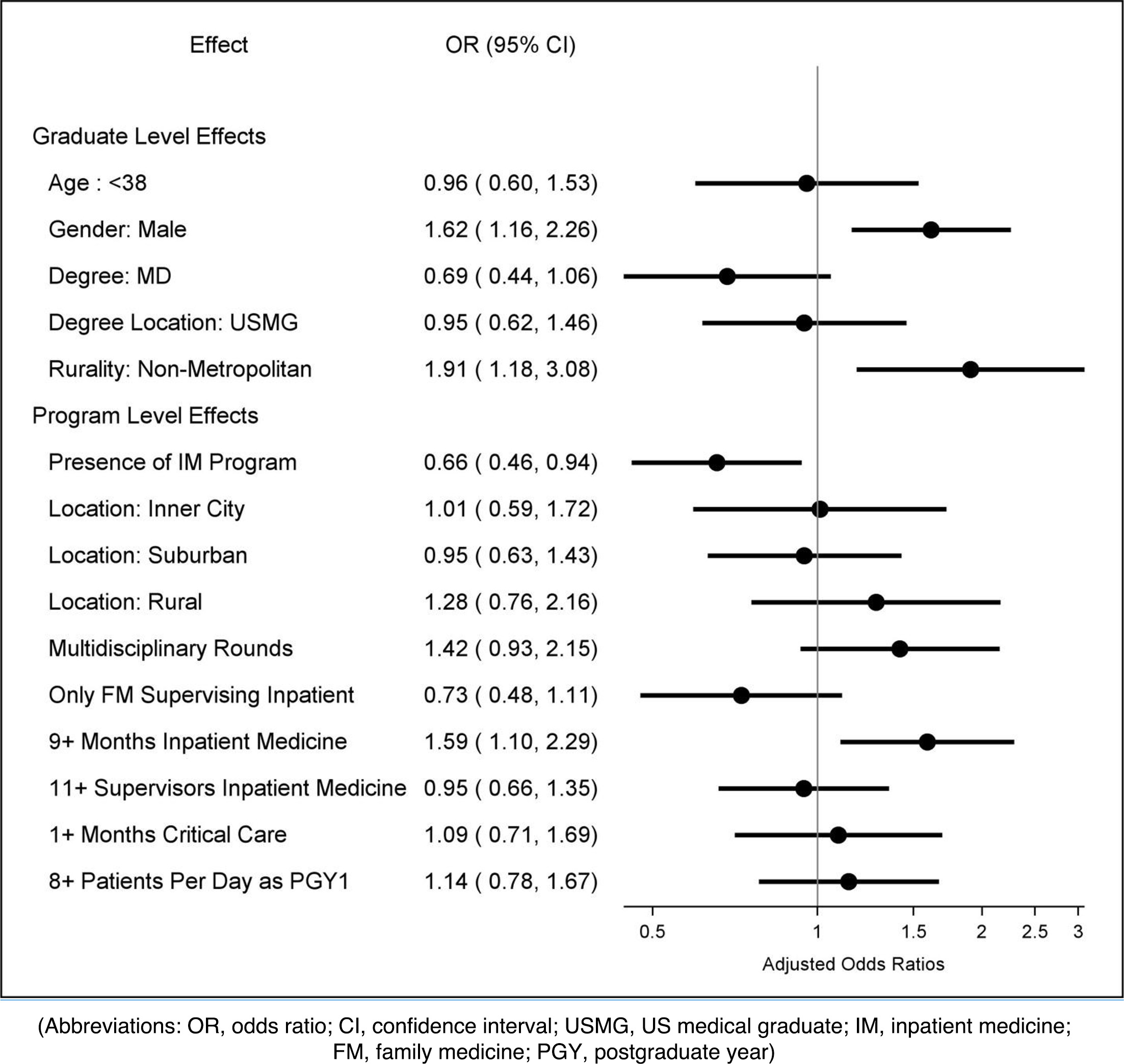
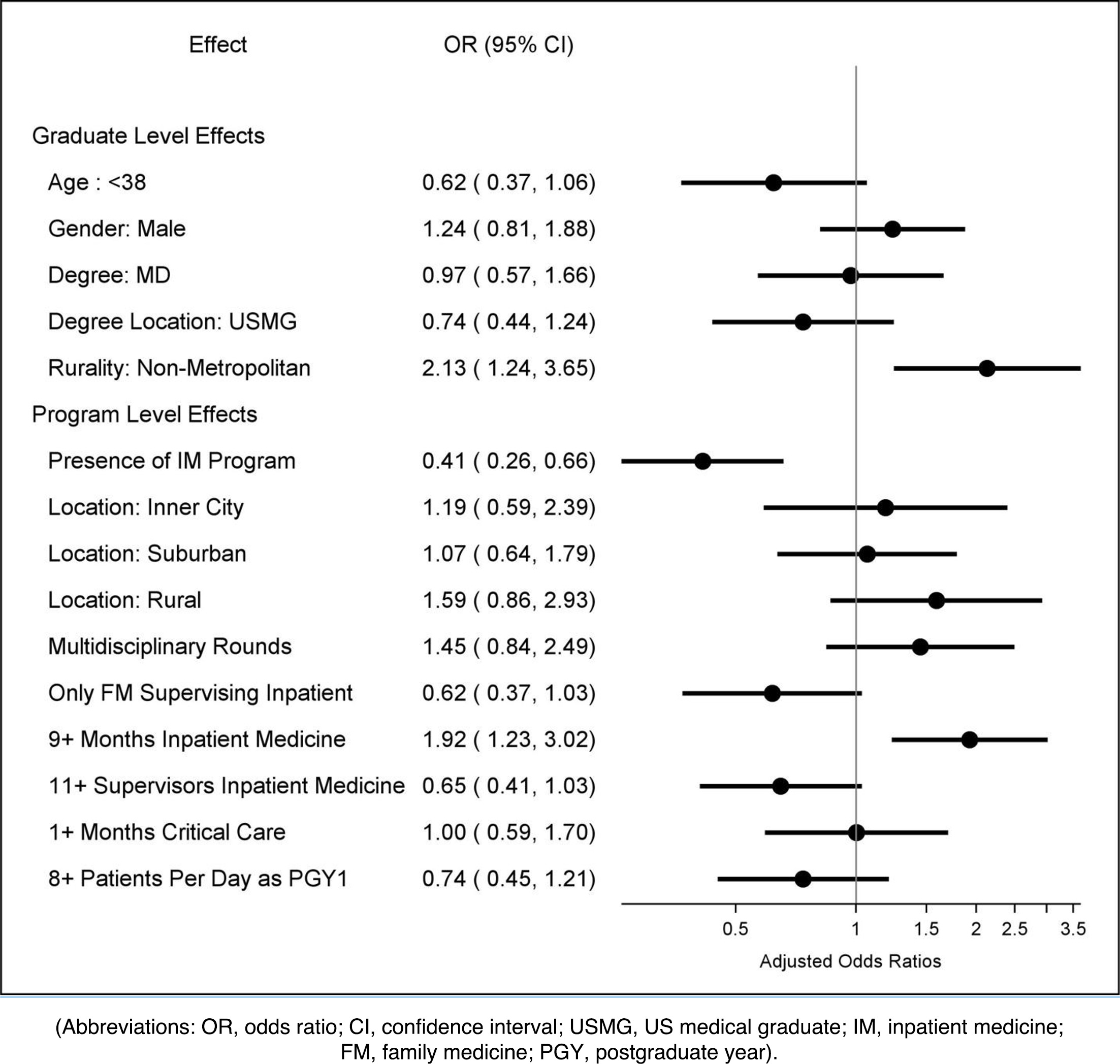
In multiple regression analysis (Figure 1), resident characteristics with higher odds of practicing inpatient medicine were being male (OR 1.62; 95% CI 1.16–2.26) in comparison to being female and lower odds of practicing inpatient medicine by practicing in a metropolitan area (OR 0.53; 95% CI 0.33–0.85) and sharing a teaching hospital with an internal medicine program (OR 0.66; 95% CI 0.46–0.94). A key curriculum characteristic of practicing inpatient medicine postresidency after controlling for confounders was requiring at least 9 months of inpatient medicine (OR 1.59; 95% CI 1.10–2.29). Factors associated with lower odds of practicing critical care medicine postresidency (Figure 2) included practicing in a metropolitan area (OR 0.47; 95% CI 0.27–0.81) and sharing a teaching hospital with internal medicine (OR 0.41; CI 0.26–0.66). A factor associated with significantly higher odds of practicing critical care medicine postresidency after controlling for confounders was requiring at least 9 months of inpatient medicine in the curriculum (OR 1.92; 95% CI 1.23–3.02).
This study illuminated key relationships between family medicine residency characteristics and graduates’ engagement in hospital-based practice. Extended inpatient medicine exposure during residency emerged as a significant predictor of future practice patterns, with residents whose programs required at least 9 months of inpatient rotations showing higher likelihood of practicing both inpatient and critical care medicine postgraduation. This relationship suggests that sustained clinical exposure enhances skills and confidence that shape career trajectories.
Geographic factors play a notable role, as metropolitan-based graduates demonstrated lower rates of hospital and critical care practice compared to their rural counterparts. This pattern reflects the differential availability of specialists across practice settings and underscores the vital role of broad-scope family physicians in rural health care delivery. The structure of training programs also influences outcomes, with graduates from single residency institutions showing greater propensity for critical care practice. The gender disparity in inpatient medicine practice warrants further investigation to understand whether this reflects differences in opportunities, preferences, support systems, or other factors. Similarly, the finding that exclusive family medicine faculty supervision correlates with reduced critical care practice suggests benefits from multidisciplinary teaching models. These insights can inform strategies to better prepare graduates for diverse practice environments.
Several methodological limitations warrant consideration. First, the overall response rates for both the CERA survey (43.7%) and the NGS (45.0%) were lower than expected, leading to a smaller-than-anticipated final cohort of 752 graduates from 211 residency programs. This reduced sample size potentially limits the study’s statistical power and generalizability. Respondents to the NGS were representative of the class of 2018 and the programs with graduates that year; however, merging with the CERA data caused graduates from smaller programs to be underrepresented in the analytic sample,12 which may have impacted the study’s findings, particularly those related to hospital-based care in smaller or rural settings. The data related to the curriculum were self-reported by program directors, which introduces potential recall and social desirability bias and reflects the program requirements for the graduating class of 2018. The single time-point measurement of program characteristics cannot capture evolutionary changes in curriculum or faculty composition. Unmeasured variables, including clinical experience quality, supervision patterns, and local health care market forces, may influence outcomes. The observational design precludes causal inference between program features and practice patterns. Self-selection of residents into programs aligned with their career intentions complicates isolation of training effects. Additionally, the broad classification of critical care practice may mask important variations in service delivery. The 3 year postgraduation timeframe limits understanding of long-term practice evolution. Long-term follow-up beyond 3 years would be valuable for future studies to better understand how practice patterns evolve over physicians’ careers.
The broad classification of critical care practice may mask important variations in service delivery. The NGS does not define the specific scope of critical care activities, which likely ranges from initial stabilization and basic intensive care unit management in rural settings to more comprehensive critical care in other contexts. This heterogeneity limited our ability to draw conclusions about the specific level of critical care being provided.
These findings align with current ACGME requirements and family medicine education research. The ABFM family medicine core outcomes require that all family medicine residency graduates be competent to care for hospitalized patients.17 Current ACGME requirements mandate at least 600 hours (6 months) of hospitalized adult care training,6 notably below our study’s finding that nine or more months significantly increases hospital-based practice likelihood. This finding supports exceeding minimum requirements to better prepare graduates for these roles. These findings should be interpreted in the context of family medicine’s long-standing commitment to training for diverse practice settings. Research from educational innovation projects such as P4 and the Length of Training Pilot demonstrate that residents actively seek programs aligned with their career intentions. The associations we identified between program characteristics and practice patterns may reflect both the influence of training experiences and resident self-selection into programs that match their goals. Programs serving different communities require different training emphasis, and our findings can help programs design curricula aligned with their mission and the needs of their target practice settings.18-22
A 2012 CERA study found that 60% of family medicine programs use hospitalists for teaching, with 63% of directors viewing them as effective educators5; recent collaborative models have demonstrated successful partnerships with maintained quality metrics.23 Our findings provide empirical support for robust inpatient training experiences aligned with current competency-based educational priorities24 and suggest that programs exceeding current minimums are essential investments in developing family physicians capable of meeting diverse community health care needs.
Findings from this study carry significant implications for residency program design and workforce development. Programs aiming to prepare graduates for hospital-based practice should evaluate their inpatient medicine exposure, interdisciplinary teaching models, and support systems for diverse learners. This study suggests that having at least 9 months of inpatient adult medicine curricular time is recommended for programs and graduates who desire to practice hospital-based medicine. Future longitudinal research can better elucidate career trajectory patterns and factors influencing scope of practice. This enhanced understanding will help optimize family medicine training to meet evolving community health care needs.
ABFM Foundation provided financial support for Dr Barr.
Society of Teachers of Family Medicine 2024 Annual Meeting, May 1–4, 2024, Los Angeles, CA.
References
-
Lapps J, Flansbaum B, Leykum LK, Bischoff H, Howell E. Growth trends of the adult hospitalist workforce between 2012 and 2019.
J Hosp Med. 2022;17(11):888–892. doi:10.1002/jhm.12954
-
-
-
Bazemore A, Petterson S, Peterson LE, Phillips RL Jr. More comprehensive care among family physicians is associated with lower costs and fewer hospitalizations.
Ann Fam Med. 2015;13(3):206–213. doi:10.1370/afm.1787
-
-
-
Coutinho AJ, Cochrane A, Stelter K, Phillips RL Jr, Peterson LE. Comparison of intended scope of practice for family medicine residents with reported scope of practice among practicing family physicians.
JAMA. 2015;314(22):2364–2372. doi:10.1001/jama.2015.13734
-
Rosenberg TL, Kuge S, Feiger J, Teng P, Raemer DB. Training experience in critical care medicine as a factor in physician practice patterns.
J Grad Med Educ. 2013;5(2):204–209. doi:10.4300/JGME-D-12-00273.1
-
Peterson LE, Fang B, Puffer JC, Bazemore AW. Wide gap between preparation and scope of practice of early career family physicians.
J Am Board Fam Med. 2018;31(2):181–182. doi:10.3122/jabfm.2018.02.170359
-
Weidner AKH, Phillips RL Jr, Fang B, Peterson LE. Burnout and scope of practice in new family physicians.
Ann Fam Med. 2018;16(3):200–205. doi:10.1370/afm.2221
-
Weidner AKH, Chen FM, Peterson LE. Developing the national family medicine graduate survey..
J Grad Med Educ. 2017;9(5):570–573. doi:10.4300/JGME-D-17-00007.1
-
Barr WB, Peterson LE, Fleischer S, Seehusen DA. National family medicine residency outcomes project methodology.
PRiMER. 2024;8:52. doi:10.22454/PRiMER.2024.588860
-
-
Seehusen DA, Mainous AG III, Chessman AW. Creating a centralized infrastructure to facilitate medical education research.
Ann Fam Med. 2018;16(3):257–260. doi:10.1370/afm.2228
-
-
Peterson LE. Using the Family Medicine National Graduate Survey to improve residency education by monitoring training outcomes.
Fam Med. 2021;53(7):622–625. doi:10.22454/FamMed.2021.719992
-
Newton WP, Magill M, Barr W, Hoekzema G, Karuppiah S, Stutzman K. Implementing competency based ABFM board eligibility.
J Am Board Fam Med. 2023;36(4):703–707. doi:10.3122/jabfm.2023.230201R0
-
-
-
Lefevre NM, Young RA, Li DM, Casey D. Scope of practice and location of 3- versus 4-year family medicine residency graduates.
Fam Med. 2022;54(9):700–707. doi:10.22454/FamMed.2022.677868
-
Lois M. The shortage of critical care physicians: is there a solution?
J Crit Care. 2014;29(6):1121–1122. doi:10.1016/j.jcrc.2014.08.001
-
Carney PA, Valenzuela S, Dinh DH, et al. Impact of training length on scope of practice among residency graduates: a report from the Length of Training Pilot Study in family medicine.
Fam Med. 2025;57(8):550–563. doi:10.22454/FamMed.2025.224773
-
Gallagher DM, Viera AJ, Bynum WE, et al. Development of a community hospital medicine affiliated inpatient rotation for family medicine residents—a collaborative success.
J Community Hosp Intern Med Perspect. 2022;12(3):5–12. doi:10.55729/2000-9666.1045
-
Newton W, Cagno CK, Hoekzema GS, Edje L. Core outcomes of residency training 2022 (provisional).
Ann Fam Med. 2023;21(2):191–194. doi:10.1370/afm.2977



There are no comments for this article.