Background and Objectives: Family physician scope of practice (SOP) has declined despite broad intentions upon graduating residency. Our objective was to understand the alignment between intended and actual SOP of graduating family medicine residents.
Methods: We used data from a retrospective, linked survey cohort through the American Board of Family Medicine to examine whether SOP intentions materialized into actual SOP for early career family physicians. Intentions were collected on the Initial Certification Questionnaire (2017–2020). Three years after graduation, physicians completed the National Graduate Survey, which assessed SOP and practice organization characteristics. The primary outcome was a summative SOP score based on self-reported provision of 31 services. We also examined individual items within the score. We used descriptive statistics and regression analyses to assess associations between intended and actual SOP and practice characteristics.
Results: Among 5,006 respondents, intended and actual SOP were significantly correlated (r = 0.58, P<0.0001). Broader SOP in early career family physicians was associated with higher SOP intentions (β = 0.32, CI: 0.30–0.34), rural practice (β = 0.89, CI: 0.69–1.09), academic settings (β = 1.42, CI: 1.21–1.63), safety net settings (Indian Health Service: β = 1.11, CI: 0.45–1.77; rural health center: β = 0.86, CI: 0.53–1.19; Federally Qualified Health Center: β = 0.83, CI: 0.61–1.04), and teaching (β = 0.97, CI: 0.81–1.13). Narrower SOP was linked to international medical graduates (β=–0.24, CI: –0.42 – –0.07) and multispecialty practices (β=–0.44, CI: –0.59 – –0.29).
Conclusions: While residents with broader SOP intentions were more likely to report wider early career SOP, practice characteristics and environment remained an important determinant of realized scope.
Family physicians (FPs) are trained to provide a broad range of services throughout a variety of settings, yet the scope of practice (SOP) of individual FPs has been declining.1-5 Maintaining broader SOP, or comprehensiveness, allows clinicians to better meet a range of patients needs while maintaining access, continuity, and satisfaction,6,7,8 and has been associated with lower costs, decreased emergency room visits, and lower hospitalizations.9-11 Furthermore, broader SOP is associated with lower physician burnout,12 which has its own effects on patient outcomes and costs.13-15
Despite the benefits of broad SOP, services among FPs have been diminishing. A 2020 study showed declines from 76.4%–69.4% in FPs caring for those under 5 years old and declines from 92.5%–87.0% in caring for those 5 to 18 years old.3 Similarly, over a 10 year period, one study saw maternity care practice decrease from 23.3%–9.7%.16 Another study showed that as FPs stop attending deliveries, they are more likely to stop providing prenatal and postpartum care,17 and a more than 50% decrease has occurred among those providing high-volume obstetrical care.2 Regarding inpatient medicine, one study over 3 years showed that both early- and late-career FPs had decreases in providing a mixed inpatient and outpatient practice (34.2%–27.1% and 23.8%–19.3%, early and late, respectively).5 Given community need for these services, the declines are alarming.18-20
Despite SOP declines among practicing FPs, graduating family medicine residents have intentions for, and are prepared for, a broader SOP.1,4 This discrepancy suggests that barriers exist to actualizing intentions, possibly including employer constraints, practice setting, limited practical support, as well as personal life changes and choice.21,22
Broader SOP has been shown among graduates of rural residencies and single-residency institutions, regardless of current practice geography or organization,23,24 where rural physicians also show wider SOP.25,26 SOP has been associated with regional geography, not explainable by adjustment for individual, practice, and community characteristics.27 Practice organization type also affects SOP—those at rural health centers and academic clinics have the widest SOP, and health maintenance organizations (HMOs) show the narrowest.28 Practice size also influences SOP, with one study showing that FPs in practices with two to 20 clinicians have the broadest SOP when compared to solo or larger practices.29
Understanding the evolution of a physician’s practice patterns, including intentions to actualization, is critical to monitoring the provision of comprehensive care that meets community needs. While previous studies have compared resident FP intentions to actual practice,1 none have followed a cohort longitudinally to link intentions with actualization. Our study aimed to examine whether intentions for a given SOP materialized in FPs 3 years after graduation, controlling for current practice characteristics.
We used data linked from two surveys administered by the American Board of Family Medicine (ABFM). Data from 2017 to 2020 were collected from the Initial Certification Questionnaire (ICQ), a mandatory component of ABFM examination registration completed 3 to 4 months prior to the initial certification examination, usually in the final year of residency.30 The ICQ asks about intended SOP upon graduation. If residents retook the exam, only the initial questionnaire was used.
Data of practicing physicians from 2020 to 2023 were taken from the National Graduate Survey (NGS), a voluntary survey administered to all ABFM-certified physicians 3 years after graduation from residency training.31,32 The NGS asks about provision of direct patient care, provision of outpatient continuity care, current SOP, and practice characteristics (ie, practice site, size, speciality mix, hours worked, participation in teaching). Respondents to the NGS have been largely representative of early career ABFM-certified physicians.32 Responses from the NGS were linked to the corresponding individual’s ICQ using ABFM identification numbers.
To measure SOP, we used the SOP score, a scaled score based on the intention to provide or provision of individual services and procedures.33 All individual services and procedures are listed in below. ICQ scores range from 0 to 30 and NGS scores from 0 to 33, with higher scores reflecting broader SOP. All services contribute to the score equally.
We linked the FP to their terminal residency and its US Census region. Current practice location from the NGS was also linked to Census region and geocoded to county-level Rural-Urban Continuum Codes (RUCC) to define urban and rural practice settings. We included the total number of hours worked and dichotomized at greater than 50 hours per week versus lower, based on the median. Demographic variables were obtained from ABFM administrative data and were included from the point of completion of the NGS.
Our primary outcome was the SOP score.33 Independent variables included physician demographic, geographic, and practice characteristics. Demographic variables included age, gender, and medical degree type. Geographic variables included the US Census region of the graduating residency program and of current practice, as well as practice rurality. Practice characteristics included practice organization type, size, specialty mix, total hours, and teaching.
Our study sample included only those who provided direct outpatient continuity care within the United States and for whom complete linked data were available. We summarized descriptive demographic and practice characteristics and then conducted bivariate analyses to examine associations between SOP and independent variables. We used t tests with binary variables; analysis of variance comparisons were conducted for categorial variables; and Pearson or Spearman correlation tests were used for numeric variables. Statistical significance was defined as P<0.05. Finally, a linear mixed model estimated adjusted associations with practicing SOP. This model included a random intercept term to account for clustering at the residency level.
As a secondary analysis, we explored the relationship between intention and practice for the individual items used to calculate the SOP scores. For each item, we reported the proportion of those intending to provide the service and those actually providing it. Then, we calculated the conditional proportions of those providing the service given the intention to do so and those not providing the service when no intention to do so existed. Finally, we combined these two intentions (to provide or not) into a single proportion of those who did as intended.
We used SAS version 9.4 (SAS Institute) for all analyses. The American Academy of Family Physicians Institutional Review Board approved this study.
Between 2017 and 2020, 14,407 graduates completed the ICQ (response rate of 100%). Three years later, between 2020 and 2023, 6,679 practicing physicians responded to the NGS (response rate of 46%). Once excluding those who did not provide outpatient continuity care, practiced outside the United States, or had missing data, our final sample size consisted of 5,006 graduates.
In our analytic sample, 58% were female, 39% were 35 years or older, and 85% practiced in urban areas (Table 1). Most graduated with a Doctor of Medicine (MD) from a US school (52%). Most practiced in hospital or health-system owned practices (39%), with six to 20 clinicians (40%), and within a family medicine-only practice (42%). The majority participated in teaching (77%). The average SOP score was 16.0.
|
n (%) |
Mean scope score
(standard deviation) |
P value |
Total |
5,006 (100) |
16.01 (3.04) |
|
Personal demographics |
Age (years) |
|
|
.2718 |
<35 |
3,075 (61.4) |
16.05 (2.92) |
|
35+ |
1,931 (38.6) |
15.95 (3.22) |
|
Gender |
|
|
.4391 |
Female |
2,898 (57.9) |
15.98 (3.08) |
|
Male |
2,091 (41.8) |
16.04 (2.98) |
|
Nonbinarya |
6 (0.1) |
17.67 (1.37) |
|
Prefer not to answera |
11 (0.2) |
16.82 (3.25) |
|
Medical degree |
|
|
<0.0001 |
MD, non-IMG |
2,587 (51.7) |
16.45 (2.85) |
|
MD, IMG |
1,226 (24.5) |
14.96 (3.44) |
|
DO, non-IMG |
1,193 (23.8) |
16.13 (2.71) |
|
Residency location and scope intentions |
Initial Certification Questionnaire Census regionb |
|
|
<0.0001 |
Northeast |
818 (16.3) |
15.35 (3.04) |
|
Midwest |
1,380 (27.6) |
16.30 (2.63) |
|
South |
1,504 (30.0) |
15.56 (3.29) |
|
West |
1,260 (25.2) |
16.73 (2.85) |
|
US territory |
44 (0.9) |
13.91 (4.78) |
|
Initial Certification Questionnaire intended scope scorec |
|
|
<0.0001 |
Lower 20% |
1,152 (23.0) |
13.84 (3.26) |
|
Middle 60% |
2,724 (54.4) |
15.82 (2.33) |
|
Upper 20% |
1,130 (22.6) |
18.68 (2.24) |
|
Current practice characteristics |
Rurality (RUCC) of current practice site |
|
|
<0.0001 |
Urban |
4,243 (84.8) |
15.71 (3.00) |
|
Rural |
763 (15.2) |
17.65 (2.70) |
|
National Graduate Survey Census region |
|
|
<0.0001 |
Northeast |
634 (12.7) |
15.33 (2.94) |
|
Midwest |
1,222 (24.4) |
16.59 (2.66) |
|
South |
1,564 (31.2) |
15.36 (3.29) |
|
West |
1,568 (31.3) |
16.50 (2.88) |
|
US territory |
18 (0.4) |
13.72 (4.6) |
|
Principal practice site |
|
|
<0.0001 |
Hospital/health system owned medical practice |
1,958 (39.1) |
15.37 (2.75) |
|
Academic health center/faculty practice |
660 (13.2) |
17.57 (2.60) |
|
Federally Qualified Health Center or look-alike |
658 (13.1) |
16.77 (2.43) |
|
Independently owned medical practice |
641 (12.8) |
15.35 (3.15) |
|
Managed care/HMO practice |
319 (6.4) |
14.36 (3.53) |
|
Rural health clinic (federally qualified) |
260 (5.2) |
18.28 (2.59) |
|
Federal |
230 (4.6) |
16.64 (2.92) |
|
Work site clinic |
78 (1.6) |
14.78 (3.73) |
|
Indian Health Service |
51 (1.0) |
18.51 (2.58) |
|
Government clinic, nonfederal |
60 (1.2) |
15.38 (4.35) |
|
Other |
91 (1.8) |
15.43 (2.66) |
|
Principal practice sizeb |
|
|
<0.0001 |
Solo practice |
120 (2.4) |
15.62 (2.70) |
|
2–5 clinicians |
1,627 (32.5) |
15.41 (3.10) |
|
6–20 clinicians |
1,990 (39.8) |
16.32 (2.91) |
|
>20 clinicians |
1,269 (25.3) |
16.32 (3.07) |
|
Practice specialty mix |
|
|
<0.0001 |
Family medicine only |
2,098 (41.9) |
16.50 (2.96) |
|
Primary care specialty mix |
1,731 (34.6) |
15.73 (2.98) |
|
Multiple specialties (not only primary care) |
1,177 (23.5) |
15.54 (3.14) |
|
Total hours worked |
|
|
<0.0001 |
<50 |
2,455 (49.0) |
15.69 (2.99) |
|
50+ |
2,551 (51.0) |
16.31 (3.06) |
|
Any teachingc |
|
|
<0.0001 |
No teaching |
1,171 (23.4) |
14.29 (3.12) |
|
Teaching |
3,835 (76.6) |
16.53 (2.81) |
|
Bivariate analyses showed statistically significant differences in the SOP score for numerous variables (Table 1): medical degree type (16.45 for US MD; 16.13 for DO; 14.96 for international MD, P<0.0001), practice characteristics, such as rurality (17.65 for rural; 15.71 for urban, P<0.0001), practice site (ranging from 14.36 at an HMO/managed care to 18.51 at Indian Health Service, P<0.0001), practice size (15.62 for solo practices; 16.32 for both 6–20 clinicians and>20 clinicians, P<0.0001), and practice specialty mix (ranging from 15.54 for multispecialty mix to 16.50 in a family medicine–only setting, P<0.0001).
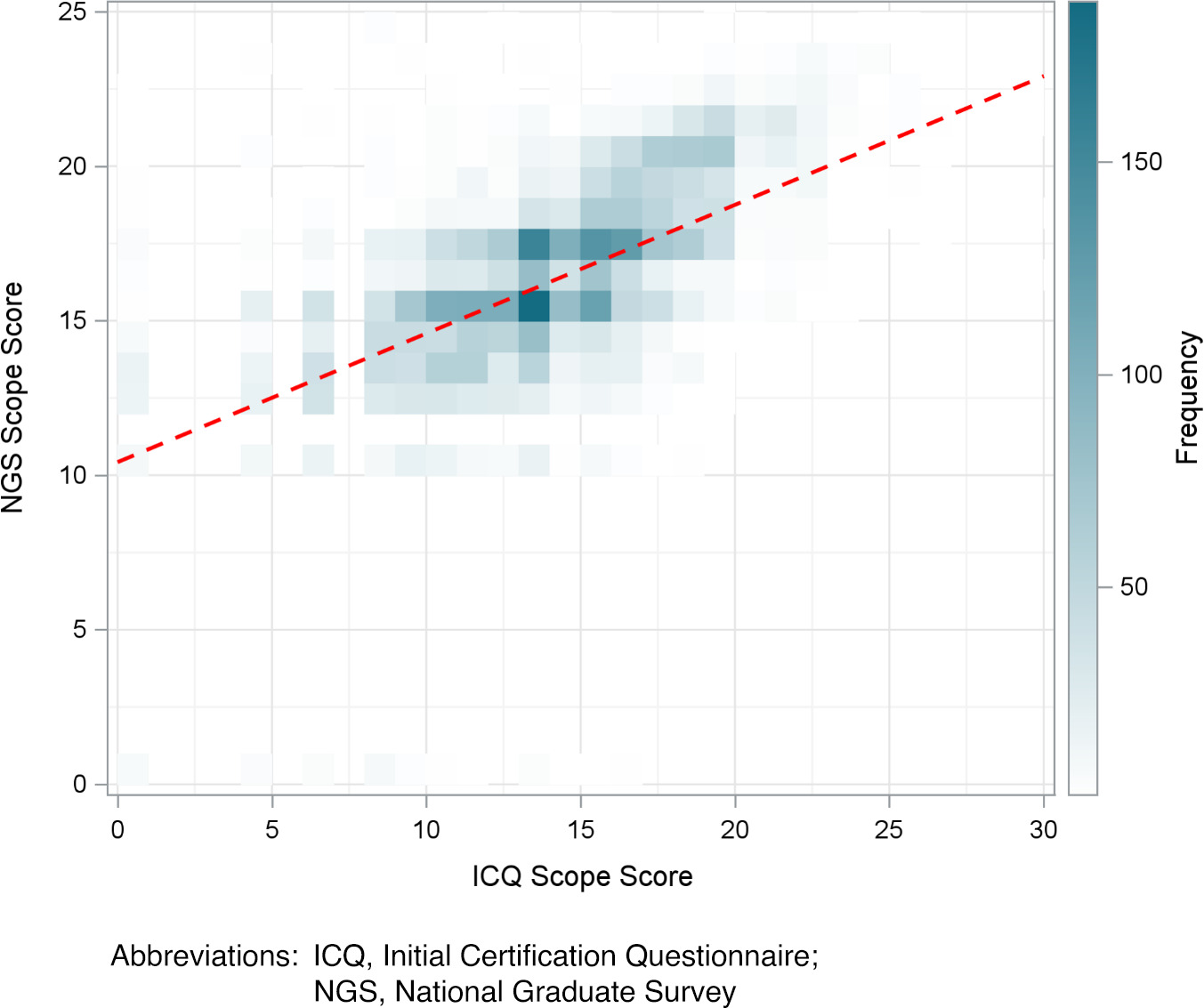
We found an association between intending a wider SOP and having one (Figure 1). Those in the top 20% of intended SOP had the highest SOP score at 18.68. Unadjusted, a broader intentioned SOP explains approximately 33% of the variation in actual SOP score. Also unadjusted, the intraclass correlation coefficient by residency for intended SOP score was 0.31 and decreased to 0.17 for actual practice.
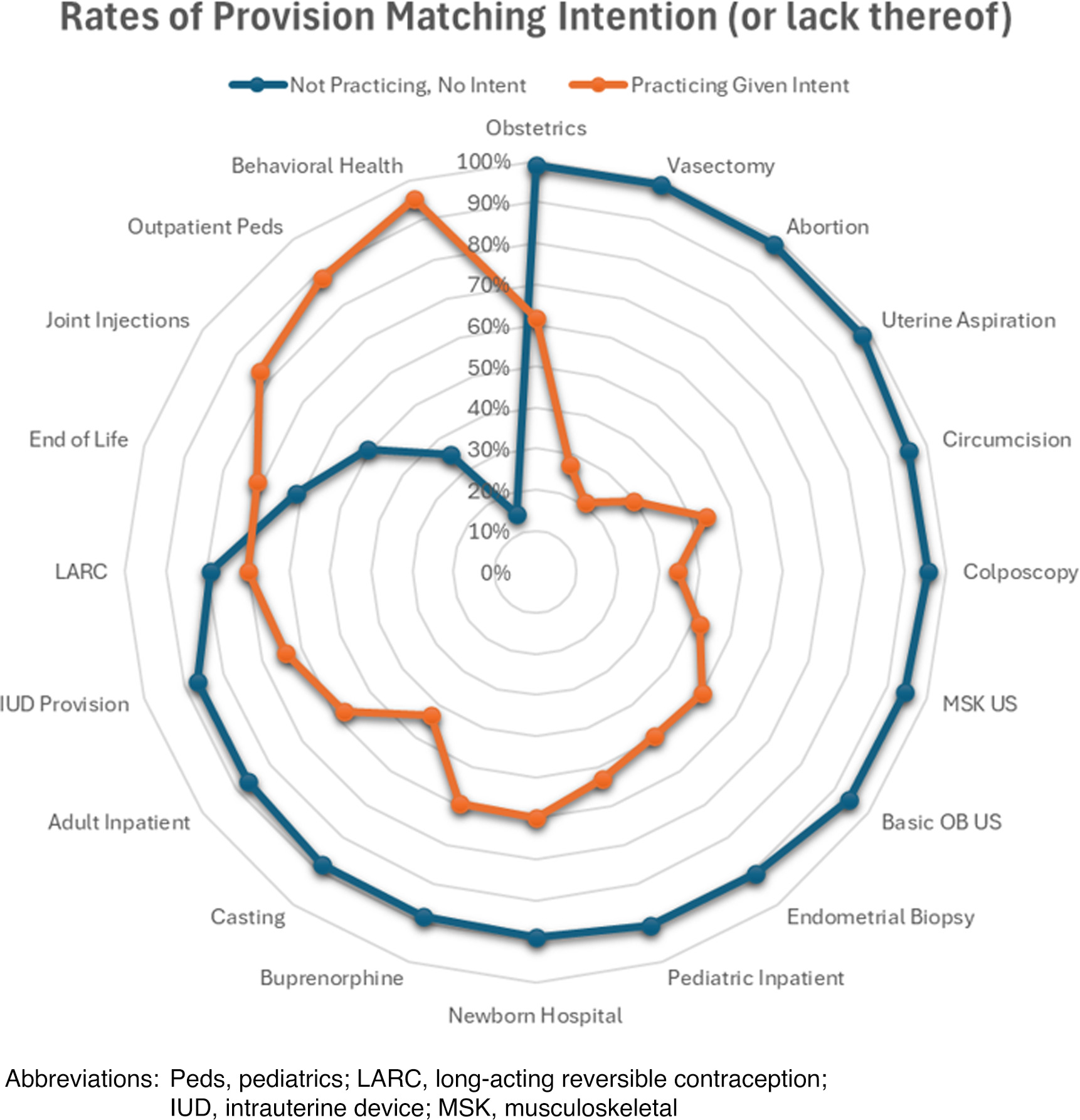
When comparing individual scope items (Table 1), we observed a higher concordance between intentions to not provide a service and not doing so, than intending to provide a service and doing so (ie, if respondents did not intend to provide a service, most often, they did not; Figure 2). The most common items that respondents had intentions to practice, and subsequently did practice, included behavioral health care, pediatric outpatient care, and joint aspiration/injection. Conversely, many of the same individual items were practiced, despite no intention to do so: behavioral heath care, pediatric outpatient care, joint aspiration/injection, and end of life care.
Overall, respondents had a higher likelihood of predicting what they would not do, compared to what they would do (3 of 31 items had a concordance>80% between intending to practice and actual practice; compared to 26 of 31 items where no intention to practice existed and it was not practiced). Some of the largest disparities of intent to practice but not actualizing occurred within outpatient procedural care: abortion (20.7% of those intending to practice were practicing), cardiac stress testing (21.2%), vasectomy (27.5%), colposcopy (34.7%), musculoskeletal ultrasound (41.9%), casting (43.2%), and neonatal circumcision (43.8%). Inpatient practice settings saw similar unrealized intentions: Only 50.3% of those intending to practice in intensive care units were doing so, 57.6% of those intending adult inpatient medicine practiced, and only 59.8% of those intending to practice newborn hospital care were. Procedural care associated with inpatient settings saw similar rates of unrealized intentions. Finally, discordance was seen in focused areas of primary care: management of HIV (40.6% were practicing given intention) and management of hepatitis C (47.3%).
In our linear regression, after adjusting, having the intention to provide higher SOP predicted a higher SOP (β = 0.32, CI: 0.30–0.34; Table 2). Additionally, male gender showed a higher SOP score than females (β = 0.21, CI: 0.08–0.34), as did practicing in a rural area compared to urban (β = 0.89, CI: 0.69–1.09), and in the Midwest or West as compared to the South (β = 0.65, CI: 0.47–0.84 and β = 0.62, CI: 0.44–0.79, respectively). Practice characteristics associated with higher SOP score included specific practice types (academic health center: β = 1.42, CI: 1.21–1.63; Indian Health Service: β = 1.11, CI: 0.45–1.77; rural health center: β = 0.86, CI: 0.53–1.19; Federally Qualified Health Center: β = 0.83, CI: 0.61–1.04, compared to a hospital/health system owned practice), and teaching (β = 0.97, CI: 0.81–1.13). Decreased SOP was associated with being an international medical graduate (IMG) MD compared to a non-IMG MD (β=–0.24, CI: –0.42 – -0.07), having a primary care specialty mix compared to family medicine alone (β=–0.44, CI: –0.59 – -0.29), and having the presence of more than primary care specialties in a single clinic compared to only family medicine (β=–0.51, CI: –0.68 – -0.34).
|
Effect estimate (95% CI)a |
Intercept |
14.45 (14.23–14.67) |
Initial Certification Questionnaire intended scope score, centered at 13 |
0.32 (0.30–0.34) |
Age (years) |
|
<35 |
Reference |
35+ |
0.04 (–0.10–0.18) |
Gender |
|
Female |
Reference |
Male |
0.21 (0.08–0.34) |
Medical degree |
|
MD, non-IMG |
Reference |
MD, IMG |
–0.24 (–0.42 – –0.07) |
DO, non-IMG |
0.14 (–0.02–0.30) |
Rurality (RUCC) of current practice site |
|
Urban |
Reference |
Rural |
0.89 (0.69–1.09) |
National Graduate Survey Census region |
|
Northeast |
0.01 (–0.21–0.23) |
Midwest |
0.65 (0.47, 0.84) |
South |
Reference |
West |
0.62 (0.44–0.79) |
US territory |
–0.43 (–1.52–0.65) |
Principal practice site |
|
Hospital/health system owned medical practice |
Reference |
Independently owned medical practice |
0.06 (–0.15–0.27) |
Managed care/HMO practice |
–0.20 (–0.49–0.08) |
Academic health center/faculty practice |
1.42 (1.21–1.63) |
Federally Qualified Health Center or look-alike |
0.83 (0.61–1.04) |
Rural health clinic (federally qualified) |
0.86 (0.53–1.19) |
Indian Health Service |
1.11 (0.45–1.77) |
Government clinic, nonfederal |
–0.20 (–0.80–0.39) |
Federal |
0.33 (–0.02–0.68) |
Work site clinic |
–0.02 (–0.55–0.50) |
Other |
0.19 (–0.30–0.68) |
Practice specialty mix |
|
Family medicine only |
Reference |
Primary care specialty mix |
–0.44 (–0.59 – –0.29) |
Multiple specialties (not only primary care) |
–0.51 (–0.68 – –0.34) |
Total hours worked, centered at 50 |
0.01 (0.01–0.01) |
Any teaching |
|
No teaching |
Reference |
Teaching |
0.97 (0.81–1.13) |
Our national retrospective, linked survey cohort study is the first to follow SOP intentions through to actualization, illustrating FP residents’ intend to practice a broad SOP; and, while this intention is linked to its actualization, practice characteristics, such as practice location, practice site, and specialty mix, also influence actualization. Broader SOP was associated with underserved locations (Federally Qualified Health Centers, rural health centers, or Indian Health Service) and academic centers; geographic characteristics, such as rural location or practicing in the West or Midwest;26,27 having an FP-only setting; and male gender. Previous models have identified factors influencing the choice of SOP,21,22 even the impact of practice characteristics; yet these studies did not correlate practicing SOP with intentions for SOP.27-29 Understanding the intentions of graduating residents, and controlling for this, is critical to assessing the influencers of SOP actualization.
Broader SOP in underserved settings and rural locations may relate to a lack of specialist access (due to geographic or insurance access), patient challenges in navigating the care system, or trust and confidence in primary care provision. Consistent with previous studies, academic centers have broader SOP, which is intuitive because teaching requires broad SOP.28 They also may have broader privileging policies, greater procedural infrastructure, interdisciplinary support, and organizational cultures that encourage a wider SOP. These practice organization examples indicate the ability to create systems to support comprehensive care delivery, and may guide graduating residents who desire a broad SOP to weigh certain practice types in their job selection.21,22
Conversely, the decreased SOP seen in hospital or health system owned practices having a larger speciality mix, regardless of the practice site, may be due to policies that streamline scheduling, restrict SOP for logistical ease or financial gain, or have differential access to certain specialties.28 For example, children may be diverted to pediatricians and women to gynecologists for services that could be easily provided by FPs—a trend supported by decreased actualization of pediatric care and gynecologic procedures.
As more physicians become employed, control over individual SOP may be diminished, which may result in decreased continuity and increased fragmentation, leading to increased overall costs.34 When examining individual scope items, procedural intentions were more commonly unrealized compared to other services. Perhaps, although these procedures are within scope, appointment length limitations may impede scheduling, the need for access to general primary care services may limit the ability to provide procedures, equipment for procedures may not be available in nonteaching facilities, or procedures may be diverted to specialty clinics for higher reimbursement. Some procedural items are unrealized due to practice setting; for example, decreased actualization of care in hospital settings decreases hospital-based procedures.
To illustrate the significance of SOP score differences, we look at two pieces of information. First, numerous quality of life measures have shown differences found with a change of half a standard deviation.35 Half the standard deviation of the scope score is 1.5, which supports that differences in our study may have meaningful clinical impact. Additionally, using an ad hoc scope scale, Bazemore et al9 found lower Medicare costs when FPs reported performing more clinical activities. Although direct comparisons between their scale and the one used in our study are difficult, their findings suggest that increases in our scale could be associated with lower-cost care. What remains meaningful is the magnitude of difference between what individuals intend to do and what they report practicing 3 years later.
Worthy of consideration are alternative perspectives outside of intentions that affect SOP, such as responsiveness to a patient population (in complexity, need of services, or other sociodemographic factors), thus naturally altering intended provision of services, or a change in colleagues or team structure that leads to less support for ongoing skill expansion. Residency curricula involve broad exposure with associated trained faculty, potentially across multiple sites, whereas many practice settings may not be similar. Additionally, certain scope areas, such as inpatient medicine or obstetrics, may be less desirable for work-life integration postresidency and may decline due to personal preference and life-course factors,21,22 which were not assessed in ABFM surveys.
Understanding patterns and influences of SOP has implications for workforce planning. A 2024 study projected a deficit of more than 57,000 primary care professionals—inclusive of nurse practitioners and physician assistants—by 2040.36 Continued decline of SOP only worsens efforts for access and continuity, exacerbating the impact of primary care workforce issues. Furthermore, a limited number of specialists are available to fill the roles of decreased SOP within primary care,37 compounding the impact on patient access. Data from graduating residents showed that they intend to provide an SOP that could address some of these concerns and meet the needs of patients.1,4 Because FPs comprise nearly 40% of the primary care physician workforce,38 their SOP is critical to providing essential services while a larger primary care workforce is trained.
Data have demonstrated that comprehensiveness is associated with lower odds of hospitalization9and lower rates of burnout,12, which lead to overall improved health39 and decreased costs to the system9,10. Additionally, broader SOP may facilitate continuity,40 which independently decreases hospitalizations and total expenditures.34 Our findings suggest that the challenge may not be a lack of physician intent, but the ability of practice environments to translate that intent into practice. Given the benefits of comprehensive care, practice organizations, federal and state policies, and insurance companies should have incentives to encourage it. Organizational decisions regarding changes in reimbursement, referral pathways, credentialing, team composition, privileging, or malpractice may collectively offer the greatest influence on whether the potential benefits of comprehensive family medicine are realized. For example, using specialty mix as an asset for clinical support, rather than a diversion, could maintain continuity and decrease fragmentation, while minimizing overall costs and maintaining access with specialists for complex patients. If graduates intend to provide broad SOP and providing this care benefits quality and costs, they should be supported to do so.
Our study was subject to limitations. First, while responders to the NGS are similar to nonresponders, the 46% response rate to the NGS may result in a biased sample by other unmeasured variables.32 Second, data are subject to the limitations of any self-reported information; we are unable to know whether the responses are true, and if so, at what volume. Third, responses on a survey administered by ABFM also may result in social desirability bias or proximity bias, especially in relation to ICQ administered within the residency time period. Fourth, the NGS does not assess personal, life-stage, or preference factors that could impact SOP. Finally, our sample was limited to ABFM-certified FPs; although at least 80% of FPs are ABFM-certified,41,42 we cannot comment on whether these findings are generalizable to non-ABFM-certified physicians. Further qualitative analysis would add understanding regarding the barriers of actualization of SOP.
This longitudinal exploration of the evolution of SOP among early-career FPs, the first national study to examine intentions followed through to actualization, revealed a gap between broad intentions and the narrower SOP practiced 3 years later. Although intended SOP was independently associated with broader early-career practice, organizational and geographic characteristics (including practice site, specialty mix, rurality, and region) also demonstrated substantial associations with realized scope. These findings suggest that translating broad training into comprehensive practice depends not only on physician intentions, but also on the environments in which physicians ultimately practice. Given the benefits of broad SOP for patient access, patient continuity, reduction of health care costs, and alleviation of physician burnout, these findings highlight the need for possible structural changes to support wider SOP for those who intend to practice broadly.
|
Intention to practice (ICQ) |
Practicing (NGS) |
Practicing given intention to practice |
Not practicing given no intention to practice |
Practicing as intended |
Scope item |
n |
Denom |
% |
n |
Denom |
% |
n |
Denom |
% |
n |
Denom |
% |
n |
Denom |
% |
Outpatient scope of care |
|
|
|
|
|
|
|
|
|
|
|
|
|
|
|
Pediatric outpatient care |
3,789 |
5,006 |
75.7 |
4,142 |
5,006 |
82.7 |
3,354 |
3,789 |
88.5 |
429 |
1,217 |
35.3 |
3,783 |
5,006 |
75.6 |
Behavioral health care |
2,554 |
5,006 |
51.0 |
4,528 |
5,006 |
90.5 |
2,440 |
2,554 |
95.5 |
364 |
2,452 |
14.8 |
2,804 |
5,006 |
56.0 |
End of life care |
1,979 |
5,006 |
39.5 |
2,581 |
5,006 |
51.6 |
1,413 |
1,979 |
71.4 |
1,859 |
3,027 |
61.4 |
3,272 |
5,006 |
65.4 |
Integrative health care |
904 |
5,006 |
18.1 |
932 |
5,006 |
18.6 |
453 |
904 |
50.1 |
3,623 |
4,102 |
88.3 |
4,076 |
5,006 |
81.4 |
Buprenorphine treatment |
1,281 |
5006 |
25.6 |
1,195 |
5,006 |
23.9 |
761 |
1,281 |
59.4 |
3,291 |
3,725 |
88.3 |
4,052 |
5,006 |
80.9 |
Pharmacologic management of Hepatitis C |
942 |
5,006 |
18.8 |
976 |
5,006 |
19.5 |
446 |
942 |
47.3 |
3,534 |
4,064 |
87 |
3,980 |
5,006 |
79.5 |
Pharmacologic management of HIV/AIDS |
877 |
5,006 |
17.5 |
929 |
5,006 |
18.6 |
356 |
877 |
40.6 |
3,556 |
4,129 |
86.1 |
3,912 |
5,006 |
78.1 |
Musculoskeletal care |
|
|
|
|
|
|
|
|
|
|
|
|
|
|
|
Joint aspiration and injection |
4,312 |
5,006 |
86.1 |
3,925 |
5,006 |
78.4 |
3,583 |
4,312 |
83.1 |
352 |
694 |
50.7 |
3,935 |
5,006 |
78.6 |
Musculoskeletal ultrasound |
1,231 |
5,006 |
24.6 |
730 |
5,006 |
14.6 |
516 |
1,231 |
41.9 |
3,561 |
3,775 |
94.3 |
4,077 |
5,006 |
81.4 |
Osteopathic Manipulative Treatment |
1,072 |
5,006 |
21.4 |
826 |
5,006 |
16.5 |
718 |
1,072 |
67 |
3,826 |
3,934 |
97.3 |
4,544 |
5,006 |
90.8 |
Outpatient reproductive health |
|
|
|
|
|
|
|
|
|
|
|
|
|
|
|
LARC |
3,919 |
5,006 |
78.3 |
2,968 |
5,006 |
59.3 |
2,743 |
3,919 |
70.0 |
862 |
1,087 |
79.3 |
3,605 |
5,006 |
72.0 |
IUD insertion and removal |
3,845 |
5,006 |
76.8 |
2,612 |
5,006 |
52.2 |
2,455 |
3,845 |
63.8 |
1,004 |
1,161 |
86.5 |
3,459 |
5,006 |
69.1 |
Basic OB ultrasound |
1,486 |
5,006 |
29.7 |
956 |
5,006 |
19.1 |
748 |
1,486 |
50.3 |
3,312 |
3,520 |
94.1 |
4,060 |
5,006 |
81.1 |
Abortion |
444 |
5,006 |
8.9 |
164 |
5,006 |
3.3 |
92 |
444 |
20.7 |
4,490 |
4,562 |
98.4 |
4,582 |
5,006 |
91.5 |
Uterine aspiration |
502 |
5,006 |
10.0 |
228 |
5,006 |
4.6 |
148 |
502 |
29.5 |
4,424 |
4,504 |
98.2 |
4,572 |
5,006 |
91.3 |
Vasectomy |
647 |
5,006 |
12.9 |
220 |
5,006 |
4.4 |
178 |
647 |
27.5 |
4,317 |
4,359 |
99 |
4,495 |
5,006 |
89.8 |
Additional women’s health procedures |
|
|
|
|
|
|
|
|
|
|
|
|
|
|
|
Endometrial biopsy |
2,465 |
5,006 |
49.2 |
1,447 |
5,006 |
28.9 |
1,215 |
2,465 |
49.3 |
2,309 |
2,541 |
90.9 |
3,524 |
5,006 |
70.4 |
Colposcopy |
1,790 |
5,006 |
35.8 |
770 |
5,006 |
15.4 |
622 |
1,790 |
34.7 |
3,068 |
3,216 |
95.4 |
3,690 |
5,006 |
73.7 |
Other outpatient procedures |
|
|
|
|
|
|
|
|
|
|
|
|
|
|
|
Neonatal circumcision |
1,900 |
5,006 |
38.0 |
973 |
5,006 |
19.4 |
833 |
1,900 |
43.8 |
2,966 |
3,106 |
95.5 |
3,799 |
5,006 |
75.9 |
Casting |
1,820 |
5,006 |
36.4 |
1,161 |
5,006 |
23.2 |
786 |
1,820 |
43.2 |
2,811 |
3,186 |
88.2 |
3,597 |
5,006 |
71.9 |
Cardiac stress test |
345 |
5,006 |
6.9 |
258 |
5,006 |
5.2 |
73 |
345 |
21.2 |
4,476 |
4,661 |
96.0 |
4,549 |
5,006 |
90.9 |
Hospital care |
|
|
|
|
|
|
|
|
|
|
|
|
|
|
|
Newborn hospital care |
1,413 |
5,006 |
28.2 |
1,241 |
5,006 |
24.8 |
845 |
1,413 |
59.8 |
3,197 |
3,593 |
89.0 |
4,042 |
5,006 |
80.7 |
Pediatric hospital care |
877 |
5,006 |
17.5 |
854 |
5,006 |
17.1 |
465 |
877 |
53.0 |
3,740 |
4,129 |
90.6 |
4,205 |
5,006 |
84.0 |
Delivering babies |
1,088 |
5,006 |
21.7 |
704 |
5,006 |
14.1 |
670 |
1,088 |
61.6 |
3,884 |
3,918 |
99.1 |
4,554 |
5,006 |
91.0 |
Adult inpatient medicine |
2,087 |
5,006 |
41.7 |
1,591 |
5,006 |
31.8 |
1,203 |
2,087 |
57.6 |
2,531 |
2,919 |
86.7 |
3,734 |
5,006 |
74.6 |
Intensive care |
453 |
5,006 |
9.0 |
650 |
5,006 |
13.0 |
228 |
453 |
50.3 |
4,131 |
4,553 |
90.7 |
4,359 |
5,006 |
87.1 |
Inpatient/emergency procedures |
|
|
|
|
|
|
|
|
|
|
|
|
|
|
|
Lumbar puncture |
816 |
5,006 |
16.3 |
399 |
5,006 |
8.0 |
268 |
816 |
32.8 |
4,059 |
4,190 |
96.9 |
4,327 |
5,006 |
86.4 |
Thoracentesis |
481 |
5,006 |
9.6 |
288 |
5,006 |
5.8 |
173 |
481 |
36.0 |
4,410 |
4,525 |
97.5 |
4,583 |
5,006 |
91.6 |
Intubation |
645 |
5,006 |
12.9 |
433 |
5,006 |
8.6 |
269 |
645 |
41.7 |
4,197 |
4,361 |
96.2 |
4,466 |
5,006 |
89.2 |
Central line |
611 |
5,006 |
12.2 |
336 |
5,006 |
6.7 |
216 |
611 |
35.4 |
4,275 |
4,395 |
97.3 |
4,491 |
5,006 |
89.7 |
Ventilator management |
341 |
5,006 |
6.8 |
381 |
5,006 |
7.6 |
152 |
341 |
44.6 |
4,436 |
4,665 |
95.1 |
4,588 |
5,006 |
91.7 |
This study was presented at the North American Primary Care Research Group Annual Conference, November 22–24, 2024, Quebec City, Quebec, Canada.
References
-
Coutinho AJ,
Cochrane A,
Stelter K,
Phillips RL Jr,
Peterson LE.
Comparison of intended scope of practice for family medicine residents with reported scope of practice among practicing family physicians.
JAMA.
2015;314(22):2364–2372.
doi:10.1001/jama.2015.13734
-
Barreto T,
Peterson LE,
Petterson S,
Bazemore AW.
Family physicians practicing high-volume obstetric care have recently dropped by one-half.
Am Fam Physician.
2017;95(12):762.
https://www.aafp.org/afp/2017/0615/p762
-
Eden AR,
Morgan ZJ,
Jetty A,
Peterson LE.
Proportion of family physicians caring for children is declining.
J Am Board Fam Med.
2020;33(6):830–831.
doi:10.3122/jabfm.2020.06.200089
-
Peterson LE,
Fang B,
Puffer JC,
Bazemore AW.
Wide gap between preparation and scope of practice of early career family physicians.
J Am Board Fam Med.
2018;31(2):181–182.
doi:10.3122/jabfm.2018.02.170359
-
Carek PJ,
Cheng Y,
Bazemore AW,
Peterson LE.
Variation in practice patterns of early- and later-career family physicians.
J Am Board Fam Med.
2024;37(1):35–42.
doi:10.3122/jabfm.2023.230176R1
-
-
-
O’Malley AS,
Rich EC,
Ghosh A,
et al.
Medicare beneficiaries with more comprehensive primary care physicians report better primary care.
Health Serv Res.
2023;58(2):264–270.
doi:10.1111/1475-6773.14119
-
Bazemore A,
Petterson S,
Peterson LE,
Phillips RL Jr.
More comprehensive care among family physicians is associated with lower costs and fewer hospitalizations.
Ann Fam Med.
2015;13(3):206–213.
doi:10.1370/afm.1787
-
Henry TL,
Petterson S,
Phillips RS,
Phillips RL Jr,
Bazemore A.
Comparing comprehensiveness in primary care specialties and their effects on healthcare costs and hospitalizations in medicare beneficiaries.
J Gen Intern Med.
2019;34(12):2708–2710.
doi:10.1007/s11606-019-05338-3
-
O’Malley AS,
Rich EC,
Shang L,
et al.
Practice-site-level measures of primary care comprehensiveness and their associations with patient outcomes.
Health Serv Res.
2021;56(3):371–377.
doi:10.1111/1475-6773.13599
-
Weidner AKH,
Phillips RL Jr,
Fang B,
Peterson LE.
Burnout and scope of practice in New Family Physicians.
Ann Fam Med.
2018;16(3):200–205.
doi:10.1370/afm.2221
-
Shanafelt TD,
Boone S,
Tan L,
et al.
Burnout and satisfaction with work-life balance among US physicians relative to the general US population.
Arch Intern Med.
2012;172(18):1377–1385.
doi:10.1001/archinternmed.2012.3199
-
Rathert C,
Williams ES,
Linhart H.
Evidence for the quadruple aim: a systematic review of the literature on physician burnout and patient outcomes.
Med Care.
2018;56(12):976–984.
doi:10.1097/MLR.0000000000000999
-
Han S,
Shanafelt TD,
Sinsky CA,
et al.
Estimating the attributable cost of physician burnout in the United States.
Ann Intern Med.
2019;170(11):784–790.
doi:10.7326/M18-1422
-
Tong STC,
Makaroff LA,
Xierali IM,
et al.
Proportion of family physicians providing maternity care continues to decline.
J Am Board Fam Med.
2012;25(3):270–271.
doi:10.3122/jabfm.2012.03.110256
-
Eden AR,
Taylor MK,
Goldstein JT,
Barreto T.
The workforce providing prenatal and postpartum care decreases when family physicians stop attending deliveries.
J Am Board Fam Med.
2023;36(4):685–686.
doi:10.3122/jabfm.2022.220404R1
-
Young RA.
Maternity care services provided by family physicians in rural hospitals.
J Am Board Fam Med.
2017;30(1):71–77.
doi:10.3122/jabfm.2017.01.160072
-
Jetty A,
Hyppolite J,
Eden AR,
Taylor MK,
Jabbarpour Y.
Underrepresented minority family physicians more likely to care for vulnerable populations.
J Am Board Fam Med.
2022;35(2):223–224.
doi:10.3122/jabfm.2022.02.210280
-
Barreto T,
Jetty A,
Eden AR,
Petterson S,
Bazemore A,
Peterson LE.
Distribution of physician specialties by rurality.
J Rural Health.
2021;37(4):714–722.
doi:10.1111/jrh.12548
-
Reitz R,
Horst K,
Davenport M,
Klemmetsen S,
Clark M.
Factors influencing family physician scope of practice: a grounded theory study.
Fam Med.
2018;50(4):269–274.
doi:10.22454/FamMed.2018.602663
-
Russell A,
Fromewick J,
Macdonald B,
et al.
Drivers of scope of practice in family medicine: a conceptual model.
Ann Fam Med.
2021;19(3):217–223.
doi:10.1370/afm.2669
-
Coutinho AJ,
Levin Z,
Petterson S,
Phillips RL Jr,
Peterson LE.
Residency program characteristics and individual physician practice characteristics associated with family physician scope of practice.
Acad Med.
2019;94(10):1561–1566.
doi:10.1097/ACM.0000000000002838
-
Pollack SW,
Andrilla CHA,
Peterson L,
et al.
Rural versus urban family medicine residency scope of training and practice.
Fam Med.
2023;55(3):162–170.
doi:10.22454/FamMed.2023.807915
-
Weigel PAM,
Ullrich F,
Shane DM,
Mueller KJ.
Variation in primary care service patterns by rural-urban location.
J Rural Health.
2016;32(2):196–203.
doi:10.1111/jrh.12146
-
Nasim U,
Morgan ZJ,
Peterson LE.
The declining scope of practice of family physicians is limited to urban areas.
J Rural Health.
2021;37(4):734–744.
doi:10.1111/jrh.12540
-
Lambert A,
Fleischer SE,
Atac O,
Bazemore A,
Peterson LE.
Regional variation in scope of practice by family physicians.
J Am Board Fam Med.
2025;38(1):28–45.
doi:10.3122/jabfm.2024.240201R1
-
Killeen D,
Jetty A,
Peterson LE,
Bazemore A,
Jabbarpour Y.
The association of practice type and the scope of care of family physicians.
J Am Board Fam Med.
2023;36(1):79–87.
doi:10.3122/jabfm.2022.220172R1
-
Liaw WR,
Jetty A,
Petterson SM,
Peterson LE,
Bazemore AW.
Solo and small practices: a vital, diverse part of primary care.
Ann Fam Med.
2016;14(1):8–15.
doi:10.1370/afm.1839
-
Peterson LE,
Fang B,
Phillips RL Jr,
Avant R,
Puffer JC.
The American Board of Family Medicine’s data collection method for tracking their specialty.
J Am Board Fam Med.
2019;32(1):89–95.
doi:10.3122/jabfm.2019.01.180138
-
Weidner AKH,
Chen FM,
Peterson LE.
Developing the national family medicine graduate survey.
J Grad Med Educ.
2017;9(5):570–573.
doi:10.4300/JGME-D-17-00007.1
-
Peterson LE.
Using the family medicine National Graduate Survey to improve residency education by monitoring training outcomes.
Fam Med.
2021;53(7):622–625.
doi:10.22454/FamMed.2021.719992
-
O’Neill T,
Peabody MR,
Blackburn BE,
Peterson LE.
Creating the Individual Scope of Practice (I-SOP) scale.
J Appl Meas.
2014;15(3):227–239.
-
Bazemore A,
Petterson S,
Peterson LE,
Bruno R,
Chung Y,
Phillips RL Jr.
Higher primary care physician continuity is associated with lower costs and hospitalizations.
Ann Fam Med.
2018;16(6):492–497.
doi:10.1370/afm.2308
-
Norman GR,
Sloan JA,
Wyrwich KW.
Interpretation of changes in health-related quality of life: the remarkable universality of half a standard deviation.
Med Care.
2003;41(5):582–592.
doi:10.1097/01.MLR.0000062554.74615.4C
-
Bazemore AW,
Petterson SM,
McCulloch KK.
US primary care workforce growth: a decade of limited progress, and projected needs through 2040.
J Gen Intern Med.
2025;40(2):339–346.
doi:10.1007/s11606-024-09121-x
-
IHS Markit Ltd.
The Complexities of Physician Supply and Demand: Projections From 2019 to 2034.
Association of American Medical Colleges; June 2021.
-
Willis J,
Antono B,
Bazemore A,
et al.
Primary Care in the United States: A Chartbook of Facts and Statistics.
Robert Graham Center, American Board of Family Medicine, IBM Watson Health; 2021.
-
-
Jimenez G,
Matchar D,
Koh GCH,
et al.
Revisiting the four core functions (4Cs) of primary care: operational definitions and complexities.
Prim Health Care Res Dev.
2021;22:e68.
doi:10.1017/S1463423621000669
-
Dai M,
Peterson LE.
Characteristics of family medicine residency graduates, 1994-2017: an update.
Ann Fam Med.
2020;18(4):370–373.
doi:10.1370/afm.2535
-
Young A,
Chaudhry HJ,
Pei X,
Arnhart K,
Dugan M,
Simons KB.
FSMB census of licensed physicians in the United States, 2020.
J Med Regul.
2021;107(2):57–64.
doi:10.30770/2572-1852-107.2.57



There are no comments for this article.