Background and Objective: Access to procedural dermatologic care is threatened by limited access to dermatologists. Our objective was to determine whether the availability of dermatologists is associated with family physicians (FPs) providing office-based skin procedures.
Methods: We used the 2022–2023 Virginia All Payer Claims Database (VA APCD), merged with American Board of Family Medicine (ABFM) administrative data, and the Area Health Resource File. We limited the sample to continuity care FPs with at least 60 claims. We determined FPs’ performance of five skin procedures from claims. We classified dermatologist supply as high, low, or none based on county-level, population-adjusted thresholds. We used logistic regression to determine adjusted associations of FPs performing skin procedures.
Results: Our sample was 1,723 ABFM-certified FPs with 75.1% performing at least one office-based dermatologic procedure. Compared to FPs in counties with high dermatologist density, those in low-density counties were 6.7% (95% confidence interval = 4.4% to 9.0%) more likely to perform any dermatologic procedure, and those in counties with no dermatologists were 11.9% (95% confidence interval = 8.4% to 15.4%) more likely (both P<0.001). This pattern was consistent across all dermatologic procedures.
Conclusions: FPs perform more office-based skin procedures in areas with limited dermatologist availability, playing an important role in providing access to services. However, some areas lack both, suggesting access gaps. These findings can influence workforce and training policies aimed at improving dermatologic care access in underserved regions and tailoring FP training to equip them to fill such gaps in care.
Disparities in access to dermatologic care exist across the United States, with particularly large shortages in rural and underserved areas. Specifically, dermatologists remain concentrated in urban areas, but rural populations remain in need of dermatologic services.1-5 In contrast, family physicians (FPs) are more evenly distributed with the population and are the most prevalent physician specialty in rural areas.6 These disparities translate into tangible barriers to care, including longer wait times, greater travel distances, and reduced access to timely diagnosis and treatment.5,7,8 Early diagnosis and intervention is especially important in dermatologic conditions, as early detection and excision of skin cancer is associated with markedly improved outcomes.9-12 Several studies show that higher physician density of dermatologists, and also primary care physicians, is associated with early diagnosis and, ultimately, lower skin cancer mortality.13-16
FPs are an essential component of the US primary care workforce and provide broad, comprehensive care to address their patients’ needs. Family medicine training encompasses skin-related medical and procedural care such as punch biopsies, excisions, and cryotherapy.17-21 With broad training, FPs often adapt the care they provide to address access gaps in patient needs, particularly in areas where specialists are scarce.22,23 Specific to dermatologic care, over half of skin-related visits are handled by nondermatologists, with FPs seeing the largest portion of these cases.21,24 Additional studies confirm that FPs routinely diagnose a variety of dermatologic conditions and are increasingly called upon to do so in communities with limited specialty access.25,26
Despite broad and robust training, studies have shown a decline in the overall scope of practice of FPs.27-32 More comprehensive care is associated with lower health care costs, fewer hospitalizations, and improved health care outcomes.28,33 The causes of the decline in comprehensiveness are multifactorial and include family needs, lifestyle concerns, environmental and workplace factors, and patient needs.22-34
Theoretical models indicate a key driver of comprehensiveness may be the availability of subspecialists. For example, in communities with an abundance of obstetricians, mental health professionals, pediatricians, and subspecialists, FPs are less likely to provide overlapping services. In contrast, in cases where specialty care is more limited, FPs adapt to the community’s needs by broadening their scope.22 For example, FPs were found to be more likely to perform cesarean sections in rural settings and counties without OB/GYNs.35 Similarly, FPs working in areas with high HIV prevalence had higher odds of providing HIV care.36 Our objective was to determine the extent to which dermatologist availability influences the likelihood that FPs in outpatient continuity settings perform certain office-based skin procedures. We hypothesized that in areas with few to no dermatologists, FPs perform more dermatologic procedures. Understanding this dynamic is important for workforce policy and planning as well as for curricular planning to ensure adequate training in office-based skin procedures.
Data Sources
We used data from 2022 to 2023 from the Virginia All Payer Claims Database (VA APCD). The VA APCD includes comprehensive health care claims data on 6.5 million Virginia residents insured through Medicare (fee-for-service), Medicaid, and private commercial insurance for a variety of health care services.37 We obtained practice location from VA APCD. FP demographic information including age, gender, degree type (MD or DO), underrepresented in medicine (URiM) status, US vs international medical graduate (USMG vs IMG) status, race/ethnicity, and National Provider Identifier (NPI) number were obtained from the American Board of Family Medicine (ABFM) administrative databases. We characterized FPs as URiM if they self-identified as “Black/African American,” “Hispanic/Latinx,” “Native Hawaiian or Pacific Islander,” “Alaskan Native/American Indian,” “Filipino,” or “Vietnamese,” or multiple race/ethnicity including at least one of these which is consistent with the AAMC and STFM definitions. County-level data including 2022 population estimates were obtained from the Area Health Resource File.38 We defined rurality using Rural-Urban Continuum Codes and characterized as “metropolitan” if 1 to 3, and “nonmetropolitan” if 4 to 9.39
Sample Selection
We restricted our sample to FPs certified by the ABFM to build more robust models including demographic information. The ABFM and VA APCD data were linked by NPI. FPs who were not practicing continuity care or who did not have at least 60 claims during the study period were excluded. Physicians not practicing continuity care were identified using a decision tree algorithm applied to a 12 month period of medical claims from the VA APCD to exclude those not providing ongoing primary care.40
Outcome Variables
The primary outcome was a summary variable reflecting if the FP performed any of the five individual services. The five categories of dermatologic procedures were derived from the ABFM Board Eligibility Core Procedures list41:
Skin biopsy (excisional, punch, shave),
Destruction of skin lesions and acrochordon removal,
Incision and drainage (I&D) of superficial abscess,
Toenail procedures, and
Simple laceration repair and suture/staple removal.
CPT codes for office-based skin procedures on the ABFM Core Procedure were mapped to these five groups.42 We further characterized the frequency of how often FPs performed these procedures for visual analysis.
Dermatologist Availability
Physician practice zip codes from the VA APCD were linked to county-level practice locations for both FPs and dermatologists. Each Virginia county was categorized into three levels of dermatologist density per capita (no, low, and high). Counties with a population<200,000–10,000* (number of dermatologists) were classified as having low dermatologist density while counties with a greater population were classified as having high dermatologist density. Supporting the assumption that dermatologists billed for the procedures in our study, we found that 94% billed for at least one of the five procedures. Additionally, we did not limit to outpatient care as 98% of dermatologists are in ambulatory practice.43,44
Analysis
First, we applied our inclusion and exclusion criteria. We then assessed the representativeness of our analytic sample using only geographic location as other data were missing for non-ABFM-certified FPs. Then, we summarized the demographic information of FPs in our sample. We tested bivariate associations between physician characteristics and performing a procedure in each of the five categories using χ2 tests with false discovery rate posthoc tests to correct for multiple comparisons. We then mapped the distribution of dermatologists and FP density to assess for clustering. For the map, the number of FPs in our data doing dermatology procedures using VA-APCD data per 100,000 people per county was determined using the Area Health Resource File for population. “Low” was considered between 1–14 FPs doing procedures per 100,000 people in the county. “High” was considered 15 + FPs doing dermatologic procedures per 100,000.
We estimated multivariable logistic regression models for the global performance and for each procedure category to assess the adjusted association between county-level dermatologist density and the marginal effects of procedure performance by a FP. Models included covariates from the ABFM administrative databases: FP age, gender, degree type, URiM status, IMG status, and practice rurality. We conducted all statistical analyses using SAS Version 9.4 (Cary, NC). This study was approved by the American Academy of Family Physicians Institutional Review Board.
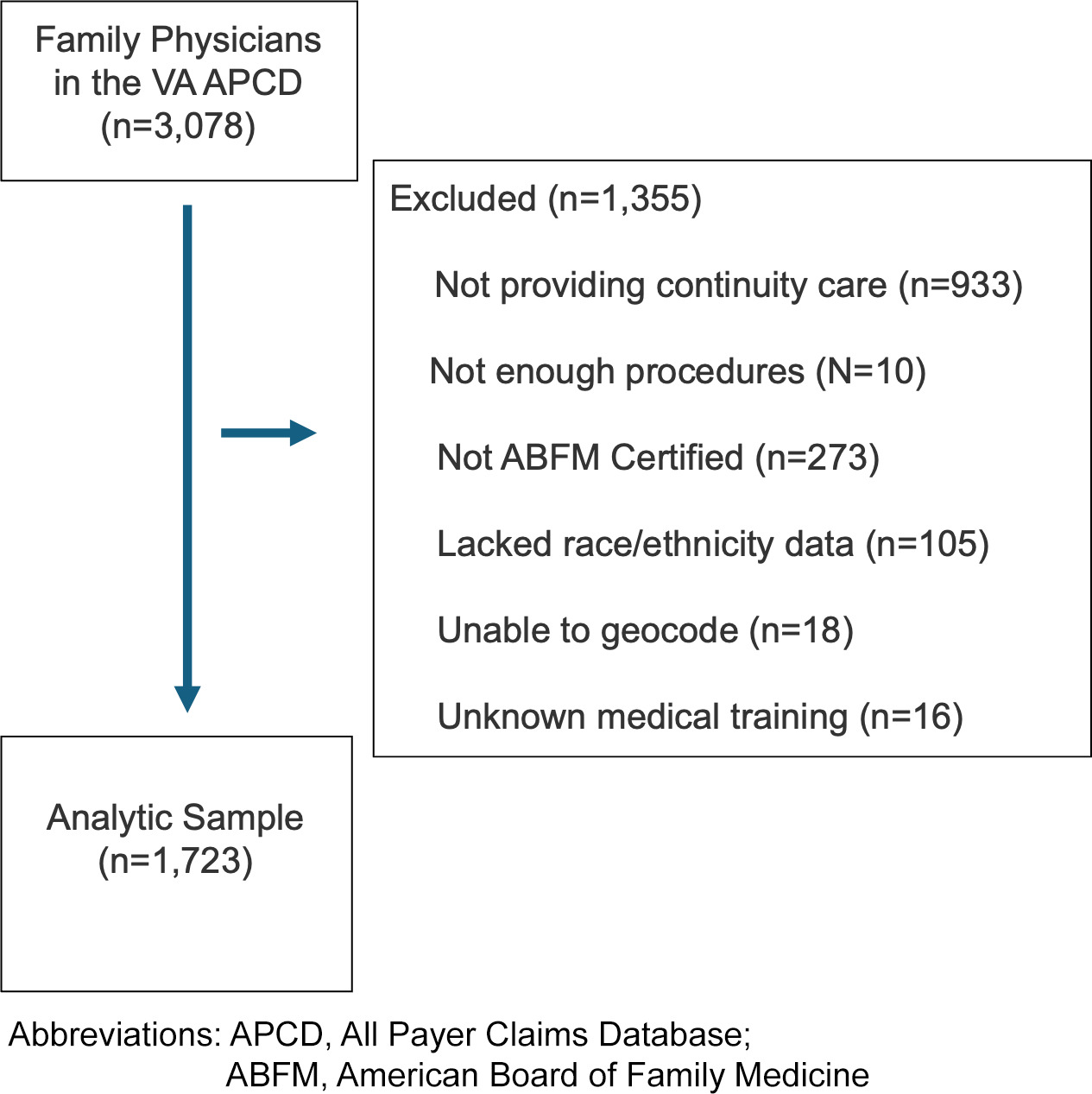
Of the 3,078 FPs in Virginia, we excluded 933 because they did not provide continuity care, 10 because they did not have claims, 273 because they were not ABFM certified, 105 because they did not have race/ethnicity data, 18 who could not be geocoded, and 16 without medical training information (Figure 1). Among those in continuity care, those excluded were more prevalent in nonmetropolitan and lower dermatologist density counties (see Appendix 1—table 1). The final analytic sample included 1723 ABFM-certified, continuity-care FPs. Our sample was a slight majority male (51.5%), 15.5% were URiM, 78.3% were USMG, and 57.7% practiced in high dermatologist density counties (Table 1).
Total |
1,723 |
Dermatologist density |
High |
995 (57.7%) |
Low |
492 (28.6%) |
Zero |
236 (13.7%) |
RUCC |
Metropolitan |
1,571 (91.2%) |
Nonmetropolitan |
152 (8.8%) |
Age, in years |
<39 |
415 (24.1%) |
40–49 |
412 (23.9%) |
50–59 |
462 (26.8%) |
60+ |
434 (25.2%) |
Gender |
Female |
832 (48.3%) |
Male |
887 (51.5%) |
Nonbinary |
1 (0.1%) |
Prefer not to answer |
3 (0.2%) |
Underrepresented in medicine |
Not URiM |
1,456 (84.5%) |
URiM |
267 (15.5%) |
International medical graduate (US/CAN) |
USMG |
1,349 (78.3%) |
IMG |
374 (21.7%) |
Degree type |
DO |
212 (12.3%) |
MD |
1,511 (87.7%) |
Of the sample, 75.1% performed at least one dermatologic procedure, with destruction (60.9%), toenail (57.6%), and I&D (57.6%) procedures being the most common, followed by skin biopsies (32.1%) and laceration repair (25.0%) procedures (Table 2). In bivariate analyses (χ2 tests, Table 2), male (80.7% male vs 69.2% female; P<0.001), USMGs (78.2% USMG vs 63.9% IMG; P<0.001), and not URiM vs URiM (77.3% not URiM vs 62.9% URiM, P<0.001) were all more likely to perform any dermatologic procedures. One exception to this trend was laceration repair, where there was no statistically significant difference between USMGs and IMGs (25.6% USMG vs 22.5% IMG). Age trends were less consistent. Degree type showed minimal difference overall, although DOs were more likely to perform skin biopsies (43.4% DOs vs 30.5% MDs, P<0.001). Environmental characteristics that led to an increased likelihood of performing dermatologic procedures in general were dermatologist density (70.2% high vs 79.1% low vs 87.7% no; P<0.001) and rurality (73.6% metropolitan vs 90.8% nonmetropolitan, P<0.001). We observed similar gradients across all five individual procedure categories.
|
Performs dermatological office-based procedures |
Skin biopsy |
Destruction |
Toenails |
Laceration repair |
I&D abscess |
Total |
|
1,294 |
553 |
1,049 |
993 |
430 |
993 |
Dermatologist density |
High |
698 (70.2%)a |
240 (24.1%)a |
537 (54.0%)a |
511 (51.4%)a |
184 (18.5%)a |
508 (51.1%)a |
Low |
389 (79.1%)a |
187 (38.0%)a |
321 (65.2%)a |
304 (61.8%)a |
139 (28.3%)a |
310 (63.0%)a |
Zero |
207 (87.7%)a |
126 (53.4%)a |
191 (80.9%)a |
178 (75.4%)a |
107 (45.3%)a |
175 (74.2%)a |
RUCC |
Metropolitan |
1,156 (73.6%) |
479 (30.5%)a |
925 (58.9%)a |
882 (56.1%)a |
356 (22.7%)a |
879 (56.0%)a |
Nonmetropolitan |
138 (90.8%)a |
74 (48.7%)a |
124 (81.6%)a |
111 (73.0%)a |
74 (48.7%)a |
114 (75.0%)a |
Age (years) |
<39 |
313 (75.4%) |
139 (33.5%) |
232 (55.9%) |
244 (58.8%) |
92 (22.2%) |
219 (52.8%) |
40–49 |
304 (73.8%) |
127 (30.8%) |
248 (60.2%) |
228 (55.3%) |
101 (24.5%) |
237 (57.5%) |
50–59 |
341 (73.8%) |
147 (31.8%) |
287 (62.1%) |
268 (58.0%) |
107 (23.2%) |
272 (58.9%) |
60+ |
336 (77.4%) |
140 (32.3%) |
282 (65.0%) |
253 (58.3%) |
130 (30.0%) |
265 (61.1%) |
Gender |
Female |
576 (69.2%)a |
233 (28.0%)a |
442 (53.1%)a |
419 (50.4%)a |
165 (19.8%)a |
411 (49.4%)a |
Male |
716 (80.7%)a |
319 (36.0%)a |
604 (68.1%)a |
573 (64.6%)a |
265 (29.9%)a |
580 (65.4%)a |
Nonbinary |
|
|
1 (100%)a |
|
|
|
Prefer not to answer |
2 (66.7%)a |
1 (33.3%)a |
2 (66.7%)a |
1 (33.3%)a |
|
2 (66.7%)a |
Underrepresented in medicine |
Not URiM |
1,126 (77.3%)a |
507 (34.8%)a |
925 (63.5%)a |
879 (60.4%)a |
385 (26.4%)a |
872 (59.9%)a |
URiM |
168 (62.9%)a |
46 (17.2%)a |
124 (46.4%)a |
114 (60.4%)a |
45 (16.9%)a |
121 (45.3%)a |
International medical graduate (US/CAN) |
USMG |
1,055 (78.2%)a |
501 (37.1%)a |
885 (65.6%)a |
834 (61.8%)a |
346 (25.6%) |
825 (61.2%)a |
IMG |
239 (63.9%)a |
52 (13.9%)a |
164 (43.9%)a |
159 (42.5%)a |
84 (22.5%) |
16 (44.9%)a |
Degree type |
DO |
171 (80.7%) |
92 (43.4%)a |
143 (67.5%) |
134 (63.2%) |
59 (27.8%) |
130 (61.3%) |
MD |
1,123 (74.3%) |
461 (30.5%)a |
906 (60.0%) |
859 (56.8%) |
371 (24.6%) |
863 (57.1%) |
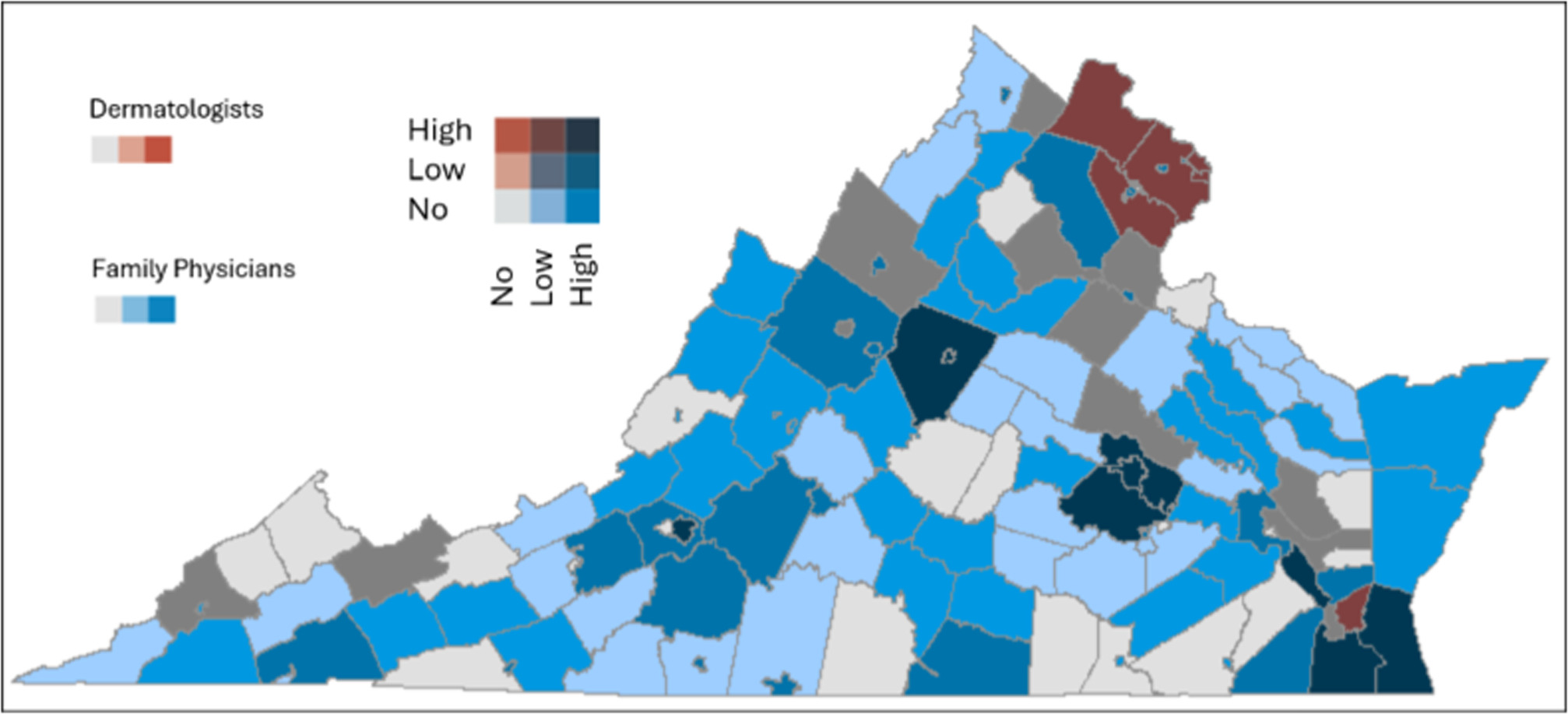
Figure 2 displays the geographic distribution of dermatologist density and FP dermatologic activity across Virginia counties (95 counties and 38 cities independent cities considered county equivalents). We categorized counties categorized into nine mutually-exclusive groups based on a 3x3 cross based on dermatologist density as shades of red (no, low, high) and FP dermatology activity as shades of blue (no, low, high). The resulting map shows considerable geographic variation across the states, with counties represented in all nine cross-classification groups. Seventeen counties had no dermatologists and no FPs performing office-based skin procedures. Small clusters of these “no care” counties were found in the northwestern, central, and southeastern parts of the state. One cluster of five counties with high dermatologist density and no FP procedural activity was found at the northeastern tip of the state. Several counties distributed throughout the state with no or low dermatologist density exhibited high FP dermatologic activity, with one particularly large cluster in the central portion of the state. Counties with both medium levels of dermatologist density and FP procedural activity were broadly dispersed across the state without clear regional clustering.
In multivariable logistic regression models using marginal effects (Table 3), dermatologist density was the strongest predictor of FP dermatologic procedure activity. Compared to high-density counties, FPs in counties with no dermatologists were 11.9% more likely to perform any dermatologic procedure (P<0.001) and 28.9% more likely to perform skin biopsies (P<0.001). The effect was also substantial for destruction (21.7%), toenail (22.4%), laceration repair (20.4%), and I&D (18.8%) procedures, all significant at P<0.001. Counties with low dermatologist density also showed meaningful increases: FPs there were 6.7% more likely to perform any dermatologic procedures. This effect was significant for all procedure categories as well. In contrast, rurality was not consistently associated with procedure performance. FPs in nonmetropolitan counties were 9.9% more likely to perform any dermatologic procedure (P<0.05), but there were no statistically significant differences in any of the individual procedure categories.
|
Performs dermatological
office-based procedures |
Skin biopsy |
Destruction |
Toenails |
Laceration repair |
I&D abscess |
Dermatologist density (reference: high) |
Low |
0.0670 (±0.0232)a |
0.120 (±0.0251)a |
0.0841 (±0.026587)a |
0.0867 (±0.0270)a |
0.0863 (±0.0241)a |
0.0965 (±0.0270)a |
Zero |
0.119 (±0.0354)a |
0.289 (±0.0427)a |
0.217 (±0.0394)a |
0.224 (±0.0404)a |
0.204 (±0.0432)a |
0.1878 (±0.0421)a |
RUCC (reference: metropolitan) |
Nonmetropolitan |
0.0993 (±0.0441)a |
-0.0462 (±0.0411) |
0.0595 (±0.0558) |
-0.0154 (±0.0557) |
0.0850 (±0.0462) |
0.0413 (±0.0550) |
Age (years; reference: 60+) |
<39 |
0.0570 (±0.0315) |
0.0824 (±0.0326)a |
0.00339 (±0.0352) |
0.110 (±0.0348)a |
-0.0181 (±0.0318) |
0.01630 (±0.0359) |
40–49 |
0.0570 (±0.0314) |
0.0822 (±0.0317)a |
0.0595 (±0.0336) |
0.0866 (±0.0342)a |
.00429 (±0.0311) |
0.0695 (±0.0344)a |
50–59 |
0.0495 (±0.0308) |
0.0313 (±0.0282) |
0.0239 (±0.0321) |
0.0500 (±0.0325) |
-0.0358 (±0.0277) |
0.0292 (±0.0327) |
Gender (reference: female) |
Male |
0.0985 (±0.0216)a |
0.0546 (±0.0228)a |
0.116 (±0.0241)a |
0.129 (±0.0245)a |
0.0816 (±0.0215)a |
0.136 (±0.0247)a |
URiM (reference: not URiM) |
URiM |
-0.116 (±0.0301)a |
-0.1559 (±0.0271)a |
-0.128 (±0.0321)a |
-0.148 (±0.0325)a |
-0.0747 (±0.0268)a |
-0.108 (±0.0326)a |
USMG vs IMG (reference: IMG) |
USMG |
0.115 (±0.0272)a |
0.2141 (±0.0236)a |
0.181 (±0.0294)a |
0.167 (±0.0297)a |
-0.00973 (±0.0267) |
0.133 (±0.0297)a |
Degree type (reference: DO) |
MD |
-0.000130 (±0.0353) |
-0.0175 (±0.0335) |
-0.0148 (±0.0373) |
0.0284 (±0.0382) |
-0.01660 (±0.0335) |
0.00914 (±0.0382) |
Physician-level factors were also significant. Male FPs were 9.9% more likely than female FPs to perform any dermatologic procedure (P<0.001), with particularly large gaps for I&D (13.6%, P<0.001) and toenail procedures (12.9%, P<0.001). USMGs were 11.5% more likely to perform any dermatologic procedure than IMGs and 21.4% more likely to perform biopsies (P<0.001). In contrast, URiM physicians were 11.6% less likely to perform any dermatologic procedures than their non-URiM peers (P<0.001), with consistent gaps across all procedure categories. Age differences were notable among younger physicians for skin biopsies, toenail procedures, and I&D procedures. FPs under the age of 40 years were 8.2% (P<0.05) more likely to perform skin biopsies and 11.0% (P<0.001) more likely to perform toenail procedures compared to those age 60+. FPs aged 40–49 showed similar trends, with an additional 7.0% increased likelihood of performing I&D procedures as well (P<0.05).
In a single-state study, we found that the strongest consistent predictor of FPs performing a range of office-based skin procedures was the availability of dermatologists. This suggests that FPs are varying their scope of practice to meet patient and community needs for care. In our sample of ABFM-certified FPs practicing continuity care in Virginia, approximately 75% of physicians performed at least one office-based skin procedure during 2022–2023. The probability of performing these procedures was higher in counties with low and no dermatologist density. Compared to counties with high dermatologist density, FPs in counties with no dermatologists were 11.9% more likely to perform any dermatologic procedure, with even greater marginal effects seen across specific procedure types such as skin biopsies (28.9%), destruction (21.7%), and toenail procedures (22.4%). This substitution pattern was consistent across multiple dermatologic procedure categories.
These findings demonstrate the adaptive behavior of FPs. In regions with no or low dermatologist supply, FPs are likely to step in to provide needed office-based skin procedures. In contrast, in areas with higher dermatologist density, FPs performed fewer dermatologic procedures, which could potentially be due to institutional referral policies or financial incentives that prioritize internal referrals to dermatologists.
However, we observed exceptions to this overall trend. Spatial mapping of our data revealed 17 counties with “no care,” which were counties with no dermatologists and no FP procedural activity that may represent populations at high risk for delayed diagnosis and treatment. These findings suggest barriers may exist beyond just dermatologist availability that restrict FPs. For example, in one study, 60% of physicians reported that they were unable to perform procedures, with time constraints being the most common obstacle.45 Additionally, physicians in more rural areas may be limited in scope due to limitations in services and staff.22 We also observed that physician-level characteristics such as male sex (9.9%), USMG status (11.5%), and non-URiM status (11.6%), were associated with a greater probability of performing office-based skin procedures in practice. URiM physicians have a higher association of practicing in underserved or health care professional shortage areas, which all the “no care” counties are, potentially factoring into the lower procedural rates in such areas.46,47
Our findings align with prior literature demonstrating dermatologist maldistribution between rural and urban areas.1-5 They also align with known health care professional shortage areas (HPSAs) in Virginia, as all the “no care” counties we identified are also designated HPSAs.46 The results also align with existing literature regarding the adaptive scope of practice of FPs by demonstrating how FPs procedural patterns can be influenced by dermatologist availability.22,35 While national-level data show a declining trend in FP comprehensiveness, our results illustrate how local health care market context could prompt FPs to maintain or expand their scope.27-32
Previous studies have demonstrated an association between FPs in rural areas and broader scope of practice.28 For example, Tong et al found that FPs who perform caesarean deliveries are mostly in rural communities, work in rural health centers, and live in counties without obstetricians, illustrating how FPs can adapt their scope of practice based on local availability of services.35 However, we found that for most procedures, rurality itself was not independently associated with higher FP procedural rates. An exception was I&D procedures, where nonmetropolitan physicians were 8.5% more likely to perform them. This suggests that dermatologist availability rather than geography alone drives FP behavior.
These results have implications for clinical practice, workforce development, and policy. First, they emphasize the need to ensure that FPs are equipped to provide dermatologic care when needed. While family medicine training includes dermatologic procedures, evidence suggests that many FPs feel underprepared.17-21,48 For example, only 65.1% of Iowa physicians said that they felt adequately trained in the diagnosis of skin lesions and a majority of them stated that they would have benefited from additional training.20 Dermatologists outperform FPs in some diagnostic areas, likely due to higher exposure and longer training in that subject.49,50 However, brief educational interventions can improve FP diagnostic accuracy of dermatologic malignancies and reduce unnecessary referrals, which could help close this gap.51,52 Thus, expanding dermatologic procedure training during residency and/or offering Continuing Medical Education could enhance FPs confidence and readiness to perform such procedures.
In addition to expanding training, it is important to invest in procedural capacity for FPs in areas where recruiting dermatologists is unfeasible. Health systems should prioritize support for FPs in underserved communities by ensuring access to appropriate clinical supplies, referral pathways, and other such mechanisms. For counties like the “no care” counties, even more interventions are needed to prevent complete gaps in dermatologic procedural care. Mobile dermatologist clinics, FP-led screening events, and teledermatology support lines are potential strategies to start extending care into these more high-risk populations. These interventions can address existing gaps while workforce strategies work to mitigate inequalities from a broader perspective.
This study has several limitations. Our analysis was limited to ABFM-certified, continuity-care FPs in Virginia with>60 claims over the study period, which may restrict generalizability. However, Virginia contains a mix of urban, suburban, and rural practice settings and is a reasonable representation for national trends. Our data set also excluded nurse practitioners and physician assistants, which increases internal validity but may underestimate overall dermatologic procedures performed. Our analysis focused on FPs and therefore also did not include internal medicine physicians, podiatrists, or pediatricians who could possibly be providing these procedures in counties with low or no dermatologists. Additionally, the study’s cross-sectional design prevents causal inference or trend analysis.
Future studies should explore longitudinal trends, especially how events such as the COVID-19 pandemic may have influenced procedural activity. Linking the VA APCD with the Virginia Cancer Registry could help examine whether higher county-level FP dermatologic activities correlated with earlier melanoma detection or improved outcomes to the same extent as counties with high dermatologist availability. Determining dermatologist supply tipping points beyond which FP procedure rates start to decline could help inform physician workforce distribution targets. Finally, exploring the role of teledermatology in supporting FPs’ diagnostic plans for dermatologic issues could prove beneficial for FPs with limited training in office-based skin procedures.
In conclusion, this study found that FPs often perform office-based skin procedures in areas with limited dermatologist availability, helping to fill critical gaps in care. However, regions with no dermatologist or FP procedural activity remain, highlighting the need for interventions to improve procedural access in those areas. These findings show the importance of supporting procedural capacity in primary care and invites future research into solutions for dermatologic care access.
RADS Virtual Research Symposium, October 2025 NAPCRG Annual Meeting, Atlanta, GA, November 2025.
References
-
Feng H,
Berk-Krauss J,
Feng PW,
Stein JA.
Comparison of dermatologist density between urban and rural counties in the United States.
JAMA Dermatol.
2018;154(11):1265–1271.
doi:10.1001/jamadermatol.2018.3022
-
Seigel L,
Shoaib S,
Maughn K,
et al.
Health disparities in psoriasis: geographic barriers to access in the United States.
J Dermatolog Treat.
2024;35(1):2365820.
doi:10.1080/09546634.2024.2365820
-
Sinha S,
Lin G,
Zubkov M,
Wu R,
Feng H.
Geographic distribution and characteristics of the pediatric dermatology workforce in the United States.
Pediatr Dermatol.
2021;38(6):1523–1528.
doi:10.1111/pde.14824
-
Ehrlich A,
Kostecki J,
Olkaba H.
Trends in dermatology practices and the implications for the workforce.
J Am Acad Dermatol.
2017;77(4):746–752.
doi:10.1016/j.jaad.2017.06.030
-
Ashrafzadeh S,
Peters GA,
Shi CR,
Nambudiri VE.
Demographic and medical school characteristics associated with urban versus rural dermatology practice: A national cross-sectional study.
Dermatol Online J.
2021;27(1):13030/qt4bn5t4b3.
.
https://pubmed.ncbi.nlm.nih.gov/33560785/.
doi:10.5070/D3271052019
-
Barreto T,
Jetty A,
Eden AR,
Petterson S,
Bazemore A,
Peterson LE.
Distribution of physician specialties by rurality.
J Rural Health.
2021;37(4):714–722.
doi:10.1111/jrh.12548
-
Kimball AB,
Resneck JS Jr.
The US dermatology workforce: a specialty remains in shortage.
J Am Acad Dermatol.
2008;59(5):741–745.
doi:10.1016/j.jaad.2008.06.037
-
Yoo JY,
Rigel DS.
Trends in dermatology: geographic density of US dermatologists.
Arch Dermatol.
2010;146(7):779.
doi:10.1001/archdermatol.2010.127
-
Brochez L,
Verhaeghe E,
Bleyen L,
Naeyaert JM.
Diagnostic ability of general practitioners and dermatologists in discriminating pigmented skin lesions.
J Am Acad Dermatol.
2001;44(6):979–986.
doi:10.1067/mjd.2001.113442
-
Thörn M,
Pontén F,
Bergström R,
Sparén P,
Adami HO.
Clinical and histopathologic predictors of survival in patients with malignant melanoma: a population-based study in Sweden.
J Natl Cancer Inst.
1994;86(10):761–769.
doi:10.1093/jnci/86.10.761
-
-
Goldsmith LA,
Koh HK,
Bewerse BA,
et al.
Full proceedings from the National Conference to Develop a National Skin Cancer Agenda.
J Am Acad Dermatol.
1996;35(5 Pt 1):748–756.
doi:10.1016/S0190-9622(96)90731-8
-
Roetzheim RG,
Pal N,
van Durme DJ,
et al.
Increasing supplies of dermatologists and family physicians are associated with earlier stage of melanoma detection.
J Am Acad Dermatol.
2000;43(2 Pt 1):211–218.
doi:10.1067/mjd.2000.106242
-
Plascak JJ,
Fisher JL,
Paskett ED.
Primary care physician supply, insurance type, and late-stage cancer diagnosis.
Am J Prev Med.
2015;48(2):174–178.
doi:10.1016/j.amepre.2014.08.014
-
Criscito MC,
Martires KJ,
Stein JA.
A population-based cohort study on the association of dermatologist density and Merkel cell carcinoma survival.
J Am Acad Dermatol.
2017;76(3):570–572.
doi:10.1016/j.jaad.2016.10.043
-
Aneja S,
Aneja S,
Bordeaux JS.
Association of increased dermatologist density with lower melanoma mortality.
Arch Dermatol.
2012;148(2):174–178.
doi:10.1001/archdermatol.2011.345
-
-
Nothnagle M,
Sicilia JM,
Forman S,
et al,
STFM Group on Hospital Medicine and Procedural Training. Required procedural training in family medicine residency: a consensus statement.
Fam Med.
2008;40(4):248–252.
-
Newman AR,
Heidelbaugh JJ,
Klemenhagen K,
Michelfelder AJ,
Power DV,
Hougas JE III.
Current procedural practices of family medicine teaching physicians.
Fam Med.
2024;56(3):156–162.
doi:10.22454/FamMed.2024.197714
-
Goetsch NJ,
Hoehns JD,
Sutherland JE,
Ulven ME,
Shiyanbola OO,
Rauch MK.
Assessment of postgraduate skin lesion education among Iowa family physicians.
SAGE Open Med.
2017;5:2050312117691392.
doi:10.1177/2050312117691392
-
Lin AJ,
Ferris LK,
Maier J,
Maier R.
Skin biopsies and diagnostic outcomes at a multisite family medicine residency network.
South Med J.
2024;117(10):609–611.
doi:10.14423/SMJ.0000000000001739
-
Russell A,
Fromewick J,
Macdonald B,
et al.
Drivers of scope of practice in family medicine: a conceptual model.
Ann Fam Med.
2021;19(3):217–223.
doi:10.1370/afm.2669
-
Reitz R,
Horst K,
Davenport M,
Klemmetsen S,
Clark M.
Factors influencing family physician scope of practice: a grounded theory study.
Fam Med.
2018;50(4):269–274.
doi:10.22454/FamMed.2018.602663
-
-
Awadalla F,
Rosenbaum DA,
Camacho F,
Fleischer AB Jr,
Feldman SR.
Dermatologic disease in family medicine.
Fam Med.
2008;40(7):507–511.
-
Tng ETV,
Tapley A,
Davey A,
et al.
General practice registrars’ clinical exposure to dermatological procedures during general practice training: a cross-sectional analysis.
Educ Prim Care.
2018;29(6):357–366.
doi:10.1080/14739879.2018.1520612
-
Weidner AKH,
Chen FM.
Changes in preparation and practice patterns among new family physicians.
Ann Fam Med.
2019;17(1):46–48.
doi:10.1370/afm.2337
-
Bazemore A,
Petterson S,
Peterson LE,
Phillips RL Jr.
more comprehensive care among family physicians is associated with lower costs and fewer hospitalizations.
Ann Fam Med.
2015;13(3):206–213.
doi:10.1370/afm.1787
-
Bazemore AW,
Makaroff LA,
Puffer JC,
et al.
Declining numbers of family physicians are caring for children.
J Am Board Fam Med.
2012;25(2):139–140.
doi:10.3122/jabfm.2012.02.110203
-
Xierali IM,
Puffer JC,
Tong STC,
Bazemore AW,
Green LA.
The percentage of family physicians attending to women’s gender-specific health needs is declining.
J Am Board Fam Med.
2012;25(4):406–407.
doi:10.3122/jabfm.2012.04.110290
-
Tong STC,
Makaroff LA,
Xierali IM,
et al.
Proportion of family physicians providing maternity care continues to decline.
J Am Board Fam Med.
2012;25(3):270–271.
doi:10.3122/jabfm.2012.03.110256
-
Cohen D,
Coco A.
Declining trends in the provision of prenatal care visits by family physicians.
Ann Fam Med.
2009;7(2):128–133.
doi:10.1370/afm.916
-
-
LeFevre N,
Young RA.
Factors influencing changing scopes of practice among contemporary graduates of the nation’s largest family medicine residency.
J Am Board Fam Med.
2025;38(1):133–138.
doi:10.3122/jabfm.2024.240172R1
-
Tong ST,
Morgan ZJ,
Bazemore AW,
Eden AR,
Peterson LE.
Maternity access in rural America: the role of family physicians in providing access to cesarean sections.
J Am Board Fam Med.
2023;36(4):565–573.
doi:10.3122/jabfm.2023.230020R1
-
Sonoda K,
Morgan ZJ,
Peterson LE.
HIV Care by early-career family physicians.
Fam Med.
2021;53(9):760–765.
doi:10.22454/FamMed.2021.415039
-
-
-
-
Morgan ZJ,
Bazemore AW,
Peterson LE,
Dai M.
Reclassifying primary care: a decision tree approach to improving workforce estimates and research using claims data.
J Gen Intern Med.
2026;41(10):2947–2955.
doi:10.1007/s11606-026-10484-6
-
Newton WP.
The Future of Residency Training= the Future of Family Medicine.
Presented at Residency Leadership Summit;
March 26, 2024,
Kansas City, MO.
-
-
-
-
Turban JW,
Cho EA,
McCue W,
Withy K.
An Examination of practices and barriers of procedures performed by physicians in rural Hawai’i.
Hawaii J Health Soc Welf.
2023;82(8):183–187.
doi:10.62547/MRJQ1126
-
-
Goodfellow A,
Ulloa JG,
Dowling PT,
et al.
Predictors of primary care physician practice location in underserved urban or rural areas in the united states: a systematic literature review.
Acad Med.
2016;91(9):1313–1321.
doi:10.1097/ACM.0000000000001203
-
Howard J,
Siegel LH,
Mok K,
Sibbald S.
Family medicine residents’ perspectives in dermatology training.
MedEdPublish.
2016;10(1):90.
doi:10.15694/mep.2021.000090.1
-
Martinka MJ,
Crawford RI,
Humphrey S.
Clinical recognition of melanoma in dermatologists and nondermatologists.
J Cutan Med Surg.
2016;20(6):532–535.
doi:10.1177/1203475415623513
-
Corbo MD,
Wismer J.
Agreement between dermatologists and primary care practitioners in the diagnosis of malignant melanoma: review of the literature.
J Cutan Med Surg.
2012;16(5):306–310.
doi:10.1177/120347541201600506
-
Westerhoff K,
McCarthy WH,
Menzies SW.
Increase in the sensitivity for melanoma diagnosis by primary care physicians using skin surface microscopy.
Br J Dermatol.
2000;143(5):1016–1020.
doi:10.1046/j.1365-2133.2000.03836.x
-
Carli P,
De Giorgi V,
Crocetti E,
Caldini L,
Ressel C,
Giannotti B.
Diagnostic and referral accuracy of family doctors in melanoma screening: effect of a short formal training.
Eur J Cancer Prev.
2005;14(1):51–55.
doi:10.1097/00008469-200502000-00007



There are no comments for this article.