Background and Objectives: Family medicine residents increasingly encounter digital behavioral health tools in clinical practice but receive limited structured training on how to evaluate their appropriateness, ethical implications, and fit within primary care workflows. This study examined how resident attitudes and evaluative judgment regarding digital behavioral health tools developed following a longitudinal educational experience.
Methods: This convergent mixed-methods study was conducted within a single family medicine residency program from 2023 to 2025. Residents completed pre- and postintervention surveys based on a modified Technology Acceptance Model assessing perceived usefulness, ease of use, attitudes, facilitators, and intention to use digital tools. Qualitative data were derived from structured reflective learning assignments completed during required behavioral health training. Quantitative analyses used descriptive matched pre–post comparisons and effect sizes. Qualitative reflections were analyzed thematically and integrated with survey findings using a joint display.
Results: Nineteen residents completed the preintervention survey, and 10 completed matched pre- and postintervention surveys. Small increases were observed in perceived usefulness and intention to use digital tools, while other domains remained stable. Qualitative findings indicated that experiential learning and reflection supported greater discernment, ethical awareness, and selective consideration of digital tools as adjuncts to care rather than routine solutions.
Conclusions: Exploratory findings suggest that structured experiential learning and reflection may help residents apply evaluative judgment when considering how digital behavioral health tools complement primary care.
Digital behavioral health tools include mobile health (or mHealth) apps and digital cognitive behavioral therapy programs.1,2 These tools can extend care and support self-management, but quality, evidence, privacy, and clinical fit vary.2-6 Family medicine residents are expected to discuss these tools with patients despite wide variation in quality, evidence, privacy protections, and clinical fit. Residents therefore need skills to judge whether a tool fits a patient, condition, goal, and care context without replacing clinical relationships.
The Technology Acceptance Model (TAM) examines perceived usefulness, ease of use, attitudes, and intention to use.7-9 Modified TAM frameworks can assess educational changes that precede adoption. Experiential learning and reflection may move residents from abstract familiarity toward applied judgment.10
Few studies have examined resident judgment about digital behavioral health tools during required training. I examined how a longitudinal curriculum influenced family medicine residents’ attitudes and evaluative judgment.
Study Design and Setting
This convergent mixed-methods study occurred in one integrated family medicine residency during from 2023 to 2025. It examined resident perceptions and evaluative reasoning about appropriateness, evidence, ethics, usability, and patient-centered fit, rather than adoption or patient outcomes.
Participants
Participants were postgraduate years 1 and 2 residents completing required behavioral health rotations. Of 24 eligible residents, 19 completed the presurvey. Ten matched surveys contributed first-year app use or second-year implementation reflections. Some contributed both. Residents, rather than reflections, were the unit for theme counts.
Educational Intervention
The longitudinal curriculum was embedded in required rotations and didactics. A 1-hour faculty session covered evidence, privacy, ethics, patient selection, and the American Psychiatric Association App Evaluation Model domains: background, privacy and safety, clinical foundation, usability, and therapeutic goals or data integration.11
During first-year training, residents selected one mHealth app for 14 day personal use. Selection reflected personal goals, clinical interests, prior experience, app store information, or an mHealth database. Apps addressed mindfulness, breathing, sleep, stress, journaling, or cognitive behavioral therapy. Residents reflected on selection, access, privacy, evidence, usability, therapeutic goals, limitations, and patient fit.
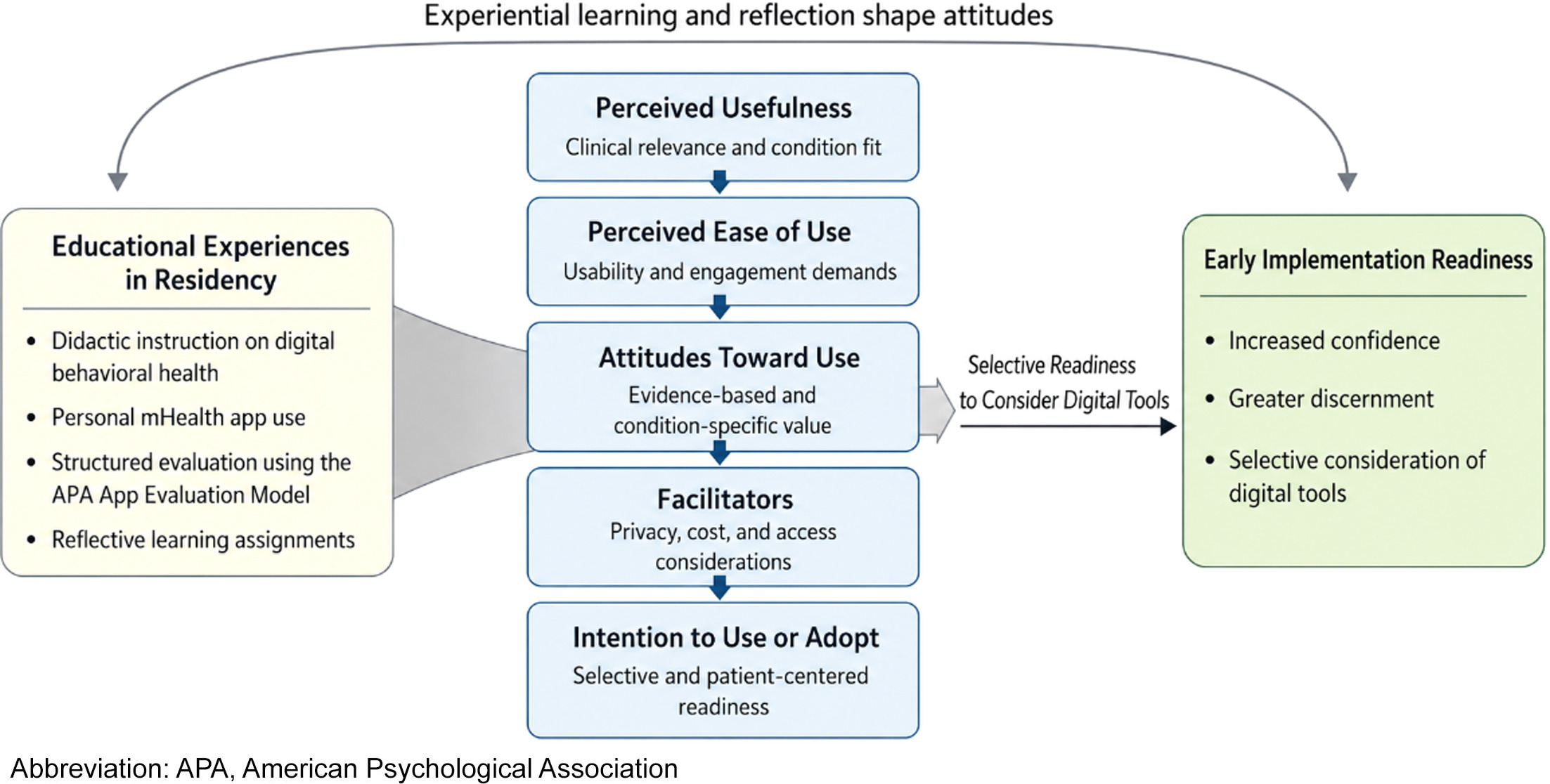
During second-year training, residents reviewed emerging evidence and implementation issues, then reflected on appropriate primary care use. Activities emphasized critical evaluation rather than routine adoption. Figure 1 summarizes the curriculum and TAM domains.
Measures
Resident attitudes were assessed using a modified TAM survey administered before and after the educational experience. Domains included perceived usefulness, perceived ease of use, attitudes toward use, facilitators, and intention to use digital tools. Items were scored on a 7-point Likert scale, with lower scores indicating more favorable responses.
Qualitative data consisted of written reflective learning assignments designed to elicit clinical reasoning, ethical considerations, and perceptions of appropriate use.
Data Analysis
Quantitative analyses included 10 matched surveys. I calculated mean changes and within-person effect sizes (Cohen’s dz), interpreted descriptively because of the small exploratory sample. I inductively coded all reflections, compared residents, and drafted themes. Because I developed the curriculum and taught residents, confirmation bias was possible. A doctoral behavioral health trainee without teaching, supervisory, or evaluative roles reviewed codes, themes, the resident-level matrix, and excerpts. The trainee and I examined discrepant evidence, discussed how roles and expectations could shape interpretation, and refined themes by consensus. Each resident was counted once per theme. Within the results, we integrated findings through a joint display linking qualitative themes, TAM domains, quantitative patterns, and interpretations to examine convergence and contextual explanation across methods.
Ethical Considerations
This study involved secondary analysis of de-identified educational data and was reviewed and determined exempt by the Atrium Health Wake Forest Baptist Institutional Review Board.
Quantitative Findings
Following the educational intervention, I observed small increases in perceived usefulness and intention to use digital behavioral health tools. Other TAM domains remained largely stable (Table 1). These patterns suggest early attitudinal development without evidence of widespread endorsement or routine adoption of digital tools.
TAM domain |
Presurvey mean (SD) |
Postsurvey mean (SD) |
Mean change |
Cohen’s dz |
Perceived usefulness |
2.67 (0.61) |
2.83 (0.54) |
+0.17 |
0.27 |
Perceived ease of use |
3.00 (0.75) |
2.90 (0.72) |
–0.10 |
–0.12 |
Attitudes toward use |
2.70 (0.80) |
2.62 (0.54) |
–0.07 |
–0.08 |
Facilitators |
2.97 (0.82) |
3.00 (0.72) |
+0.03 |
0.05 |
Intention to use/adopt |
2.73 (0.83) |
3.00 (0.83) |
+0.27 |
0.43 |
Qualitative Findings
Five themes described how residents evaluated digital behavioral health tools. Experiential learning increased perceived clinical relevance for nine residents. Eight residents described how perceived value depended on the targeted condition or supporting evidence. All 10 residents identified privacy, cost, or access as relevant to app evaluation. All 10 also discussed how usability or engagement affected continued use. Six residents explicitly described digital tools as adjuncts to clinical care. The applications represented mindfulness, breathing, sleep, stress management, journaling, and cognitive behavioral therapy–informed approaches. Together, these themes show how residents weighed clinical relevance, evidence, ethics, usability, and care context when considering digital behavioral health tools. Table 2 presents resident-level theme representation and integrated findings.
Qualitative theme |
Residents represented
n |
TAM domains |
Quantitative pattern |
Integrated interpretation |
Experiential learning increased perceived clinical relevance. |
9 |
Perceived usefulness |
Small increase |
Personal app use helped residents identify potential clinical value, but survey change remained modest. |
Value depended on condition and evidence. |
8 |
Attitudes toward use |
Minimal change |
Residents did not express broad enthusiasm. Instead, they described greater selectivity for tools aligned with evidence and clinical need. |
Privacy, cost, and access shaped recommendations. |
10 |
Facilitators |
Stable |
Ethical and practical concerns remained salient and may explain limited movement in facilitator scores. |
Usability and engagement influenced sustained use. |
10 |
Perceived ease of use |
Minimal change |
Residents recognized usability as important, but personal app use did not consistently improve perceived ease of use. |
Digital tools were viewed as adjuncts to care. |
6 |
Intention to use/adopt |
Small increase |
Increased intention reflected selective readiness to consider tools as complements to care, not as routine replacement of therapeutic relationships. |
Integrated Findings
The joint display contextualized survey changes. Qualitative findings showed broad attention to privacy, cost, access, usability, and engagement. However, fewer residents explicitly framed digital tools as adjuncts to care. This pattern suggests selective readiness, not broad enthusiasm or routine adoption. I defined selective readiness as willingness to consider digital tools when they fit the patient, condition, evidence base, and care context. The small changes in perceived usefulness and intention to use were consistent with this selective approach. The study did not measure residents’ actual clinical adoption of digital tools.
This report examined resident attitudes and evaluative judgment after a longitudinal digital health curriculum. Quantitative findings showed small changes in perceived usefulness and intention to use. Qualitative findings showed that most residents considered clinical relevance and evidence, while all residents discussed practical or usability concerns. Six residents explicitly framed digital tools as adjuncts to care. These patterns suggest increased attention to selective and contextual evaluation rather than generalized enthusiasm. This approach aligns with family medicine principles because it centers patient context, continuity, therapeutic relationships, and shared decision-making rather than treating technology as a stand-alone intervention.10,12
Personal app use allowed residents to evaluate tools from user and clinician perspectives. Structured reflection prompted attention to evidence, privacy, cost, accessibility, usability, and patient fit. These findings align with prior digital health education research.10,13,14 However, the findings represent residents’ written perceptions. They do not establish changes in clinical competence or actual technology use. Digital health curricula should therefore prioritize critical appraisal and contextual judgment while future studies evaluate behavioral and patient-level outcomes.
This study had several limitations. It involved one residency program and a small matched sample. Findings relied on self-report measures and required educational reflections. The study did not assess objective clinical adoption or patient outcomes. Attrition between surveys may have introduced selection bias because residents completing both surveys may have been more engaged with the curriculum or topic.
My involvement in curriculum development, instruction, and resident education also may have influenced coding and interpretation. Other reviewers had no direct teaching or evaluative relationships with residents, but their professional backgrounds and expectations about digital health could still have shaped interpretation. Residents completed reflections within a required educational context. Their responses may therefore have reflected social desirability or perceived faculty expectations. These limitations support cautious interpretation of the themes as residents’ reported perspectives rather than objective evidence of skill development or clinical behavior.
These findings suggest that family medicine residency curricula can incorporate structured app evaluation, personal use, and reflection when teaching digital behavioral health. Residents commonly considered evidence, privacy, access, usability, and clinical fit. Fewer explicitly described digital tools as adjuncts to care. Larger multisite studies should examine whether these educational approaches improve evaluative skills, clinical behavior, or patient outcomes.
The views expressed in this article are those of the author and do not necessarily reflect the views of Wake Forest University School of Medicine or Atrium Health.
References
-
-
Hoffman L,
Benedetto E,
Huang H,
et al.
Augmenting mental health in primary care: a 1-year study of deploying smartphone apps in a multi-site primary care/behavioral health integration program.
Front Psychiatry.
2019;10:94.
doi:10.3389/fpsyt.2019.00094
-
Fuster-Casanovas A,
Melero SM,
Cabutto D,
et al.
Exploring digital health tools for depression management in primary health care: systematic review and meta-analysis.
J Affect Disord.
2025;381:494–506.
doi:10.1016/j.jad.2025.03.187
-
Nordberg SS,
Jaso-Yim BA,
Sah P,
et al.
Evaluating the implementation and clinical effectiveness of an innovative digital first care model for behavioral health using the RE-AIM framework: quantitative evaluation.
J Med Internet Res.
2024;26:e54528.
doi:10.2196/54528
-
Whitton AE,
Hardy R,
Cope K,
et al.
Mental health screening in general practices as a means for enhancing uptake of digital mental health interventions: observational cohort study.
J Med Internet Res.
2021;23(9):e28369.
doi:10.2196/28369
-
Rollman BL,
Herbeck Belnap B,
Abebe KZ,
et al.
Effectiveness of online collaborative care for treating mood and anxiety disorders in primary care: a randomized clinical trial.
JAMA Psychiatry.
2018;75(1):56–64.
doi:10.1001/jamapsychiatry.2017.3379
-
Xia B,
Pierce BS,
Perrin PB.
Examining models of telemedicine use among U.S. physicians during the COVID-19 pandemic.
PLoS One.
2025;20(9):e0331832.
doi:10.1371/journal.pone.0331832
-
Bunnell BE,
Barrera JF,
Paige SR,
Turner D,
Welch BM.
Acceptability of telemedicine features to promote its uptake in practice: a survey of community telemental health providers.
Int J Environ Res Public Health.
2020;17(22):8525.
doi:10.3390/ijerph17228525
-
Rho MJ,
Choi IY,
Lee J.
Predictive factors of telemedicine service acceptance and behavioral intention of physicians.
Int J Med Inform.
2014;83(8):559–571.
doi:10.1016/j.ijmedinf.2014.05.005
-
Ringeval M,
Raymond L,
Pomey MP,
Paré G.
Evolving medical students’ digital health perceptions and intentions: insights from a prepandemic and postpandemic survey study.
J Med Internet Res.
2025;27:e64804.
doi:10.2196/64804
-
Lagan S,
Emerson MR,
King D,
et al.
Mental health app evaluation: updating the American Psychiatric Association’s framework through a stakeholder-engaged workshop.
Psychiatr Serv.
2021;72(9):1095–1098.
doi:10.1176/appi.ps.202000663
-
Khatib A,
Abo-Rass F,
Gelkopf M.
Theory of planned behavior: exploring the use of digital mental health interventions in Israel.
J Nerv Ment Dis.
2022;210(7):504–509.
doi:10.1097/NMD.0000000000001459
-
Kirkland EB,
DuBose-Morris R,
Duckett A.
Telehealth for the internal medicine resident: a 3-year longitudinal curriculum.
J Telemed Telecare.
2021;27(9):599–605.
doi:10.1177/1357633X19896683
-
Car J,
Ong QC,
Erlikh Fox T,
et al;
Digital Health Systems Collaborative.
The digital health competencies in medical education framework: an international consensus statement based on a Delphi study.
JAMA Netw Open.
2025;8(1):e2453131.
doi:10.1001/jamanetworkopen.2024.53131



There are no comments for this article.