Background and Objectives: Securing peer reviewers for scholarly manuscripts is essential to journal operations but has become increasingly challenging. We sought to describe trends in acceptance of reviewer invitations and review completion at two journals sponsored by the Society of Teachers of Family Medicine: PRiMER and Family Medicine.
Methods: We conducted retrospective quality assurance of reviewer invitation outcomes for research manuscripts submitted to either journal from January 2010 to April 2026. Data were extracted from ScholarOne. We calculated odds ratios (ORs) for agreement to review and for review completion for each year via binary logistic regression, employing the generalized estimating equation to control for individual reviewer behavior, journal, and article type.
Results: We included 16,905 discrete invitations to review 2,574 manuscripts. Agreement rates at Family Medicine ranged from 70.99% in 2010, to a low of 41.80% in 2025, and 37.99% through April 2026; PRiMER agreement ranged from 74.36% in 2016, to 42.79% in 2025, and 20.23% in partial 2026. Combined completion rates dropped from 89.90% in 2010, to 82.20% in 2025, and to 73.90% in partial 2026. Using 2010 as the reference year, ORs for agreement to review dropped markedly, with the odds of accepting a review invitation in 2026 only 15.9% of the 2010 (2026: OR = 0.159, P<0.001) and the odds of review completion in 2026 falling to 32.9% of 2010 (OR = 0.329, P<0.001).
Conclusions: Reviewer engagement is declining across both journals. New, innovative strategies to recruit, engage, and incentivize reviewers will be necessary to sustain peer review.
Peer review lies at the foundation of scholarship and is a vital step in assurance of integrity for scholarly publications.1 Although current peer-review practices include acknowledged flaws,2 input from experts ahead of publication helps journal editors to identify ethical concerns, methodological issues, proper contextualization, and applicability of submitted manuscripts. Peer review is both a public and disciplinary service, as well as a means of professional development.1,3-6
Invitations from journal editors to review manuscripts face increasing competition from clinical productivity demands, increasing volume of invitations from an ever-growing number of journals, demographic factors,7 and reviewer burnout and fatigue,8-11 among other competing priorities.12,13 Some analyses have noted issues with the capitalistic and exploitive nature of free reviews, leading to active refusal to review.8,14 However, beyond surveys and editorials, few reports have tracked trends in reviewer engagement. Those that have described a concerning phenomenon: Reviewer engagement is dropping. A longitudinal single-journal (Biological Invasions) analysis of reviewer trends found a steady decline in reviewer acceptance rates between 2003 and 2023, with the proportion of accepted invitations dropping from about 60% to just below 40% in that timeframe.15 More broadly, Silverchair, the commercial concern behind industry-wide editorial tools such as the ScholarOne editorial database,16 used expert interviews, survey responses from authors, reviewers and editors, and a literature review to determine that review invitation acceptance rates broadly dropped from 43% in 2018 to 22% in 2024, and that the number of reviewer invitations per manuscript has doubled over that timeframe.17,18 That study, while widely read, was not formally peer-reviewed and relied on surveys and feedback rather than direct analsyis of editorial data.
These circumstances have potentially profound impacts on scholarship. Many editorial decisions are delayed by a lack of reviewer responsiveness to invitations and actual completion of accepted reviews.19 Additionally, as the specialty of family medicine attempts to increase its research capacity in the United States,20,21 making sure that scholarly output is matched with sufficient capacity to ensure rigor via peer review will be vitally important. Unfortunately, evidence from a previous analysis of reviewer trends within the journal PRiMER (Peer-reviewed Reports in Medical Education Research) found sharp declines in acceptance of reviews and in the completion of agreed reviews, reporting a significant negative annual trend (OR = 0.656, P<0.001) in reviewer invitation acceptance between 2016 and 2025.22-24 This current analysis expands on that work by including a large body of similar data from Family Medicine to explore whether those trends are duplicated in a second journal and whether trends in reviewer engagement are similar between the two journals.
Study Design and Data Source
We conducted a retrospective analysis of reviewer invitation outcomes for Family Medicine from 2010 to 2026 and PRiMER from 2016 to 2026 using data extracted from the ScholarOne16 editorial database. These dates represent (a) the earliest year (2010) for which review data are available for Family Medicine, and (b) the first year (2016) that PRiMER began inviting reviewers for submitted manuscripts. Data from the previous analysis of PRiMER reviewer trends (2016–mid-2025) were incorporated into a larger dataset that extended the PRiMER data to mid-2026, enabling comparison and exploration with a second journal with a longer data trail in the same ecosystem.The combined data allowed not only for comparison but also for joint estimation of odds ratios with greater power.
Only invitations to review research manuscripts were included. For Family Medicine, this included submissions in the Original Article and Brief Report categories; for PRiMER, Research Briefs and Learner Research manuscripts were included. These specific manuscript types were selected because they are handled similarly editorially. Other manuscript types, such as editorials, commentaries, or others that do not report original findings, are often reviewed differently, with a smaller or select number of reviewers or editors.
Additionally, because revised manuscripts often are sent back to the reviewers of the initial submissions, these were excluded. Restricting the analysis to the first submission of article types in each journal that represent original research (Original Articles, Brief Reports, Research Briefs, and Learner Research) allowed for a greater degree of homogeneity within the peer-review process across manuscripts.
For each invitation in the ScholarOne database, we extracted relevant dates (submission, invitation, acceptance of invitation), responses to invitations (accept/agree to review, late response/agree to review, decline, unavailable, and no response), and manuscript type. Reviewer identities were converted to nonidentifying codes before any further procedures. Because this study was a quality assurance assessment of reviewer responsiveness in STFM journals, the Institutional Review Board of Upstate Medical University determined that the project did not meet the definition of human subjects research.
Statistical Analysis
We assessed two outcome variables for each year of the study:
Acceptance rate: Percentage of invitations accepted (agree to review and late response agreement = 1; decline, unavailable, no response = 0); and
Completion rate: Percentage of accepted invitations with review completed (accepted review had a date of review submission/total accepted reviews; completed/not completed for each record coded as 1 or 0).
Rates of acceptance and completion were calculated and compared descriptively across years. Binary logistic regression models were then constructed, using the generalized estimating equation to control for individual reviewer variance, journal, and article type, to calculate odds ratios (OR) for the likelihood of acceptance of review invitation and completion of review for each year. To further evaluate reviewer engagement, we subdivided outcomes into a three-category variable, keeping agree to review (accept) and late (but agreed) responses as a first category, but dividing those who actively declined an invitation or replied as unavailable into a second category, and creating a separate third category for invitations that received no recorded response. This three-category outcome was analyzed via multinomial logistic regression, with year and journal entered as predictors. Finally, we also calculated the overall and annual mean number of reviewer invitations per manuscript. Data cleaning and table generation were performed in Microsoft Excel, and all statistical analysis was performed in SPSS version 31 (IBM).
We identified a total of 16,905 discrete invitations to review 2,574 manuscripts. Further details on annual submission volume are included in Table 1. Acceptance rates ranged from a high of 70.99% in Family Medicine in 2010, to a low of 41.80% in 2025, and 37.99% in the partial year of 2026; PRiMER had a high acceptance rate of 74.36% in 2016 (first year of reviewer invitations), to 42.79% in 2025, and 20.23% in partial 2026. Combined completion rates dropped from 89.90% (Family Medicine only) in 2010, to 82.20% in 2025, and to 73.90% in partial 2026. Using 2010 as the reference year, ORs for agreement to review dropped markedly from 2010 through 2025, with the odds of acceptance of a review invitation in 2026 only 15.9% of reference year 2010 (2026: OR = 0.159, P<0.001), and odds of review completion falling in 2026–32.9% of reference year 2010 (OR = 0.329, P<0.001). Year-to-year details are presented in Table 1.
Year |
Total invitations |
Agreed to review |
Completed |
aOdds ratio (P) |
Family Medicine |
PRiMER |
Family Medicine |
PRiMER |
Both journals |
Agreed |
Completed |
2010 |
293 |
– |
70.99% |
– |
89.90% |
REF |
REF |
2011 |
448 |
– |
62.05% |
– |
88.50% |
0.640 (.004) |
0.876 (.628) |
2012 |
427 |
– |
63.23% |
– |
83.30% |
0.634 (.008) |
0.597 (.050) |
2013 |
533 |
– |
58.72% |
– |
80.80% |
0.541 (<0.001) |
0.480 (.003) |
2014 |
719 |
– |
55.63% |
– |
82.80% |
0.470 (<0.001) |
0.578 (.031) |
2015 |
791 |
– |
49.30% |
– |
83.60% |
0.362 (<0.001) |
0.620 (.056) |
2016 |
835 |
39 |
46.95% |
74.36% |
78.40% |
0.336 (<0.001) |
0.431 (<0.001) |
2017 |
831 |
217 |
46.21% |
44.24% |
81.00% |
0.314 (<0.001) |
0.528 (.007) |
2018 |
1,187 |
235 |
43.13% |
50.21% |
84.60% |
0.281 (<0.001) |
0.664 (.091) |
2019 |
871 |
163 |
42.82% |
51.53% |
85.60% |
0.275 (<0.001) |
0.678 (.129) |
2020 |
874 |
299 |
47.14% |
52.84% |
81.90% |
0.292 (<0.001) |
0.536 (.011) |
2021 |
1,011 |
313 |
46.19% |
51.12% |
86.40% |
0.256 (<0.001) |
0.711 (.171) |
2022 |
1,071 |
397 |
45.10% |
47.36% |
85.20% |
0.249 (<0.001) |
0.673 (.110) |
2023 |
1,121 |
406 |
38.45% |
42.12% |
85.90% |
0.194 (<0.001) |
0.695 (.147) |
2024 |
1,050 |
614 |
37.81% |
35.99% |
85.40% |
0.174 (<0.001) |
0.654 (.085) |
2025 |
1,036 |
444 |
41.80% |
42.79% |
82.20% |
0.188 (<0.001) |
0.519 (.008) |
2026 |
508 |
172 |
37.99% |
30.23% |
73.90% |
0.159 (<0.001) |
0.329 (<0.001) |
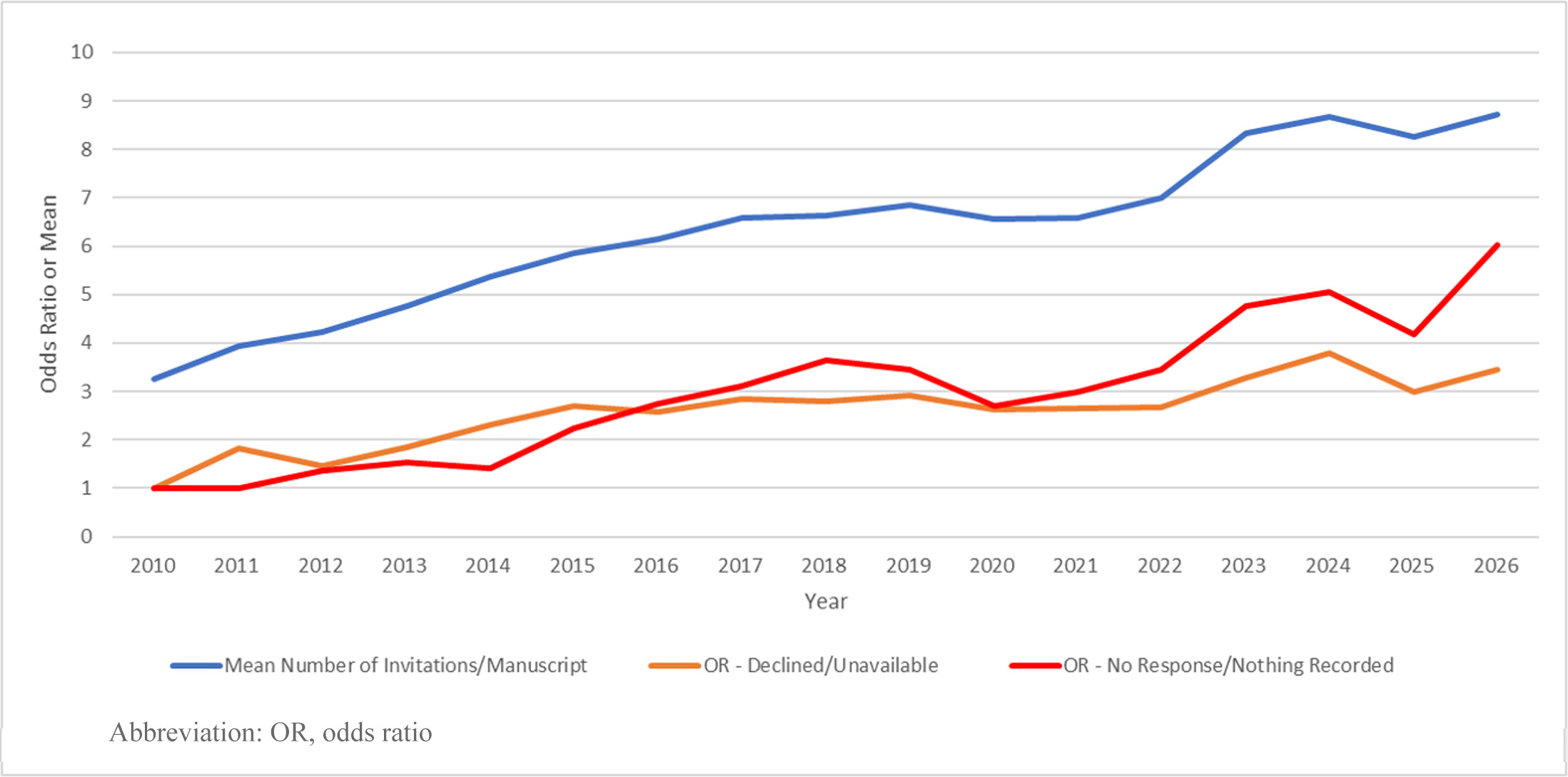
Across all manuscripts included in the study, approximately 6.57 invitations were sent per manuscript, with numbers increasing between 2010 (3.26 invitations per manuscript) and 2026 (8.72 invitations per manuscript). Relative to 2010, nonresponses to invitations became increasingly likely, with a nonresponse to an invitation to review approximately six times more likely in 2026 than in 2010 (OR = 6.03, P<0.001). ORs for nonresponses, separated from actively declined invitations, are provided in Table 2 and graphically in Figure 1.
Year |
Odds ratio (P) |
|
Declined/unavailable vs agreed |
No response/nothing recorded versus agreed |
2010 |
REF |
REF |
2011 |
1.834 (.001) |
0.990 (.968) |
2012 |
1.465 (.051) |
1.359 (.189) |
2013 |
1.850 (<0.001) |
1.525 (.060) |
2014 |
2.304 (<0.001) |
1.422 (.106) |
2015 |
2.708 (<0.001) |
2.227 (<0.001) |
2016 |
2.581 (<0.001) |
2.740 (<0.001) |
2017 |
2.849 (<0.001) |
3.113 (<0.001) |
2018 |
2.793 (<0.001) |
3.635 (<0.001) |
2019 |
2.925 (<0.001) |
3.460 (<0.001) |
2020 |
2.619 (<0.001) |
2.701 (<0.001) |
2021 |
2.649 (<0.001) |
2.987 (<0.001) |
2022 |
2.680 (<0.001) |
3.453 (<0.001) |
2023 |
3.281 (<0.001) |
4.754 (<0.001) |
2024 |
3.801 (<0.001) |
5.063 (<0.001) |
2025 |
3.002 (<0.001) |
4.187 (<0.001) |
2026 |
3.442 (<0.001) |
6.025 (<0.001) |
Declines in reviewer responsiveness over time, previously measured for PRiMER invitations only for 2016 to 2023,10 have persisted over time and are remarkably consistent across both Family Medicine and PRiMER. The reasons for such persistent declines are beyond the scope of this quality assurance project to assess, yet the consistency of a marked decline across two journals is alarming. Increasing numbers of new journals, and hence greater need for peer review, will contribute to a consequently larger number of requests sent to potential reviewers.25,26
Our analysis of nonresponsiveness (vs those who actively decline reviews) revealed that a greater number of review requests are not receiving any response. This finding suggests that the environment is becoming more intensely filled for the time and attention of reviewers. Possible contributors to reviewer invitation overload are reviewer fatigue, the growing number of submissions clearly apparent in the data we present here, and perhaps the addition of another journal (PRiMER) to the family medicine publishing ecosystem. Competing demands and faculty burnout within academic medicine are also likely contributing factors to this decline. One possibility is that potential reviewers commit out of interest and then are unable to complete reviews due to competing time demands. Additionally, at least one study has noted that potential reviewers may be pushing back against perceived exploitation of their uncompensated time and labor, with little perceived gain from volunteering to review, and few consequences for refusal.8
Cognizant of competing demands, new approaches to recruitment, engagement, and retention of peer reviewers are needed. Editing fellowships27-30 are worthwhile ventures for inviting new participants to the editorial and peer-review system but impact a very small number of individuals annually. Moreover, whether broader but simple reviewer training is effective is unclear.31 Training must overcome a sense of under-qualification among new reviewers,32 because ample guidance is already available on how to conduct a peer review.3,33-35Currently, a small pool of individuals do a large portion of the peer reviews, which is not sustainable and does not foster the development of a sizable new pool. This difficultly attaining reviewers affects authors as well by delaying the editorial decision.
Academic and scholarly communities can innovate to incentivize and support reviewers in order to maintain a rigorous vetting system for the entry and interpretation of new knowledge into discourse and practice. Many journals formally acknowledge reviewers and offer professional incentives in exchange for review (eg, continuing medical education) to motivate and engage them.1,36 Academic institutions (including department chairs, promotion/tenure committees, and other institutional leaders) should be strongly encouraged to treat peer-review activities as a service to the disciplines they represent. Others have suggested that journal publication creates a natural expectation that senior authors engage in peer review, with Keating and Mohile outlining an explicit suggested formula that proposes senior authors should be held to conducting 3.125 reviews for every manuscript they submit.37 Not only do academic institutions function with, and teach, the knowledge produced by processes informed through peer review, but also peer review can contribute to professional development when encouraged. Peer review also can be an effective teaching tool, through learner-mentor paired reviews38 or other models. Regardless, optimization of the peer-review process from the perspective of the peer reviewer needs further exploration, including calls for financial compensation for review.39,40
Limitations
Our analysis draws on data from two journals in family medicine–focused medical education, both sponsored by the same academic society. Because these journals invite a similar and overlapping pool of reviewers, generalizability of this study may be limited when applied to other journals. We also have not explored reasons why rates are declining, as this is beyond the scope of this two-journal quality assurance project. Additionally, several other limitations must be considered. For example, we did not have access to any data that suggested what email invitations were never received, and we could not analyze the role of individual reviewer traits on level of engagement.
In this analysis of peer-review trends in two journals, we found that acceptance and completion rates for peer-review invitations are declining. While this finding is not unique to our journals, ours is the first study that attempts to document the extent of the issue across US family medicine journals. Our study aligns with broader trends in academic publishing to monitor the health of the peer-review process globally.41,42 Ensuring that the process of knowledge creation retains a vetting process is vital, and we encourage the entire academic publishing industry to explore strategies to support the best process we have at our disposal so that prepublication peer review remains robust. Future research should continue to explore facilitators and barriers to peer-review engagement. Nevertheless, the recognition of declining reviewer engagement, not just anecdotally but quantitatively, should serve as both a metric for continued monitoring and the impetus for innovation in approaches to peer-reviewer recruitment.
The authors are all members of the editorial management teams of either or both the journals Family Medicine and PRiMER. The authors declare no conflicts of interest. S.G. is the senior publications manager of both journals.
This work was presented at the 2026 Society of Teachers of Family Medicine Annual Spring Conference in New Orleans, Louisiana, May 1–5, 2026.
All authors are involved in the process of peer review, from the check-in and final production of manuscripts and maintenance of our reviewer data (S.G.), to the recruitment of peer reviewers and supervision of the peer-review process. We are grateful to the editorial teams at Family Medicine (https://journals.stfm.org/familymedicine/about/#Editorial_Team) and PRiMER (https://journals.stfm.org/primer/about-primer/#Editorial_Management_Team) for their dedication to the peer-review process, as well as all the reviewers who contribute their services to these two journals.
References
-
Morley CP,
Grammer S.
Now more than ever: reflections on the state and importance of peer review.
PRiMER.
2021;5:36.
doi:10.22454/PRiMER.2021.216183
-
Kusumoto FM,
Bittl JA,
Creager MA,
et al; Peer Review Task Force of the Scientific Publications Committee.
Challenges and controversies in peer review: JACC review topic of the week.
J Am Coll Cardiol.
2023;82(21).
doi:10.1016/j.jacc.2023.08.056
-
Campbell KM,
Figueroa E,
Baluchi D,
Rodríguez JE.
Peer review is primary: presentations, publications, promotions, and practice.
PRiMER.
2024;8:42.
doi:10.22454/PRiMER.2024.148162
-
-
-
Polaha J,
Shepardson RL.
Peer review: the jury duty of science.
Fam Syst Health.
2023;41(2):135–139.
doi:10.1037/fsh0000811
-
Rodríguez JE,
Amaechi O.
Results of the
Family Medicine journal reviewer demographic survey.
Fam Med.
2024;56(9):531–533.
doi:10.22454/FamMed.2024.768129
-
-
-
Phuljhele S.
Reviewer fatigue is real.
Indian J Ophthalmol.
2024;72(suppl 5):S719–S720.
doi:10.4103/IJO.IJO_2465_24
-
Breuning M,
Backstrom J,
Brannon J,
Gross BI,
Widmeier M.
Reviewer fatigue? why scholars decline to review their peers’ work.
PS Polit Sci Polit.
2015;48(4):595–600.
doi:10.1017/S1049096515000827
-
Tite L,
Schroter S.
Why do peer reviewers decline to review? a survey.
J Epidemiol Community Health.
2007;61(1):9–12.
doi:10.1136/jech.2006.049817
-
Kovanis M,
Porcher R,
Ravaud P,
Trinquart L.
The global burden of journal peer review in the biomedical literature: strong imbalance in the collective enterprise.
PLoS One.
2016;11(11):e0166387.
doi:10.1371/journal.pone.0166387
-
Allen KA,
Reardon J,
Lu Y,
Smith D,
Rainsford E,
Walsh L.
Towards improving peer review: crowd-sourced insights from Twitter.
J Univ Teach Learn Pract.
2022;19(3).
doi:10.53761/1.19.3.2
-
Meyerson LA,
Suzzi-Simmons A,
Simberloff D.
Quantifying reviewer declines in scientific publishing: twenty-one years of data from biological invasions, 2002–2024.
Biol Invasions.
2025;27(10).
doi:10.1007/s10530-025-03679-1
-
-
-
-
Donovan EE,
Mackert M,
Lindstadt CJ,
Harrison MA.
What motivates Health Communication’s peer reviewers to review? a survey of our scholarly community.
Health Commun.
2020;35(9):1056–1060.
doi:10.1080/10410236.2020.1762970
-
Seidenberg PH,
Haque K,
Stacey S,
Kallenberg G,
Ewigman B.
Building a culture of curiosity in family medicine to increase research capacity.
J Am Board Fam Med.
2025;37(suppl 2):S35–S40.
doi:10.3122/jabfm.2024.240030R1
-
Asif I,
Elwood S,
Weidner A.
Transforming family medicine research: strategic planning, summits, and a special issue.
J Am Board Fam Med.
2025;37(suppl 2):S27–S29.
doi:10.3122/jabfm.2024.240301R0
-
Morley CP,
Prunuske J,
Phillips JP,
Wendling AL,
Heidelbaugh JJ,
Grammer S.
Reviewer engagement trends at a journal: cause for concern.
PRiMER.
2025;9:59.
doi:10.22454/PRiMER.2025.831615
-
-
Morley C,
Ledford C,
Indelicato A,
Grammer S.
Potential impact of COVID-19 pandemic on journal reviewer responses.
Ann Fam Med.
2023;21(suppl 3):5316.
doi:10.1370/afm.22.s1.5316
-
-
Kulldorff M.
The rise and fall of scientific journals and a way forward.
J Acad Public Health. January 30, 2025.
.
doi:10.70542/rcj-japh-art-45qyn0
-
-
-
Seehusen DA,
Ledford CJW,
Bowman MA.
Introducing the inaugural ABFM research and editing fellow.
J Am Board Fam Med.
2023;36(4):530–530.
doi:10.3122/jabfm.2023.230198R0
-
-
Hesselberg J-O,
Dalsbø TK,
Stromme H,
Svege I,
Fretheim A.
Reviewer training for improving grant and journal peer review.
Cochrane Database Syst Rev.
2023;11(11):MR000056.
doi:10.1002/14651858.MR000056.pub2
-
-
-
Grammer S,
Davies A.
Guidance and resources for family medicine scholarship.
Ann Fam Med.
2024;22(5):459–460.
doi:10.1370/afm.3188
-
-
Zaharie MA,
Seeber M.
Are non-monetary rewards effective in attracting peer reviewers? a natural experiment.
Scientometrics.
2018;117(3):1587–1609.
doi:10.1007/s11192-018-2912-6
-
Keating NL,
Mohile SG.
Increasing engagement in peer review.
J Geriatr Oncol.
2019;10(4):526–527.
doi:10.1016/j.jgo.2019.03.004
-
Love JN,
Merritt C,
Ilgen JS,
et al.
A collaborative approach to mentored peer reviews sponsored by the Council of Residency Directors in Emergency Medicine.
West J Emerg Med.
2024;25(1):111–116.
doi:10.5811/westjem.61488
-
Cotton CS,
Alam A,
Tosta S,
Buchman TG,
Maslove DM.
Effect of monetary incentives on peer review acceptance and completion: a quasi-randomized interventional trial.
Crit Care Med.
2025;53(6):e1181–e1189.
doi:10.1097/CCM.0000000000006637
-
Barnawi G,
Lipner SR.
Financial compensation for peer review in academic publishing.
J Am Acad Dermatol.
2026;95(3):922–923.
doi:10.1016/j.jaad.2026.04.1967
-
Ben Messaoud K,
Schroter S,
Richards M,
Gayet-Ageron A.
Analysis of peer reviewers’ response to invitations by gender and geographical region: cohort study of manuscripts reviewed at 21 biomedical journals before and during COVID-19 pandemic.
BMJ.
2023;381:e075719.
doi:10.1136/bmj-2023-075719
-
Lala A,
Hurt M,
Humphrey A,
Mentz RJ.
Using data to facilitate peer reviewer engagement: a JCF update.
J Card Fail.
2023;29(5):717–718.
doi:10.1016/j.cardfail.2023.04.004



There are no comments for this article.