Background and Objectives: As more family medicine residency programs incorporate point-of-care ultrasound (POCUS), effective ways to teach and assess POCUS competency remain a major challenge. This Delphi study aimed to create expert consensus to define POCUS general competencies for family medicine residents.
Methods: We used a traditional Delphi study design to draft and validate a list of POCUS general competencies. We recruited a panel of 25 family medicine POCUS education experts from various backgrounds. Three rounds of voting occurred between February and July of 2025. Drafted survey items were categorized to correspond to the six Accreditation Council for Graduate Medical Education (ACGME) milestones. In each round, panelists rated agreement using a 5-point Likert scale. Items failing to reach consensus after round three were excluded from the final general competency list.
Results: A total of 49 general competencies were drafted prior to round one, and an additional three competencies were added between rounds. After three rounds, 45 general competencies met positive consensus, and seven lacked consensus leading to their exclusion from the final list.
Conclusions: This study used standardized, evidence-based Delphi methodology to establish the first set of POCUS general competencies for teaching and assessing family medicine residents. The general competencies identified represent a broad scope of skills correlating to the six ACGME milestones. The study provides the foundation for future research evaluating how these general competencies can be used to assess POCUS competence for family medicine residents.
Point-of-care ultrasound (POCUS) is increasingly being recognized as a valuable tool in family medicine that can improve diagnostic accuracy, patient care outcomes, and procedural guidance. Historically, POCUS use in family medicine was limited, with 2% of residency programs reporting an established POCUS curriculum in 2015, rising to 53% of programs in 2020.1,2 The benefits of POCUS led the Accreditation Council for Graduate Medical Education (ACGME) to require residents to have clinical experience using POCUS.3 The requirement of POCUS education has come with challenges for family medicine residency training programs, which must find structured and effective ways to teach POCUS.2
One challenge with teaching POCUS is that it requires competency across several related domains, including image acquisition, interpretation, and clinical integration of findings.4 This need requires programs to teach and assess a variety of POCUS skills over time. Similar to the ACGME milestones, which guide training programs on general observable skills of residents to track over time, a set of POCUS general competencies are needed for programs to guide and track residents’ POCUS skills during training.
This study aimed to draft POCUS general competencies for use in US family medicine residency education and to provide content validation of those competencies via expert consensus through a traditional Delphi process.
Study Design
We employed a traditional Delphi study design to draft and validate a list of POCUS general competencies for US family medicine residency training. The study protocol was reviewed by the University of North Carolina at Chapel Hill Institutional Review Board and determined to be exempt (IRB Number 24–2360). To ensure methodological rigor and transparency, the study was conducted and reported in accordance with the Conducting and Reporting Delphi Studies (CREDES) guidelines.5
Delphi Panel Selection
This study was conducted in parallel with another traditional Delphi study utilizing the same panel and methods. Full demographics and more detailed methods are described in LeFevre et al.6 In brief, we recruited a heterogeneous panel of 25 family physician POCUS education experts to ensure representation across practice settings, scope of practice, clinical focus, gender, and geographical location. Inclusion criteria required panelists to have a minimum of 0.3 full-time equivalents in direct patient care and active involvement in teaching POCUS at a US family medicine residency program. Individuals with significant conflicts of interest were excluded.
The Delphi Process
The study was conducted between February and July of 2025 with three rounds of voting, determined a priori in alignment with established Delphi methodology.7-9 Survey items were developed by reviewing nonfamily medicine POCUS general competency Delphi studies and drafting a list using a subgroup of panelists.7,10-13 Drafted survey items were categorized to correspond to the six ACGME milestones.3
In each round, panelists rated agreement using a 5-point anchored Likert scale (strongly disagree,1 disagree,2 neutral,3 agree,4 or strongly agree5) in response to the statement, “Every family medicine residency graduate should meet the following POCUS competencies.” Items were organized by the six ACGME core milestones: patient care, medical knowledge, systems-based practice, practice-based learning and improvement, professionalism, and interpersonal and communication skills.3 Panelists could provide open-ended feedback regarding item clarity or wording and suggest missing competencies for inclusion in subsequent rounds. Surveys were internally and externally piloted and then administered to the panelists via Qualtrics (Qualtrics LLC) simultaneous to another related Delphi study on POCUS applications, further described in LeFevre et al.6
Positive consensus was defined a priori as ≥80% (≥20/25) of panelists strongly agreeing or agreeing with an item without minority dissent (≥2 panelists voting strongly disagree). Negative consensus was defined as ≥80% of panelists strongly disagreeing or disagreeing without minority dissent (≥2 panelists voting strongly agree). Between rounds, panelists received a summary of prior round results, including quantitative scores and revised or added items. Items failing to reach consensus after round three were excluded from the final list of general competencies.
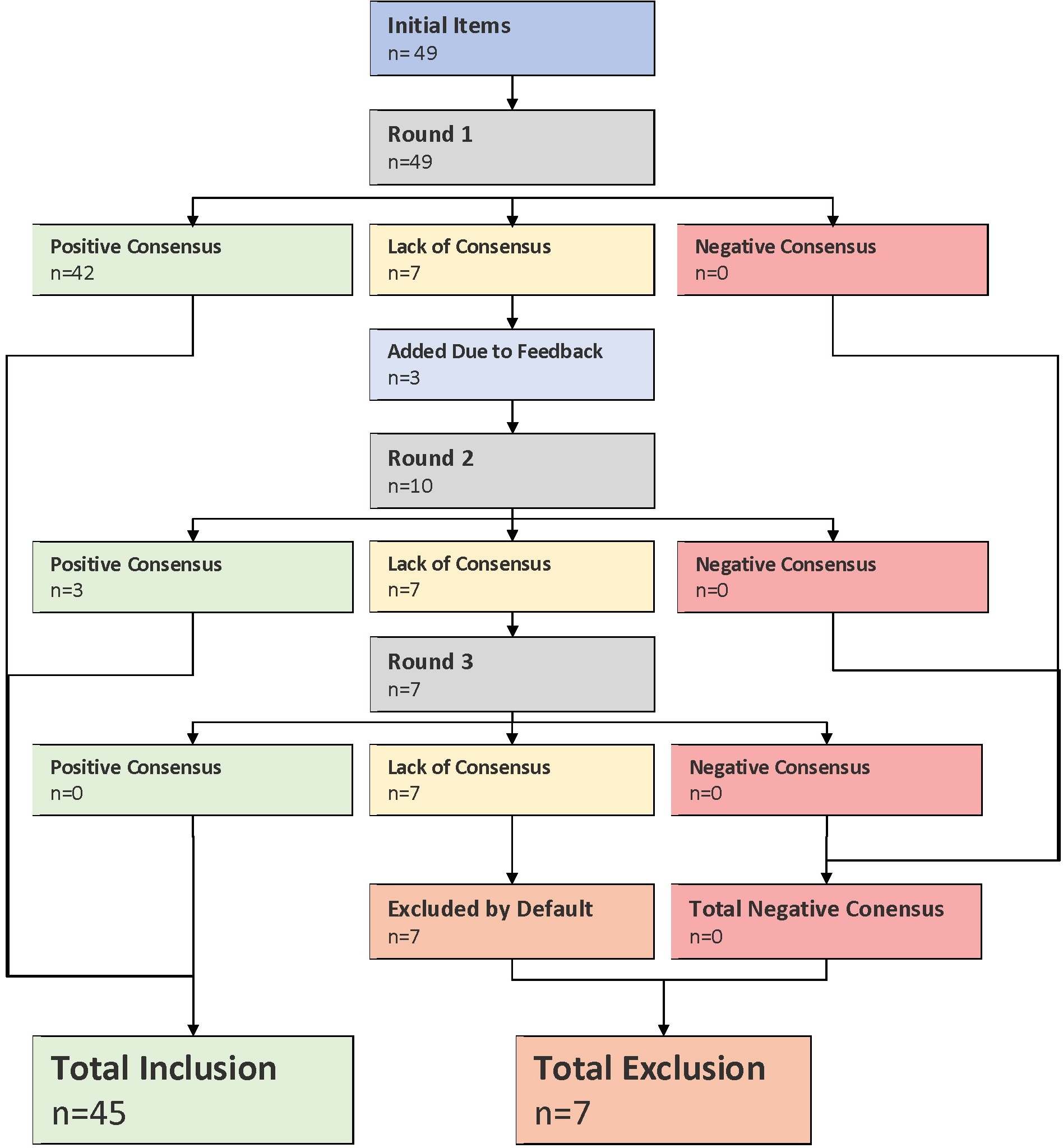
The response rate was 100% for all three rounds. Figure 1 provides an overview of the Delphi process by round. A total of 49 general competencies were drafted prior to round one. After round one, 42 items met positive consensus, seven lacked consensus, and none met negative consensus. After review of panelist feedback, three additional items were added for round two. After round two, three additional items met positive consensus, seven lacked consensus, and none met negative consensus. No additional items met positive or negative consensus during round three. After three rounds, a total of 45 general competencies met positive consensus. A total of seven general competencies lacked consensus and were excluded from the final list of general competencies. The final list of general competencies meeting positive consensus (Table 1) is organized by ACGME milestone, average Likert score, and Delphi round when consensus was met. The list of general competencies excluded due to lack of consensus (Table 2) is organized by ACGME milestone and average Likert score.
|
General competency
|
Round one positive consensus count
|
Round two positive consensus count
|
Round three positive consensus count
|
Average Likert score in included round
|
Round it was included
|
|
ACGME Milestone: Patient Care
|
|
Demonstrate understanding of the benefits and limitations of POCUS in patient care.
|
25
|
N/A
|
N/A
|
4.92
|
1
|
|
Identify when POCUS is indicated for diagnostic purposes of an acutely ill patient.
|
25
|
N/A
|
N/A
|
4.88
|
1
|
|
Effectively obtain consent from patients undergoing procedures using POCUS.
|
24
|
N/A
|
N/A
|
4.84
|
1
|
|
Identify when POCUS is not indicated for diagnostic purposes of an acutely ill patient.
|
24
|
N/A
|
N/A
|
4.84
|
1
|
|
Identify when POCUS is indicated for diagnostic purposes in patients with chronic illness.
|
25
|
N/A
|
N/A
|
4.76
|
1
|
|
Identify the benefits, risks, and complications when using POCUS for procedures.
|
24
|
N/A
|
N/A
|
4.76
|
1
|
|
Identify when POCUS is not indicated for diagnostic purposes in patients with chronic illness.
|
23
|
N/A
|
N/A
|
4.68
|
1
|
|
Understand when to perform POCUS guided versus POCUS assisted procedures.
|
23
|
N/A
|
N/A
|
4.56
|
1
|
|
Utilize of point-of-care ultrasound for health care screenings (ie, abdominal aortic aneurysm screening).
|
21
|
N/A
|
N/A
|
4.36
|
1
|
|
Perform ultrasound assisted procedures using POCUS.
|
21
|
N/A
|
N/A
|
4.36
|
1
|
|
Perform ultrasound guided procedures using POCUS.
|
20
|
N/A
|
N/A
|
4.32
|
1
|
|
ACGME Milestone: Medical Knowledge
|
|
Determine when a radiology performed ultrasound is indicated instead of POCUS.
|
25
|
N/A
|
N/A
|
4.88
|
1
|
|
Select the appropriate ultrasound probe for each specific clinical application.
|
25
|
N/A
|
N/A
|
4.80
|
1
|
|
Recognize normal anatomy on POCUS images.
|
25
|
N/A
|
N/A
|
4.76
|
1
|
|
Demonstrate proper probe placement and technique to acquire images for each clinical application.
|
24
|
N/A
|
N/A
|
4.72
|
1
|
|
Recognize pathologic findings on POCUS images.
|
25
|
N/A
|
N/A
|
4.68
|
1
|
|
Accurately interpret POCUS images within a clinical context.
|
25
|
N/A
|
N/A
|
4.64
|
1
|
|
Integrate POCUS findings into medical decision-making.
|
25
|
N/A
|
N/A
|
4.64
|
1
|
|
Recognize and differentiate key image artifacts from pathologic findings.
|
24
|
N/A
|
N/A
|
4.60
|
1
|
|
Apply image optimization techniques to improve the quality of POCUS images.
|
25
|
N/A
|
N/A
|
4.56
|
1
|
|
Identify and obtain the critical views required for each POCUS application.
|
24
|
N/A
|
N/A
|
4.56
|
1
|
|
Understand the as low as reasonably achievable (ALARA) principle and safety issues as they apply to ultrasound exposure.
|
23
|
N/A
|
N/A
|
4.56
|
1
|
|
Understand ultrasound physics and its relevance to image acquisition.
|
22
|
N/A
|
N/A
|
4.44
|
1
|
|
ACGME Milestone: Systems-Based Practice
|
|
Understand when POCUS findings warrant referral for a radiology performed ultrasound.
|
25
|
N/A
|
N/A
|
4.88
|
1
|
|
Maintain and decontaminate ultrasound machines to each machine’s standards.
|
24
|
N/A
|
N/A
|
4.48
|
1
|
|
Demonstrate understanding of the purpose of POCUS quality assurance.
|
22
|
N/A
|
N/A
|
4.36
|
1
|
|
Understand the ethical considerations related to the use of POCUS, including cost, access, and equity.
|
22
|
N/A
|
N/A
|
4.32
|
1
|
|
Identify contraindications for each POCUS application.
|
21
|
N/A
|
N/A
|
4.20
|
1
|
|
Understand basic principles of ultrasound billing and coding.
|
16
|
21
|
N/A
|
3.92
|
2
|
|
ACGME Milestone: Practice-Based Learning and Improvement
|
|
Integrate feedback from quality assurance to improve image acquisition skills.
|
23
|
N/A
|
N/A
|
4.36
|
1
|
|
Apply new POCUS evidence to improve medical decision-making.
|
17
|
21
|
N/A
|
3.96
|
2
|
|
ACGME Milestone: Professionalism
|
|
Respect patient boundaries and respond appropriately to discomfort during scanning.
|
25
|
N/A
|
N/A
|
4.96
|
1
|
|
Acknowledge uncertainties in POCUS findings and seek guidance or refer patients for radiology-performed ultrasound when appropriate.
|
25
|
N/A
|
N/A
|
4.88
|
1
|
|
Ensure patients are properly positioned and draped when performing a scan.
|
25
|
N/A
|
N/A
|
4.84
|
1
|
|
Understand how to optimize patient positioning.
|
24
|
N/A
|
N/A
|
4.60
|
1
|
|
Effectively perform an ultrasound scan on pediatric patients with empathy, fostering a comfortable and engaging environment to help them feel at ease.
|
23
|
N/A
|
N/A
|
4.56
|
1
|
|
When appropriate, utilize interpretation services to perform ultrasound and explain findings.
|
N/A added on Round 2
|
21
|
N/A
|
4.16
|
2
|
|
ACGME Milestone: Interpersonal Communication Skills
|
|
Effectively communicate the difference between POCUS and comprehensive ultrasound to patients.
|
25
|
N/A
|
N/A
|
4.80
|
1
|
|
Appropriately document POCUS findings in the medical record.
|
25
|
N/A
|
N/A
|
4.76
|
1
|
|
Effectively communicate POCUS findings to patients.
|
25
|
N/A
|
N/A
|
4.72
|
1
|
|
Clearly communicate POCUS findings to colleagues.
|
25
|
N/A
|
N/A
|
4.68
|
1
|
|
Tailor POCUS explanations to align with the patient’s health literacy level and cultural context.
|
22
|
N/A
|
N/A
|
4.56
|
1
|
|
Effectively explain the difference between educational scans vs those used for clinical decision-making.
|
23
|
N/A
|
N/A
|
4.52
|
1
|
|
Clearly explain to patients the process of image acquisition.
|
23
|
N/A
|
N/A
|
4.44
|
1
|
|
Appropriately label all ultrasound images.
|
22
|
N/A
|
N/A
|
4.32
|
1
|
|
Round 1 |
Round 2 |
Round 3 |
General competency |
Positive consensus count |
Average Likert score |
Positive consensus count |
Average Likert score |
Positive consensus count |
Average Likert score |
ACGME Milestone: Systems-Based Practice |
Troubleshoot common technical issues with ultrasound equipment. |
15 |
3.64 |
19 |
3.72 |
18 |
3.80 |
Understand administrative tasks necessary for credentialing and maintaining credentialing. |
N/A, added after round 1 |
14 |
3.48 |
10 |
3.16 |
Understand how ultrasound images are exported from ultrasound machines onto an external drive, mobile device, or electronic health record. |
14 |
3.64 |
10 |
3.40 |
8 |
3.12 |
Participate in quality improvement initiatives related to POCUS. |
11 |
3.40 |
7 |
2.92 |
2 |
2.32 |
ACGME Milestone: Practice-Based Learning and Improvement |
Understand the utility and differences between handheld and cart-based ultrasound devices. |
N/A, added after round 1 |
15 |
3.64 |
19 |
3.88 |
Stay current with advancements in POCUS by appraising the literature. |
9 |
3.44 |
13 |
3.36 |
13 |
3.40 |
Effectively teach POCUS image acquisition techniques. |
10 |
3.24 |
9 |
3.08 |
8 |
2.88 |
This study used a standardized, evidence-based Delphi process to establish the first set of POCUS general competencies for curricular use in US family medicine residencies. The general competencies defined in this study, although intended to be for family medicine, can be broadly applicable across all specialties teaching POCUS. This study identified 45 POCUS general competencies that family medicine residents should fulfill prior to completing training. These included 11 items in patient care, 12 items in medical knowledge, six items in systems-based practice, two items in practice-based learning and improvement, six items in professionalism, and eight items in interpersonal communication skills (Table 1). Given the number of competencies that met consensus, programs may consider a tiered implementation to choosing which competencies to assess as their POCUS programs grow. The competencies that did not meet consensus leaned toward administrative or scholarly activities, which likely are beyond the scope of residency and may be more applicable for fellows or faculty (Table 2).
The findings of our Delphi study align with conclusions from other general medicine POCUS studies,7,14 and its principles align globally across multiple specialties that perform POCUS.15-18 The 45 competencies established through the Delphi process are unique among prior studies because they identify general POCUS competencies. Although other studies have delineated key elements of competency, including direct observation items,7 this group believed that identifying the universal principles underlying the use of POCUS was equally important. Given the breadth of family physicians practice—from ambulatory medicine to global health settings—we sought to define a set of core POCUS principles that apply across any setting and application, which has never been comprehensively defined. These items were created within a framework of ACGME milestones so that programs can integrate POCUS general competencies into resident evaluations seamlessly.3 As programs work to incorporate POCUS education, these general competencies may serve to guide curriculum development and evaluation tools that assess longitudinal progress.
This study’s strengths were in the (a) diversity of panelist practice settings, geographic locations, and demographics; and (b) rigor of the Delphi process with a high consensus threshold providing content validation. One limitation was that this panel, regardless of makeup, could not fully represent the diversity of faculty at more than 800 family medicine residency programs.
This study laid out the groundwork concepts for future studies on POCUS competency assessment methods. In particular, future studies should look to develop and evaluate direct observation tools with entrustment scales for POCUS general competencies consistent with principles of competency-based medical education.19 The POCUS general competencies defined here can serve as a useful foundation and starting point for other specialties early in POCUS use such as infectious disease, urology, or otolaryngology.20-23
Dr Patel consults with the GE Healthcare point-of-care ultrasound team, giving input and feedback on device development and functionality specific to family medicine. Dr Patel does not have stock or equity interest in GE Healthcare. Dr Patel does not have relevant conflicts of interest from this work in relation to this publication.
This research was funded by the American Board of Family Medicine (ABFM) Foundation and the Society of Teachers of Family Medicine (STFM), the sponsors. Dr Ryan Paulus, Dr Puja Dalal, Dr Hiten Patel, and Dr Nicoll Capizzano received honoraria from STFM as core faculty in the separate STFM Family Medicine Educator’s POCUS Certificate Program. Neither ABFM nor STFM had roles in the design, analysis, or publication of this study.
The results of this Delphi process and study will be presented at the Society of Teachers of Family Medicine national conference as a workshop reviewing the general competencies for family medicine residents.
References
-
-
Hall JW, Holman H, Barreto TW, et al. Point-of-care ultrasound in family medicine residencies 5-year update: a CERA study.
Fam Med. 2020;52(7):505–511. doi:10.22454/FamMed.2020.223648
-
-
Kumar A, Kugler J, Jensen T. Evaluation of trainee competency with point-of-care ultrasonography (POCUS): a conceptual framework and review of existing assessments.
J Gen Intern Med. 2019;34(6):1025–1031. doi:10.1007/s11606-019-04945-4
-
Jünger S, Payne SA, Brine J, Radbruch L, Brearley SG. Guidance on Conducting and Reporting Delphi Studies (CREDES) in palliative care: recommendations based on a methodological systematic review..
Palliat Med. 2017;31(8):684–706. doi:10.1177/0269216317690685
-
LeFevre N, Hui W, Dalal P, et al. Recommended Point of Care Ultrasound (POCUS) Applications for U.S Family Medicine Residency Training: A National Delphi Study from the STFM POCUS Task Force. Fam Med. 2026;58(9).
-
Ma IWY, Desy J, Woo MY, Kirkpatrick AW, Noble VE. Consensus-based expert development of critical items for direct observation of point-of-care ultrasound skills.
J Grad Med Educ. 2020;12(2):176–184. doi:10.4300/JGME-D-19-00531.1
-
Oto B, Baeten R, Chen L, et al. Best practices for point of care ultrasound: an interdisciplinary expert consensus.
POCUS J. 2024;9(1):95–108. doi:10.24908/pocus.v9i1.17240
-
Kwon H, Lee JH, Suh D, You KM, Pulse Group. Developing a consensus-based POCUS protocol for critically ill patients during pandemics: a modified Delphi study.
Medicina (Kaunas). 2025;61(8):1319. doi:10.3390/medicina61081319
-
LoPresti CM, Murray KJ, Dancel R, et al. Internal medicine residency point-of-care ultrasound (POCUS) consensus recommendations for core indications and applications.
Am J Med. 2025;138(12):1705–1715. doi:10.1016/j.amjmed.2025.05.033
-
Gold D, Levine M, Hsu D, et al. Design of a point-of-care ultrasound curriculum for pediatric emergency medicine fellows: a Delphi study.
AEM Educ Train. 2021;5(4):e10700. doi:10.1002/aet2.10700
-
Mizubuti GB, Maxwell S, Shatenko S, et al, Canadian Anesthesiology POCUS Consortium. Competencies for proficiency in basic point-of-care ultrasound in anesthesiology: national expert recommendations using Delphi methodology.
Can J Anaesth. 2024;71(7):967–977. doi:10.1007/s12630-024-02746-w
-
Cormack CJ, Childs J, Kent F. Competencies required by sonographers teaching ultrasound interprofessionally: a Delphi consensus study.
BMC Med Educ. 2024;24(1):970. doi:10.1186/s12909-024-05933-x
-
Torres-Macho J, Aro T, Bruckner I, et al, EFIM´s ultrasound working group. Point-of-care ultrasound in internal medicine: a position paper by the ultrasound working group of the European federation of internal medicine.
Eur J Intern Med. 2020;73:67–71. doi:10.1016/j.ejim.2019.11.016
-
-
-
Kirkpatrick JN, Grimm R, Johri AM, et al. Recommendations for echocardiography laboratories participating in cardiac point of care cardiac ultrasound (POCUS) and critical care echocardiography training: report from the American Society of Echocardiography.
J Am Soc Echocardiogr. 2020;33(4):409–422. doi:10.1016/j.echo.2020.01.008
-
De Robertis V, Bilardo CM, Abu‐Rustum R, et al, Collaborators. ISUOG Practice Guidelines: point-of-care ultrasound in obstetrics and gynecology.
Ultrasound in Obstet & Gyne. 2026;67(1):116–127. doi:10.1002/uog.70122
-
Bell C, Hall AK, Wagner N, Rang L, Newbigging J, McKaigney C. The ultrasound competency assessment tool (UCAT): development and evaluation of a novel competency-based assessment tool for point-of-care ultrasound.
AEM Educ Train. 2021;5(3):e10520. doi:10.1002/aet2.10520
-
Warner NC, Alavian N, Dancel R. Practical application of point-of-care ultrasound for the infectious disease clinician.
Clin Infect Dis. 2025;ciaf348. doi:10.1093/cid/ciaf348
-
-
Uy M, Lovatt CA, Hoogenes J, Bernacci C, Matsumoto ED. Point-of-care ultrasound in urology: design and evaluation of a feasible introductory training program for Canadian residents.
Can Urol Assoc J. 2021;15(4):E210–E214. doi:10.5489/cuaj.6637
-
Liao LJ, Wen MH, Yang TL. Point-of-care ultrasound in otolaryngology and head and neck surgery: a prospective survey study.
J Formos Med Assoc. 2021;120(8):1547–1553. doi:10.1016/j.jfma.2021.02.021



There are no comments for this article.