Background and Objectives: Multiple organizations and accrediting bodies support or require teaching of point-of-care ultrasound (POCUS) in US family medicine residency programs. To date, no evidence-based approach has been used to determine which of the numerous POCUS applications should be required components of curricula. A task force of expert POCUS educators sponsored by the American Board of Family Medicine Foundation and the Society of Teachers of Family Medicine was formed to conduct research and draft guidelines addressing these gaps.
Methods: We conducted a traditional three-round Delphi study with a national group of 25 expert panelists, all POCUS educators at US family medicine residency programs. Panelists were diverse in geographic location, practice setting, and scope of practice. A systematic literature search identified 243 potentially relevant clinical applications of POCUS. Surveys were administered to the panel with anchored Likert scale questions. Rounds were iterative and anonymous, with 80% agreement required for consensus. Clinical applications that did not meet consensus after three rounds were excluded.
Results: Three Delphi rounds were completed with a 100% response rate for each. Among the applications, 54 met positive consensus for inclusion, 41 met consensus for exclusion, and the remaining 162 were excluded for lack of consensus.
Conclusions: US family medicine residency programs should prioritize these 54 consensus applications when structuring POCUS curricular implementation plans with a goal of facilitating graduating residents’ competency in these clinical applications.
Point-of-care ultrasound (POCUS) has been a long-standing component of education and practice in certain US medical specialties, such as obstetrics/gynecology and emergency medicine. Inclusion in family medicine training and practice is more recent but has been growing rapidly. As of 2015, only 2.2% of family medicine residencies reported having a POCUS curriculum,1 but by 2020, 15% reported an established POCUS curriculum, with another 38% actively working on establishing one.2 A 2021 survey of department chairs reported that 81% of family medicine departments had at least one POCUS-trained faculty.3 In concert with this growth of interest and training, various accrediting bodies and professional organizations now encourage or require POCUS education in family medicine training. In 2023, the Accreditation Council for Graduate Medical Education added POCUS education as a requirement for family medicine residency programs4; and in 2024, the American Board of Family Medicine (ABFM) announced a plan to require POCUS for board eligibility beginning in 2027.5
When surveyed, most family medicine residents and faculty agree that POCUS is an important part of primary care practice6; however, implementation into routine clinical practice remains limited and faces many barriers. A Medicare claims-based study (2012–2017) reported less than 10% of primary care physicians billing for any POCUS7—consistent with a 2021 study of US family medicine department chairs, of whom only 6% reported infrastructure for billing.3 Even more recent residency graduates rarely use POCUS in practice; the 2024 ABFM National Graduate Survey found that only 25% of graduates 3 years postresidency reported using POCUS in practice.8 Barriers to implementation include lack of defined scope of practice, credentialing or liability concerns, need for more trained faculty, lack of quality assurance programs, and challenges recouping or justifying the costs of initial investments.9-12
One key factor underlying the discrepancy between interest in POCUS and its incorporation into practice is the lack of consensus on what to prioritize in training. The first iteration of family medicine curriculum guidelines was published by the American Academy of Family Physicians (AAFP) in 2016 and updated in 2021.13 The guidelines are highly comprehensive, and rather than prioritizing among the many applications listed, they recommend tailoring to the needs of each program. The need remains for family medicine to define its core educational focus for ultrasound. Other specialties with more mature POCUS implementation, such as emergency medicine, benefit from clear, nationally sponsored guidelines on scope and privileging.14
Recognizing this need, a Family Medicine POCUS Task Force was formed in 2024 to work on finding consensus for POCUS standards in family medicine education and competency-based assessment. Among the task force’s objectives was the development of an evidence-based consensus on which of the many POCUS applications US family medicine residency graduates should be competent in by the end of residency training.
In considering research strategies to inform a recommendation statement, the task force acknowledged that consensus would be best guided by empirical, real-world evidence—for example, studies identifying which POCUS applications most influence clinical decision-making, most meaningfully improve patient-oriented outcomes, or are most commonly performed across primary care settings by clinicians with established training and resources. Although such studies are emerging, a gap remains in family medicine–focused literature. In the absence of a sufficient empirical evidence base to define which POCUS applications should be taught to all family physicians—and recognizing the many POCUS experts already embedded within US family medicine residency programs—the task force selected a rigorous, traditional Delphi design, an established method for achieving expert consensus.
Delphi Quality Standards
The study was structured in accordance with the Conducting and REporting DElphi Studies (CREDES) criteria for rigorous conduct and reporting.15 Voting rounds and consensus criteria were decided a priori. A quality reporting checklist, modeled after the CREDES criteria, is provided in Supplemental Table 1.
Panel Selection and Expertise
To recruit panelists, an informational post was published to the Society of Teachers of Family Medicine POCUS Collaborative and the AAFP POCUS Member Interest Group, inviting individuals to submit a curriculum vitae and a statement of interest. A key initial group of family medicine POCUS leaders, selected by the project’s principal investigator (R.P.), also nominated panelists for review. The scope of family medicine practice is broad, and residency training programs vary in educational emphasis. Accordingly, in addition to POCUS expertise, panelists were intentionally selected to represent a range of practice locations, employer types, primary clinical focus, practice scope, gender, and rurality. Through this process, 12 family physicians were selected to serve on the core POCUS task force. To ensure diversity and strengthen the Delphi process with a larger group of experts, 13 additional voting panelists (POCUS education experts) were selected. These members were chosen from applications submitted to the task force and were selected partly to fill perspective gaps (practice settings, scopes, or geographic locations absent from the core task force). All panelists were required to have POCUS expertise, to dedicate at least 0.3 full-time equivalent (FTE) to direct patient care, to teach POCUS at a US family medicine residency program, and to be free of significant conflicts of interest. The final group of 25 voting panelists broadly reflected the diversity and scope of practice within the family medicine discipline (as detailed in Table 1).
|
Years since graduating residency
|
Average POCUS scans performed weekly in clinical care
|
|
0 to 5
|
9
|
0 to 5
|
7
|
|
6 to 10
|
11
|
6 to 10
|
8
|
|
11 to 15
|
4
|
11 to 15
|
5
|
|
16 to 20
|
1
|
16 to 20
|
3
|
|
Gender
|
21 to 25
|
1
|
|
Male
|
15
|
>25
|
1
|
|
Female
|
10
|
Average self-reported hours teaching POCUS weekly
|
|
Race/ethnicity
|
0 to 5
|
8
|
|
White
|
13
|
6 to 10
|
8
|
|
Asian
|
10
|
11 to 15
|
3
|
|
Hispanic or Latino
|
2
|
>15
|
6
|
|
Other
|
1
|
Source(s) of POCUS education among panelists (multiple allowed)
|
|
Geographic region
|
Independent study
|
16
|
|
South
|
11
|
Formal short courses
|
14
|
|
West
|
7
|
In-person POCUS fellowship
|
10
|
|
Midwest
|
5
|
Ultrasound training integrated into residency
|
9
|
|
Northeast
|
2
|
Virtual POCUS fellowship
|
1
|
|
Years using POCUS in clinical care
|
Residency program size
|
|
0 to 5
|
13
|
0 to 15
|
2
|
|
6 to 10
|
6
|
16 to 30
|
9
|
|
11 to 15
|
5
|
31 to 45
|
8
|
|
16 to 20
|
1
|
>45
|
6
|
|
Majority of direct patient care time is spent
|
Principal employer
|
|
Outpatient care
|
17
|
Academic health center/faculty practice
|
15
|
|
Inpatient care
|
3
|
Hospital/health-system owned medical practice
|
5
|
|
Urgent care
|
2
|
Federally qualified health center or look-alike
|
3
|
|
Emergency department
|
1
|
Federal
|
2
|
|
Sports medicine
|
1
|
Where direct clinical care is provided (rurality)
|
|
Obstetrical care
|
1
|
Micropolitan (urban population of >20,000 but <250,000)
|
12
|
|
All patient care areas included in scope of practice
|
Urban (counties in metro areas of >250,000 people)
|
10
|
|
Outpatient care
|
24
|
Large rural (population of 5,000 to 20,000)
|
5
|
|
Inpatient care
|
19
|
Small rural (population <5,000)
|
3
|
|
Obstetrical care
|
11
|
|
Urgent care
|
10
|
Self-assessed POCUS proficiency as per EM milestone definitions (1–5, 5 = expert)
|
|
Emergency department
|
8
|
Level 2
|
2
|
|
Nursing home
|
5
|
Level 4
|
1
|
|
Home-based care
|
1
|
Level 5
|
22
|
Literature Review, Item Drafting, and Survey Creation
A University of North Carolina (UNC) medical librarian conducted a literature review of relevant POCUS application studies (Supplemental Figure 1), and then study leads (R.P., N.L.) filtered key studies of primary care relevant application compendia. The final list of starting resources from the search included application compendia from other specialties (internal medicine, emergency medicine), curricular guidelines and texts from emergency medicine and family medicine, and other comparable Delphi studies from internal medicine and family medicine.14,16-20 These articles and resources, as well as some already known to the task force (eg, the AAFP POCUS curriculum guidelines13 and relevant textbooks), were used to draft POCUS clinical application items for inclusion in the study. To produce an inclusive list, each core task force member drafted application items for one organ system, including all applications from the provided resources and, if necessary, additional applications based on their expert knowledge. Subsequently, they peer-reviewed application items for two additional organ systems using the provided text of the key resources and expert knowledge. Nonpanelist research team members (P.S., S.B.), as well as a group of UNC family medicine resident physicians, peer-reviewed all items for clarity and drafted additional items based on a review of the provided resources. Writers and reviewers were instructed not to exclude items from the initial list based on individual judgments. Surveys were built in Qualtrics (Qualtrics LLC). They were iteratively piloted internally by research team members and externally by resident physicians at UNC family medicine to assess time to completion, technical function, writing clarity, and readability prior to dissemination to panelists.
Panel Demographics
Each panelist completed an institutional review board–approved consent form and demographics survey prior to Delphi round one. Questions on practice patterns and employer characteristics were developed to align with standard definitions from ABFM.8 The results are shown in Table 1. Panelists were 60% male and 40% female, practiced in 18 states, and were 50% White, 38% Asian, and 8% Hispanic. Eighty percent had fewer than 10 years of practice after residency, with most (44%) between 6 and 10 years. The clinician scope of practice, residency program size, and employer type were diverse. Ninety-six percent practiced at least some outpatient care, with 68% reporting that outpatient care was the primary setting for the majority of their patient care time. Although all panelists were selected for their ultrasound expertise, no universally accepted, valid external measure of such competence exists. For this reason, panelists were asked to self-report their ultrasound competence in alignment with levels defined by a multiorganizational emergency medicine milestone revision task force,21 with most panelists identifying as experts. All panelists were current family medicine residency POCUS educators, and 80% had presented on POCUS at national meetings. Practice rurality definitions were collapsed from those provided by the US Department of Agriculture Economic Research Service.22 Thirty-two percent of panelists reported practicing at least a portion of their time in a rural area. Notably, most participants reported receiving their POCUS education outside of core residency training; 44% (11/25) had completed a formal POCUS fellowship.
Voting Framework and Principles
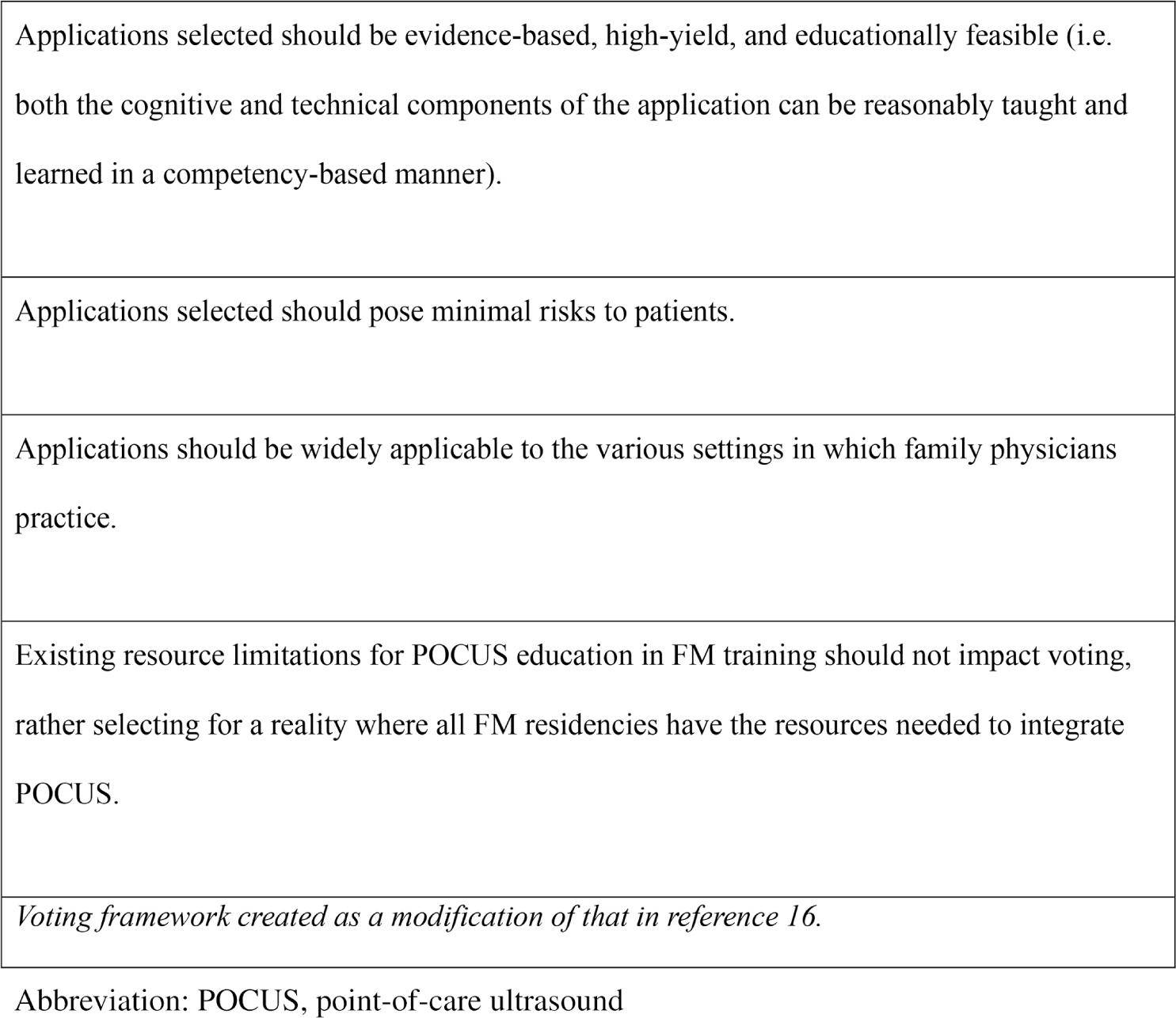
We developed a modified version of the framework described in a similar IM POCUS Delphi study by Ma et al.16 to guide panelists’ voting (Figure 1). These principles were communicated to panelists before round one, in writing and via a prerecorded presentation, and were included at the top of each Qualtrics survey round. Participants were invited to ask clarifying questions before round one. For procedural applications, panelists were instructed to vote on the premise that consensus would imply that the procedure should be taught in US family medicine residency programs and, when taught, that it should be performed with ultrasound guidance. Ultrasound guidance for procedures varies, and the specific procedural technique (eg, static vs dynamic) was not specified.
Voting and Definitions of Consensus
Three Delphi rounds were conducted between February and July 2025. In each round, items were rated on a traditional 5-point anchored Likert scale (fully disagree-1; partially disagree-2; neutral-3; partially agree-4; fully agree-5). Panelists were asked to rate their agreement with the statement “It is important for a graduating family medicine resident to obtain and interpret ultrasound findings consistent with . . .?” followed by the various applications in that organ system. Open-ended feedback was solicited in each round through two questions: one addressing any issues with item clarity or wording, and another identifying any POCUS applications that were missing and should be included in the next round.
A review of consensus thresholds across Delphi studies found a median of 75%.23 For rigor and in recognition of the various challenges to ultrasound implementation, 80% was chosen a priori as the definition of consensus for either exclusion or inclusion (at least 20 of 25 panelists). Based on the detailed principles described by Fitch et al.,24 we defined consensus as agreement without significant dissent. Definitions of positive consensus, negative consensus, lack of consensus, and minority dissent are provided in Table 2. Items meeting positive or negative consensus were removed from future rounds of voting. Items that did not meet these consensus criteria in round one were advanced to round two for voting. Items not meeting consensus in round two were advanced to round three for voting. We decided in advance that consensus would not be forced after round three and that any applications still lacking consensus at that stage would be excluded by default. Doing so prioritized fewer applications for a national core list of exams but doesn’t imply the irrelevance of these exams. Each of these applications lacking consensus is provided in full in Supplemental Table 2.
Application |
An individual point-of-care ultrasound application included for voting (eg, diagnosis of knee effusion) |
Consensus |
Group agreement on an application—either for inclusion or exclusion |
Significant minority dissent |
A notable level of disagreement, defined as two or more panelists voting in opposition on an item that would otherwise meet the criteria for group consensus |
Negative consensus (exclusion) |
At least 80% of panelists (more than 20) voting 1 (“completely disagree”) or 2 (“partially disagree”), without significant minority dissent, which was defined as two or more panelists voting 5 (“completely agree”) |
Positive consensus (inclusion) |
Agreement was defined as at least 80% of panelists (more than 20) voting 5 (“strongly agree”) or 4 (“agree”), without significant minority dissent, which was defined as two or more panelists voting 1 (“completely disagree”) |
Lack of consensus (consider in next round) |
Meeting neither positive nor negative consensus |
Feedback Between Rounds and Mitigation of Bias
Methodological choices in the study design emphasized safeguards to minimize bias introduced by panelists or research team members. First, no discussion rounds were conducted. Traditional Delphi studies are iterative and anonymous, allowing group consensus to emerge without the loudest voice in the room having undue influence.25 Having no discussion prevents a particularly passionate or persuasive panelist from steering the group’s trajectory. Between rounds, each panelist received a written summary of the prior round’s results, including items that met positive consensus, negative consensus, and those that lacked consensus. They also received the quantitative scores for each item from the prior round and an explicit list of applications that had been reworded or added in response to panelist feedback.
Second, consensus criteria were defined a priori, preventing post hoc threshold adjustment based on emerging results. Third, item generation and survey instruments underwent external peer review, and nonvoting contributors participated in item development and pilot testing. Fourth, all individual-level data were managed by a nonvoting research coordinator (S.B.), with only de-identified, aggregate summaries shared between rounds to maintain anonymity. Finally, any modifications to item wording between rounds were adjudicated by nonvoting senior investigators (P.S., S.Z.). Nonvoting research team members (S.B., P.S., S.Z.) independently reviewed the fidelity of the data collected, the data displayed, and the integrity of the final manuscript. Collectively, these measures were designed to preserve methodological rigor and minimize the potential for investigator bias in accordance with established Delphi guidance.
The study protocol was submitted to the University of North Carolina at Chapel Hill Institutional Review Board and was determined to be exempt from full review as nonhuman subjects research (IRB Number 24–2360).
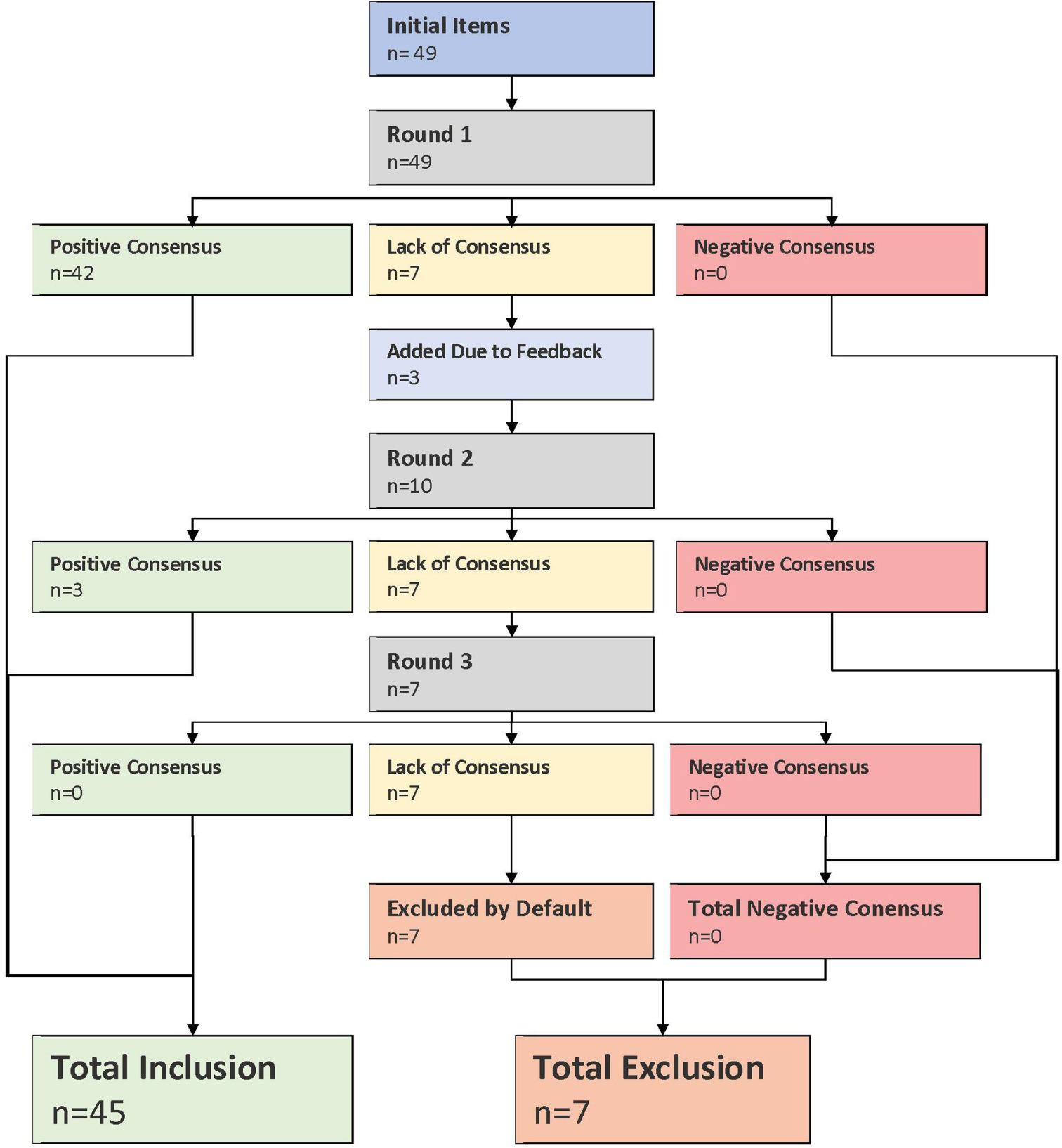
The flow of ultrasound applications meeting consensus across rounds is summarized in Figure 2. After round one, 50 of 243 items met positive consensus, three met negative consensus, and 190 did not reach consensus. After reviewing panelist feedback, 18 items were added for round two, and four items were revised. After round two, four additional items met positive consensus, and 21 additional items met negative consensus. Round three produced no further positive consensus items but yielded 17 additional negative consensus items. In total, after three rounds of voting, 54 total applications met positive consensus. A total of 203 items were excluded for either negative (n = 41) or lack of consensus (n = 162). The final list of applications meeting positive consensus is organized by organ system, average Likert score, and Delphi round in Table 3. The final list of applications with negative consensus is organized by organ system, average Likert score, and round, and is provided as Supplemental Table 3. For reference, the full list of items excluded for lack of consensus after three rounds is provided in Supplemental Table 2.
|
Body system
|
Application
|
Round one positive consensus count
|
Round two positive consensus count
|
Round three positive consensus count
|
Average likert score in included round
|
Round it was included
|
|
Pulmonary
|
|
|
Pleural effusion
|
25
|
N/A
|
N/A
|
4.92
|
Round 1
|
|
Pneumonia
|
24
|
N/A
|
N/A
|
4.68
|
Round 1
|
|
Pulmonary edema
|
24
|
N/A
|
N/A
|
4.76
|
Round 1
|
|
Pneumothorax
|
23
|
N/A
|
N/A
|
4.28
|
Round 1
|
|
Cardiac
|
|

|
Dilated cardiomyopathy
|
16
|
20
|
N/A
|
3.76
|
Round 2
|
|
Right ventricular strain
|
19
|
21
|
N/A
|
3.96
|
Round 2
|
|
Pericardial effusion
|
25
|
N/A
|
N/A
|
4.92
|
Round 1
|
|
Heart failure with reduced ejection fraction
|
25
|
N/A
|
N/A
|
4.88
|
Round 1
|
|
Left ventricular hypertrophy
|
21
|
N/A
|
N/A
|
4
|
Round 1
|
|
Cardiac tamponade
|
20
|
N/A
|
N/A
|
4.24
|
Round 1
|
|
Obstetric and gynecologic
|
|

|
Uterine position (ie, anteverted, retroverted)
|
19
|
20
|
N/A
|
3.96
|
Round 2
|
|
Intrauterine pregnancy identification
|
25
|
N/A
|
N/A
|
4.88
|
Round 1
|
|
Fetal position and presentation
|
25
|
N/A
|
N/A
|
4.48
|
Round 1
|
|
Fetal heart rate
|
25
|
N/A
|
N/A
|
4.76
|
Round 1
|
|
Intrauterine device
|
24
|
N/A
|
N/A
|
4.4
|
Round 1
|
|
Amniotic fluid measurement
|
23
|
N/A
|
N/A
|
4.36
|
Round 1
|
|
Pregnancy dating by crown rump length
|
23
|
N/A
|
N/A
|
4.44
|
Round 1
|
|
Placental location
|
21
|
N/A
|
N/A
|
4.12
|
Round 1
|
|
Multiple gestation
|
21
|
N/A
|
N/A
|
4.16
|
Round 1
|
|
Soft tissue
|
|
|
Cellulitis
|
25
|
N/A
|
N/A
|
4.92
|
Round 1
|
|
Abscess
|
25
|
N/A
|
N/A
|
4.92
|
Round 1
|
|
Foreign body
|
25
|
N/A
|
N/A
|
4.68
|
Round 1
|
|
Lipoma
|
25
|
N/A
|
N/A
|
4.56
|
Round 1
|
|
Cyst (epidermal inclusion cyst)
|
25
|
N/A
|
N/A
|
4.48
|
Round 1
|
|
Edema
|
24
|
N/A
|
N/A
|
4.52
|
Round 1
|
|
Soft tissue mass
|
22
|
N/A
|
N/A
|
4.2
|
Round 1
|
|
Vascular
|
|
|
Lower extremity proximal DVT
|
23
|
N/A
|
N/A
|
4.64
|
Round 1
|
|
Inferior vena cava diameter (central venous pressure elevation)
|
N/A
|
24
|
N/A
|
4.24
|
Round 2
|
|
Inferior vena cava collapsibility (central venous pressure elevation)
|
25
|
N/A
|
N/A
|
4.68
|
Round 1
|
|
Abdominal aortic aneurysm
|
25
|
N/A
|
N/A
|
4.8
|
Round 1
|
|
Procedural
|
|

|
Abscess drainage
|
24
|
N/A
|
N/A
|
4.76
|
Round 1
|
|
Foreign body removal
|
23
|
N/A
|
N/A
|
4.36
|
Round 1
|
|
Soft tissue mass removal
|
22
|
N/A
|
N/A
|
4.32
|
Round 1
|
|
Knee joint injection/aspiration
|
22
|
N/A
|
N/A
|
4.4
|
Round 1
|
|
Intrauterine device placement
|
21
|
N/A
|
N/A
|
4.24
|
Round 1
|
|
Paracentesis
|
21
|
N/A
|
N/A
|
4.24
|
Round 1
|
|
Musculoskeletal
|
|

|
Knee effusion
|
25
|
N/A
|
N/A
|
4.68
|
Round 1
|
|
Baker’s cyst
|
25
|
N/A
|
N/A
|
4.52
|
Round 1
|
|
Ganglion cyst
|
23
|
N/A
|
N/A
|
4.2
|
Round 1
|
|
Shoulder effusion
|
21
|
N/A
|
N/A
|
3.96
|
Round 1
|
|
Carpal tunnel syndrome
|
21
|
N/A
|
N/A
|
4.08
|
Round 1
|
|
Hematoma
|
20
|
N/A
|
N/A
|
3.96
|
Round 1
|
|
Fracture
|
20
|
N/A
|
N/A
|
4
|
Round 1
|
|
Achilles tear
|
20
|
N/A
|
N/A
|
4.12
|
Round 1
|
|
Abdominal or biliary
|
|

|
Gallbladder sludge
|
23
|
23
|
N/A
|
4.08
|
Round 2
|
|
Free fluid in the abdomen
|
25
|
N/A
|
N/A
|
4.84
|
Round 1
|
|
Cholelithiasis
|
24
|
N/A
|
N/A
|
4.8
|
Round 1
|
|
Cholecystitis
|
22
|
N/A
|
N/A
|
4.44
|
Round 1
|
|
Renal or bladder
|
|

|
Hydronephrosis
|
25
|
N/A
|
N/A
|
4.76
|
Round 1
|
|
Bladder volume
|
24
|
N/A
|
N/A
|
4.8
|
Round 1
|
|
Simple renal cyst
|
23
|
N/A
|
N/A
|
4.4
|
Round 1
|
|
Foreign body (Foley catheter) in bladder
|
23
|
N/A
|
N/A
|
4.32
|
Round 1
|
|
Nephrolithiasis
|
20
|
N/A
|
N/A
|
3.88
|
Round 1
|
|
Ocular
|
|

|
Retinal detachment
|
20
|
N/A
|
N/A
|
4
|
Round 1
|
This study presents the first evidence-based consensus approach to determining which POCUS applications should be taught in US family medicine residency programs. We identified 54 POCUS applications that met consensus criteria for all residents to learn before completing training. These included four pulmonary, six cardiac, nine obstetric or gynecologic, four vascular, six procedural, seven soft tissue-related, eight musculoskeletal, four abdominal or biliary, five urinary, and one ocular application.
Our findings align closely with previous US internal medicine and European primary care studies that utilized expert panels and Delphi methods to find consensus and prioritize high-yield, generalist-relevant POCUS exams for curriculum development.26,27 Both our study and the recent European Delphi study included primary care physicians using POCUS who practiced primarily in outpatient settings—an important feature of this study, given the ultimate practice location of most US family medicine graduates; 77%–81% of family medicine residency graduates practice in an outpatient continuity clinic setting.28 In contrast, the internal medicine study included 50% (7/14) POCUS experts who did not practice outpatient medicine.26 Our Delphi consensus results on family medicine POCUS applications closely mirror those of the European study, providing a measure of external validity. Notably, of 40 consensus applications in the European study, our consensus list included 30.27 Our final POCUS applications also closely align with the results of other previous international primary care POCUS Delphi studies.28-33 Our consensus list includes more musculoskeletal and obstetric applications, reflecting the comprehensive nature of the family medicine discipline and its training requirements. In addition, the finalized family medicine POCUS applications include six ultrasound-assisted/guided procedures, which were absent from the European study. Compared with the internal medicine study,26 we did not reach consensus on some common procedural applications, such as thoracentesis, peripheral IV, lumbar puncture, and central venous catheterization, which may be more relevant in the more hospital-centric internal medicine discipline. Our results heavily emphasize procedures performed in the outpatient clinic setting. Overall, similarities with prior studies support external validity across primary care disciplines, while differences underscore the unique contribution of this study: development of the first US family medicine–specific prioritization framework reflecting the specialty’s outpatient continuity focus, broader procedural scope, and comprehensive training expectations.
Our study had several strengths: the comprehensiveness of the initial list of exams, the expertise and diversity of the panelists, rigorous adherence to quality guidelines for Delphi studies, a 100% response rate, and external validity demonstrated by comparison with other similar studies in the field. Limitations of this study were largely related to the level of evidence derived from the Delphi method itself. Given the breadth of family medicine and the number of family medicine residency programs, we could not possibly represent all settings or points of view. Despite our attempt to include the range of geographic and practice settings in our task force, complete representativeness is never possible in a Delphi panel.
Standardization of curricula across family medicine residencies is not a challenge unique to POCUS. Individual programs with varied settings and focuses are likely to view the list (and the list of excluded items) and see applications that feel more or less relevant. However, the formation of the task force was intentional to include a breadth of program types, practice settings, and geographic variation. As mentioned previously, the Delphi method was chosen because of the lack of empirical, real-world evidence to guide recommendations. These studies should be prioritized in future research and used to revise family medicine POCUS curricular guidelines.
Using the results of this Delphi study, the task force recommends that curricular development and implementation efforts in the family medicine discipline center around the future goal of each family medicine resident gaining competency in each of these applications prior to graduation. As previously stated, numerous active barriers exist to POCUS implementation, and the task force does not claim that this list represents a realistic current state or advise that accrediting bodies move toward requiring each of these exams immediately. In fact, our voting framework instructed panelists to ignore current resource constraints. To realize this goal, POCUS infrastructure and faculty expertise in US family medicine residency programs will need to mature significantly. A separately published paper using the nominal group method tiers these applications by implementation priority.34 The totality of these two studies should help guide accrediting and regulatory organizations as the discipline weighs future steps amid competing educational priorities.
Dr Patel consults with the GE Healthcare point-of-care ultrasound team, giving input and feedback on device development and functionality specific to family medicine. Dr Patel does not have stock or equity interest in GE Healthcare. Dr Patel does not have relevant conflicts of interest from this work in relation to this publication.
This research was funded by the American Board of Family Medicine (ABFM) Foundation and sponsored by both ABFM and the Society of Teachers of Family Medicine (STFM). Dr Ryan Paulus, Dr Puja Dalal, Dr Hiten Patel, and Dr Nicoll Capizzano received honoraria separately from STFM as core faculty in the STFM Family Medicine Educator’s POCUS Certificate Program. Neither ABFM nor STFM had roles in the design, analysis, or publication of this study.
Preliminary data were presented as a poster at the 2025 North American Primary Care Research Group Conference, Atlanta, GA, November 21–25, 2025.Overview of this content was presented at the World Organization of Family Doctors (WONCA) World 2025 in Lisbon and Portugal, and at the Society of Clinical Ultrasound Fellowships Annual meeting 2025 in St. Louis, MO. However, the content presented did not reveal the details of the results and discussed only the process and steps.
We express our gratitude to the group of medical students and residents at the University of North Carolina at Chapel Hill (UNC) who contributed to this project with their time and knowledge: medical students Carolyn Christ, Asia Brannon, Jordan Swandell, and Jack O’Hara for their work building the Delphi surveys; and residents Miniraj Jeyaraju, Brooke Hess, Sheridan Finnie, and Brian Elgart who peer-reviewed all survey content.
We thank the expert physician panelists for taking the time to complete the Delphi surveys:
Paul Bornemann, MD, University of South Carolina School of Medicine
Benjamin Bryden, MD, University of Montana
Nicoll Capizzano, MD, University of Michigan
Rachel Carter, MD, Naval Medical Center Camp Lejeune
Matt Chan, MD, Oregon Health Sciences University
Puja Dalal, MD, Novant Health
John Doughton, MD, University of North Carolina
Kyle Flattery, MD, Brown University
Bradley Green, MD, Gadsen Regional Medical Center
William Hui, MD, Stanford University School of Medicine
Jerica Johnson, MD, University of New Mexico
Nicholas LeFevre, MD, University of Missouri
Andrea Lewis, DO, Southern Colorado Family Medicine
Daniela Lobo, MD, Indiana University
Alex McDonald, MD, Kaiser Permanente Fontana Medical Center
Natalie Nguyen, DO, Kaiser Permanente Los Angeles Medical Center
Hiten Patel, MD, The Ohio State University
Ryan Paulus, DO, University of North Carolina
Anthony Recidoro, DO, Camp Pendleton Family Medicine Residency Program
Summer Scavone, MD, University of Virginia
Joy Shen-Wagner, MD, Prism Health
Varshaben Songara, MD, Cape Fear Valley Health
Johnny Tenegra, MD, Southern Illinois University
Ryan Trantham, MD, Ascension Providence Hospital
Nick Weida, MD, Lawrence Family Medicine Residency Program
References
-
-
Hall JW, Holman H, Barreto TW, et al. Point-of-care ultrasound in family medicine residencies 5-year update: a CERA study.
Fam Med. 2020;52(7):505–511. doi:10.22454/FamMed.2020.223648
-
Capizzano JN, O’Dwyer MC, Furst W, et al. Current state of point-of-care ultrasound use within family medicine.
J Am Board Fam Med. 2022;35(4):809–813. doi:10.3122/jabfm.2022.04.220019
-
-
-
Ludden-Schlatter A, Kruse RL, Mahan R, Stephens L. Point-of-care ultrasound attitudes, barriers, and current use among family medicine residents and practicing physicians.
PRiMER. 2023;7:13. doi:10.22454/PRiMER.2023.967474
-
Niblock F, Byun H, Jabbarpour Y. Point-of-care ultrasound use by primary care physicians.
J Am Board Fam Med. 2021;34(4):859–860. doi:10.3122/jabfm.2021.04.200619
-
-
Arnold AC, Fleet R, Lim D. Barriers and facilitators to point-of-care ultrasound use in rural Australia.
Int J Environ Res Public Health. 2023;20(10):5821. doi:10.3390/ijerph20105821
-
Nathanson R, Williams JP, Gupta N, et al. Current use and barriers to point-of-care ultrasound in primary care: a national survey of VA medical centers.
Am J Med. 2023;136(6):592–595. doi:10.1016/j.amjmed.2023.01.038
-
Smith M, Krishnan SV, Leamon A, et al. Removing barriers to emergency medicine point-of-care ultrasound: illustrated by a roadmap for emergency medicine point-of-care ultrasound expansion in India.
J Emerg Trauma Shock. 2023;16(3):116–126. doi:10.4103/jets.jets_50_23
-
Järvinen J, Hannula O, Meuronen A, Mattila K. Perceptions and barriers to the use and training of point-of-care ultrasound among Finnish emergency physicians—a nationwide survey.
BMC Med Educ. 2025;25(1):92. doi:10.1186/s12909-024-06609-2
-
-
Ultrasound guidelines: emergency, point-of-care, and clinical ultrasound guidelines in medicine. Annals of Emergency Medicine. 2023;82(3):e115–e155. doi:10.1016/j.annemergmed.2023.06.005
-
Jünger S, Payne SA, Brine J, Radbruch L, Brearley SG. Guidance on conducting and reporting Delphi studies (CREDES) in palliative care: recommendations based on a methodological systematic review.
Palliat Med. 2017;31(8):684–706. doi:10.1177/0269216317690685
-
Ma IWY, Arishenkoff S, Wiseman J, et al. Internal medicine point-of-care ultrasound curriculum: consensus recommendations from the Canadian internal medicine ultrasound (CIMUS) group.
J Gen Intern Med. 2017;32(9):1052–1057. doi:10.1007/s11606-017-4071-5
-
Bornemann PH. Ultrasound for Primary Care. Wolters Kluwer Health; 2020.
-
Haidar DA, Peterson WJ, Minges PG, et al. A consensus list of ultrasound competencies for graduating emergency medicine residents.
AEM Educ Train. 2022;6(6):e10817. doi:10.1002/aet2.10817
-
Lewiss RE, Tayal VS, Hoffmann B, et al. The core content of clinical ultrasonography fellowship training.
Acad Emerg Med. 2014;21(4):456–461. doi:10.1111/acem.12349
-
Soni NJ, Arntfield R, Kory P, eds. Point of Care Ultrasound. 2nd ed. Elsevier Health Sciences; 2019.
-
Nelson M, Abdi A, Adhikari S, et al. Goal-directed focused ultrasound milestones revised: a multiorganizational consensus.
Acad Emerg Med. 2016;23(11):1274–1279. doi:10.1111/acem.13069
-
-
Diamond IR, Grant RC, Feldman BM, et al. Defining consensus: a systematic review recommends methodologic criteria for reporting of Delphi studies.
J Clin Epidemiol. 2014;67(4):401–409. doi:10.1016/j.jclinepi.2013.12.002
-
Fitch K, Bernstein SJ, Aguilar MD, et al. The Rand/UCLA Appropriateness Method User’s Manual. Rand; 2001.
-
Humphrey-Murto S, Varpio L, Gonsalves C, Wood TJ. Using consensus group methods such as Delphi and nominal group in medical education research.
Med Teach. 2017;39(1):14–19. doi:10.1080/0142159X.2017.1245856
-
LoPresti CM, Murray KJ, Dancel R, et al. Internal medicine residency point-of-care ultrasound (POCUS) consensus recommendations for core indications and applications..
Am J Med. 2025;138(12):1705–1715. doi:10.1016/j.amjmed.2025.05.033
-
Andersen CA, Løkkegaard T, Nayahangan LJ, et al. A core curriculum of point-of-care ultrasound examinations for frontline physicians in primary care: results from a European Delphi study.
Ultraschall Med. 2026;47(2):160–170. doi:10.1055/a-2590-5242
-
Carek PJ, Cheng Y, Bazemore AW, Peterson LE. Variation in practice patterns of early- and later-career family physicians.
J Am Board Fam Med. 2024;37(1):35–42. doi:10.3122/jabfm.2023.230176R1
-
Camard L, Liard R, Duverne S, Ibanez G, Skendi M. Consensus on relevant point-of-care ultrasound skills in general practice: a two-round French Delphi study.
BMC Med Educ. 2024;24(1):341. doi:10.1186/s12909-024-05072-3
-
Conangla-Ferrin L, Guirado-Vila P, Solanes-Cabús M, et al. Ultrasound in primary care: consensus recommendations on its applications and training. results of a 3-round Delphi study.
Eur J Gen Pract. 2022;28(1):253–259. doi:10.1080/13814788.2022.2150163
-
Homar V, Gale ZK, Lainscak M, Svab I. Knowledge and skills required to perform point-of-care ultrasonography in family practice—a modified Delphi study among family physicians in Slovenia.
BMC Fam Pract. 2020;21(1):56. doi:10.1186/s12875-020-01130-z
-
Løkkegaard T, Todsen T, Nayahangan LJ, Andersen CA, Jensen MB, Konge L. Point-of-care ultrasound for general practitioners: a systematic needs assessment.
Scand J Prim Health Care. 2020;38(1):3–11. doi:10.1080/02813432.2020.1711572
-
Mans PA, Yogeswaran P, Adeniyi OV. Building consensus on the point-of-care ultrasound skills required for effective healthcare service delivery at district hospitals in South Africa: a Delphi study.
Int J Environ Res Public Health. 2023;20(23):7126. doi:10.3390/ijerph20237126
-
Patel H, Nguyen N, Dala P, et al. Establishing point-of-care ultrasound general competencies: a consensus-based Delphi process in family medicine. Fam Med. 2026;58.



There are no comments for this article.