Background and Objectives: Health professional educators (HPEs) play an increasingly important role in family medicine education yet commonly experience barriers to program integration and access to faculty support. A decade ago, the Department of Family and Community Medicine at the University of Toronto established a formal HPE program to better support this group of educators across its large, multisite training program. This support included the creation of an HPE community of practice (CoP) to facilitate collaboration, networking and information exchange.
Methods: This study describes the current and desired state of the HPE CoP from the perspective of its membership. We used a mixed-methods approach involving both a survey and focus groups. Survey results underwent descriptive analysis while focus groups were evaluated using inductive thematic analysis.
Results: The survey had a 19.7% response rate with seven professions represented. Respondents were experienced educators involved in diverse academic activities; however, few had formalized academic job descriptions or protected time to teach. Major barriers included clinical workload and inappropriately targeted faculty development. Nine HPEs subsequently participated in one of two focus groups. They validated survey findings and identified themes of limited integration, structural barriers to academic participation, and the CoP’s importance for HPE connection and advocacy.
Conclusions: HPEs make significant contributions to family medicine education and continue to face various structural barriers to effective integration. Intentional, faculty-focused support strategies are therefore needed to optimize HPEs’ role as core educators in family medicine training programs.
The Department of Family and Community Medicine (DFCM) at the University of Toronto has a long history of interprofessional education (IPE) coupled with collaborative learning and practice. This effort both catalyzes and reflects a broader shift in Canadian health care toward team-based models of care.1 Beyond the documented benefits of IPE,2,3 integrating nonphysician health professional educators (HPEs)—such as pharmacists, nurses, dietitians, and behavioral health clinicians—as teachers in family medicine training offers significant advantages, including improving access to care and relieving the burden of physician faculty.4-8 Working in interprofessional teams promotes job satisfaction and retention of health care workers,9 and training in collaborative practice is an accreditation standard in Canada.10,11 Perhaps most importantly, a recent quantitative systematic review and meta-analysis demonstrated that interprofessional learning can improve patient outcomes.12
The DFCM is a large, distributed academic department, comprising 14 teaching sites across urban and rural settings at the time of this study (and is larger now). Recognizing the value of HPEs’ contributions across the department, the DFCM launched a formal HPE program in 2015. One key initiative was the creation of an HPE community of practice (CoP) to support networking, collaboration, and information sharing.13,14 Notably, the CoP for HPEs was designed to be inclusive, in that all HPEs engaged in education in the DFCM are eligible to participate regardless of university faculty appointment status. The CoP engages, informs, and supports HPEs across the department through advocacy for their roles, annual community events and quarterly newsletters that share relevant updates, advertising and hosting faculty development opportunities, and sharing of targeted resources for HPE integration at the teaching unit level. The CoP also fosters networking by connecting members with shared professional interests or roles across clinical sites as needs arise.
CoPs are widely used in health care and faculty development as a strategy to advance professional practice by supporting the creation of new knowledge through collaborative learning in a specific domain.15-17 They foster development of shared values, integrated learning, and cooperative problem-solving to address difficult practice problems. CoPs are a dynamic means of disseminating new knowledge and innovative practice, thereby benefiting both individuals and organizations.14,15
This study aimed to describe both the current and desired state of the DFCM’s HPE CoP from the perspective of its members. Using a mixed-methods design, we described the academic contributions of HPEs in the CoP, identified common barriers to success, as well as highlighted opportunities to further optimize role integration.
An interprofessional research team developed survey questions, drawing on relevant literature,5,13 existing CoP frameworks,14,15 and a needs assessment sent annually to DFCM physician faculty. The survey aimed to characterize CoP membership, including current academic roles, supports and challenges, and preferences for CoP structure and function. The survey was pilot tested for content and face validity and then administered via Qualtrics (Qualtrics LLC) in the Spring of 2023 by email invitation sent to all members of the HPE CoP, followed by five biweekly reminders. Respondents completing the survey could enter a drawing for a small incentive.
Virtual focus groups were then conducted in the Summer of 2024 using a semistructured guide that was iteratively refined and informed by the literature and survey results. Focus groups aimed to validate survey results (as a form of member checking),18 deepen understanding of issues, and further generate ideas for CoP evolution. The full CoP membership, regardless of survey participation, received an invitation to participate in focus groups, and targeted invitations were additionally sent to survey respondents who had expressed interest in participating. A trained research assistant facilitated the focus groups, which began with a brief prerecorded presentation summarizing survey findings. Participants received a small monetary incentive to participate. Discussions were recorded and professionally transcribed. Two research team members independently conducted initial inductive thematic analysis of the transcripts to agree on an overall coding framework; the full research team then reviewed transcript summaries in an iterative manner to identify additional concepts and themes.
The University of Toronto Research Ethics Board approved this project (Protocol #00044070) and the DFCM Art of the Possible grant, cycle 4, provided funding.
Survey
Survey invitations were sent to 117 HPE CoP members. Twenty-three (19.7%) individuals responded (average age of 46.6 years [range 29–61], and 95% female). Respondents represented seven health professions: nurse practitioner (N = 8), pharmacy (N = 3), nursing (N = 3), dietitian (N = 2), physician assistant (N = 2), chiropody (N = 1), and occupational therapy (N = 1). Primary workplaces were distributed across seven different DFCM teaching sites. All were involved as part of their teaching roles in training undergraduate and postgraduate medicine learners as well as other health professional learners. Participants were experienced educators, with 85.0% (n = 17/20) reporting at least 6 years of teaching experience, and 25.0% reporting more than 16 years of teaching experience. Fifty-five percent of respondents held faculty appointments.
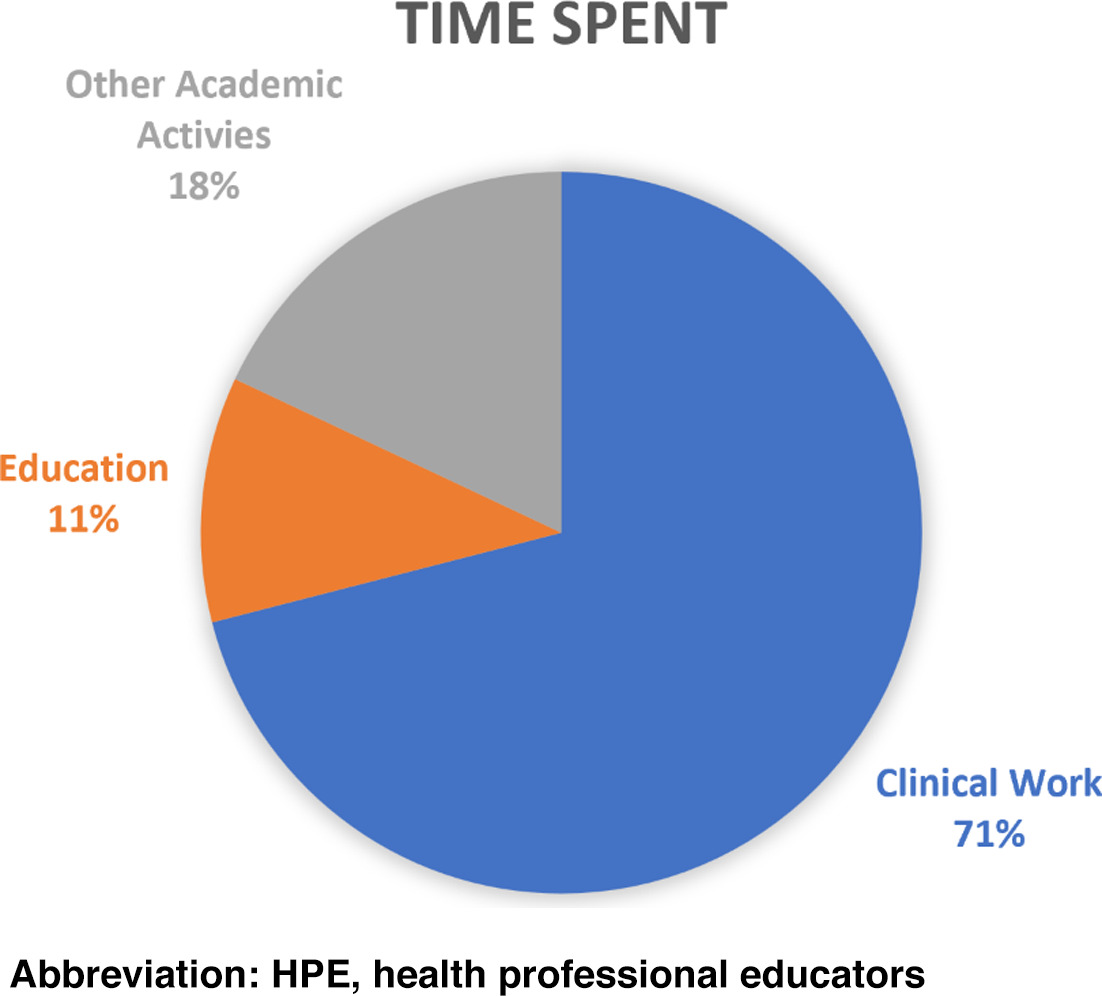
Participants described involvement in a broad range of academic activities including clinical teaching (73.9%), IPE (73.9%), quality improvement activities (69.6%), administrative service such as committee work (60.8%), program development for clinical care (60.8%), and classroom-based teaching (52.7%; Table 1). Respondents spent 11% of their time on education and 18% on other academic activities, including program development and research (Figure 1). Despite this level of academic involvement, only 22.2% (n = 4/18) reported having academic roles outlined in their formal job descriptions.
Academic activity |
HPEs
(N = 23)
n (%) |
Teaching in a clinical setting |
17 (73.9) |
Interprofessional education |
17 (73.9) |
Quality improvement activities |
16 (69.6) |
Administrative service (eg, committee work) |
14 (60.9) |
Program development for clinical care (eg, diabetes education program) |
14 (60.9) |
Classroom-based teaching |
12 (52.2) |
Providing mentorship |
8 (34.8) |
Creative professional activities (eg, advocacy or policy work) |
8 (34.8) |
Teaching faculty development/CPD |
4 (17.4) |
Research |
4 (17.4) |
Education scholarship |
2 (8.7) |
Curriculum and course development or evaluation |
2 (8.7) |
HPEs identified that training for their academic roles came from a variety of sources, including formal education (75.0%, n = 15/20), self-directed learning (65.0%, n = 13/20), online modules (55.0%, n = 11/20), and workshops (55%, n = 11/20). Half of respondents (n = 10/20) had participated in a DFCM-led internal faculty development offering.
The survey asked participants about their feeling of preparedness for their various academic roles, with a majority feeling “very well” or “extremely well” prepared to teach in clinical (83.3%) and IPE settings (70.0%). However, only 35.0% reported feeling well-prepared for classroom-based teaching. Fewer felt well-prepared for engaging in curriculum or course development and evaluation (5.3%) and education scholarship (6.3%).
HPEs were asked about the challenges they experienced in their roles and what additional supports were needed. Fewer respondents reported satisfaction with protected time for mentorship (31.3%), creative professional activity (35.7%), curriculum development (33.3%), education scholarship (22.2%), and research (16.6%). At least 50% were “satisfied” or “very satisfied” with protected time for IPE (63.2%), clinical teaching (55.6%), administrative services work (55.6%), and classroom teaching (50.0%). Participants identified heavy clinical workload, physician focused faculty development, and insufficient time for academic commitments as the most important barriers to effective implementation of their roles (Table 2). Fourteen respondents (73.6%) knew their faculty development lead, who acts as a local site-based resource for faculty development, mentorship, awards, and other education opportunities. However, only 34.8% of respondents reported receiving regular formal feedback on teaching.
Potential barriers |
Level of importance
(fairly important/very important)
n (%) |
Heavy clinical load or responsibilities (N = 18) |
18 (100) |
Faculty development activities available are often geared to an MD (N = 19) |
18 (94.7) |
Lack of sufficient time to fulfill teaching or academic commitments (N = 19) |
17 (89.5) |
Perceived lack of value for HPE role by learners (N = 19) |
15 (78.9) |
Perceived lack of value for HPE role by colleagues or peers (N = 20) |
15 (75.0) |
Perceived lack of value of HPE role by leadership (N = 20) |
15 (75.0) |
Lack of adequate preparation or training to complete teaching or other academic tasks (N = 19) |
14 (73.7) |
Lack of formal evaluation or feedback on my teaching (N = 20) |
14 (70) |
Lack of adequate background information on learners or their scope of practice (N = 19) |
12 (63.2) |
Lack of appropriate physical space for teaching (N = 19) |
12 (63.2) |
Lack of understanding as to how my areas of expertise are useful to learners in medicine (N = 19) |
11 (57.9) |
For half of respondents (n = 10/20), the DFCM’s HPE CoP was their first participation in a formal CoP. Respondents identified key desired CoP roles: sharing best practices for enhancing integration of HPEs (52.9%), facilitating cross-site peer mentorship (47.1%), and curating a repository of resources for HPE academic work (47.1%). Nearly all (95%–100%) identified recognition, mentorship, integration, networking, faculty appointment, research support, and faculty development for HPEs as important departmental responsibilities. They also viewed provincial and national advocacy by the CoP on HPE-related issues to be a critical function.
Focus Groups
Nine HPEs representing five health professions (nurse practitioner, nursing, dietitian, pharmacy, and psychology) participated in one of two focus groups. Participants validated the survey results and further elaborated on barriers and support needs of HPEs. Five interrelated themes emerged.
1. Limits to Integration of HPEs. HPEs described a lack of meaningful integration into family medicine education. They valued their roles as teachers but often felt like an afterthought in education planning.
“There’s this general feeling that education provided by the HPEs at our site is lovely to have, but it’s almost like an extra by-the-by type of thing. … We’re kind of like the icing, but we’re not actually a component in the recipe.” “I [feel] like an afterthought … I’m an optional reading.”
Participants emphasized the importance of being valued by learners, leadership and physician colleagues as a key facilitator to implementing their academic roles. Participants further highlighted that system barriers, including current academic funding structures and limitations on protected academic time, shaped leadership perceptions of their value as teachers and amplified the challenge of balancing clinical and education responsibilities.
2. Shifting the Focus of Faculty Supports. Participants described existing faculty development and academic processes in the DFCM as being physician-focused rather than more broadly faculty-focused. They often felt “left out of the loop” when it came to education or funding opportunities and described having to take the initiative themselves to get involved. Participants saw the site-based faculty development lead role as primarily focused on physician, rather than HPE, support. In contrast, they described HPEs at sites with an identified HPE lead as better-informed and supported.
Suggestions to more proactively engage HPEs included circulating faculty development opportunities to all teachers, supporting faculty appointments, and advocating for protected time and funding for HPE teaching. Participants also emphasized the value of collaborating with physician partners as advocates to advance the integration of HPEs at the site level.
3. Access to Faculty Recognition and Status. Participants appreciated existing DFCM awards for HPEs as a formal acknowledgment of their contributions to family medicine education. Some felt that the faculty appointment eligibility requirement was an unnecessary barrier for nominations.
HPEs felt that several factors contributed to an ongoing low rate of HPEs possessing faculty appointment status, including high turnover of HPE staff, lack of awareness of the process, high volume of paperwork involved, and perceived lengthy application process. They highlighted mentorship and encouragement from physician colleagues or HPE peers as a potential solution.
“I’m lucky our team here is quite supportive that way, and I think because of him [a physician], he was supportive of me and helped me move forward on getting my faculty appointment.”
Participants described that HPEs lack, yet desire, formal and informal teaching feedback to help ensure that they are meeting learner goals and needs. This finding was contrasted with physician colleagues, whom they perceived as receiving more consistent feedback. One participant raised the challenge of HPE teaching done in the context of clinical collaboration, which they saw as more “amorphous” and more difficult to delineate as an episode of teaching.
“When we’re collaborating, you’re teaching, but you’re also working with … I think it’s easier to get feedback in the circumstances where I’m doing a didactic teaching session, or there’s a set rotation for HPEs, where maybe we could [get] better feedback. That doesn’t always happen consistently for us.”
Similarly, some participants discussed a willingness to be involved in medical learner assessments but a lack of awareness of the processes involved.
4. Benefits of the Community. Participants described the DFCM HPE program and the CoP as playing important and multifaceted roles in supporting their work. Participants saw the CoP as providing a “communal voice” in advocating for HPE integration; raising HPEs’ awareness of academic opportunities; supporting networking, mentorship, and guidance; and sharing knowledge and collaboration across sites.
“The vision [for the CoP], in my mind it’s three things. It’s to connect HPEs, advocate for HPEs, and help to integrate HPEs at the DFCM and the local sites.”
Participants highlighted the HPE CoP newsletter as a useful way to engage HPEs and help them stay informed. Some participants expressed interest in attending regular, formal CoP meetings (either in person or virtually), however noted time pressure as a barrier.
5. DFCM Recognized as a Leader, but More Work Needs to Be Done. Participants applauded the DFCM as a leader in HPE support compared to other family medicine training programs. However, they felt that the department required more of a culture shift toward more purposeful HPE integration and meaningful recognition to achieve program success.
“I think it’s amazing we even have a faculty lead. I feel like that’s a fantastic evolution … the CoP, but I feel it’s amazing that the DFCM has actually specifically recognized the unique contributions [of HPEs].” “It’s great that they [the DFCM] recognize the value that other regulated health professionals have to contribute to medical education.”
At the time of our project, only 20 of 117 (17%) members in the HPE CoP held a faculty appointment within the DFCM. In contrast, study participants represented a more highly affiliated HPE cohort with 55.0% of survey respondents possessing faculty status. Furthermore, survey respondents were experienced teachers who reported dedicating approximately one-third of their working time to a range of academic activities. Thus, we view the survey as representing the experiences of a highly engaged and active group of HPE teachers in the DFCM.
Unfortunately, despite this high level of engagement, participants reported continued barriers to implementing their academic roles, including lack of protected time, limited access to appropriate faculty development supports, and insufficient mentorship and feedback on their teaching. Similar studies have reported on these same barriers,5,6,7,13 noting that addressing them will take continued time, effort, and explicit attention.
Results from both the survey and focus groups described an insufficient integration of HPEs into the department’s educational structure and culture, potentially reinforcing a hidden curriculum. HPEs felt their colleagues and leaders valued their contributions in principle but treated them as supplementary rather than core to family medicine training. Addressing this gap will require intentional and visible integration strategies, including structural changes to curriculum planning such as formalizing learning objectives for HPE teaching and supporting more regular inclusion of HPEs in teacher recruitment. These changes may improve the consistency and depth to which programs involve HPEs in teaching activities and reinforce visible institutional support for their value in family medicine education.
Although most of the participants in this study reported completion of some form of faculty development, many felt less prepared for curriculum development and education scholarship activities, which are both key activities for driving education innovation in optimizing cross-professional learning experiences. Like other studies,6 participants reported that DFCM faculty development opportunities often targeted a physicians-only audience rather than attending to the needs of a mixed-professional faculty. Focus group discussions also noted this misalignment and identified improved clarity of responsibility for the faculty development lead for HPEs, the creation of HPE lead roles, and targeted training and mentorship initiatives as potential opportunities for change. Effective integration of HPEs in family medicine education requires that HPEs have access to and use appropriate training and faculty development resources.
Granting faculty status to nonphysician educators is another sign of strong institutional commitment to HPEs as essential contributors to training programs.19 Limitations to obtaining such status further exacerbate barriers to fulsome academic engagement, such as exclusion from faculty listserv communications, participation in learner assessments, or eligibility for standardized feedback on teaching. Assessment of teaching is an accreditation standard for all faculty in residency programs in Canada,11 and HPEs should be afforded the same systematic feedback as physician educators to promote both the quality of HPE teaching and teacher and learner satisfaction with HPE activities.20
Despite these noted opportunities for improvement, HPEs in this study appreciated existing efforts by departmental leadership to recognize their roles as educators in family medicine and highlighted specifically the benefit of advocacy by physician colleagues for their roles. HPEs viewed the HPE CoP initiative as a valuable structure for promoting networking, advocacy, and shared learning to support their unique needs and experiences as educators in the DFCM. Increasing opportunities for dialogue and resource exchange between members could further enhance its impact.
Limitations
A small sample size, especially for the survey portion of this study, limits the generalizability of these results. However, project respondents represented the views of a highly experienced and engaged HPE cohort in the DFCM and are consistent with prior work. Member checking of survey findings with focus group participants added additional credibility to project results. Notably, participants were recruited through existing HPE CoP communication channels, so satisfaction with the HPE CoP and related departmental supports possibly are overestimated in these findings.
This study was designed before the onset of the COVID pandemic, which significantly shifted the landscape of medical education from in-person, classroom, and bedside teaching to include online/virtual, asynchronous, and hybrid forms of education.21,22 Participants provided survey responses at a time when the education environment was still transitioning to pandemic recovery, such that reports of preparedness for and proportional engagement in different academic activities by HPE may have since evolved. Increased adoption of online platforms and digital tools are changing the way teams communicate and collaborate,23 and our project did not explore the degree to which HPEs are involved in virtual or other online forms of teaching or faculty development and engagement.
Finally, future research is needed to determine the extent to which the experiences of HPEs in this large, multicenter academic department mirror the experiences of HPEs in other family medicine training programs.
Results from this study suggest that HPEs at our university continue to face challenges in optimizing their roles as teachers in family medicine. Traditional academic and funding structures may pose larger barriers to effective HPE integration compared to relational or attitudinal deterrents. Moving forward, advancing purposeful structural integration of HPEs in family medicine training will require more intentional inclusion. This may include targeted faculty development efforts, enhanced support to balance clinical and academic work pressures, and better explicit recognition of HPEs through awards, faculty appointments, and visible curricular changes including more consistent feedback on teaching. Structural programmatic changes such as these are accessible and tangible ways to advance collaborative, team-based education in any academic family medicine setting.
ARTIFICIAL INTELLIGENCE DISCLOSURE
Microsoft Copilot (artificial intelligence [AI] tool, institutional account) was used April 2026 and July 2026; for writing (review and editing), AI was used for editing syntax and grammar.
This work was funded by the University of Toronto’s Department of Family and Community Medicine (DFCM) Art of the Possible grant. Judith Peranson received stipend support for scholarship work through the academic funding program at her clinical teaching site within the DFCM. Josh Plener contributed to the project as a paid research assistant for part of the study period. Serena Beber received salary support for her role of Health Professional Educator Faculty Lead with the DFCM during the period of this study.
November 2025 workshop. Part of the Recipe, Not Just the Icing on the Cake: Integrating Health Professional Educators in Family Medicine. Family Medicine Forum Conference 2025, Winnipeg, Manitoba, Canada. Presenters: Beber S., Kopansky-Giles D., Antao V.
May 2025 poster presentation. Part of the Recipe, Not Just the Icing on the Cake: Integrating Health Professional Educators in Family Medicine Training in Canada. World Federation of Chiropractic Biennial Congress (2025), Copenhagen, Denmark. Presenters: Peranson J., Kopansky-Giles D.
May 2025 workshop. Part of the Recipe, Not Just the Icing on the Cake: Integrating Health Professional Educators in Family Medicine. University of Toronto Department of Family and Community Medicine Conference 2025. Toronto, Ontario, Canada. Presenters: Beber S., Peranson J., Bourgeois N.
April 2025 oral presentation. Celebrating a Decade: Successes and Next Steps of a Community of Practice for Health Professional Educators in Family Medicine. International Congress of Academic Medicine 2025, Halifax, Nova Scotia, Canada. Presenter: Peranson J.
October 2023 poster presentation. Design, Development and Advancement of a Community of Practice for Health Professional Educators: Exploring an Innovative Approach to Supporting HPEs in Family Medicine at the University of Toronto (work in progress). Association of Family Health Teams of Ontario 2023 Conference, Toronto, Ontario, Canada. Presenter: Beber S.
May 2023 poster presentation. Design, Development and Advancement of a Community of Practice for Health Professional Educators: Exploring an Innovative Approach to Supporting HPEs in Family Medicine at the University of Toronto (work in progress). University of Toronto Department of Family and Community Medicine Conference 2023, Toronto, Ontario, Canada. Presenters: Beber S., Peranson J.
The authors thank Danielle Dudycha, Faculty Development Program Administrator, for her support and Vyshnave Jeyabalan for help with focus group facilitation and analysis.
References
-
-
Soklaridis S,
Oandasan I,
Kimpton S.
Family health teams: can health professionals learn to work together?
Can Fam Physician.
2007;53(7):1198–1199.
https://www.cfp.ca/content/53/7/1198
-
Reeves S,
Fletcher S,
Barr H,
et al.
A BEME systematic review of the effects of interprofessional education: BEME Guide no.39.
Med Teach.
2016;38(7):656–668.
doi:10.3109/0142159X.2016.1173663
-
-
-
Lien K,
Kays-Sommer J,
Bite A,
Ladha Z,
Roeper R,
Costa A.
The role of non-physician health care professionals in the education of medical students at satellite campuses.
J Reg Med Campuses.
2018;1(1).
doi:10.24926/jrmc.v1i1.998
-
Walsh A,
Moore A,
Barber A,
Opsteen J.
Educational role of nurse practitioners in a family practice centre: perspectives of learners and nurses.
Can Fam Physician.
2014;60(6):e316.
https://www.cfp.ca/content/60/6/e316
-
-
-
-
-
Webster CS,
Coomber T,
Liu S,
Allen K,
Jowsey T.
Interprofessional learning in multidisciplinary healthcare teams is associated with reduced patient mortality: a quantitative systematic review and meta-analysis.
J Patient Saf.
2024;20(1):57–65.
doi:10.1097/PTS.0000000000001170
-
Beber S,
Antao V,
Telner D,
et al.
Examining the teaching roles and experiences of non-physician health care providers in family medicine education: a qualitative study.
BMC Med Educ.
2015;15(1):15.
doi:10.1186/s12909-015-0283-8
-
Wenger E,
McDermott R,
Snyder WM.
Cultivating Communities of Practice: A Guide to Managing Knowledge.
Harvard Business Review Press; 2002.
-
-
Noar AP,
Jeffery HE,
Subbiah Ponniah H,
Jaffer U.
The aims and effectiveness of communities of practice in healthcare: a systematic review.
PLoS One.
2023;18(10):e0292343.
doi:10.1371/journal.pone.0292343
-
de Carvalho-Filho MA,
Tio RA,
Steinert Y.
Twelve tips for implementing a community of practice for faculty development.
Med Teach.
2020;42(2):143–149.
doi:10.1080/0142159X.2018.1552782
-
-
Gonzalo JD,
Graaf D,
Wolpaw DR,
Lehman E,
Thompson BM.
Non-physician and physician preceptors in landscapes of practice: a mixed-methods study exploring learning for 1st-year medical students in clinical experiences.
Med Educ Online.
2023;28(1):2166386.
doi:10.1080/10872981.2023.2166386
-
Krasniqi D,
Ismajli H.
The role of feedback frequency on teachers’ professional development and self-efficacy.
Educ Process Int J.
2025;15(1):e2025102.
doi:10.22521/edupij.2025.15.102
-
Samuel A,
Durning SJ.
From crisis to opportunity: reinventing medical education after COVID-19.
Perspect Med Educ.
2025;14(1):371–382.
doi:10.5334/pme.1672
-
Davoody N,
Stathakarou N,
Swain C,
Bonacina S.
Exploring the impact of the COVID-19 pandemic on learning experience, mental health, adaptability, and resilience among health informatics master’s students: focus group study.
JMIR Med Educ.
2025;11:e63708.
doi:10.2196/63708
-
Lane JN,
Leonardi PM,
Contractor NS,
DeChurch LA.
Teams in the digital workplace: technology’s role for communication, collaboration, and performance.
Small Group Res.
2024;55(1):139–183.
doi:10.1177/10464964231200015



There are no comments for this article.