Background and Objectives: Medical students often express concern that increased clinical demands during clerkships reduce study time and affect standardized examination performance. This study evaluated the relationship between hours worked during the family medicine clerkship and National Board of Medical Examiners (NBME) family medicine subject examination scores.
Methods: This was a retrospective, cross-sectional, single-institution exploratory study of students who completed an 8week family medicine clerkship from 2022 to 2025. We calculated total hours worked from weekly student time logs. NBME scores were obtained from academic records. We used Pearson correlation and one-way analysis of variance (ANOVA) to examine associations.
Results: We analyzed data from 206 students. We found a positive correlation between hours worked and NBME scores (r = 0.21, P = 0.002). Students were grouped by total hours worked: ≤330, 331–374, and ≥375. ANOVA showed significant differences across groups: F (2, 203) = 6.14, P = 0.003. Post hoc comparisons revealed that students in the ≤330 hour group scored significantly lower than those in the other two groups. We observed the highest average scores in the 331–374 group. We found no significant difference between the other groups.
Conclusions: Modest increases in clerkship workload were associated with higher NBME examination performance. Students in the lowest workload tertile scored significantly lower than students in the other two groups; however, the overall association was weak, and these findings should not be interpreted as evidence of a specific workload threshold. Yet, results may inform clerkship scheduling, support faculty in balancing workload and academic demands, and guide students in planning time effectively during clinical rotations.
Medical students frequently express concern that clinical and educational responsibilities during clerkships limit available time for personal study and thus could negatively impact performance on high-stakes standardized assessments such as the examinations of the National Board of Medical Examiners (NBME).1 Family medicine clerkship models that allocate individuals to different clinical sites can result in a wide range of clinical experiences and variability in duty time requirements among students. Clerkship directors frequently are tasked with balancing adequate clinical exposure with academic preparation. In addition, the Liaison Committee on Medical Education requires medical schools to monitor the total number of hours medical students are required to spend in clinical and educational activities throughout the curriculum and to ensure they do not exceed 80 hours (averaged over 4 weeks) for clinical and structured learning activities.2 However, little data exist to guide how clerkship workload, measured in hours worked, relates to student performance on standardized examinations.
Previous studies in other specialties have found that length of clerkships, timing of clerkships during the academic year, and order of enrollment in clerkships may impact NBME scores.3,4 A positive effect was noted between internal medicine clerkship length and the NBME internal medicine subject examination when used as an end-of-clerkship assessment.3 Additionally, a study in psychiatry demonstrated that longer overall clerkship length, and thus more clinical and educational time, was correlated with higher examination scores.4 However, other studies examining the relationship between medical student duty hours and NBME performance on an obstetrics and gynecology clerkship and a surgical clerkship found no association between overall clinical hours and examination scores.5,6 Given the lack of studies examining time spent on clerkship duty hours and examination scores in the family medicine clerkship, a better understanding of this relationship within this context is needed.
This study examined the relationship between the number of duty hours worked during the family medicine clerkship and scores on the NBME family medicine subject examination. A clearer understanding of this relationship may help inform clerkship scheduling, workload expectations, and student study strategies.
This retrospective, cross-sectional study was approved by the University of Kansas School of Medicine (KUSM) Institutional Review Board. Data were obtained from clerkship time logs and academic records of students who completed the 8-week family medicine clerkship at KUSM–Wichita between 2022 and 2025. Total hours worked per student during the clerkship were calculated by summing the hours from the students’ weekly logs. Student NBME family medicine subject examination scores, scaled from 0 to 100, were extracted from the institutional academic database. Hours worked included clinical and academic activities such as patient care, administrative duties, and scheduled clerkship conferences or seminars. Hours worked did not include studying, traveling, or preparation time spent away from clinical sites.7 Only students with complete time logs and examination scores were included.
To assess the relationship between total hours worked and NBME examination performance, we calculated Pearson correlation coefficients. Students were divided into tertiles based on the total number of hours worked: low (≤330 hours), moderate (331–374 hours), and high (≥375 hours; Table 1). We used a one-way analysis of variance (ANOVA) to examine differences in examination scores between these three groups, with post hoc comparisons to identify specific group differences.
|
|
# of students |
Hours |
≤330 hours |
72 |
331–374 hours |
74 |
≥375 |
60 |
Total |
206 |
Years |
2022–2023 |
71 |
2023–2024 |
65 |
2024–2025 |
70 |
Total |
206 |
Completed log and examination scores were available for 206 students during the study timeframe. One student was excluded due to incomplete information. All other students who completed the clerkship during the study timeframe were included. The average number of total hours worked was 349.9 (SD 34.9; Range 220–480) or 43.7 hours per week (Table 2). The average examination score was 77.3 (SD 6.2; Range 44–91).
|
Average # of hours |
Median # of hours |
Mode # of hours |
Range of hours |
Total over 8-week clerkship |
349.9 |
350.0 |
320.0 |
220–480 |
Per week |
43.7 |
43.8 |
40.0 |
0–70 |
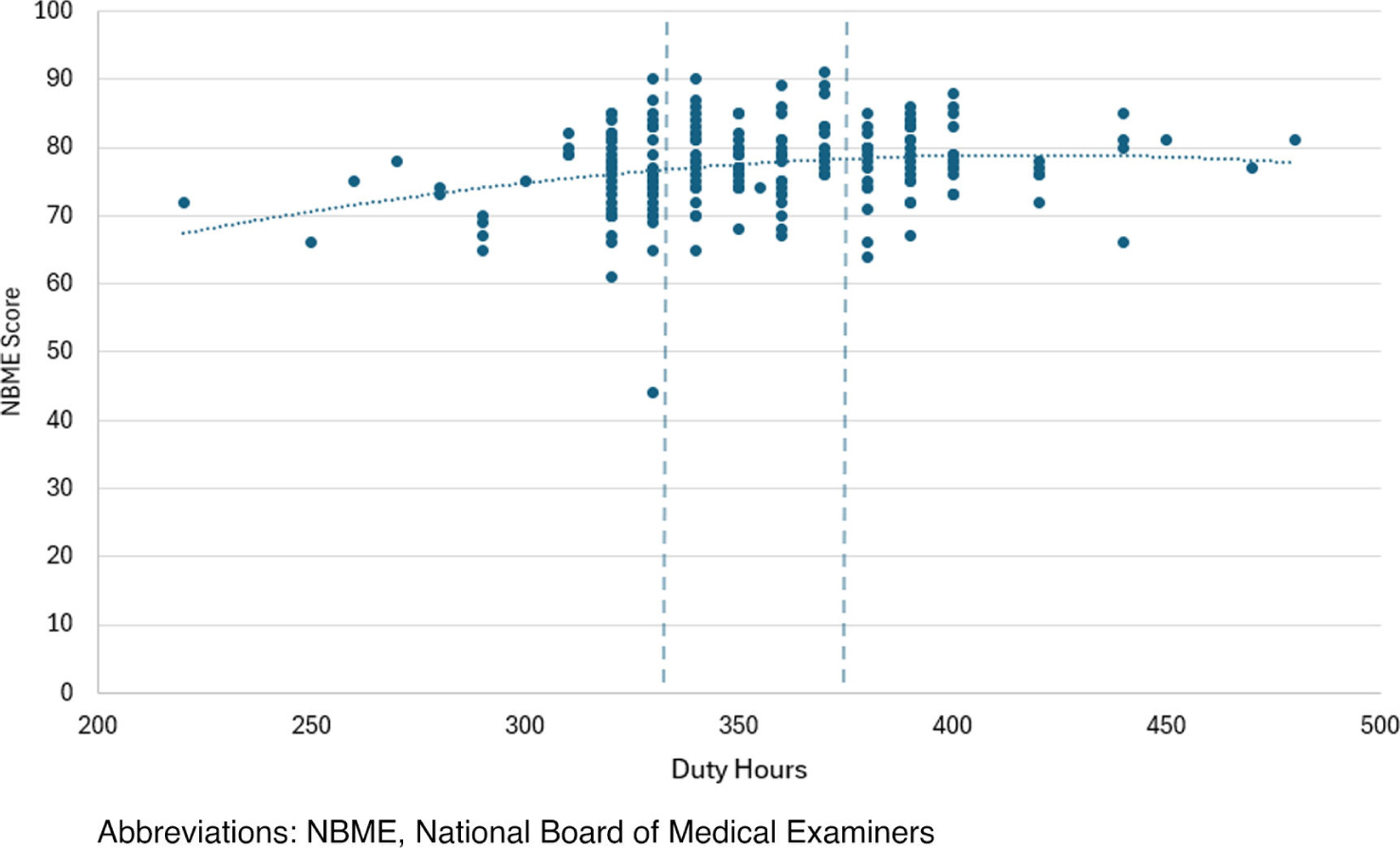
A positive correlation existed between the total number of hours worked during the clerkship and examination scores (r = 0.21, P = 0.002). A one-way ANOVA conducted to explore differences between the groups (low, moderate, and high) demonstrated significant differences between the groups, F(2, 203) = 6.14, P = 0.003, with a medium effect size of η2 = 0.06. Post hoc comparisons showed that students in the lowest hours group (≤330 hours) had significantly lower examination scores (M 75.3; SD 7.0) than students in both the moderate hours group (M 78.5; SD 5.2; P = 0.003) and the high hours group (M 78.1; SD 5.9; P = 0.044; Figure 1). Examination scores in the moderate and high hours groups showed no significant differences (P = 0.934). Excluding the single lowest examination score yielded similar results (r = 0.21, P = 0.007), suggesting that the observed association was not driven by a single influential observation.
In this single institution exploratory study, findings demonstrated that total clinical and educational hours during the family medicine clerkship are modestly but significantly associated with NBME examination performance. This finding suggests that small differences in clerkship workload may impact examination performance. Specifically, students who worked fewer than 331 hours scored, on average, more than six points lower on the NBME examination compared to their peers who worked more hours.
Although students in the lowest workload tertile scored significantly lower than students in the moderate and high workload tertiles, the overall relationship between duty hours and examination performance was weak (r = 0.21). Figure 1 demonstrates a modest positive linear association. The lack of significant difference between the moderate and high workload groups may reflect the relatively small effect size and limited statistical power rather than a true plateau in performance. Previous studies have suggested that moderate levels of clinical immersion promote learning, while excessive time commitments may not provide proportional academic returns.5,6,8 Additional studies using larger multicenter samples are needed to determine whether clinically meaningful workload thresholds exist.
The NBME assesses medical knowledge, clinical reasoning, and application, along with problem-solving skills. Such exams are used as a measure to demonstrate likely clinical competency, and high scores may assist with competitiveness in residency applications. Given student concern about how to best prepare for the standardized assessments such as the NBME family medicine subject examination, these results may provide insight into the optimal balance of hands-on clinical work, structured academic opportunities, and personal study. Future studies are needed to investigate the impact on scores of the differential of hours worked on clinical versus scheduled academic work.
This study had several limitations. It was completed at a single academic institution, relied on self-reported student duty hours, did not consider travel time or individual differences in student study time, and used the NBME family medicine subject examination for end-of-clerkship evaluation. Additionally, we did not collect data on the specific activities included in reported duty hours. These factors may limit generalizability. Students were placed at different sites, which may have influenced workload, and work duty hours were self-reported by students, which could impact accuracy. The wide range of reported hours likely reflects differences in preceptor schedules and placement locations, including rural rotations with duties outside of standard hours; however, data in this regard were not collected.
Medical school curricula are increasingly adapting to changing learner needs and graduation competencies. Clerkship instructional methods and strategies may benefit from adjustment to meet many requirements, including achieving satisfactory results on NBME subject examinations. These findings may contribute to adjusting clerkship design, supporting medical educators in balancing experiential learning with academic preparation, and informing students’ scheduling and study planning during clinical rotations. Future research should explore how specific types of clinical experiences contribute to examination performance and whether similar patterns exist across other clerkships and institutions.
References
-
-
Liaison Committee on Medical Education.
Functions and Structure of a Medical School: Standards for Accreditation of Medical Education Programs Leading to the MD Degree—For Surveys in the 2026-27 Academic Year.
LCME; May 2025.
.
https://lcme.org/standards-and-rules
-
Ouyang W,
Cuddy MM,
Swanson DB.
US medical student performance on the NBME subject examination in internal medicine: do clerkship sequence and clerkship length matter?
J Gen Intern Med.
2015;30(9):1307–1312.
doi:10.1007/s11606-015-3337-z
-
Bostwick JM,
Alexander C.
Shorter psychiatry clerkship length is associated with lower NBME psychiatry shelf exam performance.
Acad Psychiatry.
2012;36(3):174–176.
doi:10.1176/appi.ap.11020020
-
Harris BS,
Harris HM,
Baldwin MA,
Dotters-Katz SK.
Medical student duty hours and shelf performance: is there a correlation?
Am J Perinatol.
2024;41(Suppl 1):e2135–e2137.
doi:10.1055/a-2099-8611
-
Barnum TJ,
Halverson AL,
Helenowski I,
Odell DD.
All work and no play: addressing medical students’ concerns about duty hours on the surgical clerkship.
Am J Surg.
2019;218(2):419–423.
doi:10.1016/j.amjsurg.2018.12.012
-
-
Vaughan M,
Johnson KA,
Bergin CR.
Impact of clerkship length and sequence on NBME subject exam performance.
Med Sci Educ.
2025;35(3):1313–1322.
doi:10.1007/s40670-025-02305-y



There are no comments for this article.