Background and Objectives: New Accreditation Council for Graduate Medical Education and American Board of Family Medicine guidelines encourage training family medicine residents in point-of-care ultrasound (POCUS). Prior studies have focused on the perceived needs of learners but did not assess patient or community need.
Methods: We performed a triangulated learner- and patient-oriented needs assessment to inform POCUS curriculum development within a family medicine residency. Our learner assessment consisted of a Likert scale survey of the perceived skill and importance of 36 POCUS modalities discussed in the 2016 American Academy of Family Physicians POCUS curriculum guidelines. Our patient-oriented needs assessment was collected through analysis of all family medicine practice (FMP) site imaging orders placed in 2023.
Results: The learner survey demonstrated the highest skill gaps in POCUS training to be evaluation for hemothorax and evaluation for pleural effusion. FMP site imaging order analysis demonstrated that hepatobiliary and obstetrics/gynecology concerns were the most frequently answered by POCUS for patients seen at the FMP site.
Conclusions: POCUS is an important and underutilized diagnostic tool in family medicine. POCUS curricula in graduate medical education are vital to successful implementation of POCUS in primary care; however, needs assessment techniques used in prior studies differ from the patient and community needs in our study. We recommend the use of both needs assessment strategies for optimal POCUS training outcomes. Further research replicating this modality is necessary to determine the optimal needs assessment approach for POCUS in family medicine.
New Accreditation Council for Graduate Medical Education (ACGME) program requirements for family medicine graduate medical education1 and American Board of Family Medicine (ABFM) procedural competency recommendations2 encourage training in point-of-care ultrasonography, representing a shift to bring point-of-care ultrasound (POCUS) into primary care to improve the efficiency and accuracy of health care delivery. Existing studies have demonstrated the development of POCUS curricula in primary care specialties;3-10 however, many of these studies focused on the perceived needs of learners without attention to the needs of the patients or communities in which these residents practice. In accordance with ACGME recommendations for residencies to provide care that meets the needs of communities,1 we performed a needs assessment to inform POCUS curriculum development within a family medicine residency.
We employed a triangulated needs assessment approach to capture learner and patient needs in POCUS. Specifically, we analyzed patient needs through the family medicine practice (FMP) site imaging orders as an indicator of community demand, recognizing that patient interviews may not fully capture the utility of this underutilized tool. We paired this with a traditional learner-centered assessment by replicating established survey methodologies.11,12 By integrating patient-oriented data with learner perspectives, we sought to identify convergences and divergences in training needs. We hypothesized that curricular priorities derived from these complementary sources would differ and that triangulating assessments would provide a richer, more inclusive foundation for POCUS curriculum development and inform future research in this topic.
Context
This study occurred at an unopposed single family medicine residency in an urban community hospital affiliated with a large academic health system. Residents completed introductory didactics in POCUS and approximately two to four interactive POCUS workshops to improve their familiarity with POCUS modalities and techniques prior to the study. Musculoskeletal and skin infection workshops were the only specific modalities taught before the study. Institutional review board approval was obtained through Northwestern University (STU00220400). All data were analyzed using SPSS version 28 for Windows (IBM Corp).
Learner-Oriented Needs Assessment: Survey of Perceived Importance and Confidence
The survey was developed de novo because no existing instruments capture POCUS needs in family medicine residencies. We reviewed the American Academy of Family Physicians (AAFP) POCUS curriculum guidelines13 and extracted 36 POCUS modalities to include in our survey instrument. Participants were asked to rate the importance of and their perceived skill in performing each modality on a 5-point Likert scale as performed in prior studies.11,12 The skill gap for each modality was calculated as the mean difference between the importance and confidence ratings, with greater differences indicating important yet unfamiliar US modalities. The survey was generated in REDCap (REDCap Consortium) and distributed to all faculty and residents at the program via email over a 30-day period. All items were analyzed using descriptive statistics.
Patient-Oriented Needs Assessment: Imaging Order Analysis at FMP Site
We analyzed imaging orders placed over a 1-year period (2023). Each order was categorized by imaging type (eg, ultrasound, CT, MRI) and clinical indication (associated ICD-10 code). We then determined whether the clinical question could be answered using basic or advanced POCUS modalities, as defined by the AAFP curriculum guidelines.13 Chart review was performed when these data were unclear. If the clinical question was not identifiable with the given information, it was excluded from the analysis (N = 98).
Learner Survey
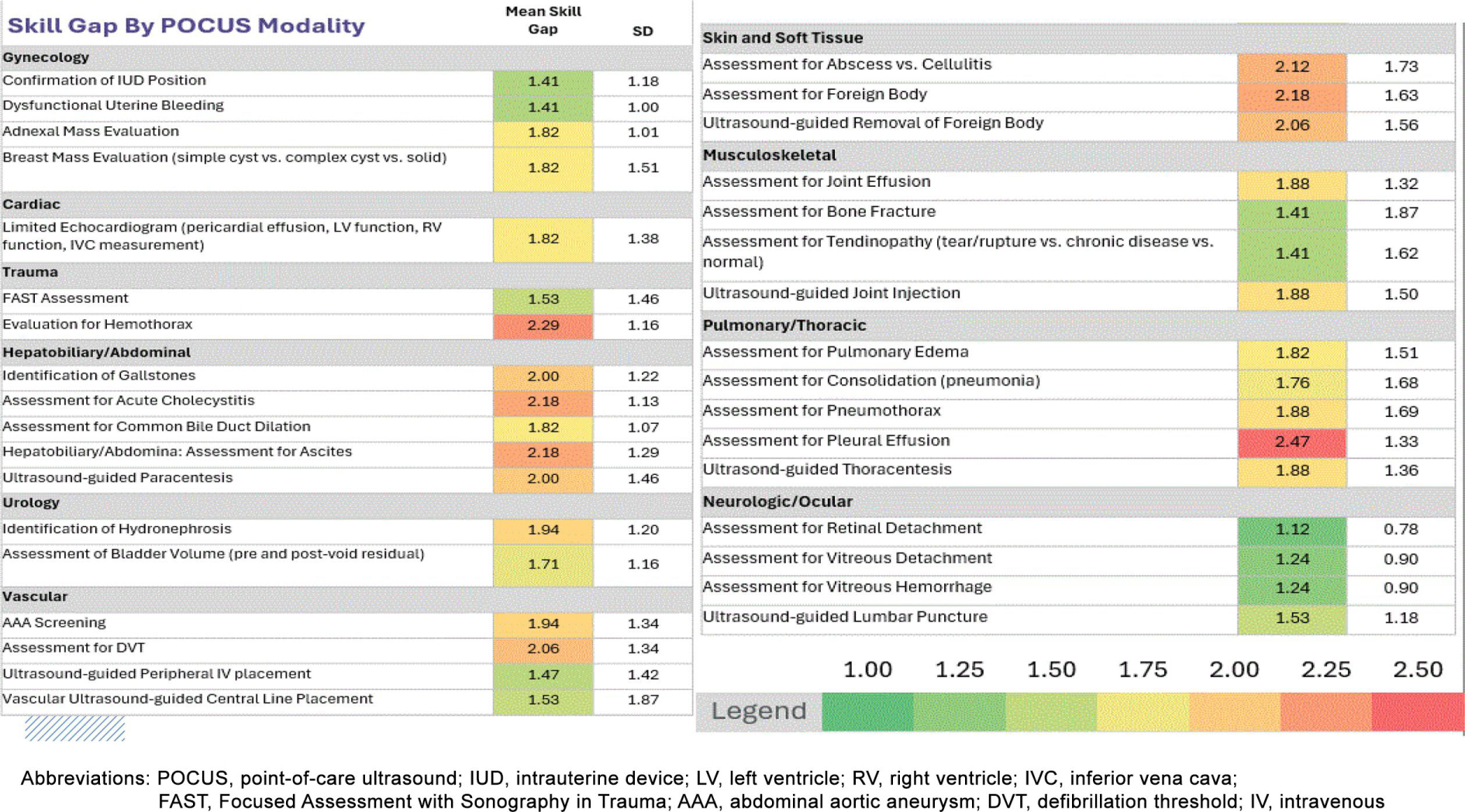
Of 24 eligible participants, 17 completed the survey (71% response rate). Survey participation represented all levels of training (five postgraduate year [PGY] 1, four PGY-2, five PGY-3, three faculty). Of the participants, 59% had some POCUS training prior to joining the residency program. We found were no statistical differences when comparing responses between different training levels. The three most important ultrasound modalities rated by learners were second and third trimester obstetrics ultrasound, assessment for joint effusion, and ultrasound-guided joint injection being. Skill gap averages are summarized in Figure 1. Assessment for pleural effusion and assessment for hemothorax had the highest average skill gap among the POCUS modalities (2.47 and 2.29, respectively), while hepatobiliary and skin/soft tissue categories carried the highest skill gaps among system groupings.
Imaging Order Analysis
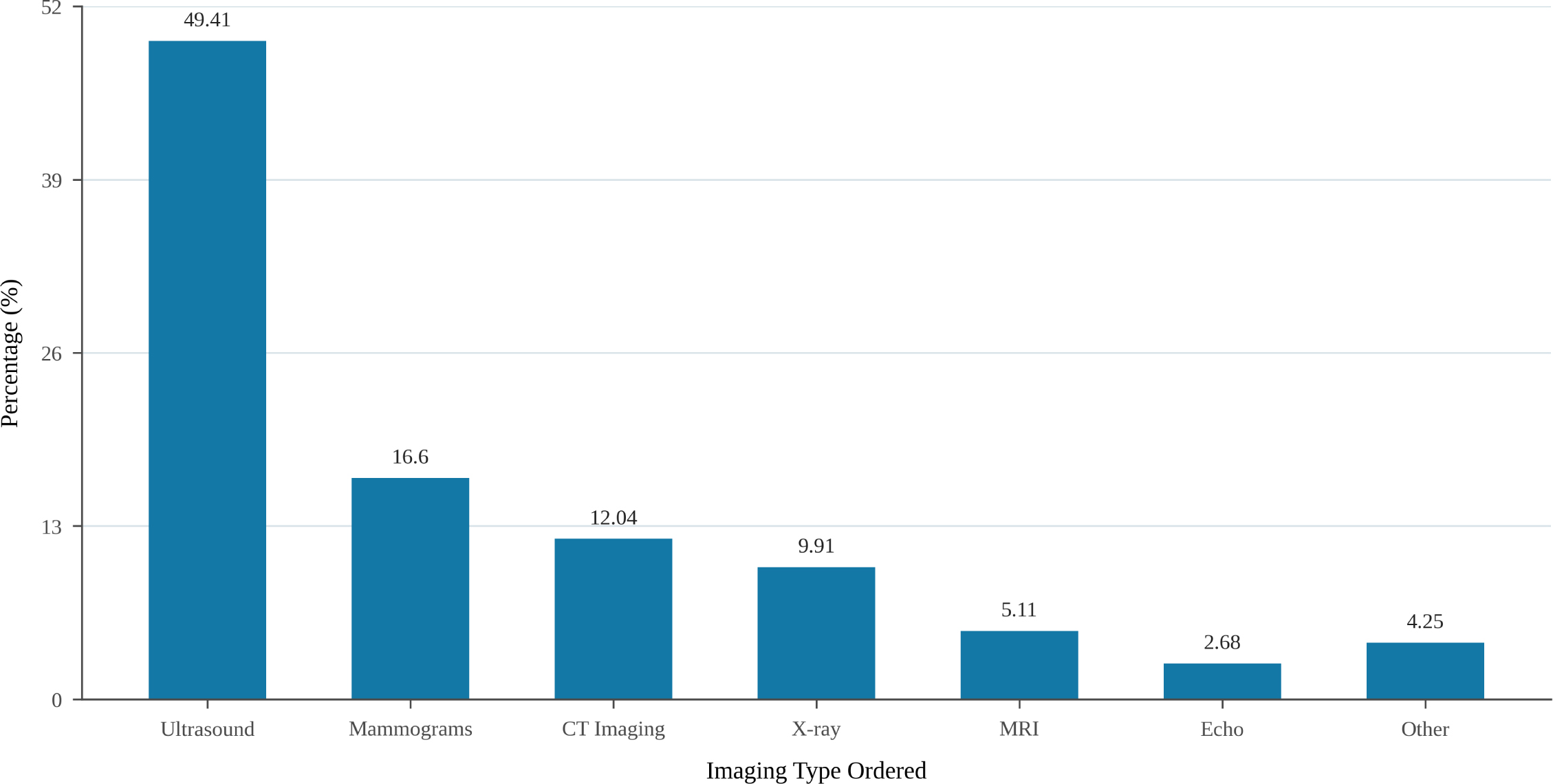
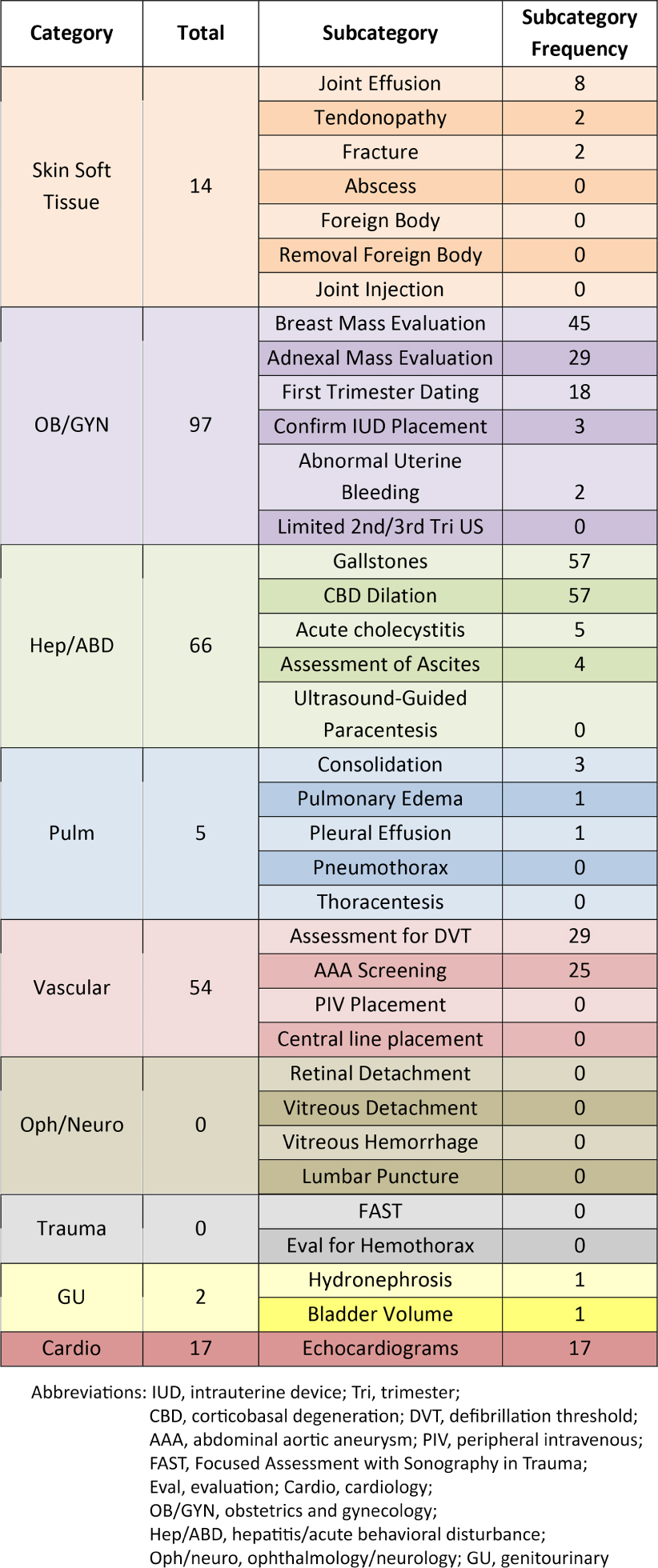
A total of 1,271 imaging studies were ordered at the FMP site in 2023, with the percentage of each imaging type summarized in Figure 2. Of these, 7.7% were excluded from analysis due to an unclear clinical question. Of the remaining 1,173 orders, 30% were found to be answered by a POCUS modality in the AAFP curriculum guidelines (18.7% basic, 11.3% advanced). Obstetrics and gynecology, hepatobiliary, and vascular studies were the most common imaging classifications identified, while evaluation for cholelithiasis, cholecystitis, and breast mass were the most common specific clinical questions for imaging studies, with more detailed analysis summarized in Figure 3.
POCUS is a tool that stands to enhance efficiency and accuracy of care in the primary care setting. New ACGME and ABFM requirements support this call for additional training and implementation within the field of family medicine. Our study demonstrated a useful methodology for multisource needs assessment when designing and implementing POCUS curricula in graduate medical education.
Collectively, our data illustrate how learner-perceived training needs and actual imaging order patterns only partially overlapped. Figure 1 shows that trainees identified the greatest skill gaps in evaluation of hemothorax and pleural effusions, whereas Figure 3 demonstrates that the most frequent POCUS-related clinical questions in the community involved hepatobiliary, obstetrics and gynecology, and vascular concerns. This study represents, to our knowledge, the first POCUS published needs assessment within a family medicine residency, and the first POCUS needs assessment to incorporate both learner perspectives and patient-oriented data.
This study highlights how established learner survey methodologies11,12 differ from measure of patient needs in POCUS training. Updated ACGME requirements in family medicine emphasize a need for training that meets community needs, with our study suggesting that these needs may be at odds with traditional curriculum development strategies. Though confirmation of this trend in other settings is outside the scope of this study, both needs assessment strategies are practical methodologies that other residency programs may borrow in crafting their own curricula. Our study had limitations that will guide future study. First, learner self-assessment of importance and confidence may not correlate with more objective measures of learner performance.14,15 Longitudinal surveys after further training, coupled with observed clinical competence, are necessary to ensure reliability of our findings and demonstrate effectiveness of POCUS curricula in closing skill gaps. Second, the learner survey questions did not specify a particular care setting. Given the broad spectrum of settings (eg, inpatient, outpatient, labor and delivery) in which residents and faculty practice, importance may be skewed by which practice setting participants envisioned while completing the survey. To address this concern, future surveys will explicitly reference care settings to determine whether context influences reported priorities. Lastly, we did observe higher importance ratings for musculoskeletal topics and high skill gaps in skin and soft tissue ultrasound modalities, which were workshops many learners were exposed to prior to the survey. The Dunning-Kruger effect16 may have altered our results; however other studies have called this effect into question.17
Given the benefits and underutilization of POCUS in the primary care setting, we suggest that family medicine residencies use multiple perspectives to prioritize POCUS curriculum design to satisfy new ACGME and ABFM requirements and implement POCUS in a way that immediately meets community needs for more effective and efficient care. Our triangulated approach (integrating objective imaging order analysis with learner-centered surveys) offers a unique and transferable methodology for balancing educational and community perspectives. As POCUS curricula continue to evolve, this dual approach will help educators decide how to prioritize training to more effectively implement POCUS into the practice of family physicians.
North American Primary Care Research Group Annual Meeting, Quebec City, Canada, November 20–24, 2024.
References
-
-
-
Løkkegaard T, Todsen T, Nayahangan LJ, Andersen CA, Jensen MB, Konge L. Point-of-care ultrasound for general practitioners: a systematic needs assessment.
Scand J Prim Health Care. 2020;38(1):3–11. doi:10.1080/02813432.2020.1711572
-
Homar V, Gale ZK, Lainscak M, Svab I. Knowledge and skills required to perform point-of-care ultrasonography in family practice - a modified Delphi study among family physicians in Slovenia.
BMC Fam Pract. 2020;21(1):56. doi:10.1186/s12875-020-01130-z
-
Anstey JE, Jensen TP, Afshar N. Point-of-care ultrasound needs assessment, curriculum design, and curriculum assessment in a large academic internal medicine residency program.
South Med J. 2018;111(7):444–448. doi:10.14423/SMJ.0000000000000831
-
Watson K, Lam A, Arishenkoff S, et al. Point of care ultrasound training for internal medicine: a Canadian multi-centre learner needs assessment study.
BMC Med Educ. 2018;18(1):217. doi:10.1186/s12909-018-1326-8
-
-
Chahley T, Lam AW, Halman S, Watson K, Ma IWY. First year internal medicine residents’ self-report point-of-care ultrasound knowledge and skills: what (Little) difference three years make.
BMC Med Educ. 2021;21(1):476. doi:10.1186/s12909-021-02915-1
-
Arichai P, Delaney M, Slamowitz A, et al. Pediatric residency point-of-care ultrasound training needs assessment and educational intervention.
Cureus. 2022;14(9). doi:10.7759/cureus.28696
-
Jamil SF, Rajendram R. Training pediatric residents in point-of-care ultrasound: an assessment of the needs and barriers to acquire the skill.
Int J Pediatr Adolesc Med. 2022;9(1):49–55. doi:10.1016/j.ijpam.2021.06.001
-
Jarwan W, Alshamrani AA, Alghamdi A, et al. Point-of-care ultrasound training: an assessment of interns’ needs and barriers to training.
Cureus. 2020;12(10). doi:10.7759/cureus.11209
-
Rajendram R, Alrasheed AO, Boqaeid AA, Alkharashi FK, Qasim SS, Hussain A. Training medical students in physical examination and point-of-care ultrasound: an assessment of the needs and barriers to acquiring skills in point-of-care ultrasound.
J Family Community Med. 2022;29(1):62–70. doi:10.4103/jfcm.jfcm_369_21
-
-
Davis DA, Mazmanian PE, Fordis M, Van Harrison R, Thorpe KE, Perrier L. Accuracy of physician self-assessment compared with observed measures of competence: a systematic review.
JAMA. 2006;296(9):1094–1102. doi:10.1001/jama.296.9.1094
-
Elliott BP, Berglund A, Markert R, Burtson K. Confidence and utilization are poorly associated with point-of-care ultrasound competency among internal medicine trainees.
Mil Med. 2023;188(Supplement_6):316–321. doi:10.1093/milmed/usad127
-
Kruger J, Dunning D. Unskilled and unaware of it: how difficulties in recognizing one’s own incompetence lead to inflated self-assessments.
J Pers Soc Psychol. 1999;77(6):1121–1134. doi:10.1037/0022-3514.77.6.1121
-
Nuhfer E, Fleischer S, Cogan C, Wirth K, Gaze E. How random noise and a graphical convention subverted behavioral scientists’ explanations of self-assessment data: numeracy underlies better alternatives.
Numer. 2017;10(1). doi:10.5038/1936-4660.10.1.4



There are no comments for this article.