ORIGINAL ARTICLES

Training Needs for Rural Primary Care Practice: A Scoping Review of Resident Physician Preparation

David F. Schmitz, MD | Annie Koempel, PhD, RD | Campbell Cook | Andrew W. Bazemore, MD

Fam Med.

Published: 2/20/2026 | DOI: 10.22454/FamMed.2026.909274

Abstract

Background and Objectives: Some graduate medical education programs focus on the preparation of physicians for rural primary care practice. More exploration is needed to understand what is taught and how medical educators prepare resident and fellow physicians for rural practice. The purpose of this scoping review was to identify the primary dimensions of the concept of graduate medical education competencies for rural practice settings and describe the related evidence and gaps in the literature.

Methods: In 2024, we used a modified PRISMA-ScR approach to identify studies that addressed the unique training needs and competencies of residents intending practice in a rural area of the United States. For our study, we gathered peer-reviewed materials from a 10 year period (2013–2023) using PubMed as our data source.

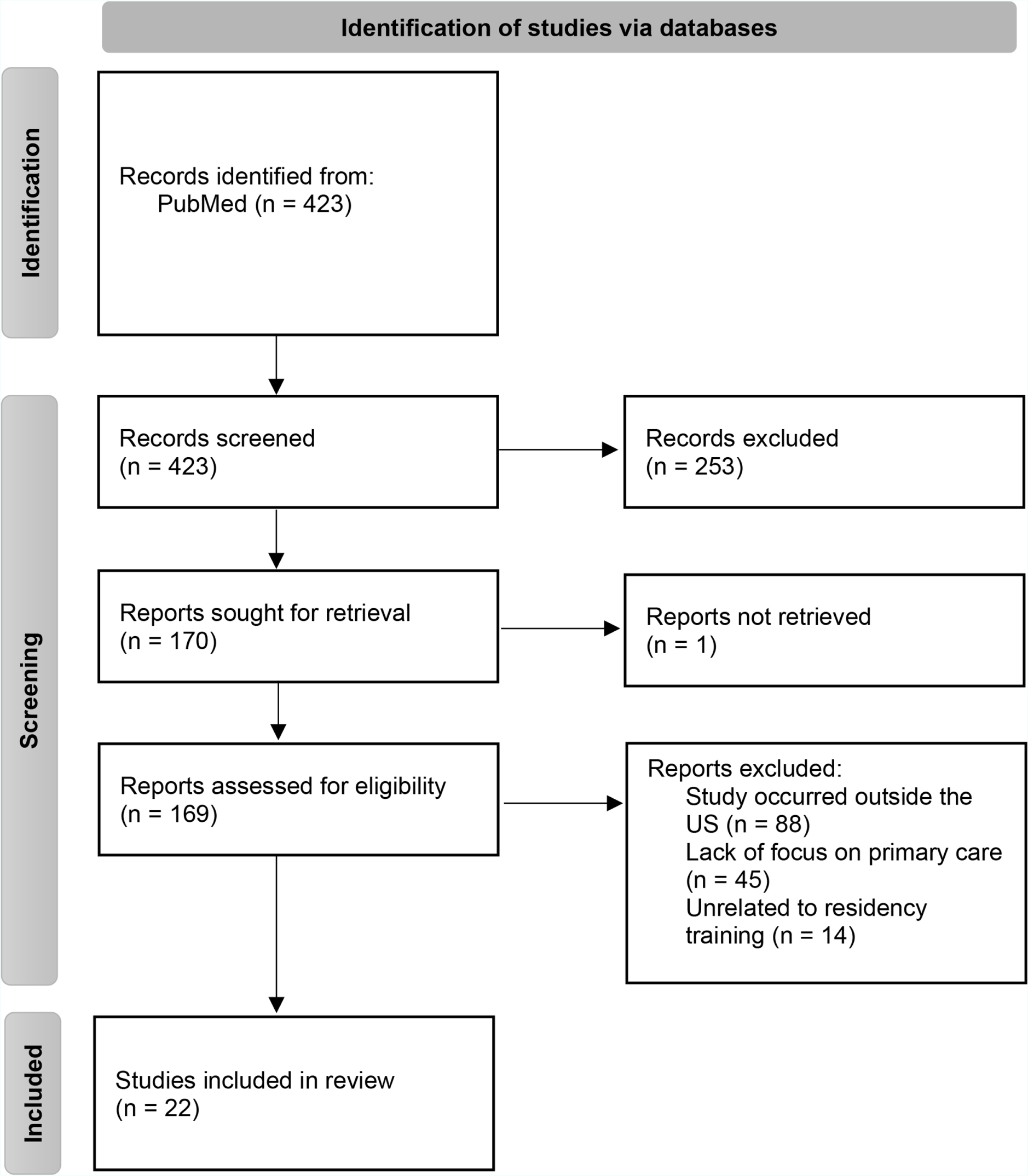
Results: A total of 423 articles were identified. We screened abstracts and manuscripts, and included 22 articles. Eleven articles (50%) described training in preparation for rural practice, including two concerning fellowship-level graduate medical education. Five (23%) articles described residency or fellowship training occurring in rural areas. Six (27%) articles described studies involving focused training occurring in rural versus nonrural locations.

Conclusions: Limited literature exists to systematically define the graduate medical education competencies required for eventual rural practice. This gap necessitates a clearer framework for training and preparing physicians for these settings.

INTRODUCTION

The training, recruitment, and retention of primary care physicians providing care in rural practice settings are frequently the subject of peer-reviewed research articles.1,2 Primary care physicians provide essential access to medical care in US rural and underserved settings, which often present distinct resource limitations3 and challenges. Some graduate medical education (GME) programs aim to provide resident and fellow physicians specific educational curricular opportunities to prepare them for the demands of rural practice.

Graduates from rurally located GME programs practice in rural settings at a higher rate than their urban-trained counterparts.4 Still, the majority of rurally located practicing physicians are identified to have been trained in urban places.5,6 Medical educators and policymakers may seek to promote the preparation of a competent rural primary physician workforce through both curricular and environmental learning designs. We sought to identify the primary dimensions of the concept of graduate medical education competencies for rural practice settings to better understand the current evidence available to address these educational and workforce needs.

For our study, we conducted a scoping review of the available literature to address this research question: What are the graduate medical education competencies and training needs for primary care residents who will practice in rural areas of the United States?

METHODS

Literature Search

In January 2024, we conducted a scoping review following a modified Preferred Reporting Items for Systematic Reviews and Meta-Analyses Extension for Scoping Reviews (PRISMA-ScR) approach with the database PubMed as the information source. The search strategy was developed by a team of researchers with experience in rural health care and graduate medical education research. The search strategy was established to identify studies that addressed the unique training needs and competencies (eg, curriculum, clinical competence, competency-based education) for residents and fellows (eg, internship and residency, medical residents, residency program, fellowships) who will practice in a rural area (eg, rural health services, rural population, rural health, rural hospitals) of the United States. Rural United States was defined as regions of the United States designated by the Census Bureau as rural (nonurban).

Eligibility Criteria

Articles were included if they met the criteria for studies involving medical residents in primary care settings within rural areas of the United States. To meet criteria for GME in primary care, articles had to explicitly reference terms related to clinical competence, competency-based education, curriculum, or residency, as defined by relevant MeSH (medical subject headings) terms and text words (eg, “clinical competence”[MeSH], “internship and residency”[MeSH], “graduate medical education”[tiab, restrictive field code]). To address competencies or curriculum for rural practice, articles had to include terms associated with rural health, rural populations, or rural hospitals (eg, “rural health services”[MeSH], “rural population”[MeSH], “rural”[tiab]). Consistent with guidance from the JBI Manual for Evidence Synthesis,7 we limited our search to articles published in English within the last 10 years to ensure feasibility and capture the most current evidence. Articles were excluded if they involved undergraduate medical students, practicing physicians, or nonprimary care inpatient settings, or if they focused on urban, suburban, or nonrural areas or non-US contexts.

Article Review Process

A subset of 30 titles and abstracts were independently screened and discussed by two reviewers (C.C. and A.K.). The remaining titles and abstracts were screened by one reviewer (C.C.), with questions and discrepancies resolved via discussion with a second reviewer (A.K.). All full text reviews were conducted by both reviewers independently, followed by discussion to resolve discrepancies and select final articles for inclusion. The article review process proceeded as per Figure 1 for a final set of 22 studies to be analyzed in our scoping review.

Data Analysis

We abstracted and charted data using codes based on themes identified in the existing literature regarding GME training for primary care and rural practice settings. Coding included GME programs providing intentional training for rural practice settings regardless of training location, GME programs located in rural places, and focused GME training occurring in rural settings. Studies regarding focused GME training occurring in rural settings contrasted with urban settings were included. Studies charted included research conducted with both learners and/or medical educators as respondents. We all reviewed the results until consensus was reached on themes to be included in our final analysis. Here we provide an overview of the articles identified, levels of GME training (eg, residency or fellowship), specialty of GME training program, area(s) of focused skill training, and location of training (ie, rural vs urban).

RESULTS

A total of 22 articles met criteria for inclusion. Characteristics of included articles are noted in Table 1.

Eleven articles (50%) described training programs specifically designed to prepare physicians for rural practice. Two of these concerned fellowship-level graduate medical education, and one did not specify a level of training. Five of these related to pediatricians: three comparing the practice behaviors of rurally located pediatricians with residency training requirements (each: descriptive, cross-sectional) and two describing curricula designed to train pediatricians for rural practice (each: descriptive, case report). Family medicine training was the subject of five of the remaining six articles focused on preparation for rural practice, while one article also did include internal medicine residents. Each of the two fellowship-level training articles related specifically to maternity care fellowship training. The remaining article addressing preparation for rural practice did not specify level of training or specialty. That article also was the only article of all those in the review to describe competence for rural training specifically.25

Five (23%) articles described residency or fellowship training occurring in rural areas. While these articles did not specifically address training for rural practice, each was identified as a study conducted with training programs located in a rural location. Four of these involved behavioral, gender, and/or developmental health in family medicine residency training programs, while the fifth was in regard to health equity training in a family medicine fellowship program.

Six (27%) articles described studies involving study cohorts with training occurring in rural versus nonrural locations. Some articles in this group intentionally contrasted the data of rural versus nonrural located residents in specific curricular areas such as diabetes care, telemedicine, and HIV preexposure prophylaxis. One article26 contrasted the academic achievement of rural and nonrural located trainees; and while providing an analysis of ACGME competencies, the article did not seek to describe competence unique to rural practice.

DISCUSSION

This scoping review revealed a limited number of recent peer-reviewed articles addressing specific training and competency needs of graduate medical education for primary care in rural practice settings. A majority of those studies focused on general training preparation, and a few addressed unique skills utilized in rural practice. This scoping review did not include articles referencing certain skills that may be considered more relevant to rural practice settings (eg, certain procedural training) and did not utilize the relevant MeSH terms and text words used in this methodology. Such articles may, for example, compare the likelihood of obtaining certain skills when contrasting rural to urban located training.27

The studies included in this review highlight various aspects of rural training, from specific curriculum designed for skill development such as leadership28 and community health29 to comparative analyses of rural versus nonrural training locations.30 However, the development of competencies specifically for rural practice remains underexplored. Because rural health care settings present distinct challenges, such as diverse patient needs in a setting of limited resources, the need is critical for GME programs to define these skills and train residents more explicitly. As reflected in the Longenecker et al article,25 development of a common language and framework for addressing training of rural physicians should allow graduates to provide optimal care in resource-constrained environments. In rural care settings, the most appropriate care options may differ from nonrural applications of similar medical knowledge. For example, treatment of acute myocardial infarction or trauma occurring remotely from definitive care may require a unique systems-based practice approach. Interpersonal and communication skills become of paramount importance to care coordination, for example in the case of patient transfer to another facility. System-based practice competencies would include a contextual awareness of resource availability, the capacity to develop alternative treatment plans, and communication skills applied in coordinating both local and distant care of the patient. Additionally, the likelihood of dual relationships is greater in rural settings, requiring professionalism competencies related to the management of patient care and nonprofessional life within the rural community. Competence in rural primary care settings involves not only medical knowledge (eg, procedural skills competency), but also the development of metacognitive adaptive practice skills to achieve technical and applied competencies resulting in care that is contextually appropriate and clinically relevant.

While the Longenecker et al article25 elaborated dimensions of competence believed to be important for rural practice, further research should be conducted to elucidate how competencies can be measured and applied for both trainee assessments and within programs seeking to prepare physicians for rural practice settings, regardless of program location. Qualitative study of rural medical educators accompanied by a qualitative study of rural practicing primary care physicians could further explore this area of research. Study of rural practicing physicians should ideally occur in the initial years of practice following program completion in order to isolate the GME training outcomes from the effects of rural practice experience on adaptive expertise development.31

Recent federal initiatives and investments have resulted in increased numbers of rurally located GME programs.32 Yet urban-located programs also continue to train and prepare graduates to practice in rural and underserved areas. Long-standing state and federal programs33 offer loan-repayment and financial incentives for physicians locating in rural and underserved communities. Seeking to address health disparities found in rural locations, ACGME recently defined the Rural Track Program designation34 in alignment with Section II of its Medically Underserved Areas/Populations framework.35 The importance of the location of training in addition to the content of training are becoming increasingly recognized in the literature.36

Identification of curricular objectives and learner assessments uniquely applicable to preparing graduates for rural practice settings represents a novel and important area for additional research. While evidence exists that GME training in a rural area is associated with subsequent rural practice,37 whether or not unique competency development occurs differentially in rural settings should be an area of additional study. If competencies related to rural practice could be identified and measured, measuring outcomes both during training and at program completion would then be possible. Comparing training models involving both urban and rurally located training sites to better determine how and where the induction of metacognitive skills, such as adaptive expertise development, is occurring at a programmatic level also may be possible.31 This understanding also may allow for urban-based training sites to idealize augmentation of training through rural experiences, simulation, mentoring, or other methods to accomplish similar competency goals. Applying these methods could result in subsequent voluntary adoption of these education strategies by GME programs to better prepare a physician workforce for rural and underserved care.

Better prepared graduates also may experience less stress, reducing the risk of burnout and leading to improved retention rates of the rural physician workforce. Longenecker et al published an article related to resiliency in rural practice38 in 2010, and additional study in conjunction with measured competencies may be another area for further research, correlating competencies to both burnout and retention rates. Additional training, mentoring, and development for trainees with an identified plan for entering rural practice, such as with participants in the National Health Service Corps,39 may also benefit from intentional curricular training and support. Additional research in the training needs for rural primary care service could both improve health for patients and improve physician career satisfaction.

Limitations

This review had several limitations, the first of which was its constraint to a fixed time period (2013–2023) and English language; additional articles may exist in other languages or prior to the period included in the study or since the analysis. Identified studies contained a variety of study methods and interventions, thus limiting a comparison of results. Limiting databases used to peer-reviewed literature may exclude additional gray literature contributions. Furthermore, PubMed was the only database searched; future work could explore additional databases (eg, ERIC, Embase) to capture a broader range of rural training literature. A recent peer-reviewed text not referenced in PubMed does summarize literature prior to 2013, “Training for Rural Practice: Place-Based, Mission-Aligned, and Community-Engaged.”40 Also, research studies concerning skills or training considered relevant to rural practice settings but not utilizing the relevant MeSH terms and text words used in this methodology would not be included in this scoping review.

CONCLUSIONS

This review calls attention to the scarcity of literature addressing the specific competencies and training needs of GME programs preparing primary care residents for rural practice in the United States. While some studies explored rural-focused skills training and education occurring in rural environments, most did not explicitly identify competencies unique to rural practice. Chronic primary care workforce shortages in rural communities and the recent investments being made in expanding physician training in these areas underscore the need for medical educational policy and reforms that address specific rural competencies. The existing gap underscores the need for targeted research and curricular development to equip future physicians with the skills required to address the distinct challenges of rural health care. Informing policymakers and accrediting bodies of best practices in educating physicians for rural practice can help address physician shortages in underserved areas, improving health care access and outcomes in rural communities.

References

  1. Parlier AB, Galvin SL, Thach S, et al. The road to rural primary care: a narrative review of factors that help develop, recruit, and retain rural primary care physicians. Acad Med. 2018;93(1):130140. doi:10.1097/ACM.0000000000001839
  2. Schubert N, Evans R, Battye K, Gupta TS, Larkins S, McIver L. International approaches to rural generalist medicine: a scoping review. Hum Resour Health. 2018;16(1). doi:10.1186/s12960-018-0332-6
  3. Murphy P, Burge F, Wong ST. Measurement and rural primary health care: a scoping review. Rural Remote Health. 2019;19(3). doi:10.22605/RRH4911
  4. Russell DJ, Wilkinson E, Petterson S, Chen C, Bazemore A. Family medicine residencies: how rural training exposure in GME is associated with subsequent rural practice. J Grad Med Educ. 2022;14(4):441450. doi:10.4300/JGME-D-21-01143.1
  5. Chen C, Petterson S, Phillips RL, Mullan F, Bazemore A, O’Donnell SD. Toward graduate medical education (GME) accountability: measuring the outcomes of GME institutions. Acad Med. 2013;88(9):12671280. doi:10.1097/ACM.0b013e31829a3ce9
  6. Arredondo K, Touchett HN, Khan S, Vincenti M, Watts BV. Current programs and incentives to overcome rural physician shortages in the United States: a narrative review. J Gen Intern Med. 2023;38(Suppl 3):916922. doi:10.1007/s11606-023-08122-6
  7. Peters M, Godfrey C, McInerney P, Munn Z, Tricco A, Khalil H. Scoping reviews. In: Aromataris E, Lockwood C, Porritt K, Pilla B, Jordan Z, eds. JBI Manual for Evidence Synthesis.; 2024. 10.46658/JBIMES-24-09. Accessed September 24, 2025
  8. Hughes S, Herrera-Mata L, Dunn J. Impact of healthy steps on developmental referral rates. Fam Med. 2014;46(10):788791. https://www.stfm.org/familymedicine/vol46issue10/Hughes788
  9. Peterson LE, Blackburn B, Phillips RL Jr, Puffer JC. Structure and characteristics of family medicine maternity care fellowships. Fam Med. 2014;46(5):354359. https://www.stfm.org/familymedicine/vol46issue5/Peterson354
  10. Vickery KD, Rindfleisch K, Benson J, Furlong J, Martinez-Bianchi V, Richardson CR. Preparing the next generation of family physicians to improve population health: a CERA study. Fam Med. 2015;47(10):782788. https://www.stfm.org/familymedicine/vol47issue10/Vickery782
  11. Skariah JM, Rasmussen C, Hollander-Rodriguez J, et al. Rural curricular guidelines based on practice scope of recent residency graduates practicing in small communities. Fam Med. 2017;49(8):594599. https://www.stfm.org/familymedicine/vol49issue8/Skariah594
  12. Robohm JS. Training to reduce behavioral health disparities: How do we optimally prepare family medicine residents for practice in rural communities? Int J Psychiatry Med. 2017;52(3):298312. doi:10.1177/0091217417730294
  13. Eden AR, Peterson LE. Challenges faced by family physicians providing advanced maternity care. Matern Child Health J. 2018;22(6):932940. doi:10.1007/s10995-018-2469-2
  14. Pak-Gorstein S, Batra M, Johnston B, et al. Training pediatricians to address health disparities: an innovative residency track combining global health with community pediatrics and advocacy. Acad Med. 2018;93(9):13151320. doi:10.1097/ACM.0000000000002304
  15. Iyer MS, Way DP, Kline J, Wallihan R, Stanley RM. A comparison of national pediatric procedures training guidelines with actual clinical practice in Ohio. J Grad Med Educ. 2019;11(2):159167. doi:10.4300/JGME-D-18-00746.1
  16. Peltan ID, Poll J, Sorensen J, et al. Clinician perspectives regarding in-hospital cardiac arrest resuscitation: a multicenter survey. Crit Care Med. 2019;47(3):e190e197. doi:10.1097/CCM.0000000000003612
  17. Terry DL, Terry CP. Addressing mental health concerns in primary care: practices among medical residents in a rural setting. J Clin Psychol Med Settings. 2019;26(4):395401. doi:10.1007/s10880-019-09609-3
  18. Iyer MS, Lo CB, Stanley RM. General pediatricians’ performance of accreditation agency’s recommended procedures: a complementary analysis using administrative data and the knowledge translation model. J Contin Educ Health Prof. 2020;40(1):1118. doi:10.1097/CEH.0000000000000284
  19. Healy AM, Uhrig JL, Shubrook JH, Aung NL, Sadhu AR. Resident opinions of diabetes management in training: a survey. J Osteopath Med. 2021;121(9):755762. doi:10.1515/jom-2021-0035
  20. Iyer MS, Way DP, Schumacher DJ, Lo CB, Leslie LK. What procedures are important to general pediatricians and why? Acad Pediatr. 2021;21(7):12811287. doi:10.1016/j.acap.2021.03.012
  21. Nishiguchi EP, Kadunc K, Lee A, et al. Assessing 5-year outcomes of an academic pediatrics-community partnership focused on rural child health. Prog Community Health Partnersh. 2021;15(2):243253. doi:10.1353/cpr.2021.0026
  22. Jasper BK, Becker JN, Myers A, Cronholm PF. HIV Preexposure prophylaxis training in family medicine residencies: a national survey. Fam Med. 2022;54(1):2429. doi:10.22454/FamMed.2022.740210
  23. Altschuler R, Mann AK. The development of accessible and sustainable transgender health education for rural-serving medical providers in Appalachia. Rural Remote Health. 2023;23(2). doi:10.22605/RRH7827
  24. Bajra R, Frazier W, Graves L, et al. Feasibility and acceptability of a US national telemedicine curriculum for medical students and residents: multi-institutional cross-sectional study. JMIR Med Educ. 2023;9. doi:10.2196/43190
  25. Longenecker RL, Wendling A, Hollander-Rodriguez J, Bowling J, Schmitz D. Competence revisited in a rural context. Fam Med. 2018;50(1):2836. doi:10.22454/FamMed.2018.712527
  26. Peterson L, Morgan ZJ, Andrilla CHA, et al. Academic achievement and competency in rural and urban family medicine residents. Fam Med. 2023;55(3):152161. doi:10.22454/FamMed.2023.656489
  27. Pollack SW, Andrilla CHA, Peterson L, et al. Rural versus urban family medicine residency scope of training and practice. Fam Med. 2023;55(3):162170. doi:10.22454/FamMed.2023.807915
  28. Thach SB, Hodge B, Cox M, Parlier-Ahmad AB, Galvin SL. Cultivating country doctors: preparing learners for rural life and community leadership. Fam Med. 2018;50(9):685690. doi:10.22454/FamMed.2018.972692
  29. Sun SW, O’Keefe A, Tobey M. A health equity fellowship based in experiential learning through a rural academic-community partnership. J Grad Med Educ. 2023;15(3):387389. doi:10.4300/JGME-D-22-00764.1
  30. Evans DV, Patterson DG, A Andrilla CH, Schmitz D, Longenecker R. Do residencies that aim to produce rural family physicians offer relevant training? Fam Med. 2016;48(8):596602. https://www.stfm.org/familymedicine/vol48issue8/Evans596
  31. Branzetti J, Hopson LR, Gisondi MA, Regan L. Training for adaptive expertise: why, what, and how. Acad Med. 2024;99(1):121. doi:10.1097/ACM.0000000000005217
  32. Hawes EM, Lombardi B, Adhikari M, et al. Physician training in rural and health center settings more than doubled, 2008–24. Health Aff (Millwood). 2025;44(5):572579. doi:10.1377/hlthaff.2024.01297
  33. Health Resources & Services Administration. Loan repayment, NHSC. 2021. Accessed February 18, 2025. https://nhsc.hrsa.gov/loan-repayment
  34. Accreditation Council for Graduate Medical Education. Rural track program designation. 2025. Accessed February 18, 2025. https://www.acgme.org/initiatives/Rural-and-Underserved-GME/rural-tracks
  35. Accreditation Council for Graduate Medical Education. Medically underserved areas/populations and graduate medical education initiatives. 2025. Accessed February 18, 2024. https://www.acgme.org/globalassets/pdfs/muap-framework-and-acgme-rtp-designation-summary_web.pdf
  36. Schmitz D. The role of rural graduate medical education in improving rural health and health care. Fam Med. 2021;53(7):540543. doi:10.22454/FamMed.2021.792533
  37. Patterson DG, Shipman SA, Pollack SW, et al. Growing a rural family physician workforce: the contributions of rural background and rural place of residency training. Health Serv Res. 2024;59(1). doi:10.1111/1475-6773.14168
  38. Longenecker R, Zink T, Florence J. Teaching and learning resilience: building adaptive capacity for rural practice. a report and subsequent analysis of a workshop conducted at the Rural Medical Educators Conference, Savannah, Georgia, May 18, 2010. J Rural Health. 2012;28(2):122127. doi:10.1111/j.1748-0361.2011.00376.x
  39. Schmitz D. Readiness to Practice Protocol for Health Care Providers in Underserved Communities: Facilitators, Barriers, and Potential Measures. Report of the National Advisory Council of the National Health Service Corps; 2021. https://www.hrsa.gov/sites/default/files/hrsa/advisory-committees/national-health-service-corps/nacnhsc-practice-protocol-hcp-underserved-communities.pdf
  40. Longenecker R, Rodefeld L, Schmitz D. Training for rural practice: place-based, mission-aligned, and community-engaged. In: Kellerman R, Irwin G, eds. From Basic to True Innovation Springer.; 2025:387402. 10.1007/978-3-031-70741-4_34

Lead Author

David F. Schmitz, MD

Affiliations: Department of Family and Community Medicine, School of Medicine and Health Sciences, University of North Dakota, Grand Forks, ND

Co-Authors

Annie Koempel, PhD, RD - American Board of Family Medicine, Lexington, KY

Campbell Cook - College of Medicine, The University of Tennessee Health Science Center, Memphis, TN

Andrew W. Bazemore, MD - Center for Professionalism and Value in Health Care, American Board of Family Medicine, Washington, DC

Corresponding Author

David F. Schmitz, MD

Correspondence: Department of Family and Community Medicine, School of Medicine and Health Sciences, University of North Dakota, Grand Forks, ND

Email: david.f.schmitz@und.edu

Fetching other articles...

Loading the comment form...

Submitting your comment...

There are no comments for this article.

Downloads & Info

Share

Related Content