Background and Objectives: Preparing residents for rural family practice requires attention to competency domains not consistently emphasized in urban training environments. This study identified the competency domains suggested to be uniquely important for successful rural practice and strategies to support their development during residency.
Methods: In April 2023, two focus groups with 11 family medicine program directors, faculty, and residents were conducted at the Rural Training Track Collaborative Annual Meeting in Missoula, Montana. Eleven semistructured interviews were then conducted with early-career rural family physicians randomly selected from the American Board of Family Medicine National Graduate Survey. Sessions elicited competency domains, curricular gaps, and modes of education. Transcripts were analyzed using inductive content analysis via NVivo software.
Results: Competency goals emphasized by participants included confidence, agency, flexibility, adaptability across settings, lifelong learning, emotional resiliency, and continuity. Curricular strategies included key areas such as procedural care and practice management, as well as flexibility and learning in rural places. Key modes of education included direct experiential learning, role modeling, and mentoring, in particular for communication, leadership, and skills in clinical procedures.
Conclusions: Competency domains essential for rural practice extend beyond current graduate medical education individual and programmatic evaluative frameworks. Findings underscore the importance of curricular flexibility, rural immersion, and multimodal teaching in fostering not only broad technical skills but also adaptive capacities among rural trainees. This study extends previous work by linking competency domains to specific curricular strategies and educational modalities. The results could be used to guide intentional curricular design to strengthen the rural health workforce.
Family physicians in rural communities must provide a broad scope of services, adapt to resource limitations, and sustain continuity across geographically dispersed patients. Preparing residents for rural practice requires competency domains not fully encompassed by general assessments such as the Accreditation Council for Graduate Medical Education (ACGME) Milestones,1 and most residencies are inconsistent in their incorporation of rural-specific modalities in the preparation of their graduates for practice.2
Competency-based medical education was designed agnostic of place and remains a dominant paradigm in graduate medical education (GME). While universal frameworks provide consistency across training sites, they may inadvertently obscure the contextual demands of different practice types. In rural communities, where physicians often practice in geographic isolation and with limited resources, the most appropriate care paradigms may distinctly differ.3 Moreover, the consequences of competency gaps and their impacts to patient and physician well-being are likely amplified in settings with less peer support and fewer resources.4
Prior conceptual work has argued that competence in rural practice is multidimensional, dynamic, and contextual.5,6,7 Other work has emphasized actual rural exposures as crucial to the development of competence and downstream rural practice.8,9 Rural physicians are called not only to demonstrate breadth of skill, but also to exercise judgment, resilience, and adaptability in settings where no immediate safety net may exist.10 Existing literature has mapped themes such as adaptability and courage, but relatively few empirical studies have systematically identified which competencies matter most for rural practice from both educator and practicing physician perspectives.5 Furthermore, evidence integrating perspectives of program directors, residents, and practicing rural physicians remains limited. This study addressed that gap by examining how rural educators and early-career rural physicians describe the domains, curricular features, and educational modalities most important in preparing physicians for rural practice. Rather than proposing a new competency framework, this study focused on how training environments, curricular flexibility, experiential learning, and rural immersion may support preparation for sustainable rural practice.
This study was approved by the American Academy of Family Physicians Institutional Review Board.
We used qualitative methods to explore rural physicians’ experiences. Two focus groups were conducted at the Rural Training Track (RTT) Collaborative annual meeting in April 2023 in Missoula, Montana. Focus group participants (N = 11) were identified by the RTT Collaborative as rural program directors and invited to participate via email by the second author (A.K.; PhD, anthropology). To maintain anonymity and confidentiality, A.K. did not inform the first author (D.S.) about final participant recruitment or participation. Each focus group had one resident present (two out of 11 focus group participants were residents). Focus groups were comprised of two components: discussion and written. The focus group guide was informed by a scoping review conducted previously by the authors11 and piloted with two practicing physicians prior to implementation. Focus groups were recorded and a notetaker (A.B.) was present.
Following verbal consent of the participants, the focus group moderator (A.K.) prompted them to discuss what is unique about rural practice, what a new physician should know about rural practice, and what was learned in rural practice that was not taught in residency. The moderator took notes on a large easel to reduce repetition and encourage diverse ideas. Next, participants received one of five papers with a different question at the top of each sheet. Questions asked for key competency domains for rural practice, how programs prepare graduates, learning experiences, and curriculum adjustments. Each participant had 1 minute to brainstorm as many answers as they could. After 1 minute, the paper was handed to the right, and each participant responded to a new question. Once all pages were circulated, the moderator prompted a verbal discussion of each question by asking participants to highlight key ideas and what was missed.
Interviews were conducted in June through August 2023 with 11 early-career American Board of Family Medicine diplomates, randomly recruited from the 2023 National Graduate Survey. We specifically chose to interview early-career physicians because of their proximity to residency and their new perspective on rural practice. Verbal consent was obtained at the start of each interview. Interview questions were the same as the focus group questions, but followed a semistructured format, with the interviewer (A.K.) able to ask more follow-up questions and elicit a deeper level of nuance. Interviews lasted an average of 45 minutes. Interviewees received $ 150 in remuneration for their time and effort.
Interviews were recorded and transcribed verbatim. Data were iteratively analyzed by two authors (A.K., D.S.) via inductive content analysis. The initial codebook was created by A.K., then tested by D.S. using the first focus group transcript. Through iterative discussions, a final codebook was developed and applied to the remaining focus group and all interviews. Additional codes were added as needed, then reapplied to previously coded transcripts. Coding disagreements were reconciled via discussion. The qualitative software NVivo version 14 (Lumivero) was utilized for data analysis and a coding comparison query; all codes achieved greater than 90% agreement. Representative quotations have been edited for readability.
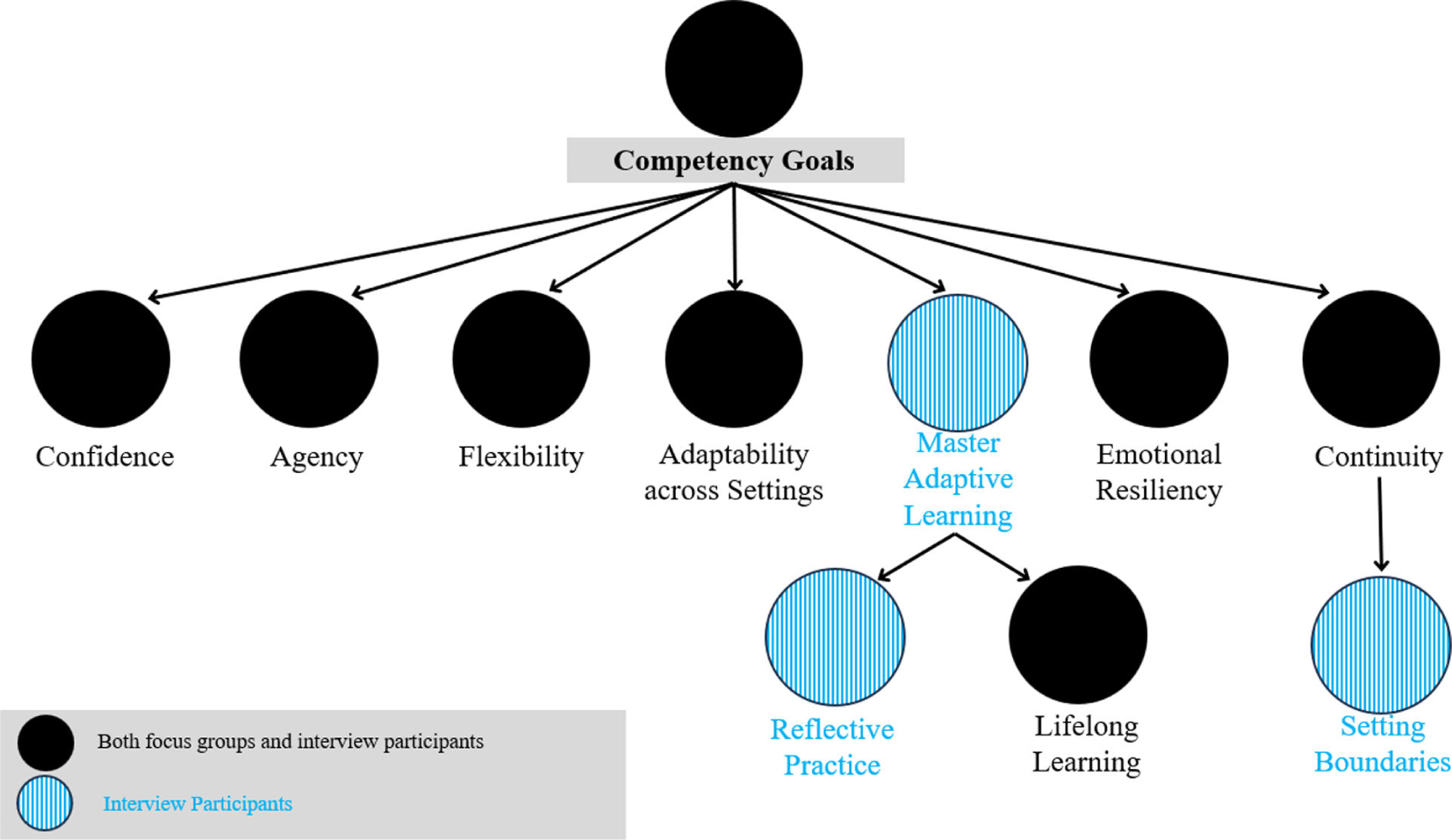
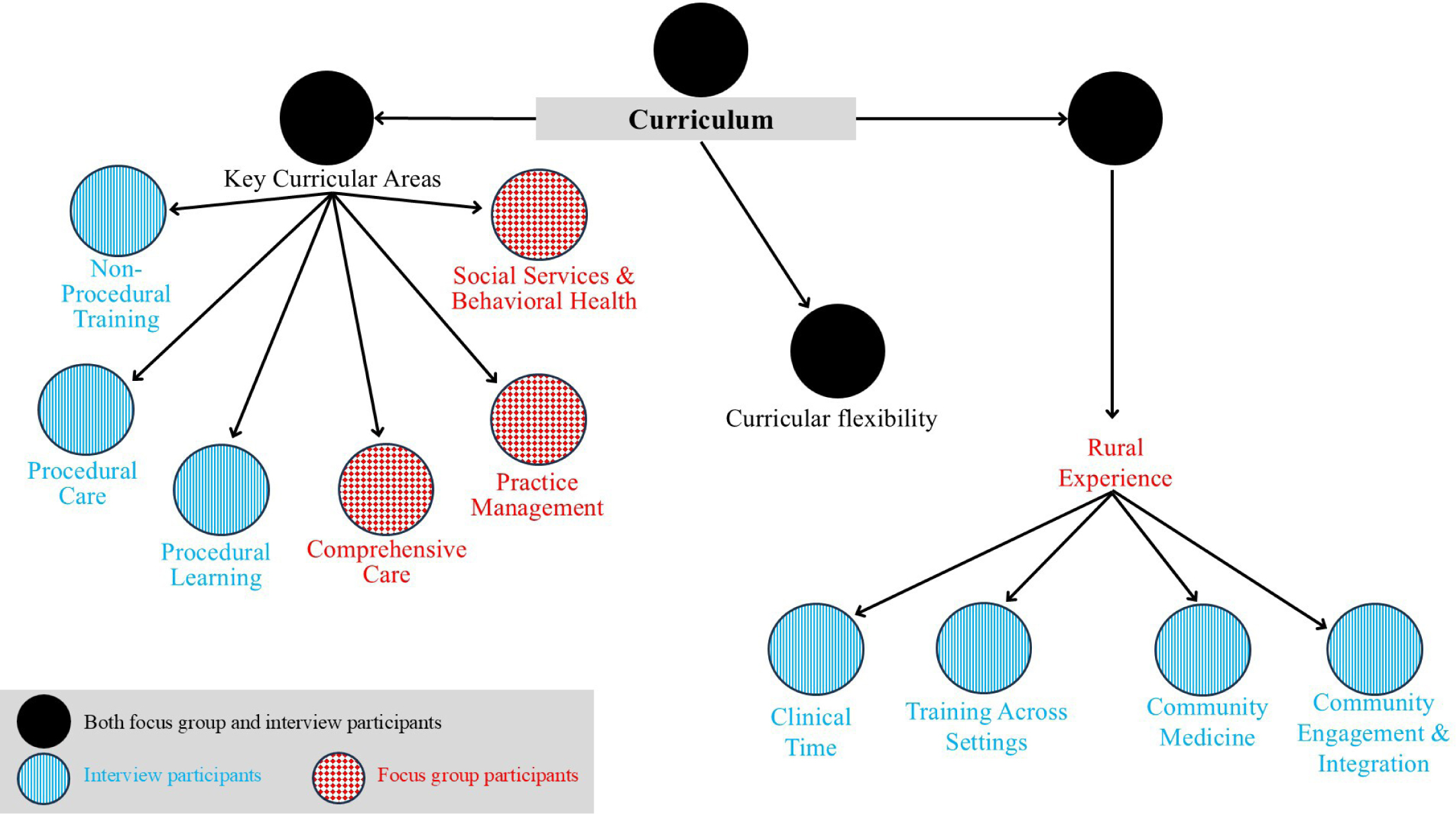
Data were organized into three overarching areas: competency domains, curriculum, and modes of education. The results are presented here in text, tables, and figures. Each table presents identified themes along with definitions (where applicable) and representative quotations. Each figure illustrates how the themes are related and whether they were identified in focus groups, interviews, or both.
Competency Domains for Rural Practice
Participants consistently emphasized domains extending beyond standard GME Milestones. These domains included confidence, agency, flexibility, adaptability across settings, lifelong learning, emotional resiliency, and continuity. Table 1 presents each competency domain with its definition and exemplary quotations; the domains also are illustrated in Figure 1.
Domain |
Definition |
Exemplary quotation |
Confidence |
Application of the judgment about whether to execute an action; the courage to execute an action |
“Getting a little creative with how you want to manage the patient that is not able to see the specialists and expanding your scope of practice.” |
|
|
“To know your limits. So you want that confidence, but you also have to have the confidence to say, ‘I have no idea. And that’s out of my realm of comfort.’” |
Agency |
Acting independently in situations that are typically handled by a team; power or responsibility placed on the physician |
“The hospital I worked at, the tribal center, we had to have . . . like we delivered about five babies a year in the ER, and a good percentage of them were premature because it was a high-risk population. So, we had to have all the equipment and everything, and we had a dog warmer to keep them warm in the middle of the winter, and we had to be able to stabilize those folks for 12 hours if the weather was a problem.” |
|
|
“I should add leadership because you’re gonna end up being the chief of staff. You’re gonna end up being . . . because there’s nobody else. It’s not necessarily because you’re amazingly skilled, but they’re like, OK, according to the bylaws, you can now hold an office. Congratulations.” |
Flexibility in treatment plan |
The choice to take certain actions over others, eg, in response to limited resources or other reasons when prescribed actions are not available |
“[In rural practice] I think there’s a lot more sort of troubleshooting and a need to be willing to figure things out as you go that you may not . . . You’re going to have people coming in with a variety of different sorts of problems.” |
|
|
“And then I think for me another thing was not being frustrated with the process of tertiary centers; everybody’s like uptrain, you have nutrition, social work, everyone that is at your fingertip. But in the rural setting, those roles may or may not be there. And so it’s getting creative or allowing maybe different individuals to fulfill those roles.” |
Adaptability of skills across settings |
Ability to transfer skills across clinical settings, eg, outpatient clinic, hospital, emergency department, obstetrical suite, nursing home, and home visits in 1 day or week |
“We provide health care sometimes in like unique settings. We get to go to more school events or like, we have school clinics. Which is really nice. More home visits I think than you would get in an urban setting.” |
|
|
“One [thing] that was mentioned a lot was balancing all of the different areas that we work in—clinic, hospital, ER, OB, nursing home. How do you do all of that in a single day?” |
Lifelong learning |
Continuously and reflexively learning new procedures, skills, and medical knowledge |
“The first 7 years, usually you do as much or more reading than you did when you were a resident for the reasons we already talked about, because you’re expanding your knowledge base into areas that you didn’t think you might be practicing or doing.” |
|
|
“I learned quite a bunch of procedures in my rural practice years that I maybe didn’t learn much in residency and became broader scope. I think that’s a really cool thing that people going into a more urban practice are probably not going to encounter.” |
Emotional resiliency |
Sustaining well-being in isolated and high-demand environments |
“The things that stick out in my mind the most actually, I learned how to take care of premature babies. I learned how to deliver breech babies. I learned how to run codes and deal with way too many dead people, honestly, just because the place that I worked had lots of teenage suicides, lots of car accidents. I learned to be really emotionally resilient actually in those situations and because it was just really difficult” |
|
|
“You have to emotionally prepare for disasters walking in your door that you didn’t necessarily see in an urban setting because the ER sort of filtered all those out for you.” |
Continuity |
Building trust and providing longitudinal care |
“That you are gonna have true continuity in family practice, and that is both a blessing and a curse. [laughter] Because it is, like there is such joy in getting to take care of multigenerational families, in getting to truly know, suddenly, you know the social stressors that are going on because you are also taking care of their family member who’s challenged with substance abuse disorder and all of those things, and you know it from both sides. You’re gonna be, you are so invested that it . . . I’m not saying that all doctors aren’t invested in their patients, but at the same time, like it hurts more when you have a fetal demise.” |
|
|
“That I think that as a family doctor, I’d always like continuity. . . . I had framed continuity as the continuity of relationship with my patients and being in a place for our 20 some years. Loved those relationships and those multigenerational relationships, but had never heard anybody talk about continuity with a place or continuity with a community and a system. And that’s so amazing and rich, I don’t know why anybody doesn’t talk about it. So it’s that other level of continuity that I love.” |
Curriculum Content and Context
Rural experiences, curricular flexibility, and fundamental practice topics reinforced and informed one another to form the foundations of a rural-based curriculum. Table 2 presents curriculum content and exemplary quotations; the curriculum content and context also are illustrated in Figure 2.
Curriculum content |
Context |
Quotations |
Key curricular areas |
Nonprocedural training |
“Introduce them to committees and boards they will likely be on [when they enter practice].” |
“A lot of the unknowns, for me at least, came from like a systems level. You know, I mean, even things like billing . . . they kind of give you some spiel, but for me, at least, I had to learn a lot of that after the fact, and even then, I was kind of just going off of my basic knowledge. But I think it would be good if we kind of went into practice being a little bit more knowledgeable about that kind of stuff.” |
Procedural care |
“There are just maybe certain things that I wish I got more of. Like, I’ve always felt that I wish I had more procedure time during residency and I’ve talked with and seen other residences like the way they factor that into their training and I’ve always just wished that we just had more of that.” |
“The more hands-on stuff, the better.” |
Procedural learning |
“I think we had a good simulation lab. . . . And I think we had good mannequins, we had good scenarios, we had good instructors and preceptors for that, and it gives you an opportunity to practice some of those things that you might not see on a regular basis but still need to have some knowledge or familiarity with.” |
Comprehensive care |
“Practice practice practice. They are doing the work of the rural doc 90% of their training. They have selective time to build skills tailored to future (hopefully) rural location, ie, ER, adult inpatient, peds, OB.” |
“Comprehensiveness across all settings with options for advanced skills in procedures such as surgical OB, trauma, ICU, POCUS, and care of vulnerable populations like HIV, MAT, Hep C, gender-affirming care, full scope reproductive care.” |
Practice management |
“Gaining a little bit more understanding about the administrative side of medicine because I think in the rural health setting, whether you like it or not, that impacts your day. And so if you don’t really understand or are not involved in those conversations then there’s a lot more frustration and a lot more ignorance about why you keep on running into the same issue.” |
“Involvement with admin and other ancillary services (QI, safety, med staff, etc.) and meetings to learn leadership and internal advocacy skills.” |
Social services and behavioral health |
“Increase complement of integrated care from social worker, counselor.” |
“Creativity in utilizing resources in different areas—psych/behavior medicine.” |
Curricular flexibility |
|
“So, for example, in residency training, you might get offered, hey, OK, you’ve got this many electives. Sometimes it’s just saying, hey, I wanna make my own elective. I found this physician that works out in this town. I’ve already coordinated with him; he says I can come work with him for the month and then doing that as an elective or so.” |
|
|
“I had the ability, for example, to go spend some extra time with dermatology and get comfortable with some things that I was interested in. And having some degree of flexibility to do that, I think it’s important. Because if you know you’re going into a practice environment that’s going to be limited in resources, you can make some decisions. . . . These are things that I feel like I need to know, or these are places where I feel like my knowledge is not as strong and I need to work on my comfort level with those things, or these are specific procedures that I feel like I need to do.” |
Rural experience |
Clinical time |
“Full scope procedural care including surgical OB and endoscopy.” |
|
Training across settings |
“So I think probably training in all areas like being comfortable in all settings so primary care, urgent care, emergency. And if you’re going to be plus or minus doing inpatient stuff. But I feel like having maybe not necessarily equal time in all of those things, but feeling comfortable and competent in all of those areas, and especially I think the more urgent care emergency time because I know in my residency we had time; it was allotted and I don’t remember what percentage, whatever.” |
|
Community medicine |
“We have a community medicine rotation that allows residents to get out into the schools/service organizations, etc.” |
“Understanding of agricultural medicine.” |
|
Community engagement and integration |
“Being part of that community, you’re seeing your patients not just in the clinic; they’re going to the community events with you, whether it’s church, whether it’s school, whether it’s Walmart.” |
|
|
“For me, one of the unique things is patient rapport, patient connection. I don’t feel that in an urban setting, you get to have that connection as well with the patients. For instance, one of my patients and I joke about he’s not gonna let me go pick his corn this season from his field because he was mad because I told him I had to send him to a specialist or something. So like that rapport already, and I’m only 7 months in. So I think that connections in rural.” |
Regarding rural experiences, participants emphasized the need for residents to spend time in rural communities and clinics, across a variety of settings. These experiences were incredibly important and mentioned regularly in both focus groups and interviews.
I think the biggest thing [in residency] is rural experience. . . . The studies show that the [residents] that train in [rural] environment[s] are a lot more likely to be doing that 7 to 10 years after they’re completed in the small towns doing that full scope practice. So, I think that exposure is critical to help with that because some of it, they don’t . . . really understand some of the challenges of just living in that community, let alone practicing medicine in the community.
Fundamental practice topics included providing comprehensive care, understanding and integrating behavioral health services, and developing skills around practice management.
Curricular flexibility was the central, tethering component. Interview participants in particular highlighted the importance of electives to preparing them for eventual rural practice. Others mentioned the ability to create their own rotations based on the training needs of the community they planned to practice in. The flexibility to incorporate these opportunities was invaluable to preparing residents and meeting the needs of communities.
Modes of Education
Educating for rural practice can best be achieved through a combination of experiential learning and modeling or mentoring with an emphasis on strong communication. Residents need to both observe and practice good communication, leadership, and procedural care. Table 3 presents each mode of education and exemplary quotations.
Modes of education |
Quotations |
Experiential learning |
“I think we had a rotation. . . I can’t remember what they called it, but it was like rural something. . . . I don’t remember what year either. But you had to rotate in the rural track clinic. So I mean that in itself just I guess forcing you to be in that environment is helpful.” |
“Immersive experience in the rural practice where the residency is located.” |
Teaching |
“I think there are a lot of things that you are taught theoretically, even going through residency like you know that, OK, this thing is something to look out for. And when that happens, this is what you do.” |
“Informal teachback/grading on biweekly basis during rotation.” |
Communication |
“Strong connectedness with consultants . . . clear communication (not just referring patient to consultant).” |
Leadership |
“Being familiar or getting comfortable with [APPs’] scope of practice. But also knowing that you can uptrain your support staff and so being comfortable with uptraining your support staff so that you’re more supported in your day-to-day workflow.” |
“Opportunities to pursue a leadership track.” |
Procedural care |
“I did a high-volume rotation which allowed me more exposure to high-risk patients. Maybe that is thinking that that’s the reason why the high-risk patients that I had during my time with the organization I was working with, like I hesitate to say comfortable because it’s . . . never comfortable to be caring for two people and it’s a high-risk situation, but like I was able to do it I think partly because of that. So I think that definitely did help.” |
“Full scope procedural care including surgical OB and endoscopy.” |
Modeling or mentoring |
“When I started my job, I was doing inpatient and outpatient, a little bit of OB and residency, as well as some addiction work. My mentor had done all of that. Plus, he did nursing home at the same time. A lot of people, when they hear about that think, you’re crazy. Why would you want to do so many things? But having someone who understands the joy of doing full spectrum family medicine was really helpful in helping me understand this is really possible. You can get a lot of joy from this. Here’s some stuff to look out for; it just made it feel more doable, gave me someone who felt like a cheerleader rather than a nay-sayer.” |
“And then mentorship, I think I mentioned the importance of being able to have a strong support going in and feeling comfortable to be able to kind of reach out, but not just for the clinical stuff. I think even for the personal stuff, because I think one of the things that I realized about being out in practice away from training is it can be a little bit more isolating.” |
This study identified seven core competency domains for rural practice and linked them directly to curriculum content and modalities necessary to develop them. Participants consistently emphasized domains extending beyond what is measured with use of existing ACGME Milestones.1 These domains build on earlier conceptual models of rural competency5 and included confidence, agency, flexibility, adaptability across settings, lifelong learning, emotional resiliency, and continuity. Our study extended this work by linking competency domains to specific curricular strategies and educational modalities.
The similarities between our findings and Longenecker’s competency domains of adaptability and resiliency reinforce the validity and importance of these domains.5 Achieving consensus of domain names is challenging because of overlap and interconnectedness. Participants mentioned living with scarcity and limits, and that is related to Longenecker’s competency domain by that title, among others.5 In this study, confidence, agency, and flexibility were identified as teachable characteristics that could help a physician navigate a context of scarcity and/or limits. Furthermore, engaging in lifelong learning can reinforce contextually necessary skills12 and contribute to community-oriented comprehensiveness.13 Of note, the domain from Longenecker’s paper on collaboration and community responsiveness5 is about the physician’s relationship with the rural community and is perhaps best aligned with the new domain of continuity. The responses from both the focus groups and interviews of recent graduates may reflect a continuing challenge for family medicine residencies in promoting engagement with the community outside health care. While participants of this study were grateful for competent and responsive colleagues, the framing of questions around competency for individual residents planning to enter rural practice limited discussions of collaboration within the clinical setting. Finally, continuity is important to all primary care practices, but program directors and practicing physicians identified building a longitudinal relationship with patients as central to rural practice.
This study also added needed detail to curricular content and modes of education necessary to achieving increasing competence. Residency programs should implement a combination of key curricular areas that all future rural physicians receive, incorporating learning in a rural community with curricular flexibility. Curricular flexibility allowed residents to tailor their GME to the needs of their future practice community. Didactics supplemented, but did not substitute for, experiential learning, role modeling, and mentoring. Program faculty must model and communicate, for example, the confidence, agency, and flexibility in treatment plans required when faced with a difficult scenario. Technical breadth alone was deemed insufficient. Participants described a need for adaptive expertise, or the metacognitive capacity to use skills appropriately in unforeseeable, resource-limited contexts.14
Many identified domains align closely with recently revised ACGME family medicine outcome expectations, including continuity, comprehensiveness, leadership, adaptability across care settings, and lifelong learning. Participants nevertheless described distinctive challenges in developing and sustaining these capacities within rural practice environments. These results could be used to refine areas of further research for those interested in developing supplemental subcompetencies for voluntary use in programs educating residents for rural practice. These internal measures could provide program-level feedback and internal and interprogram collaborative opportunities to adjust curriculum content and modalities. Any future application of these findings should prioritize curricular flexibility and avoid unnecessary administrative burden for rural programs. Gaining a better understanding of the specific curricular and modal basis for program success in training for rural practice would be distinctly valuable and beyond the existing research linking geographic location of rural programs to rural workforce outcomes.
Education in a rural setting was identified as a key component of the curriculum to support competence for rural practice. However, not all states and regions may have equal opportunities for rurally located GME program development. This can be due to resource limitations such as small patient populations or other resource restrictions that would be required for program accreditation.15,16 Such programs may benefit from additional research and curricular development carried out in a combination of rural and urban locations. For example, sparsely populated rural states may have long or impractical travel challenges from urban centers to training-capable rural communities. They may benefit from a blueprint for implementing a flexible curriculum for rural training through means in addition to periods of rural immersion. Defining rural competency domains and components of educational strategies, such as rural experiential learning as well as modeling and mentoring, allows for intentional program implementation and the measurement of relative effectiveness over time and between program types.
While rural graduate placement outcomes have been noted as an indicator of program success,17 these analyses may not consider influential factors such as loan-repayment status, personal geographic preferences, or other noneducational factors related to posttraining recruitment and retention.18,19 By incorporating outcome measures such as the voluntary use of supplemental subcompetencies, programs could measure effectiveness in new ways specifically related to curriculum and teaching modalities. Program success among interprogram variability could support much needed flexibility for rurally located programs. Additionally, establishing best practices for curricular components and modalities specific to rural GME programs may have broader use for both GME planning and related policymaking.
Our findings reflect the experiences of 22 purposively recruited program directors, residents, and early-career rural physicians, and thus may not capture the full breadth of rural training environments or career trajectories. As with all qualitative research, results are context-dependent and intended to provide nuanced insight rather than generalizations.20 A strength of this research was in its methods: collecting and analyzing data from program directors to inform in-depth interviews with early-career physicians. This method ensured a variety of perspectives; however, future research should include mid- and late-career rural physicians or follow residents longitudinally to validate competencies in real time and identify barriers and supports. Future research should validate reported competencies across diverse rural contexts and examine their relationship to physician retention, well-being, and patient outcomes. Further research should validate these competencies across broader samples, refine rural milestones, and evaluate curricular innovations for their impact on rural practice retention and outcomes.
This study identified seven competency domains uniquely important to rural primary care practice: confidence, agency, flexibility, adaptability across settings, lifelong learning, emotional resiliency, and continuity. This study expanded prior work around the domains of competence important to preparation for sustained rural practice and linked each to specific curricular strategies and educational modalities required for learners to achieve foundational competence for rural practice. Our findings also highlighted key curricular components for rural training, including rural immersion, targeted procedural and practice-management skills, and the central role of curricular flexibility. Competency-based education for rural family medicine must extend beyond general educational frameworks and assessment tools. Incorporation of rural-focused subcompetencies and curricular strategies into GME design can strengthen rural workforce readiness and improve alignment between training and the realities of rural practice. This study demonstrated that competency domains for rural practice will be best understood as a dynamic integration of broad clinical scope, adaptive capacities, and community connection.
Limited findings and discussion presented at 2024 Rural Medical Training Collaborative annual meeting and 2025 Accreditation Council for Graduate Medical Education Annual Meeting (poster).
This project was supported by the American Board of Family Medicine Foundation and its Visiting Scholars Program.
We thank the Rural Medical Training Collaborative and American Board of Family Medicine research team for their support, and the physicians and residents who generously shared their insights.
References
-
-
Patterson DG, Andrilla CHA, Garberson LA. Preparing physicians for rural practice: availability of rural training in rural-centric residency programs.
J Grad Med Educ. 2019;11(5):550–557. doi:10.4300/JGME-D-18-01079.1
-
Pollack SW, Andrilla CHA, Peterson L, et al. Rural versus urban family medicine residency scope of training and practice.
Fam Med. 2023;55(3):162–170. doi:10.22454/FamMed.2023.807915
-
-
Longenecker RL, Wendling A, Hollander-Rodriguez J, Bowling J, Schmitz D. Competence revisited in a rural context.
Fam Med. 2018;50(1):28–36. doi:10.22454/FamMed.2018.712527
-
Schmitz D. The role of rural graduate medical education in improving rural health and health care.
Fam Med. 2021;53(7):540–543. doi:10.22454/FamMed.2021.792533
-
-
Russell DJ, Wilkinson E, Petterson S, Chen C, Bazemore A. Family medicine residencies: how rural training exposure in GME is associated with subsequent rural practice.
J Grad Med Educ. 2022;14(4):441–450. doi:10.4300/JGME-D-21-01143.1
-
Rosenblatt RA, Andrilla CHA, Curtin T, Hart LG. Shortages of medical personnel at community health centers: implications for planned expansion.
JAMA. 2006;295(9):1042–1049. doi:10.1001/jama.295.9.1042
-
Konkin J, Grave L, Cockburn E, et al. Exploration of rural physicians’ lived experience of practising outside their usual scope of practice to provide access to essential medical care (clinical courage): an international phenomenological study.
BMJ Open. 2020;10(8):e037705. doi:10.1136/bmjopen-2020-037705
-
Schmitz DF, Koempel A, Cook C, Bazemore AW. Training needs for rural primary care practice: a scoping review of resident physician preparation.
Fam Med. 2026;58(3):199–207. doi:10.22454/FamMed.2026.909274
-
Mylopoulos M, Regehr G. Cognitive metaphors of expertise and knowledge: prospects and limitations for medical education.
Med Educ. 2007;41(12):1159–1165. doi:10.1111/j.1365-2923.2007.02912.x
-
Reitz R, Horst K, Davenport M, Klemmetsen S, Clark M. Factors influencing family physician scope of practice: a grounded theory study.
Fam Med. 2018;50(4):269–274. doi:10.22454/FamMed.2018.602663
-
Pusic MV, Hall E, Billings H, et al. Educating for adaptive expertise: case examples along the medical education continuum.
Adv Health Sci Educ Theory Pract. 2022;27(5):1383–1400. doi:10.1007/s10459-022-10165-z
-
-
-
Meyers P, Wilkinson E, Petterson S, et al. Rural workforce years: quantifying the rural workforce contribution of family medicine residency graduates.
J Grad Med Educ. 2020;12(6):717–726. doi:10.4300/JGME-D-20-00122.1
-
Baker ET, Schmitz DF, Wasden SA, MacKenzie LA, Epperly T. Assessing community health center (CHC) assets and capabilities for recruiting physicians: the CHC Community Apgar Questionnaire.
Rural Remote Health. 2012;12:2179. doi:10.22605/RRH2179
-
Schmitz DF, Baker E, Nukui A, Epperly T. Idaho rural family physician workforce study: the Community Apgar Questionnaire.
Rural Remote Health. 2011;11(3):1769. doi:10.22605/RRH1769
-
Small ML. ‘How many cases do I need?’ On science and the logic of case selection in field-based research.
Ethnography. 2009;10(1):5–38. doi:10.1177/1466138108099586



There are no comments for this article.