Background and Objectives: Point-of-care ultrasound (POCUS) is increasingly used in primary care and is now an Accreditation Council for Graduate Medical Education training expectation for family medicine residents. However, standardized methods for teaching, observing, and assessing POCUS skills in clinical settings remain limited.
Methods: The University of Hawai‘i Family Medicine Residency Program developed direct-observation checklists for obstetric (OB) and musculoskeletal (MSK) POCUS. OB assessments included first- and third-trimester scans, while MSK assessments focused on knee and shoulder examinations. Checklist content was adapted from existing validated tools and refined through Plan-Do-Study-Act cycles. The checklists were designed for use before, during, and/or after patient encounters to guide observation and feedback. Faculty and residents completed surveys to evaluate usability, workflow integration, and educational impact.
Results: From March to October 2025, 39 checklists (28 OB, 11 MSK) and 60 surveys were collected from faculty and residents at two clinical sites. Most attending physicians reported checklist completion and feedback delivery in less than 5 minutes. Faculty most frequently used the tools postencounter. Perceived utility was high: 76% of OB and 88% of MSK attending responses rated the checklist as very useful, and nearly all residents (95% OB; 100% MSK) reported that the checklists supported a systematic approach and reinforced learning. Time constraints and certain indirectly observable checklist items were identified as implementation challenges.
Conclusions: Structured POCUS teaching checklists are feasible and well-received in family medicine residency training. These tools support direct observation, structured feedback, and standardizing expectations during supervised scanning encounters.
Point-of-care ultrasound (POCUS) is an increasingly important diagnostic and procedural tool in primary care, providing real-time, cost-effective, radiation-free imaging that enhances bedside decision-making.1,2 The Accreditation Council for Graduate Medical Education now emphasizes POCUS experience within the core procedural training expectations for family medicine residents.3 However, standardized approaches for teaching, assessing, and documenting POCUS skills remain limited.4
Historically, POCUS competency relied on the number of completed scans as a surrogate for proficiency, despite limited evidence that volume alone reflects true competence.4 In contrast, modern competency-based education emphasizes direct observation, structured assessments, image review, and entrustable professional activities as more meaningful indicators of skill.5 These approaches require practical tools that can be integrated into routine clinical supervision.
To address this gap, the University of Hawai‘i Family Medicine Residency Program developed and piloted structured obstetric (OB) and musculoskeletal (MSK) POCUS teaching checklists. Designed to support direct observation and feedback during clinical encounters, these educational tools may complement other assessment strategies such as image review to inform learner competency. This study described the development, implementation, and pilot evaluation of these checklists, examining perceived utility, workflow integration, and early educational impact.
Framework Development
In August 2024, POCUS-trained faculty designed an observation-based framework for real-time resident education and feedback. OB POCUS assessments included first- and third-trimester examinations focused on confirming intrauterine pregnancy; estimating gestational age; and assessing fetal presentation, placental location, and amniotic fluid. MSK POCUS focused on limited shoulder and knee exams.
Faculty Competence
Faculty ultrasound experience varied, prompting standardization efforts. For OB POCUS, five experienced faculty served as primary evaluators; two completed a dedicated first-trimester scanning session with an OB ultrasonographer to confirm technique, accuracy, and interrater consistency, with plans for remaining faculty to complete similar training in the future.
MSK ultrasound evaluations were performed solely by a sports-medicine board-certified faculty member. Five additional faculty with variable MSK experience have begun structured training that includes a 30-minute faculty development session, a 4-hour hands-on workshop, and supervised scanning. Competency will be assessed using pilot checklists and review of submitted scans by the sports-medicine faculty.
Checklist Identification and Adaptation
A literature review identified existing validated POCUS assessment tools.6-9 Identified tools included an internal maternal fetal medicine evaluation form, a first-trimester dating checklist from the Reproductive Health Access Project, and the validated B-QUIET ultrasound assessment tool.8,9 Key elements were adapted to create family medicine-specific OB and MSK checklists aligned with existing program direct-observation formats (Appendices A-C). OB POCUS used separate first- and third-trimester checklists, while MSK used a general checklist supplemented by scan-specific anatomy subtables. All checklists included interpersonal skills, ultrasound technique, medical knowledge, and narrative feedback.
PDSA Cycles
Checklist drafts were refined through Plan-Do-Study-Act (PDSA) cycles (Table 1). Early piloting identified barriers, including limited opportunities for direct observation and clinic time constraints, prompting content and workflow adjustments.
Cycle |
Plan |
Do |
Study |
Act |
1 |
Identified the need for standardized competency-based POCUS assessment
Reviewed existing tools and literature |
Drafted OB and MSK POCUS competency checklists
Developed Google surveys assessing checklists, usefulness, and barriers
Gathered informal feedback from colleagues related to checklists and surveys
Announced pilot implementation to residents and faculty
Refined survey questions |
Feedback confirmed strong interest in structured assessment.
Checklist content and survey structure were appropriate for piloting. |
Finalized pilot checklist and surveys for clinical implementation |
2 |
Standardized POCUS assessment during OB and MSK clinical encounters |
Piloted checklist during OB and MSK visits
Collected attending and resident surveys
Reviewed qualitative feedback
Assessed usability and time burden |
Checklists were highly valued educationally.
Opportunities for refinement were identified, including checklist and survey length, observational burden, comment space, and checklist accessibility. |
Created checklist version two with revisions: shortened interpersonal skills section, expanded comment section, and laminated the checklists to be stored near the ultrasound machines
Simplified the survey, made it more accessible via QR code on the checklist |
3 |
Improved checklist integration into clinical flow and enhanced efficiency |
Implemented checklist version two and updated survey during OB and MSK visits
Continued collecting survey feedback
Assessed usability and time burden |
Version two improved clinical workflow.
Feedback suggested aligning language with competency frameworks and reducing medical knowledge burden. |
Created checklist version three incorporating entrustable professional activities (EPAs)-based summative language and a shortened medical knowledge section |
Survey Development
Parallel Google-based surveys were created to assess checklist usability and educational impact. Instruments included a 5-point Likert scale and free-text responses. Survey links were provided to faculty and residents on the checklists for their feedback. The University of Hawai’i Institutional Review Board determined this project was not human subjects research.
Implementation
Checklists were implemented at two clinical sites: a family medicine continuity clinic and a women’s health clinic. Laminated checklists were available in the precepting room. Faculty were encouraged to use the tools before, during, and/or after encounters; and residents were prompted to involve attendings early to facilitate direct observation. Quick-response (QR) codes were placed on checklists to improve survey accessibility, facilitate completion, and inform ongoing PDSA-based refinements.
Participants
Between March one and October 31, 2025, five faculty completed 39 checklists (20 first-trimester OB, 8 third-trimester OB, 7 MSK shoulder, 4 MSK knee) and 33 surveys (25 OB, 8 MSK). Four attendings completed OB checklists; one completed MSK checklists exclusively. Residents submitted 27 surveys (21 OB, 6 MSK), representing postgraduate year (PGY) one through PGY-3 trainees and one sports-medicine fellow. Descriptive statistics summarized responses as percentages.
Workflow Integration
Checklist completion and feedback delivery was efficient. For OB POCUS, 76% of attending surveys reported completion in less than 5 minutes and 24% in 5 to 10 minutes. For MSK, 63% required less than 5 minutes and 37% required 5 to 10 minutes.
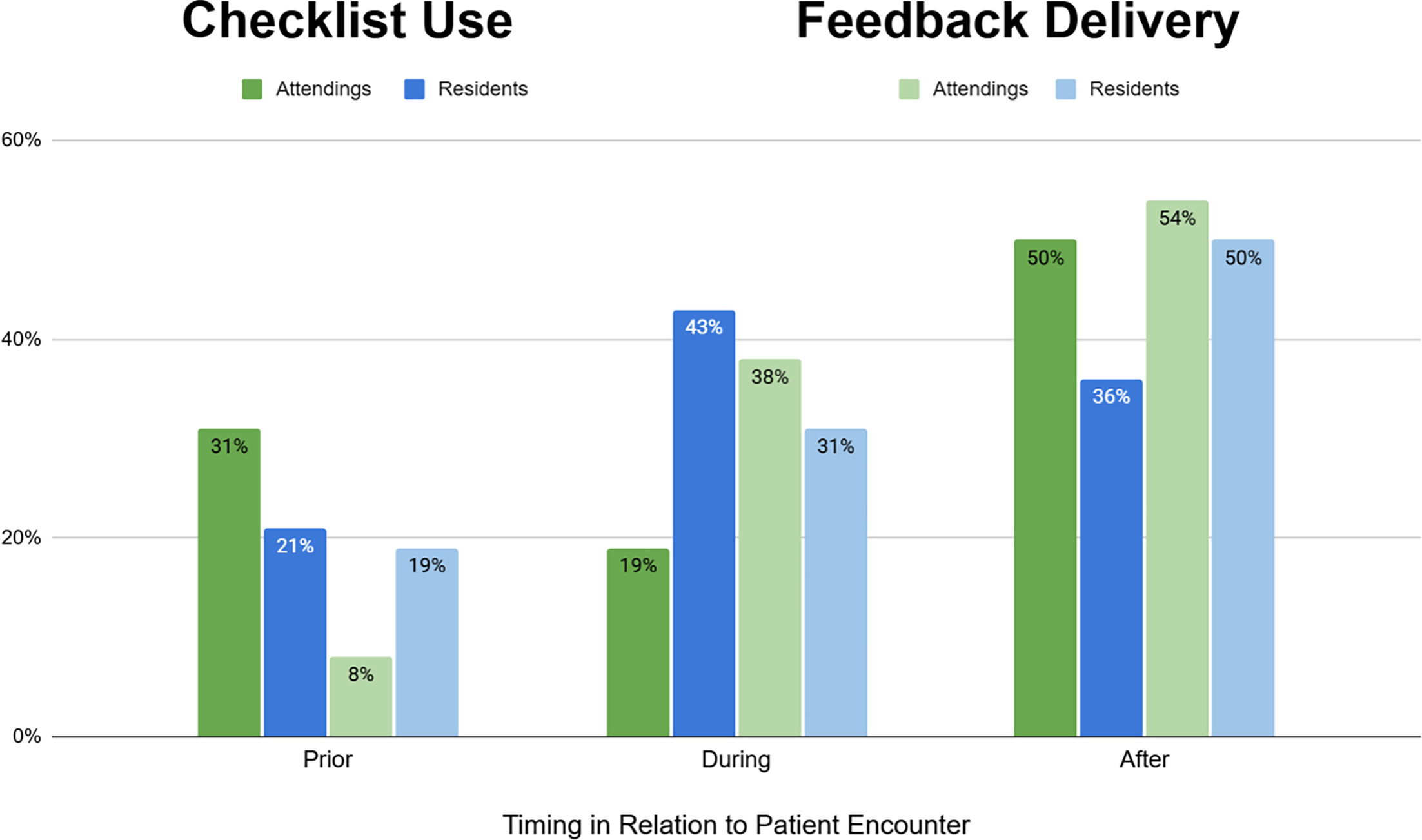
All attendings utilized the checklists postencounter (Figure 1). Preencounter utilization was reported by 76% of OB and 75% of MSK responders. Real-time use during scanning was more common for OB POCUS (76%) than MSK POCUS (13%).
Residents reported similar patterns. Fifty-seven percent of residents performing OB POCUS and 50% performing MSK POCUS used the checklist across multiple encounter phases. Fifty-two percent of residents performing OB POCUS reported receiving feedback at multiple stages, whereas 43% performing OB and 83% performing MSK scans reported feedback exclusively after the encounter.
Perceived Utility and Educational Impact
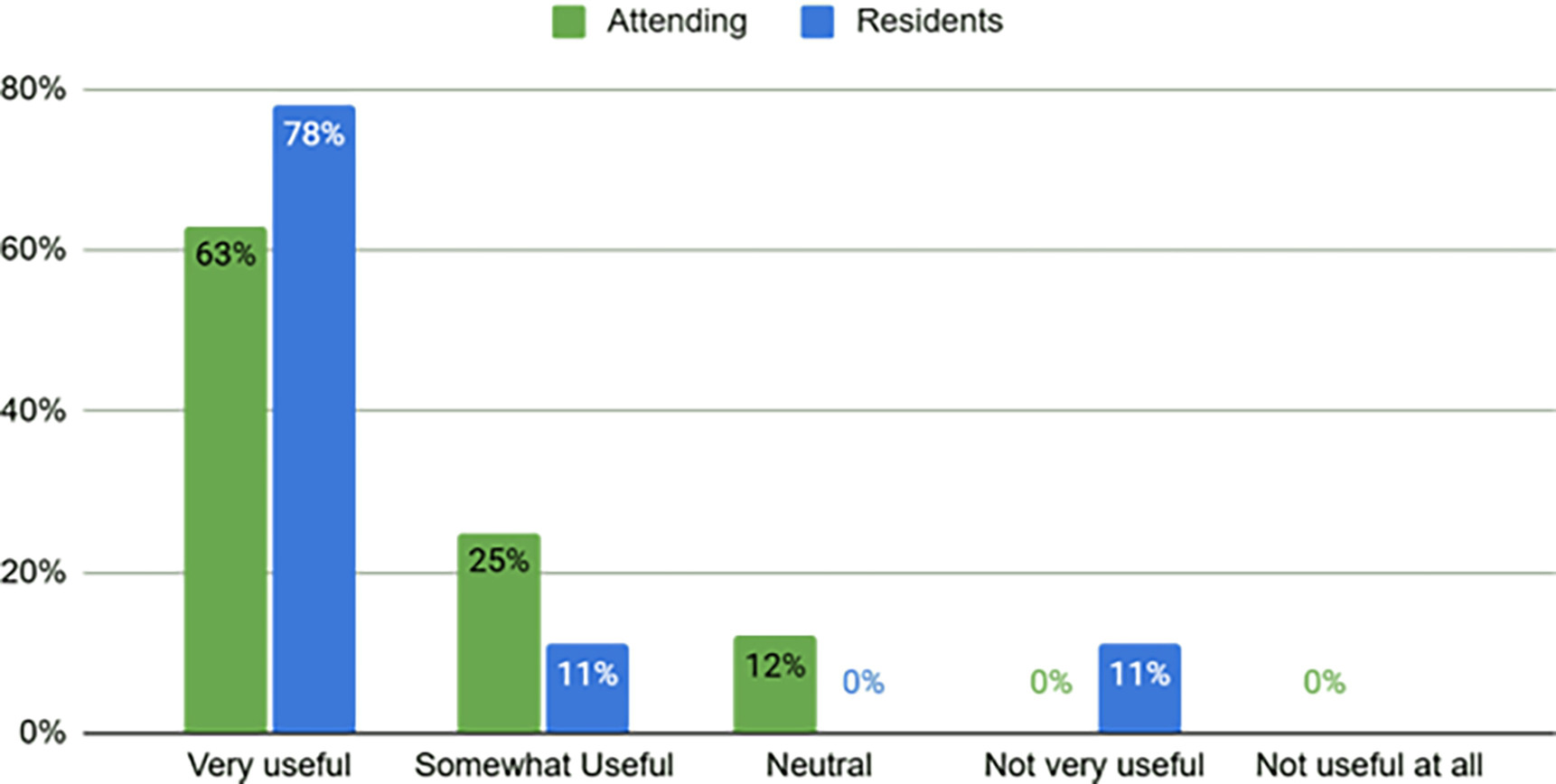
Overall perceived utility was high. Among attendings, 76% of OB and 88% of MSK survey responses rated the checklist as very useful (Figure 2). Attendings cited its value for assessing resident skill level, guiding individualized teaching, identifying knowledge gaps, and facilitating structured feedback.
Residents’ qualitative feedback was similarly positive. Ninety-five percent of OB POCUS respondents reported that the checklist helped clarify expectations and highlight areas for improvement. All MSK respondents indicated that the checklist supported a systematic scanning approach and reinforced learning during image review.
Challenges and Areas for Improvement
Time constraints were the main implementation barrier, particularly completion of the medical knowledge section (OB 24%; MSK 13%), prompting calls from attendings to abbreviate it. Indirectly observable items, such as transducer disinfection and data entry, were also recommended for removal (OB 16%; MSK 50%). Additionally, participants suggested electronic formats, expanding comment space, providing laminated copies, and additional visual aids.
This pilot demonstrated that structured OB and MSK POCUS teaching checklists are feasible and well-received within a family medicine residency training environment. Faculty and residents reported that the tools integrated smoothly into clinical workflows and supported supervised scanning encounters. Flexible use across encounter phases enabled the checklist to support preparation, provide real-time guidance, standardize expectations, and facilitate structured feedback. By providing a shared observational framework, the tool encouraged deliberate teaching while helping learners identify areas for improvement. Across training levels, the checklist supported both foundational skill development for junior residents and refinement of technique among more experienced learners. Iterative refinement through PDSA cycles further clarified the checklist’s primary role as a direct observation and feedback instrument rather than a comprehensive knowledge assessment tool.
Several limitations should be considered. The pilot involved a small number of participants, particularly for MSK POCUS, and faculty had varying levels of ultrasound experience. The modest sample size and incomplete survey responses may limit generalizability, and some findings may reflect individual teaching styles rather than the performance of the checklists themselves. Additionally, the study focused on perceived utility rather than objective measures of skill acquisition or competency development.
Future work should include expanding faculty development, refining checklist content, and evaluating implementation across additional sites and POCUS domains. Integration with other assessment strategies, such as image review and objective structured clinical examinations, also may help programs build more comprehensive approaches to competency assessment.10
Overall, structured POCUS teaching checklists represent a practical and scalable strategy to support direct observation, improve feedback quality, and promote shared expectations in family medicine ultrasound education.
Portions of this manuscript were presented as poster presentations at the Society of Teachers of Family Medicine Annual Spring Conference, Salt Lake City, Utah, May 3–7, 2025. Poster titles included “Use of a Competency-Based Assessment Tool to Evaluate Family Medicine Resident Training in Obstetrical Point-of-Care Ultrasound: A Pilot Study” and “Evaluating Learners’ Competency in Musculoskeletal Point-of-Care Ultrasound in a Family Medicine Training Program.”
Portions of this manuscript were presented as a poster at the Health Professions Education Conference, John A. Burns School of Medicine, Honolulu, Hawai‘i, on January 31, 2026.
References
-
Andersen CA, Holden S, Vela J, Rathleff MS, Jensen MB. Point-of-care ultrasound in general practice: a systematic review.
Ann Fam Med. 2019;17(1):61–69. doi:10.1370/afm.2330
-
Moore CL, Copel JA. Point-of-care ultrasonography.
N Engl J Med. 2011;364(8):749–757. doi:10.1056/NEJMra0909487
-
-
Gottlieb M, Duanmu Y. Beyond the numbers: assessing competency in point-of-care ultrasound.
Annals of Emergency Medicine. 2023;81(4):427–428. doi:10.1016/j.annemergmed.2023.01.020
-
Tulshian P, Montgomery L, McCrory K, et al. National recommendations for implementation of competency-based medical education in family medicine.
Fam Med. 2025;57(4):253–260. doi:10.22454/FamMed.2025.866091
-
-
-
-
Bahner DP, Adkins EJ, Nagel R, Way D, Werman HA, Royall NA. Brightness mode quality ultrasound imaging examination technique (B-QUIET): quantifying quality in ultrasound imaging.
J Ultrasound Med. 2011;30(12):1649–1655. doi:10.7863/jum.2011.30.12.1649
-



There are no comments for this article.