Background and Objective: Artificial intelligence (AI) adoption in medicine is rapidly expanding, including ambient AI (AAI), which converts clinician-patient conversations into documentation. Despite growing use among practicing physicians, little is known about student access to AAI or barriers to implementation during medical student clerkships.
Methods: We surveyed 174 family medicine clerkship directors (CDs) through the Council of Academic Family Medicine Educational Research Alliance network regarding AAI availability, permissibility, and opinions on student use. We analyzed responses using descriptive statistics and Fisher’s exact tests.
Results: Ninety-four CDs responded to AAI-related questions. Student AAI use was permitted for only 3% of core family medicine clerkships. CDs cited missing technology (38.3%) or institutional restrictions (42.5%) as barriers. Opinions on student use were divided: 42.6% opposed any use, 41.5% supported some use, and 16% were unsure. Among those who opposed use, major concerns included potential negative effects on clinical reasoning (82.5%) and communication skills (85%). Supporters of student use were significantly more likely to believe AI will improve training and become commonplace in students’ careers than those who did not support student use of AAI (P<0.0001).
Conclusions: Access to AAI for medical students during core family medicine clerkships is rare, and CDs expressed substantial concerns regarding its impact on clinical reasoning and communication skills. Given the expeditious integration of AI into clinical practice, medical educators must be prepared to teach with technology, proactively design curricula that assume AAI availability, and consider modalities in addition to clinical documentation to assess student clinical reasoning.
Artificial intelligence (AI) is rapidly transforming health care, from cancer detection and drug discovery to billing and coding support.1-3 Major industry stakeholders continue to invest heavily in AI tools, signaling their permanence in clinical workflows.4-6 Concurrently, medical schools are introducing AI curricula, garnering interest from medical students;7-12 and organizations such as the Association of American Medical Colleges (AAMC) have issued principles for responsible AI use in education.13 These trends underscore the need for medical educators to prepare students for their careers in an AI era.14,15
One emerging technology is ambient AI (AAI), which transcribes clinician-patient encounters, summarizes key clinical content, and organizes content into clinical documentation using natural language processing techniques.16 Evidence has suggested that AAI improves documentation efficiency and reduces clinician burnout.16-21 Early studies indicate potential benefits for medical students, such as enhanced note quality and real-time feedback.22,23 Concerns persist regarding its impact on clinical reasoning and communication skills,24-26 especially as AAI continues to develop abilities beyond transcription alone (eg, agentic capabilities including order entry, diagnosis coding, billing).18,20
Despite growing adoption among physicians—two-thirds of whom use health AI tools27,28—AAI availability for medical students remains unclear. Barriers may include potential educational harms, cost (estimated at $84–$600 per monthly user),29 institutional policies, electronic medical record availability,30 and ethical considerations such as Health Insurance Portability and Accountability Act (HIPAA) compliance or AI-specific concerns such as hallucinations or bias.31 Faculty attitudes toward AAI and national frameworks for AI integration in family medicine education are evolving.32,33 Understanding these factors is critical as documentation practices shift and traditional written notes—long used to assess clinical reasoning26 and interprofessional communication skills—may be supplemented or replaced by AI.
To address this knowledge gap, we surveyed family medicine clerkship directors (CDs) to characterize AAI availability and permissibility during core family medicine clerkships and identify factors influencing its implementation.
Ten questions on AAI were included in the 2025 Council of Academic Family Medicine Educational Research Alliance (CERA) survey of family medicine clerkship directors. These questions specifically addressed AAI transcription services, referred to hereafter as AAI. The authors worked with CERA survey leaders to develop questions aligned with the study aims and existing evidence; the CERA clerkship director survey methodology has been described previously.34
The survey included two outcome questions describing AAI availability and CDs’ opinions regarding medical student use of AAI. We created eight statements on potential benefits, risks, or effects of AAI use. These items were rated on a 5-point Likert scale ranging from 1 (strongly disagree) to 5 (strongly agree). Internal consistency was assessed using Cronbach’s α. The initial eight-item scale demonstrated acceptable reliability (α = 0.752). However, “Using AAI will be helpful for patient care,” “Medical students’ use of AAI will hinder their success in a residency without access to AAI,” and “Supervising faculty are resistant to AAI in their own practices” showed low item-total correlations (0.189, 0.287, and –0.074, respectively). Removing these items increased Cronbach’s α to 0.861, indicating improved internal consistency.
We tested associations between the outcome variable and each statement using Fisher’s exact tests in SAS (SAS Institute Inc). We used the Benjamini-Hochberg procedure to control the false discovery rate. The outcome variable, CDs’ opinions regarding AAI use by medical students on their core family medicine clerkship, was recoded into three categories: (1) “Students should not be able to use AAI at all,” (2) “Students should be able to use AAI for select/most/any patient encounters,” and (3) “Unsure.” Responses to the associated statements were similarly grouped as (1) “Disagree” (strongly disagree/disagree), (2) “Neutral” (neither agree nor disagree), and (3) “Agree” (agree/strongly agree). A P value less than .05 was considered statistically significant. All analyses were conducted using SAS version 9.4.
Of 174 surveys distributed, 100 family medicine CDs responded (57.47%; Table 1). Respondents were a mean of 16.5 years (SD 10.7, range 3–45 years) removed from residency training, 66.0% were female, and 75.5% were White. Six participants did not complete the AAI questions and were excluded from the AAI analyses.
|
n (%) |
School |
Public |
65 (69.2) |
Private |
27 (28.7) |
Not answered |
2 (2.1) |
School region |
New England (NH, MA, ME, VT, RI, or CT) |
4 (4.3) |
Middle Atlantic (NY, PA, or NJ) |
13 (13.8) |
South Atlantic (PR, FL, GA, SC, NC, VA, DC, WV, DE, or MD) |
18 (19.2) |
East South Central (KY, TN, MS, or AL) |
7 (7.5) |
East North Central (WI, MI, OH, IN, or IL) |
17 (18.1) |
West South Central (OK, AR, LA, or TX) |
9 (9.6) |
West North Central (ND, MN, SD, IA, NE, KS, or MO) |
7 (7.5) |
Mountain (MT, ID, WY, NV, UT, AZ, CO, or NM) |
6 (6.4) |
Pacific (WA, OR, CA, AK, or HI) |
8 (8.5) |
Canada |
5 (5.3) |
Gender |
Female |
62 (66.0) |
Male |
32 (34.0) |
Race and ethnicity |
Asian |
16 (17.0) |
Black/African American |
4 (4.3) |
White |
71 (75.5) |
Others |
4 (4.3) |
Hispanic |
4 (4.3) |
Years since residency graduation, mean (SD) |
16.5 (10.7) |
Table 2 highlights AAI availability and situational permissibility within clerkships. Among 94 respondents, 38.3% reported that AAI was unavailable in their health system. An additional 58.5% reported that AAI was available but not permitted for student use by the health system, medical school, or clerkship leadership. Ultimately, only 3.2% of CDs surveyed reported having AAI available and permissible for student use.
|
n (%) |
Are medical students permitted to use an ambient AI transcription service during their core family medicine clerkship? |
No—the health system does not have this service available. |
36 (38.3) |
No—the health system has the service available, but the health system does not permit medical student use. |
40 (42.5) |
No—the health system has the service available, but the medical school does not permit medical student use. |
9 (9.6) |
No—the service is available within the health system and the medical school permits student use, but the clerkship director does not permit student use of the service. |
6 (6.4) |
Yes—the service is available within the health system, the medical school permits student use, and the clerkship director permits student use of the service. |
3 (3.2) |
As clerkship director, what is your opinion on whether medical students should be permitted to use an ambient AI transcription service on their core family medicine clerkship? |
Students should not be able to use it at all. |
40 (42.6) |
Students should be able to use it for select patient encounters. |
31 (33.0) |
Students should be permitted to use it for most patient encounters. |
2 (2.1) |
Students should be permitted to use it for any patient encounter. |
6 (6.4) |
Unsure |
15 (16.0) |
Survey data further indicate that 42.6% of CDs did not think medical students should be permitted to use AAI on their core clerkship. Among those supporting AAI use, approximately one-third endorsed use for select patient encounters, 2.1% for most encounters, and 6.4% for any encounter. Overall, 41.5% supported some level of student AAI use, while 16.0% were unsure.
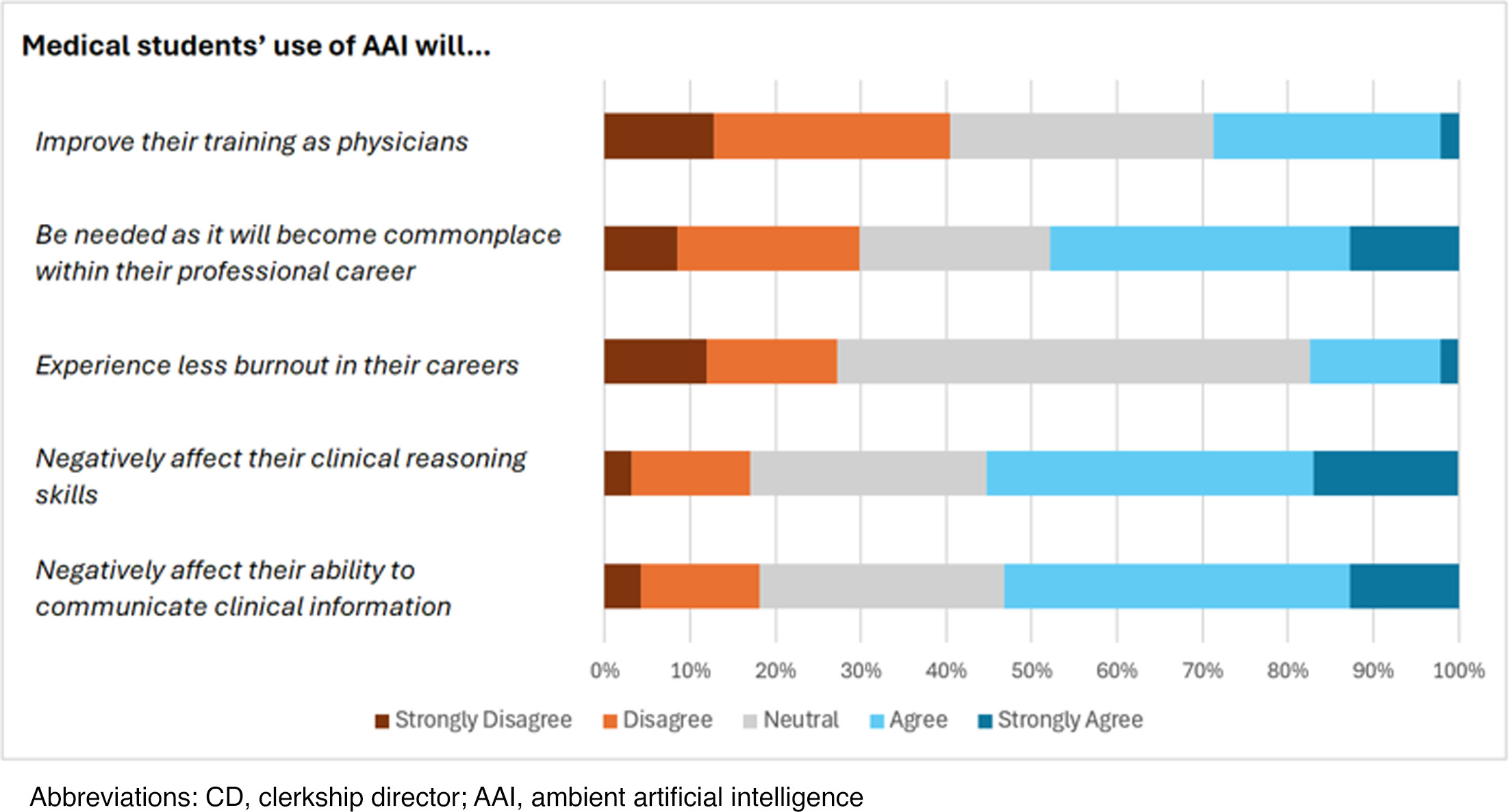
Figure 1 shows CDs’ level of agreement with five statements regarding the impact of medical student AAI use, as measured on 5-point Likert scales. Upon grouping the responses as described in the Methods section, the highest levels of agreement were for concerns that medical student AAI use will “negatively affect their clinical reasoning skills” and “negatively affect their ability to communicate clinical information” (53.2% and 55.3%, respectively). Nearly half of respondents (47.9%) agreed that medical students need to use AAI because it will become commonplace during their career. Fewer believed AAI would reduce burnout (17.0%), with substantial uncertainty (55.4%). Only 28.7% agreed that AAI would improve medical student training.
As Table 3 illustrates, survey responses from CDs who supported student use of AAI and those who opposed student use were analyzed across five additional questions. For each listed result, support of student use of AAI was statistically associated with differing response patterns regarding potential benefits, risks, or effects of AAI use when compared with those who opposed student use.
|
CD opinion regarding medical student use of AAI
n (%) |
P valuea |
CD level of agreement with the statement: Medical students’ use of AAI will … |
Should not be able to use
(N = 40) |
Should be able to use
(N = 39) |
|
Improve their training as physicians. |
|
|
<0.0001 |
Disagree |
31 (77.5) |
6 (15.4) |
|
Neutral |
8 (20.0) |
11 (28.2) |
|
Agree |
1 (2.5) |
22 (56.4) |
|
Be needed as it will become commonplace within their professional career. |
|
|
<0.0001 |
Disagree |
24 (60.0) |
4 (10.3) |
|
Neutral |
12 (30.0) |
4 (10.3) |
|
Agree |
4 (10.0) |
31 (79.5) |
|
Experience less burnout in their careers. |
|
|
.009 |
Disagree |
17 (43.6) |
7 (18.4) |
|
Neutral |
20 (51.3) |
21 (55.3) |
|
Agree |
2 (5.1) |
10 (26.3) |
|
Negatively affect their clinical reasoning skills. |
|
|
<0.0001 |
Disagree |
2 (5.0) |
11 (28.2) |
|
Neutral |
5 (12.5) |
16 (41.0) |
|
Agree |
33 (82.5) |
12 (30.8) |
|
Negatively affect their ability to communicate clinical information. |
|
|
<0.0001 |
Disagree |
2 (5.0) |
12 (30.8) |
|
Neutral |
4 (10.0) |
16 (41.0) |
|
Agree |
34 (85.0) |
11 (28.2) |
|
Although the following statements were excluded from the overall construct, a minority of CDs (15.8%) agreed that “Supervising faculty are resistant to using AI transcription services in their own clinical practice,” while nearly half (46.3%) disagreed, and 37.2% were neutral. Conversely, a substantial majority (74.5%) agreed that “Using AAI will be helpful for patient care,” while only 2.1% disagreed and 23.4% were neutral.
While health care professionals are quickly adopting AAI,18 data from this survey suggest that medical student access to AAI is a rarity, with only 3% of family medicine clerkships allowing student AAI use. Reasons for this are multifactorial, but this study addressed issues of availability and permissibility.
Availability
The results of this survey demonstrate that AAI is unavailable at 38% of CDs’ health systems. One small possibility is that unavailability could be due to the absence of an electronic health record at the training site, as data from the 2021 National Electronic Health Records Survey demonstrated an 88.2% nationwide adoption rate of any electronic health record.30 However, a more plausible explanation for this finding is that installing and maintaining AAI is expensive, with costs ranging from $84 to $600 per monthly user for health systems adopting the technology.29
A major ethical and privacy concern arises when AAI is used through public large language model platforms, which may not be designed to handle protected health information.31 As AAI tools become increasingly available at little or no cost,5 financial barriers to HIPAA-compliant AAI have declined. This shift increases the likelihood that students may adopt these tools independently, potentially before explicit permission is granted or before critical issues—such as cybersecurity, HIPAA compliance, and downstream effects on patients, learners, or institutions—have been adequately considered. Together, these factors underscore the urgency for medical educators to provide early, structured instruction to guide students toward ethical and appropriate use of AAI.
Permissibility
Compared to AAI availability, barriers surrounding AAI permissibility are more diverse and can be divided into four subthemes: health system and medical school barriers, CD AAI opinions, relationships between belief statements and CD opinions on AAI use, and clinical reasoning and communication skills.
Health System and Medical School Barriers. Over half of those surveyed (59%) indicated that, although their health system did have AAI, use by medical students was not permitted, either because the health system, medical school, or clerkship director did not allow it. While issues of permissibility at the health system and/or medical school level are speculatory and wide-ranging (eg, cultural, ethical, security, and academic domains),31 this survey did provide multiple insights into family medicine CD opinions regarding AAI use.
CD AAI Opinions. CD opinions showed that nearly the same percentage of CDs opposed AAI use by medical students during their core family medicine clerkship altogether (42.6%) compared to those supporting some level of use (41.5%). At the time of the survey, medical students at only three institutions were allowed to use AAI during their family medicine clerkship, and only eight CDs agreed that students should be permitted to use AAI for most or all patient encounters. We initially hypothesized that factors such as a CD’s time from residency graduation, age, or other demographic characteristics of the medical school or CD might be associated with AAI implementation. However, the low frequency of these responses limited our ability to conduct meaningful analysis. As a result, we were unable to assess potential relationships between these variables and AAI implementation.
Despite low numbers of CDs who agreed with widespread medical student use of AAI, some openness to allowing student use for select patient encounters (33%) was apparent. Our study did not define “select patient encounters” nor have other studies with applications specifically for family medicine, but one article proposed adoption in areas where documentation is relatively straightforward and learning is minimal, such as a post-op note within a surgical clerkship.32
Our findings also suggest that CDs view supervising faculty as largely receptive to adopting AAI in their clinical practice, with resistance perceived by only 15.8% of CD respondents. We suspect that trends for medical student adoption will follow those of faculty implementation,27 with use growing rapidly.
Relationships Between Belief Statements and CD Opinions on AAI Use. This study further examined CD responses by opinions regarding use and analyzed response patterns according to five belief statements, as shown earlier in Table 3. The group of CDs who opposed student use had differing response patterns regarding potential benefits, risks, or effects of AAI use in comparison to those who supported student use, with Fisher’s exact tests indicating statistical significance for each of these statements.
The greatest frequencies of responses for those who opposed student use included beliefs that medical students’ use of AAI will (a) negatively affect their ability to communicate clinical information (85%), (b) negatively affect their clinical reasoning skills (82.5%), and (c) will not improve their training as physicians (77.5%). Sixty percent disagreed that AAI will be needed because it will become commonplace in students’ professional careers. For those who supported student use, the most common responses were that medical students’ use of AAI will (a) be needed because it will become commonplace within their professional career (79.5%) and (b) improve their training as physicians (56.4%).
These results suggest that CDs who supported student use do so because students will need to know how to use this technology, because it is likely to become commonplace in their careers. In contrast, those who opposed student use most commonly cited concerns about potential negative effects on communication skills and clinical reasoning.
Clinical Reasoning and Communication Skills. When evaluating the overall responses to the statements regarding potential benefits, risks, or effects of AAI use, a particularly notable result was that, while family medicine CDs expressed optimism regarding the ability of AAI to be helpful in patient care (74.5%), consistent with national trends,18 significant CD concerns existed regarding AAI’s impact on medical student development of clinical reasoning skills (55.3%) and communication skills (53.2%). Our study did not assess whether actual effects existed on these skills or the underlying reasons for these perceptions.
Medical educators have proposed that AAI may benefit trainees’ clinical reasoning and communication skills through avenues such as real-time feedback to students.23 Among practicing clinicians, AAI use has been associated with enhanced clinician-patient communication and improvement of perceived care, while preserving documentation quality.20,21 However, potential harms such as deskilling25 or underdevelopment of cognitive skills,24 including the risk of never-skilling, have also been described. As contemporary AAI tools increasingly expand beyond documentation into areas such as automated order entry, diagnosis coding, billing, and clinical decision-making, the potential educational implications increase.18,20 Continued research is critical to guide appropriate use of AI in medical education.
Recommendations
Medicine is entering the age of artificial intelligence,14 and CDs must be prepared for student access to tools despite high levels of concern for possible negative impacts on clinical reasoning and communication skills. The rate of AAI availability continues to expand rapidly, and these tools are likely readily available, even before additional research delineates best practices.27,28 The focus should shift from whether AI should be used to how it can be integrated responsibly to support the development of skilled, thoughtful physicians. Based on our findings, the authors recommend the following:
Institutions should address knowledge gaps among faculty by offering targeted education on AI fundamentals and supporting clinical informatics–trained faculty as implementation leaders. Following is one such educational resource from AAMC:
CDs and medical schools should proactively design curricula with the assumption of readily available AAI. Introduction could occur in low-stakes contexts or alongside reflective exercises that require students to critique and expand upon AI-generated documentation. Such strategies would position AAI as a learning and documentation tool rather than a substitute for decision-making, reinforcing cognitive engagement while preparing students for future practice. Leading organizations in medical education such as the Society of Teachers of Family Medicine (STFM) and the American Medical Association (AMA) have provided the following resources regarding additional strategies:
CDs and medical schools should invest in enterprise-grade AAI to standardize its use across the curriculum, because low-cost or free AAI alternatives may differ in their clinical validation, hallucination rates, and data management practices. Lack of consistent, reliable AAI during early instruction may lead students to adopt low-cost or free tools independently, which may expose them to risks that institutional users may not experience.
Educators should explore additional methods for assessing clinical reasoning beyond written notes, such as utilizing transcripts or recordings of patient encounters. By evaluating what learners communicate with patients during clinical encounters—rather than relying primarily on the notes they later produce—we may be able to provide more meaningful feedback on both clinical reasoning and communication skills. Although the most resource-intensive of these recommendations, this approach could yield a more authentic and holistic representation of a learner’s decision-making processes and bedside communication.
Ultimately, the conversation about AAI in medical education is not about technology alone; it is about the evolving role of physicians in an era of intelligent systems. As highlighted by the National Academy of Medicine and medical education scholars, preparing students for this AI-enabled health system requires a pedagogical shift from mere information acquisition to knowledge management. Trainees must be taught the ability to critically synthesize, evaluate, and apply AI-assisted information.14,15
Limitations
Our study had several limitations. The 10-question survey focused on perspectives most relevant to curriculum design and trainee impact and did not capture all factors influencing AAI availability or permissibility (eg, security or ethical concerns). Also possible is that respondents interpreted the questions to be referring to AAI abilities beyond transcription (eg, automated ordering, diagnosis coding), impacting the results. Findings reflect only family medicine clerkship directors and may not generalize to other specialties. Finally, questions addressed AAI use only within the core family medicine clerkship and not advanced electives or other clinical settings.
Future Directions
As STFM develops a national framework for AI in clinical practice and medical education,33 it is imperative that CDs and other leaders in family medicine concurrently contribute to ongoing research on AAI to create best practice standards regarding trainee use of this technology. This study highlighted the need to evaluate whether medical student use of AAI is, in fact, associated with negative effects on clinical reasoning or communication skills. Future efforts could include structured pilot programs evaluating the impact of supervised AAI use on these outcomes, as well as studies identifying the optimal timing of AAI integration to maximize benefits while minimizing risks.
This study demonstrated that only 3% of family medicine core clerkships permitted medical student use of AAI and that CD opinions on the matter were divided. Supporters largely agreed that AAI will become commonplace in future practice, whereas those who opposed student use expressed substantial concern about negative effects on communication skills and clinical reasoning. As AAI becomes more widely available, medical educators must be prepared to teach responsible and effective use of AAI, including proactively designing curricula and assessments that assume AAI availability. Educators, health systems, and technology developers should take a collaborative approach to address areas of concern identified in this study and establish best practices that preserve core competencies. By introducing AAI thoughtfully and early in training, educators can equip students with the skills to critically synthesize and apply AI-assisted information so that they are prepared to lead and thrive in an increasingly AI-enabled health care environment.
Exploring the Implementation of Ambient AI Transcription in Family Medicine Clerkships (in-progress research project). STFM Conference on Medical Student Education, January 29–February 1, 2026, Charlotte, NC.
References
-
Uzun Ozsahin D,
Ikechukwu Emegano D,
Uzun B,
Ozsahin I.
The systematic review of artificial intelligence applications in breast cancer diagnosis.
Diagnostics (Basel).
2022;13(1):45.
doi:10.3390/diagnostics13010045
-
Bassey GE,
Daniel EA,
Okesina KB,
Odetayo AF.
Transformative role of artificial intelligence in drug discovery and translational medicine: innovations, challenges, and future prospects.
Drug Des Devel Ther.
2025;19:7493–7502.
doi:10.2147/DDDT.S538269
-
Landau MB,
Rosbrugh J,
Rizzuto K,
Mortell T,
Schlosser A,
Chaffin AE.
Revamping medical coding with AI: a systematic review of interdisciplinary applications and perspectives for plastic surgery.
Art Int Surg.
2025;5(1):24–35.
doi:10.20517/ais.2024.78
-
-
-
-
Liu DS,
Sawyer J,
Luna A,
et al.
Perceptions of US medical students on artificial intelligence in medicine: mixed methods survey study.
JMIR Med Educ.
2022;8(4):e38325.
doi:10.2196/38325
-
Pinto Dos Santos D,
Giese D,
Brodehl S,
et al.
Medical students’ attitude towards artificial intelligence: a multicentre survey.
Eur Radiol.
2019;29(4):1640–1646.
doi:10.1007/s00330-018-5601-1
-
Al Hadithy ZA,
Al Lawati A,
Al-Zadjali R,
Al Sinawi H.
Knowledge, attitudes, and perceptions of artificial intelligence in healthcare among medical students at Sultan Qaboos University.
Cureus.
2023;15(9):e44887.
doi:10.7759/cureus.44887
-
Wood EA,
Ange BL,
Miller DD.
Are we ready to integrate artificial intelligence literacy into medical school curriculum: students and faculty survey.
J Med Educ Curric Dev.
2021;8.
doi:10.1177/23821205211024078
-
Gordon M,
Daniel M,
Ajiboye A,
et al.
A scoping review of artificial intelligence in medical education: BEME guide no. 84.
Med Teach.
2024;46(4):446–470.
doi:10.1080/0142159X.2024.2314198
-
Liaw W,
Kueper JK,
Lin S,
Bazemore A,
Kakadiaris I.
Competencies for the use of artificial intelligence in primary care.
Ann Fam Med.
2022;20(6):559–563.
doi:10.1370/afm.2887
-
-
Wartman SA,
Combs CD.
Medical education must move from the information age to the age of artificial intelligence.
Acad Med.
2018;93(8):1107–1109.
doi:10.1097/ACM.0000000000002044
-
Lomis K,
Jeffries P,
Palatta A,
et al.
Artificial intelligence for health professions educators.
NAM Perspect. September 8, 2021.
doi:10.31478/202109a
-
Tierney AA,
Gayre G,
Hoberman B,
et al.
Ambient artificial intelligence scribes to alleviate the burden of clinical documentation.
NEJM Catal Innov Care Deliv.
2024;5(3).
doi:10.1056/CAT.23.0404
-
Upshaw TL,
Craig-Neil A,
Macklin J,
et al.
Priorities for artificial intelligence applications in primary care: a Canadian deliberative dialogue with patients, providers, and health system leaders.
J Am Board Fam Med.
2023;36(2):210–220.
doi:10.3122/jabfm.2022.220171R1
-
Tierney AA,
Gayre G,
Hoberman B,
et al.
Ambient artificial intelligence scribes: learnings after 1 year and over 2.5 million uses.
NEJM Catal Innov Care Deliv.
2025;5(3).
doi:10.1056/CAT.25.0040
-
Misurac J,
Knake LA,
Blum JM.
The effect of ambient artificial intelligence notes on provider burnout.
Appl Clin Inform.
2025;16(2):252–258.
doi:10.1055/a-2461-4576
-
Guo Y,
Wang J,
Hu D,
et al.
Evaluating ambient artificial intelligence documentation: effects on work efficiency, documentation burden, and patient-centered care.
J Am Med Inform Assoc.
2026;33(2):273–282.
doi:10.1093/jamia/ocaf180
-
Afshar M,
Baumann MR,
Resnik F,
et al.
A pragmatic randomized controlled trial of ambient artificial intelligence to improve health practitioner well-being.
NEJM AI.
2025;2(12).
doi:10.1056/aioa2500945
-
Lien M,
Max C,
Fanciullo R,
et al.
Integrating AI transcription software in medical education: a comparative study of OSCE documentation.
S D Med.
2025;78(suppl 5):s31–s32.
-
Narayanan S,
Ramakrishnan R,
Durairaj E,
Das A.
Artificial intelligence revolutionizing the field of medical education.
Cureus.
2023;15(11):e49604.
doi:10.7759/cureus.49604
-
Gerlich M.
AI tools in society: impacts on cognitive offloading and the future of critical thinking.
Societies (Basel).
2025;15(1):6.
doi:10.3390/soc15010006
-
Budzyń K,
Romańczyk M,
Kitala D,
et al.
Endoscopist deskilling risk after exposure to artificial intelligence in colonoscopy: a multicentre, observational study.
Lancet Gastroenterol Hepatol.
2025;10(10):896–903.
doi:10.1016/S2468-1253(25)00133-5
-
Bowker D,
Torti J,
Goldszmidt M.
Documentation as composing: how medical students and residents use writing to think and learn.
Adv Health Sci Educ Theory Pract.
2023;28(2):453–475.
doi:10.1007/s10459-022-10167-x
-
-
Yang F,
Graetz I.
Ambient AI tool adoption in US hospitals and associated factors.
Am J Manag Care.
2026;32(1):e25–e30.
doi:10.37765/ajmc.2026.89876
-
-
-
Hamilton A.
Artificial Intelligence and healthcare simulation: the shifting landscape of medical education.
Cureus.
2024;16(5):e59747.
doi:10.7759/cureus.59747
-
Gilchrist C,
Goldszmidt M.
Proceed with caution: conceptualizing the risk of artificial intelligence scribes in medical education.
Med Teach.
2026;48(1):1–2.
doi:10.1080/0142159X.2025.2497889
-
Lin S.
Establishing a national framework for family medicine AI centers of excellence.
Fam Med.
2025;57(8):612–614.
doi:10.22454/FamMed.2025.142618
-
Kost A,
Biggs R,
Ho T.
Methodology and new avenues for the 2025 CERA clerkship director survey.
PRiMER.
2025;9:61.
doi:10.22454/PRiMER.2025.174022



There are no comments for this article.