FAMILY MEDICINE FOCUS

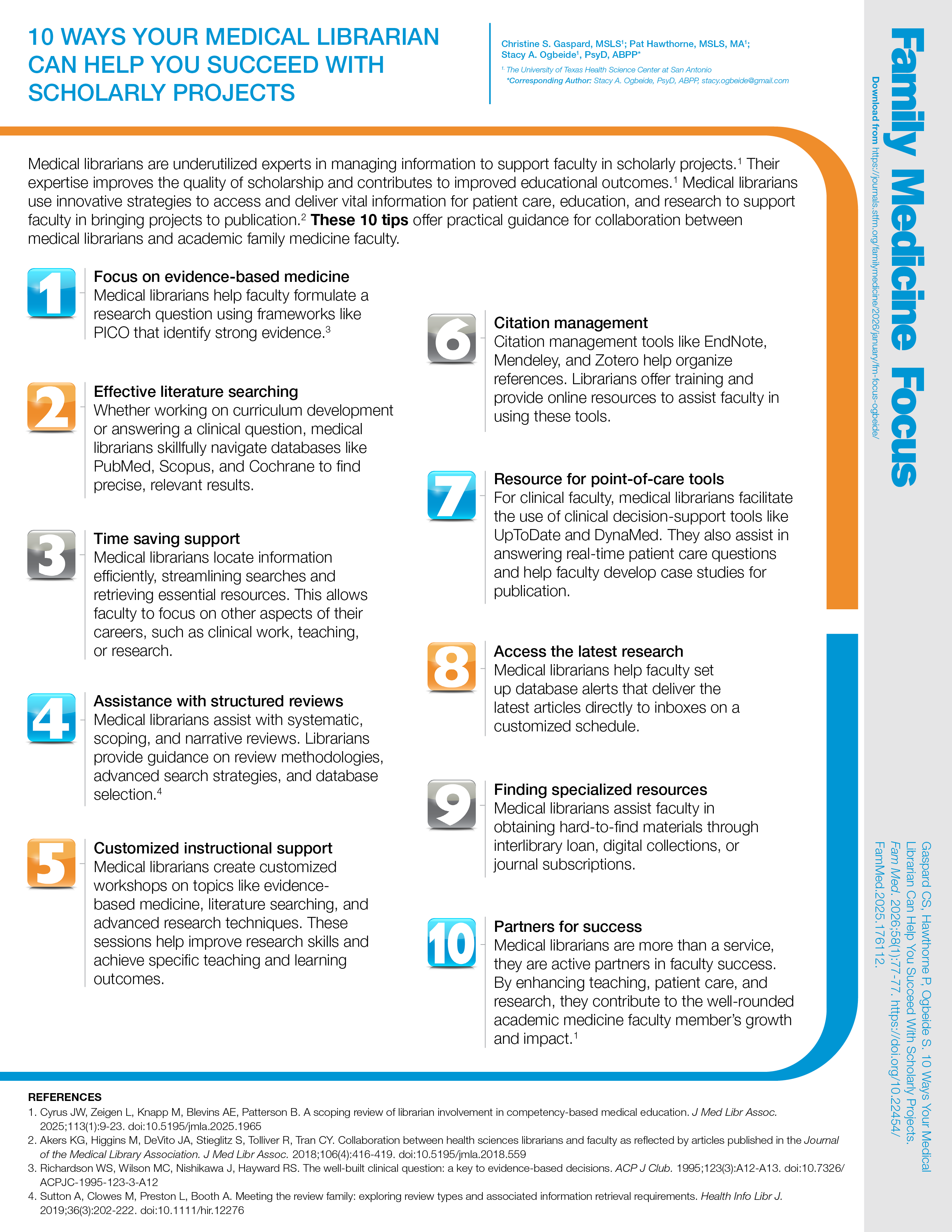
10 Ways Your Medical Librarian Can Help You Succeed With Scholarly Projects

Christine S. Gaspard, MSLS | Pat Hawthorne, MSLS, MA | Stacy Ogbeide, PsyD, ABPP

Fam Med.

Published: 10/28/2025 | DOI: 10.22454/FamMed.2025.176112

Lead Author

Christine S. Gaspard, MSLS

Affiliations: The University of Texas Health Science Center at San Antonio

Co-Authors

Pat Hawthorne, MSLS, MA - The University of Texas Health Science Center at San Antonio

Stacy Ogbeide, PsyD, ABPP - The University of Texas Health Science Center at San Antonio

Corresponding Author

Stacy Ogbeide, PsyD, ABPP

Correspondence: The University of Texas Health Science Center at San Antonio

Email: stacy.ogbeide@gmail.com

Fetching other articles...

Loading the comment form...

Submitting your comment...

By William R. Phillips, MD, MPH, FAAFP  /  Posted 11/30/2025

Medical Librarians as Research Consultants When coordinating a medical student research program, I encouraged every student to consult – early in the process – two types of experts: a medical librarian and a biostatistician. The purpose was not only to start their studies on the right step, but to help them learn that librarians and statisticians are peer professionals with expert knowledge, advanced skills, and valuable experience. In clinical practice, we use consultants to improve the care and outcomes for our patients. In research, we need to learn to use librarians to advance the planning and results of our studies. A positive consultation experience teaches early-career scholars that librarians can be valuable partners. With the rapid expansion of scientific publications, journals, bibliographic tools, and now AI, librarians as information specialists can help us do our best work by setting it on firm foundations and in complete contexts.

Downloads & Info

Share

Related Content

Tags

Searching for articles...