Background and Objectives: This study examined educational debt among family medicine residency graduates in the United States, analyzing differences by medical school type, gender, and race, and comparing their debt levels to those of other, comparable medical school graduates.
Methods: We completed a secondary analysis of 2017–2019 data from the American Board of Family Medicine Initial Certification Questionnaire. Descriptive statistics compared family medicine residents’ reported debt by medical school type, race/ethnicity, and gender. Using best available data sources, we compared each individual’s reported debt to the mean reported debt of graduates of their medical school.
Results: Median debt of indebted family medicine residents was $250,000 for allopathic graduates, $300,000 for osteopathic graduates, and $298,000 for international medical school graduates. Family medicine residents reported higher debt than their medical school’s mean—by $19,128 (allopathic), $36,574 (osteopathic), and $56,274 (international). US underrepresented in medicine (URiM) family medicine residents had significantly higher debt than non-URiM peers, with African American students reporting substantially higher debt than non-Hispanic White students (median debt $250,000 vs $200,000 and $350,000 vs $300,000 for allopathic and osteopathic institutions, respectively).
Conclusions: High debt burdens among family medicine residents, particularly URiM family medicine residents, pose a direct threat to the stability and growth of the primary care workforce. Given the worsening primary care physician shortage and its impact on population health, policymakers and health care leaders must act decisively. Policymakers and institutions should offer more scholarship opportunities to students who choose primary care. Existing paths to loan forgiveness for primary care physicians should be preserved and significantly expanded.
Family medicine residents have very high educational debt; nearly half reported more than $250,000 in debt in 2019.1 Notably, median self-reported educational debt for all graduates of US allopathic institutions has plateaued in recent years at approximately $200,000 (among those reporting debt on the Association of American Medical Colleges [AAMC] Graduation Questionnaire).2 However, the family medicine resident workforce also has undergone demographic changes, which may shape their indebtedness differently than other members of the physician workforce.
Osteopathic graduates are more likely to enter family medicine residency than allopathic US graduates, making them disproportionately represented in the family medicine workforce.3 While about 60% of allopathic graduates attend public medical schools, most osteopathic graduates attend private schools, which are more costly.4
In addition, a growing proportion of US-citizen graduates of international medical schools (US-IMGs) has been entering family medicine residency programs, also at increased educational cost.3 Very little information is published about the debt of international medical school graduates, but international graduates who are US citizens most commonly attend Caribbean medical schools. These institutions typically have higher tuition and fees than US medical schools.5
Medical educators are concerned about the high debt incurred by their students, and many institutions have made substantial efforts to develop scholarship support. While federal and private loans make medical education accessible to some students from disadvantaged families, this educational debt is disproportionately borne by students from low-income families and underrepresented minority students.6,7 Scholarship support, if appropriately disseminated, could help medical schools recruit disadvantaged students, building a workforce that better reflects our nation’s communities.6 Targeted scholarships for the most disadvantaged also would help ensure that medical education is accessible to all qualified students in the context of new limits on federal student loan borrowing.8,9,10
However, securing substantial scholarship support remains challenging.6 Institutions with the most financial resources may or may not have a strong curricular and cultural orientation toward primary care. Grants and scholarships are not always directed toward students interested in primary care. Thus, existing institutional programs to decrease the cost of undergraduate medical education may or may not substantially benefit future family physicians.
The educational debt of family medicine residents also may be different from the community of allopathic medical school graduates as a whole because of other demographic differences. US medical students entering family medicine disproportionately come from relatively lower-income families.11-16 Robust analyses have demonstrated that students from lower income families also graduate with more medical education debt and that they are more likely to serve Medicaid beneficiaries and practice in underserved areas.6,11,13,17
Using best available data sources, this study aimed to examine the educational debt levels of a cohort of family medicine residency graduates in the United States—including differences in medical school type, gender, and race—and to compare their debt levels to those of other, comparable medical school graduates. This examination is important because it allows policymakers and institutions to consider how public and private approaches to medical education financing can best support the primary care physician workforce. By quantifying disparities in educational debt across different physician demographics, this study aimed to provide necessary evidence for policymakers to refine loan forgiveness programs, expand need-based scholarships, and evaluate the costs and benefits of medical education. Evidence-based policymaking is particularly relevant in this particular political moment, when the costs and benefits of subsidized education are being publicly debated and new limits to federal borrowing have been instituted for all students, including medical students.8-10
This study was a secondary analysis of data reported to the American Board of Family Medicine (ABFM) by residency graduates from 2017 to 2019 as they registered for their initial board certification examination, which is typically completed in the final year of residency. The Initial Certification Questionnaire (ICQ) is a required component of examination registration, ensuring universal completion and avoidance of selection bias, and is completed 3 to 4 months before the examination date.18 The ICQ asks about practice intentions, training, race, ethnicity, and educational debt. All data are self-reported. Race is reported as a response to a single select-best-option question, and Asian race was not disaggregated at the time these data were collected. Debt is self-reported as a numeric variable, representing the total educational debt of the resident. Residents’ gender and medical school were obtained from ABFM administrative databases.
We calculated mean, standard deviation, and median debt levels for all family medicine residents, stratified by medical school type, race/ethnicity, and gender. We compared URiM graduates to those not URiM, using the Association of American Medical Colleges definition.19
Where available, mean debt levels of individual medical schools were obtained from US News and World Report (for US schools)20 and the US Department of Education (for international schools).21 We obtained these data points in January of 2021 using institution-specific searches of each site. Individuals were excluded from analyses when their institutional data were missing.
No organization monitors and reports the aggregate debt of graduates of international medical schools who enter US residency programs, making comparisons difficult. However, the American Academy of Family Physicians (AAFP) reports entering family medicine residents’ most commonly attended medical schools, and the US Department of Education18 monitors the federal loans borrowed by US citizens who graduate from selected international schools. We used these two data sources, for comparison purposes, to create a weighted-mean composite representative of typical international graduate debt.
Finally, we compared each individual resident’s debt to the mean reported debt of graduates of their medical school in the same cohort year or the closest available year using the publicly available data sources described here. We analyzed the results using descriptive statistics. This study was approved by the AAFP Institutional Review Board.
Family Medicine Resident Debt Compared to Other Medical School Graduates
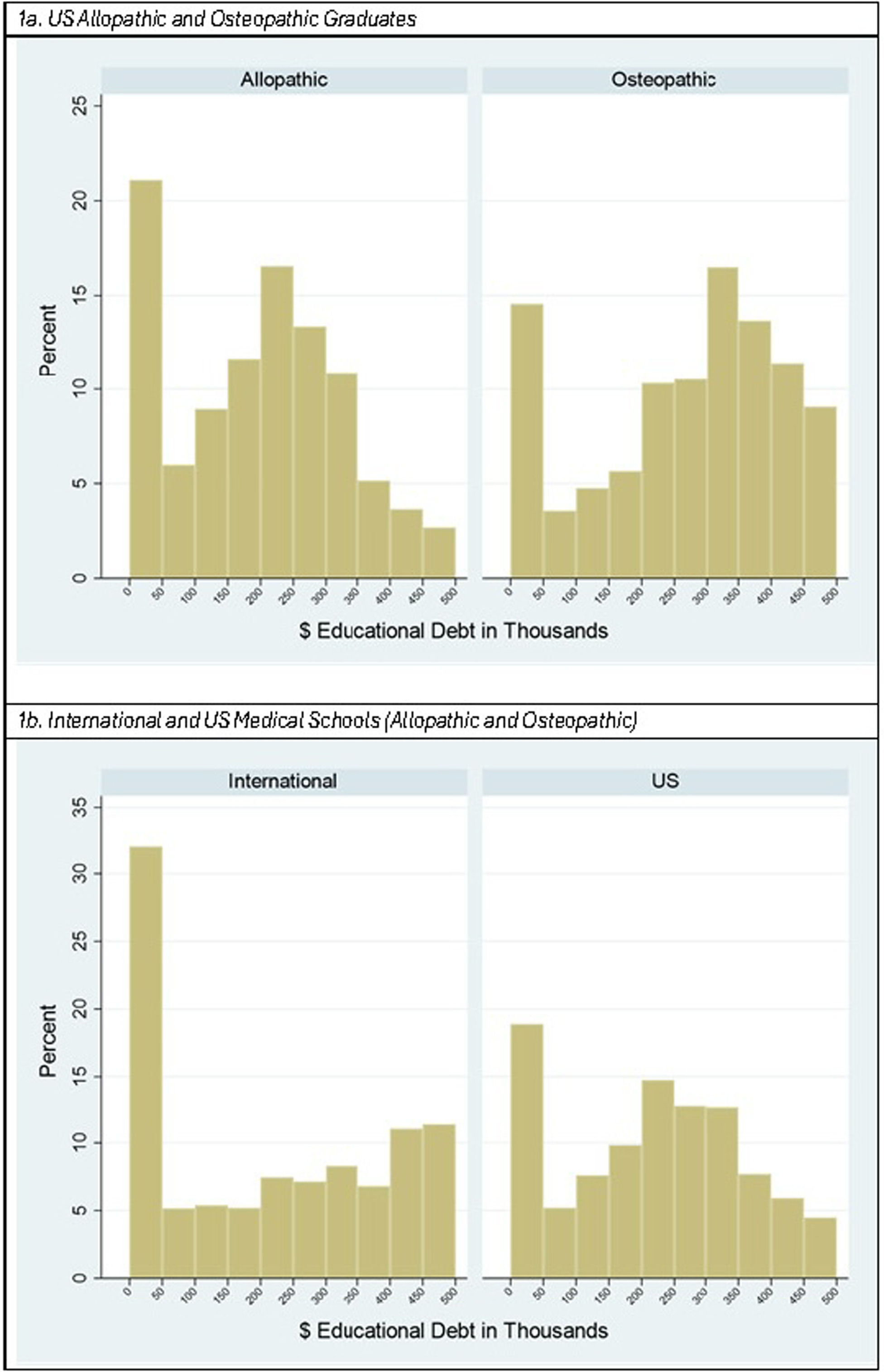
The proportion of family medicine residents with debt was high: 84% of allopathic graduates, 89% of osteopathic graduates, and 75% of international medical school graduates reported educational debt. The mean debt for all allopathic US graduates was $184,639; for all osteopathic US graduates, $256,851; and for all international graduates, $202,125 (Table 1). Osteopathic graduate debt was significantly higher than allopathic graduate debt (P<0.01; Table 1). The median debt of indebted family medicine residents was $250,000, $300,000, and $298,000 for each of these groups, respectively. Figure 1 displays the distribution of family medicine residents’ reported debt by medical school type.
|
Mean debt (standard deviation) |
Median debt |
Median debt of indebted graduates |
Percentage with debt |
Percentage (number) of sample population |
Allopathic US medical schools |
Public |
$177,339 (120,146) |
$200,000 |
$200,000 |
85 |
37 (3,661) |
Private |
$205,664 (144,014) |
$210,000 |
$250,000 |
83 |
12 (1,217) |
All |
$184,639 (127,316) |
$200,000 |
$250,000 |
84 |
49 (4,932) |
Osteopathic US medical schools |
Public |
$177,193 (130,909) |
$200,000 |
$220,000 |
81 |
3 (274) |
Private |
$270,382 (142,484) |
$300,000 |
$300,000 |
91 |
16 (1,637) |
All |
$256,851 (144,634) |
$300,000 |
$300,000 |
89 |
19 (1,911) |
International medical schools |
All |
$202,125 (173,826) |
$200,000 |
$298,000 |
75.3 |
32 (3,233) |
Graduates of all three types of institutions reported higher debt than the mean reported for their institution: graduates of allopathic schools reported mean debt $ 19,128 higher than the mean reported for their institutions; graduates of osteopathic schools reported mean debt $ 36,574 higher than the mean for their institutions; and international family medicine graduate reported debt $ 56,274 higher than the mean reported for their medical schools. The most commonly attended international schools attended by family medicine residents, and the mean federal loan amounts borrowed by students attending those schools (as reported by the US Department of Education), are listed in Appendix Table 1. Nearly all are Caribbean medical schools.
Family Medicine Resident Debt by Gender
Male family medicine residents were slightly more likely to have debt than female residents (83.6% vs 81.8%; P<0.01; Tables 2 and Appendix Table 2). This difference was almost entirely due to a higher debt prevalence among male international medical school graduates (78.4% vs 72.5%). The mean debt of male residents who graduated from international medical schools was $20,005 higher than the debt of female graduates of international schools (P<0.01; Appendix Table 2). Male graduates of US medical schools also carried more debt, but these differences were relatively small and not statistically significant.
|
Mean debt (standard deviation) |
Median debt |
Median debt of indebted graduates |
Percentage with debt |
Male |
US-allopathic |
$186,431 (126,839) |
$ 200,000 |
$220,000 |
84.1 |
US-osteopathic |
$261,321 (144,452) |
$300,000 |
$300,000 |
89.2 |
International |
$212,199 (173,800) |
$200,000 |
$300,000 |
78.4 |
All |
$211,034 (150,059) |
$220,000 |
$250,000 |
83.6 |
Female |
US-allopathic |
$183,305 (127,646) |
$200,000 |
$208,000 |
84.1 |
US-osteopathic |
$253,393 (144,661) |
$280,000 |
$300,000 |
88.5 |
International |
$192,194 (173,332) |
$200,000 |
$280,000 |
72.5 |
All |
$200,824 (147,646) |
$200,000 |
$250,000 |
81.8 |
Family Medicine Resident Debt by Race and Ethnicity
Family medicine resident debt levels differed substantially by race/ethnicity (Table 3). Across medical school types, Asian family medicine residents were the least likely to have educational debt and had the lowest mean and median debt levels.
|
Mean debt (standard deviation) |
Median debt |
Median debt of indebted graduates |
Percentage with debt |
Percentage (number) of samplea |
Race/ethnicity (all) |
White, not Hispanic |
$217,151 (143,290) |
$230,000 |
$250,000 |
85.6 |
55 (5,564) |
Hispanic (any race) |
$193,124 (152,926) |
$200,000 |
$230,000 |
82.4 |
9 (913) |
Asian, not Hispanic |
$171,381 (151,330) |
$160,000 |
$220,000 |
73.8 |
22 (2,190) |
Black or African American, not Hispanic |
$247,583 (148,379) |
$250,000 |
$287,500 |
90.8 |
7 (736) |
Native American, Alaskan Native |
$183,392 (152,759) |
$180,000 |
$200,000 |
84.5 |
0.7 (88) |
Native Hawaiian and Pacific Islander |
$262,636 (146,884) |
$200,000 |
$210,000 |
87.8 |
0.3 (33) |
Others |
$184,385 (158,434) |
$190,000 |
$250,000 |
75.5 |
6 (555) |
Race/ethnicity (international medical school) |
White, not Hispanic |
$248,343 (171,860) |
$275,000 |
$300,000 |
82.1 |
11 (1,102) |
Hispanic (any race) |
$170,614 (180,811) |
$65,000 |
$250,000 |
70.8 |
4 (364) |
Asian, not Hispanic |
$169,969 (162,101) |
$150,000 |
$250,000 |
70.2 |
11 (1,130) |
Black or African American, not Hispanic |
$232,428 (181,083) |
$250,000 |
$300,000 |
81.7 |
3 (290) |
Native American, Alaskan Native |
$216,333 (201,990) |
$200,000 |
$385,000 |
84.3 |
0.2 (21) |
Native Hawaiian and Pacific Islander |
$288,363 (166,016) |
$350,000 |
$350,000 |
100 |
0.1 (11) |
Others |
$169,973 (165,608) |
$150,000 |
$220,000 |
69.4 |
3 (315) |
Race/ethnicity (US allopathic medical school) |
White, not Hispanic |
$183,985 (124,613) |
$200,000 |
$220,000 |
84.9 |
31 (3,106) |
Hispanic (any race) |
$198,396 (123,238) |
$200,000 |
$210,000 |
90.8 |
5 (485) |
Asian, not Hispanic |
$141,093 (125,064) |
$140,000 |
$200,000 |
72.9 |
7 (688) |
Black or African American, not Hispanic |
$247,942 (119,665) |
$ 250,000 |
$250,000 |
96.6 |
4 (413) |
Native American, Alaskan Native |
$168,175 (132,890) |
$ 160,000 |
$200,000 |
85.9 |
0.5 (57) |
Native Hawaiian and Pacific Islander |
$112,916 (105,711) |
$ 120,000 |
$150,000 |
75.1 |
0.1 (12) |
Others |
$194,752 (142,867) |
$ 200,000 |
$250,000 |
84.8 |
2 (171) |
Race/ethnicity (US osteopathic medical school) |
White, not Hispanic |
$261,651 (143,023) |
$ 300,000 |
$300,000 |
90.1 |
13 (1,356) |
Hispanic (any race) |
$277,573 (143,324) |
$ 300,000 |
$312,500 |
91.2 |
0.6 (65) |
Asian, not Hispanic |
$228,931 (147,486) |
$ 250,000 |
$ 280,000 |
84.7 |
4 (372) |
Black or African American, not Hispanic |
$341,272 (114,938) |
$ 350,000 |
$350,000 |
96.9 |
0.3 (33) |
Native American, Alaskan Native |
$212,666 (134,727) |
$ 225,000 |
$225,000 |
100 |
<0.1 (6) |
Native Hawaiian and Pacific Islander |
$216,000 (111,873) |
$ 225,000 |
$230,000 |
90 |
0.1 (10) |
Others |
$254,813 (146,466) |
$ 300,000 |
$300,000 |
85.5 |
0.7 (69) |
Hispanic residents were slightly less likely to have debt than non-Hispanic White residents. This difference was present because only 70.8% of Hispanic students who attended international medical schools had debt, compared to 82.1% of non-Hispanic White students. Among both US allopathic and osteopathic graduates, Hispanic residents were slightly more likely to have debt than non-Hispanic White residents (90.8% vs 84.9% and 91.2% vs 90.1%, respectively). However, median debt of indebted Hispanic residents was comparable to median debt of non-Hispanic White residents.
For both US allopathic and US osteopathic graduates who entered family medicine residency, African American residents reported substantially higher debt than non-Hispanic White residents. In this cohort, 96.9% of African American osteopathic graduates and 96.6% of allopathic graduates had debt. The median debt of indebted African American graduates was also the highest of any race/ethnicity group: $250,000 for graduates of allopathic schools and $350,000 for graduates of osteopathic schools. Among international medical student graduates, African American and non-Hispanic White students had comparable debt levels and debt prevalence.
Although their numbers were small, Native American and Alaskan Native family medicine graduates reported relatively lower debt than other groups for all medical school types. Native Hawaiian and Pacific Islander graduates of international schools reported high debt, but Native Hawaiian and Pacific Islander graduates of US schools reported relatively low debt.
URiM graduates as a whole had significantly more debt if they had attended US medical schools (mean difference $24,003 for osteopathic graduates and $37,343 for allopathic graduates, P<0.01) but less debt if they had attended international schools (mean difference $19,334, P<0.01; Appendix Table 2).
The financial burden of family medicine residents has reached a crisis point, jeopardizing efforts to build a sustainable primary care workforce. Data from medical school and residency graduates revealed that family medicine residents reported higher debt than the means for their medical schools. Because mounting debt dissuades medical students from choosing family medicine,12,22 the nation faces a worsening shortage of frontline physicians needed to manage chronic disease, reduce health care costs, and advance health equity. Even more alarming, new limits on federal borrowing for education will prohibit the most disadvantaged students from attending medical school at all.8-10 Because students from low-income families have been, historically, more likely to choose family medicine than other students,14-16 these changes are likely to disproportionately affect the family medicine workforce.
The enduring shortage of primary care physicians in the United States has a measurable negative impact on population health outcomes.23,24 Family physicians are the most widely distributed primary care physicians25 and the most likely to care for underserved populations.26 Therefore, policymakers and institutions should strongly consider expansion of scholarships for students who choose primary care. In addition, existing paths to loan forgiveness for primary care physicians should be preserved and expanded.27-29
The reasons for the increased debt among those who enter family medicine are less clear and are likely multifactorial. As discussed earlier, students who prefer family medicine are more likely to come from lower-income families, which is also associated with higher debt.11-14,17 Students from lower-income families also may experience more challenges during their medical education and have fewer resources to help them navigate those challenges,30,31,32 which may increase the likelihood that their education is prolonged and therefore more costly.16,33-35
Our findings expand a literature that has, historically focused on allopathic medical student debt. They are important because half of family medicine residents in our cohort graduated from international or osteopathic medical schools, and these graduates were the most likely to report debt exceeding $400,000 (Figure 1). The rapid growth in osteopathic medical education over the last two decades was principally driven by private and for-profit schools,36 which have higher student costs. Among our osteopathic sample, 86% attended private schools. International medical school education targeting US practice has similarly increased over two decades, and graduates of international schools were more likely to ultimately practice primary care.37
Our results also highlight concerningly high debt levels among African American family medicine residents. Among graduates of US medical schools who entered family medicine, African American graduates had the highest debt prevalence (96.6% and 96.9% for allopathic and osteopathic graduates, respectively), the highest mean debt ($247,942 and $341,272, respectively), and the highest median debt for indebted graduates ($250,000 and $350,000, respectively). When international graduates were excluded, Hispanic graduates were also more likely to carry debt than non-Hispanic White graduates, and all URiM graduates had higher mean debt.
This disturbing inequity reflects disparities in generational wealth.38 In 2019, approximately 49% of African American osteopathic graduates and 83% of African American allopathic graduates received scholarship support.4,6 These scholarship data are encouraging, but persistently high debt levels suggest they are woefully insufficient. Other researchers have reported that many medical students finance their education with personal and family resources, but these resources are concentrated among White and Asian students; URiM students are more likely to have more of their education financed by educational loans.39 A study of residents across specialties, using AAMC data, also demonstrated significantly higher debt for African Americans.40
High debt levels for African American graduates compound workforce shortages because URiM groups are more likely to eventually care for disadvantaged populations41; yet, young family physicians with high debt are less likely to choose initial jobs caring for these populations.42 African Americans also are underrepresented in academic medicine, including academic family medicine;43 yet, graduating family medicine residents with high debt are less likely to choose academic careers.42 Increasing scholarship support for African American medical students, particularly those interested in family medicine, is essential for increasing access to care for disadvantaged populations and supporting diversity in academic medicine.
Finally, although the amount of educational debt incurred by family medicine residents is concerning, one must acknowledge that access to low-interest federal loans is essential for all students. Low-interest federal loans make undergraduate medical education more accessible in the United States. Although we believe that student debt represents a real financial crisis, we also are alarmed that the primary care shortage will be worsened and the diversity of the workforce diminished9,10 as access to federal loans is restricted.
The study had several limitations, including sampling inclusive of family medicine residents who registered for the board certification examination. Those who did not choose to certify may have had different debt levels. All sources of debt data were self-reported, and self-reported debt is potentially subject to bias or error. Comparative data for each US medical school were obtained from US News and World Report, but not all institutions chose to report. Comparative data for international medical schools was obtained from the US Department of Education, reflecting only the debt incurred by US citizens and only federal debt (excluding private loans). The international comparisons principally reflected Caribbean schools, where one-quarter of graduates were not US citizens at the time of medical school matriculation.44 Non-US citizen family medicine residents in our sample could have incurred more or less debt, impacting the validity of the comparison in ways that we could not explore further because ABFM does not collect citizenship data on examination registrants. The data analyzed here were collected in 2017–2019; although we have no reason to expect that the debt patterns measured have changed in the last decade, these data possibly do not reflect more recent graduates. Finally, the race/ethnicity and gender categorizations of the original survey instruments did not fully capture the complexity of diversity among family medicine residents.
In conclusion, family medicine residents entering the workforce continue to carry significant levels of debt. This debt disproportionately affects African American graduates and URiM groups, excluding graduates of international schools. To optimize population health, medical school leaders and policymakers should prioritize debt relief efforts for students, residents, and physicians practicing primary care,27,28,29 particularly members of URiM groups, and relax restrictions on federal borrowing for medical education.
Financial support for this study was provided by the American Board of Family Medicine Foundation.
References
-
Phillips JP, Morgan ZJ, Bazemore AW, Peterson LE. Debt of family medicine residents continues to grow.
J Am Board Fam Med. 2021;34(3):663–664. doi:10.3122/jabfm.2021.03.200567
-
-
Phillips JP, Wendling A, Bentley A, Marsee R, Morley CP. Trends in US medical school contributions to the family physician workforce: 2018 update from the American Academy of Family Physicians.
Fam Med. 2019;51(3):241–250. doi:10.22454/FamMed.2019.395617
-
-
Government Accountability Office, Report to Congressional Committees. Foreign Medical Schools: Education Should Improve Monitoring of Schools That Participate in the Federal Student Loan Program. June 2010. .
https://www.gao.gov/assets/310/306021.pdf
-
-
-
-
Jacobs JW, Booth GS. Federal student loan limits and implications for physician workforce diversity.
JAMA. 2025;334(12):1055–1056. doi:10.1001/jama.2025.13120
-
McCann NC, Walensky RP. Financing medical school in a changing policy landscape: consequences for students and the physician pathway.
Ann Intern Med. 2026;179(5):746–748. doi:10.7326/ANNALS-25-05391
-
-
Phillips JP, Petterson SM, Bazemore AW, Phillips RL. A retrospective analysis of the relationship between medical student debt and primary care practice in the United States.
Ann Fam Med. 2014;12(6):542–549. doi:10.1370/afm.1697
-
Cooter R, Erdmann JB, Gonnella JS, Callahan CA, Hojat M, Xu G. Economic diversity in medical education: the relationship between students’ family income and academic performance, career choice, and student debt.
Eval Health Prof. 2004;27(3):252–264. doi:10.1177/0163278704267041
-
Senf JH, Campos-Outcalt D, Kutob R. Factors related to the choice of family medicine: a reassessment and literature review.
J Am Board Fam Pract. 2003;16(6):502–512. doi:10.3122/jabfm.16.6.502
-
Eguia E, Kolachina S, Miller E, Eguia MA. Medical students from socioeconomically disadvantaged backgrounds are less likely to match into surgery.
World J Surg. 2022;46(6):1261–1267. doi:10.1007/s00268-022-06510-3
-
Zheng S, Brutus N, Rivera A, et al. First-generation low-income individuals in medicine: a scoping review.
Acad Med. 2025;100(4):507–521. doi:10.1097/ACM.0000000000005877
-
-
Peterson LE, Fang B, Phillips RL Jr, Avant R, Puffer JC. The American Board of Family Medicine’s data collection method for tracking their specialty.
J Am Board Fam Med. 2019;32(1):89–95. doi:10.3122/jabfm.2019.01.180138
-
-
-
-
Phillips JP, Wilbanks DM, Salinas DF, Doberneck DM. Educational debt in the context of career planning: a qualitative exploration of medical student perceptions.
Teach Learn Med. 2016;28(3):243–251. doi:10.1080/10401334.2016.1178116
-
Basu S, Phillips RS, Berkowitz SA, Landon BE, Bitton A, Phillips RL. Estimated effect on life expectancy of alleviating primary care shortages in the United States.
Ann Intern Med. 2021;174(7):920–926. doi:10.7326/M20-7381
-
Basu S, Berkowitz SA, Phillips RL, Bitton A, Landon BE, Phillips RS. Association of primary care physician supply with population mortality in the United States, 2005-2015.
JAMA Intern Med. 2019;179(4):506–514. doi:10.1001/jamainternmed.2018.7624
-
Barreto T, Jetty A, Eden AR, Petterson S, Bazemore A, Peterson LE. Distribution of physician specialties by rurality.
J Rural Health. 2021;37(4):714–722. doi:10.1111/jrh.12548
-
Goodfellow A, Ulloa JG, Dowling PT, et al. Predictors of primary care physician practice location in underserved urban or rural areas in the United States: a systematic literature review.
Acad Med. 2016;91(9):1313–1321. doi:10.1097/ACM.0000000000001203
-
Davis CS, Meyers P, Bazemore AW, Peterson LE. Impact of service-based student loan repayment program on the primary care workforce.
Ann Fam Med. 2023;21(4):327–331. doi:10.1370/afm.3002
-
Phillips J, Edwards-Johnson J, Wendling A. US federal policies should better support the primary care physician workforce.
Fam Med. 2018;50(1):7–9. doi:10.22454/FamMed.2018.784272
-
Edwards-Johnson J, Phillips J, Wendling A. The public service loan forgiveness program should be reformed, not eliminated.
Acad Med. 2018;93(7):959. doi:10.1097/ACM.0000000000002246
-
Havemann C, Mason HRC, Russell RG, et al. Challenges facing first-generation college graduates in medical school: a qualitative analysis.
JAMA Netw Open. 2023;6(12):e2347528. doi:10.1001/jamanetworkopen.2023.47528
-
Wyatt TR, Casillas A, Webber A, Parrilla JA, Boatright D, Mason H. The maintenance of classism in medical education: “time” as a form of social capital in first-generation and low-income medical students.
Adv Health Sci Educ Theory Pract. 2024;29(2):551–566. doi:10.1007/s10459-023-10270-7
-
Mason HRC, Webber A, Wyatt TR, et al. Understanding the medical education experiences of low-income students through a Maslow’s hierarchy of needs lens: an exploratory qualitative study.
J Gen Intern Med. 2025;40(6):1367–1377. doi:10.1007/s11606-024-09161-3
-
Jerant A, Sciolla AF, Henderson MC, et al. Medical student socioeconomic disadvantage, self-designated disadvantage, and subsequent academic performance.
J Health Care Poor Underserved. 2019;182(9):917–924. doi:10.1001/jamainternmed.2022.2194
-
Nguyen M, Chaudhry SI, Desai MM, et al. Association of sociodemographic characteristics with US medical student attrition.
JAMA Intern Med. 2022;182(9):917-924. doi:10.1001/jamainternmed.2022.2194
-
Nguyen M, Song SH, Ferritto A, Ata A, Mason HRC. Demographic Factors and Academic Outcomes Associated With Taking a Leave of Absence From Medical School.
JAMA Netw Open. 2021;4(1):e2033570. doi:10.1001/jamanetworkopen.2020.33570
-
Shannon SC, Teitelbaum HS. The status and future of osteopathic medical education in the United States.
Acad Med. 2009;84(6):707–711. doi:10.1097/ACM.0b013e3181a43be8
-
van Zanten M, Boulet JR. Medical education in the Caribbean: quantifying the contribution of Caribbean-educated physicians to the primary care workforce in the United State.
Acad Med. 2013;88(2):276–281. doi:10.1097/ACM.0b013e31827c6cd3
-
Addo FR, Houle JN, Simon D. Young, Black, and (still) in the red: parental wealth, race, and student loan debt.
Race Soc Probl. 2016;8(1):64–76. doi:10.1007/s12552-016-9162-0
-
Shahriar AA, Sagi V, Castañón-Gonzalez LA, Kottke TE, Vazquez-Benitez G, Crichlow R. Comparison of medical school financing plans among matriculating US medical students from 2017 to 2019.
JAMA Netw Open. 2021;4(7):e2117704. doi:10.1001/jamanetworkopen.2021.17704
-
Holaday LW, Weiss JM, Sow SD, Perez HR, Ross JS, Genao I. Differences in debt among postgraduate medical residents by self-designated race and ethnicity, 2014–19.
Health Aff (Millwood). 2023;42(1):63–73. doi:10.1377/hlthaff.2022.00446
-
Xierali IM, Nivet MA. The racial and ethnic composition and distribution of primary care physicians.
J Health Care Poor Underserved. 2018;29(1):556–570. doi:10.1353/hpu.2018.0036
-
Phillips JP, Peterson LE, Fang B, Kovar-Gough I, Phillips RL Jr. Debt and the emerging physician workforce: the relationship between educational debt and family medicine residents’ practice and fellowship intentions.
Acad Med. 2019;94(2):267–273. doi:10.1097/ACM.0000000000002468
-
Lett E, Orji WU, Sebro R. Declining racial and ethnic representation in clinical academic medicine: a longitudinal study of 16 US medical specialties.
PLoS One. 2018;13(11):e0207274. doi:10.1371/journal.pone.0207274
-
Duvivier RJ, Wiley E, Boulet JR. Supply, distribution and characteristics of international medical graduates in family medicine in the United States: a cross-sectional study.
BMC Fam Pract. 2019;20(1):47. doi:10.1186/s12875-019-0933-8



There are no comments for this article.