Introduction: Securing peer reviewers for scholarly manuscripts is essential to journal operations but has become increasingly challenging. Previous PRiMER data suggested that reviewer responsiveness has been declining, and we examined whether this decline persisted over time.
Methods: We conducted a retrospective secondary analysis of reviewer invitation outcomes for all research manuscripts submitted to PRiMER from 2017 to July 31, 2025. Only invitations for research briefs (n=2,951) across 459 manuscripts were analyzed. Data were extracted from the ScholarOne editorial database. χ2 tests compared acceptance rates over time. Fixed-effect binary logistic regression controlled for individual reviewer behavior to assess linear trends in invitation acceptance and review completion rates.
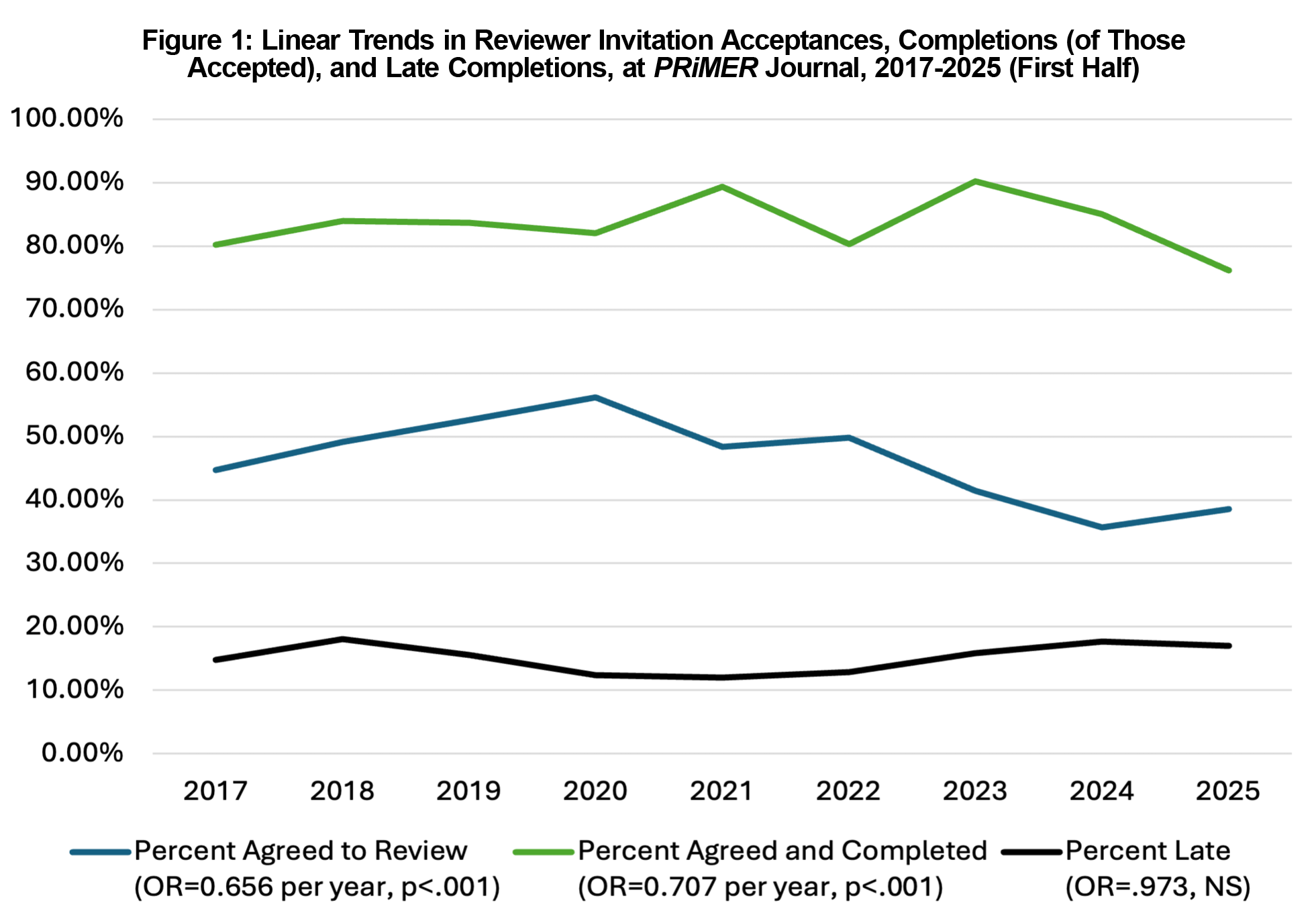
Results: Invitation acceptance peaked at 56.14% in 2020, then declined to 35.71% in 2024 and 38.58% in 2025—the lowest since journal inception. Logistic regression revealed a significant negative annual trend (OR=0.656, P<.001). Review completion rates declined from 89.31% in 2021 to 76.19% in 2025 (OR=0.707, P<.001). Late review rates ranged from 11.97% (2021) to 18.09% (2018) with no significant time trend.
Conclusion: Reviewer responsiveness to PRiMER invitations has continued to decline, both in accepting invitations and completing reviews. If similar patterns exist across journals, innovative strategies to recruit, engage, and incentivize reviewers will be necessary to sustain peer review in its current form.
The peer review process is one of several steps contributing to the integrity of scholarly publications.1 While it is subject to criticism,2 expert peer review helps identify methodological flaws, biases, and ethical concerns, helps ensure scientific findings are presented with appropriate context, and helps reduce the likelihood of publishing poor-quality data or erroneous conclusions. Beyond serving the public in this way, peer review also benefits the reviewers, discipline, and academic community.1,3 Some reviewers may grapple with feeling (or actually being) underqualified to offer comments, which may limit willingness to serve,4 but there is ample guidance available on how to conduct a peer review.3,5
The peer review system is dependent upon voluntary reviewers. Increasing clinical productivity demands, increasing volume of both journals and manuscript submissions, and reviewer burnout may be contributing to a relative decline in available reviewers.6,7 The availability of peer reviewers is a potentially rate-limiting step in the editorial process,8 and increasingly, journals are struggling to find peer reviewers. This has been true at the Peer-reviewed Reports in Medical Education Research (PRiMER) journal. To characterize this trend, we periodically conduct and report an internal analysis of the rates at which reviewers accepted and completed invitations to review, and have previously found and reported reduced reviewer responsiveness.9,10 In this study, we sought to further characterize reviewer behavior in the current context, including rates of agreement to peer review, review completion rates, and timeliness of reviewer responses.
Study Design and Data Source
We conducted a retrospective analysis of reviewer invitation outcomes for PRiMER from January 1, 2017 to July 31, 2025. We extracted data from the journal’s manuscript submission database, ScholarOne. Only invitations to review research manuscripts were included. Nonresearch manuscript invitations (editorials, special papers, methodological briefs, professional development perspective pieces, and letters to the editor) were excluded, as were invitations to conduct reviews of revised manuscripts, as reviewers for nonresearch papers are chosen with different criteria, and several of these categories were new to the journal at time of analysis. Additionally, invitations to review revised manuscripts are typically sent to the same individuals who reviewed the initial submission.
Each line of the data file included data linked to an invitation to review a manuscript. Data included manuscript ID; dates of submission, invitation, acceptance of invitation, and final disposition; as well as reviewer details. All reviewer-identifying information was converted to a nonidentifying code in the analytic file before any further procedures. As a quality assurance project at the journal that utilized anonymized peer review records, this project was determined to not meet the definition of research by the Institutional Review Board of Upstate Medical University.
Key outcome variables included
- Acceptance rate: Percentage of invitations accepted.
- Completion rate: Percentage of accepted invitations with review completed.
- Timeliness: Percentage of completed reviews returned late.
We used contingency tables with χ2 to compare invitation acceptance rates between years. Fixed-effect binary logistic regression models controlled for individual reviewer behavior to assess linear trends in acceptance and completion rates over time. Statistical significance was defined as P<.05. Data cleaning and table generation steps were performed in Microsoft Excel. All statistical analysis was performed in SPSS v.31.
We identified a total of 2,951 discrete invitations to review 459 manuscripts. Acceptance rates increased from 44.69% in 2017 to a peak of 56.14% in 2020, before declining to 35.71% in 2024 and 38.58% in 2025. The logistic regression model showed a significant negative linear trend (OR=0.656 per year, P<.001). Among accepted invitations, completion rates (including both on-time and late reviews) decreased from a high of 89.31% in 2021 to 76.19% in 2025 (OR=0.707 per year, P<.001). The proportion of reviews returned late ranged from 11.97% (2021) to 18.09% (2018), with an overall mean of 14.83%. No significant trend in timeliness was detected (OR=.973, NS). Counts and percentages are displayed in Table 1. Linear trends are displayed in Figure 1.
Our findings confirm that declines in reviewer responsiveness at PRiMER have continued since our last analysis. Declines were observed both in the willingness to accept invitations and in the completion of agreed reviews. The timeliness of completed reviews, however, remained relatively stable.
Several factors may contribute to these trends, including increasing demands on faculty time, reviewer fatigue, and competing professional and non-work-related priorities. There has been a 20% increase in the number of new journals over the past 10 years, which has significantly increased demand for reviewers.11,12 In discussion with other family medicine journal editors, our observed declines are consistent with those seen at other journals, suggesting systemic challenges in sustaining the peer review process.
Editing manuscripts for medical journals can be an intimidating task that may prevent many clinicians from engaging or learning this valuable skill. Many reviewers are invited through collegial relationships or as perceived topic experts, both of which are strategies that often yield a small number of reviewers who review multiple manuscripts for a given journal. In recent years, efforts at training family physicians to be confident and effective reviewers have aimed to increase the number of available reviewers. Within the US/North American Family Medicine specialty journals, such efforts include the Society of Teachers of Family Medicine (STFM) Medical Editing Fellowship,13,14 the American Board of Family Medicine (ABFM) Research and Editing Fellowship,15 and the Dr Jay Siwek Medical Editing Fellowship through the American Academy of Family Physicians.16 Journal editorial teams have also presented workshops on reviewing manuscripts at national family medicine educational and research conferences. Such sessions serve as both educational events and reviewer recruitment opportunities. However, the impact of reviewer training remains questionable.17
To remain sustainable, journals must develop editorial practices that address the challenge of reviewer recruitment, including adopting innovative strategies that both incentivize and support reviewers. Recognizing and rewarding reviewer contributions—whether through formal acknowledgment, professional development credits, or public recognition—can enhance motivation and engagement.1,18 Implementing reviewer development programs may help cultivate a more skilled and confident reviewer pool, especially among early-career researchers, students, trainees, and others new to academics. Exploring alternative peer review models, such as learner-mentor paired reviews,19 may help new reviewers develop the requisite skillset, expertise, and perspectives to review and support sustainable solutions to decrease reviewer fatigue. Journals representing specific disciplines and specialties may also explore ways to partner with department chairs to create models that provide a time allocation within departments as “service,” or create mentoring models for junior reviewers as part of a scholarly development process. We recognize that protected time may not be an option for all departments and other creative solutions may emerge, such as working with emeritus faculty or others who may be interested in developing new peer reviewers.
Limitations
Our analysis reflects data from a single journal in the discipline of family medicine focused medical education, which may limit generalizability. This study was also not designed to explore the why of peer review invitation acceptance and completion. We hope to follow up with a multijournal analysis in the future and to continue to monitor trends, and explore both reasons and solutions for the why. Ongoing monitoring, phenomenological exploration of the reasons behind this trend, testing of new incentives, and re-evaluating the peer review process for opportunities to improve, are examples of further steps.
In this analysis of peer-review trends in the journal PRiMER, we found that both acceptance and completion rates of peer review invitations are declining. The current analysis documents what most editors know – it is getting harder to recruit reviewers. Addressing these issues will help our current academic publishing model survive as a means to communicate scientific and academic knowledge.
Acknowledgments
All authors are involved in the process of peer review, from the check-in and final production of manuscripts and maintenance of our reviewer data (Mr Grammer), to the recruitment of peer reviewers (all authors) and supervision of the peer review process (Drs Morley, the editor-in-chief, and Drs Wendling, Heidelbaugh, Phillips, and Prunuske, associate editors) at PRiMER. Additionally, Amy Lee, MD, and John W. Epling, MD, MSEd, provided feedback on the initial manuscript and serve as associate editors at PRiMER; Amanda Kost, MD MEd, Kristen Bene, PhD, and Tyler Barreto, MD are also associate editors who contribute significantly to the peer-review process at PRiMER. Other than our affiliation with this journal, the authors have no other conflicts of interest to report. We acknowledge that artificial intelligence was utilized to format the first manuscript of this article, but all content was written and approved by the authors.
Previous Presentation: This work has been accepted for presentation at the 2025 NAPCRG Annual Meeting in November 2025, in Atlanta, Georgia. The status of that abstract submission is undetermined at time of manuscript submission. A previous abstract covering an earlier analysis with older data was presented at the 2023 NAPCRG Annual Meeting in San Francisco, California.
Conflict of Interest Statement: The authors are all members of the editorial management team at the journal PRiMER. The authors declare no conflicts of interest.
References
- Morley CP, Grammer S. Now more than ever: reflections on the state and importance of peer review. PRiMER Peer-Rev Rep Med Educ Res. 2021;5:36. doi:10.22454/PRiMER.2021.216183
- Kusumoto FM, Bittl JA, Creager MA, et al; Peer Review Task Force of the Scientific Publications Committee. Challenges and controversies in peer review: JACC review topic of the week. J Am Coll Cardiol. 2023;82(21):2054-2062. doi:10.1016/j.jacc.2023.08.056
- Campbell KM, Figueroa E, Baluchi D, Rodríguez JE. Peer review is primary: presentations, publications, promotions, and practice. PRiMER Peer-Rev Rep Med Educ Res. 2024;8:42. doi:10.22454/PRiMER.2024.148162
- Winnie K, Jackson JT. Imposter syndrome and the peer-review crisis. PRiMER Peer-Rev Rep Med Educ Res. 2021;5:46. doi:10.22454/PRiMER.2021.584691
- Morley CP, Prunuske J. Conducting a manuscript peer review. PRiMER Peer-Rev Rep Med Educ Res. 2023;7:35. doi:10.22454/PRiMER.2023.674484
- Tite L, Schroter S. Why do peer reviewers decline to review? A survey. J Epidemiol Community Health. 2007;61(1):9-12. doi:10.1136/jech.2006.049817
- Kovanis M, Porcher R, Ravaud P, Trinquart L. The global burden of journal peer review in the biomedical literature: strong imbalance in the collective enterprise. PLoS One. 2016;11(11):e0166387. doi:10.1371/journal.pone.0166387
- Donovan EE, Mackert M, Lindstadt CJ, Harrison MA. What motivates Health Communication's peer reviewers to review? A survey of our scholarly community. Health Commun. 2020;35(9):1056-1060. doi:10.1080/10410236.2020.1762970
- Morley CP, Ledford CJW, Indelicato AM, Grammer S. Potential Impact of COVID-19 Pandemic on Journal Reviewer Responses. Presentation at NAPCRG Annual Conference, October 31, 2023. Accessed August 6, 2025. https://napcrg.org/conferences/2017/sessions/5316
- Morley C, Ledford C, Indelicato A, Grammer S. Potential impact of COVID-19 pandemic on journal reviewer responses. Ann Fam Med. 2023;21(suppl 3):5316. doi:10.1370/afm.22.s1.5316
- AARC Research. Growth in the number of scholarly journals and articles. AARC Research. Accessed August 22, 2025. https://aarcresearch.com/blog/2025-01-28T0000-0500-Growthinthenumberofsch-59RF2kcwmaRxNMyWsDLZ4g
- Kulldorff M. The rise and fall of scientific journals and a way forward. J Acad Public Health. Published online January 30, 2025. Accessed August 22, 2025. https://publichealth.realclearjournals.org/perspectives/2025/01/the-rise-and-fall-of-scientific-journals-and-a-way-forward/
- STFM Medical Editing Fellowship. Society of Teachers of Family Medicine. Accessed August 22, 2025. https://www.stfm.org/facultydevelopment/fellowships/medicaleditingfellowship/overview/
- The STFM medical editing fellowship: a gateway to scholarly growth for community physicians. STFM Blog. February 23, 2024. Accessed August 22, 2025. https://blog.stfm.org/2024/02/23/the-stfm-medical-editing-fellowship-a-gateway-to-scholarly-growth-for-community-physicians/
- Seehusen DA, Ledford CJW, Bowman MA. Introducing the inaugural ABFM research and editing fellow. J Am Board Fam Med. 2023;36(4):530-530. doi:10.3122/jabfm.2023.230198R0
- White L. Introducing the AFP 2025-2026 Jay Siwek Medical Editing Fellow: Dr. Michael C. Harding. American Academy of Family Physicians. Accessed August 22, 2025. https://www.aafp.org/pubs/afp/afp-community-blog/entry/introducing-the-afp-2025-2026-jay-siwek-medical-editing-fellow-dr-michael-c-harding.html
- Hesselberg JO, Dalsbø TK, Stromme H, Svege I, Fretheim A. Reviewer training for improving grant and journal peer review. Cochrane Methodology Review Group, ed. Cochrane Database Syst Rev. 2023;2023(11). doi:10.1002/14651858.MR000056.pub2
- Zaharie MA, Seeber M. Are non-monetary rewards effective in attracting peer reviewers? A natural experiment. Scientometrics. 2018;117(3):1587-1609. doi:10.1007/s11192-018-2912-6
- Love JN, Merritt C, Ilgen JS, et al. A collaborative approach to mentored peer reviews sponsored by the council of residency directors in emergency medicine. West J Emerg Med. 2024;25(1):111-116. doi:10.5811/WESTJEM.61488




There are no comments for this article.