Introduction: Promising strategies for increasing the number of primary care physicians practicing in rural America include admitting medical students from rural areas, as they are more likely to practice in rural settings; and introducing rural clinical experiences into medical school curricula. However, prepandemic estimates suggest that US medical schools have low rates of rural student recruitment strategies and rural curricular opportunities on their webpages.
Methods: We performed a website analysis of US allopathic and osteopathic medical schools to provide a contemporary estimate of the frequency of content related to rural student recruitment and rural health care opportunities.
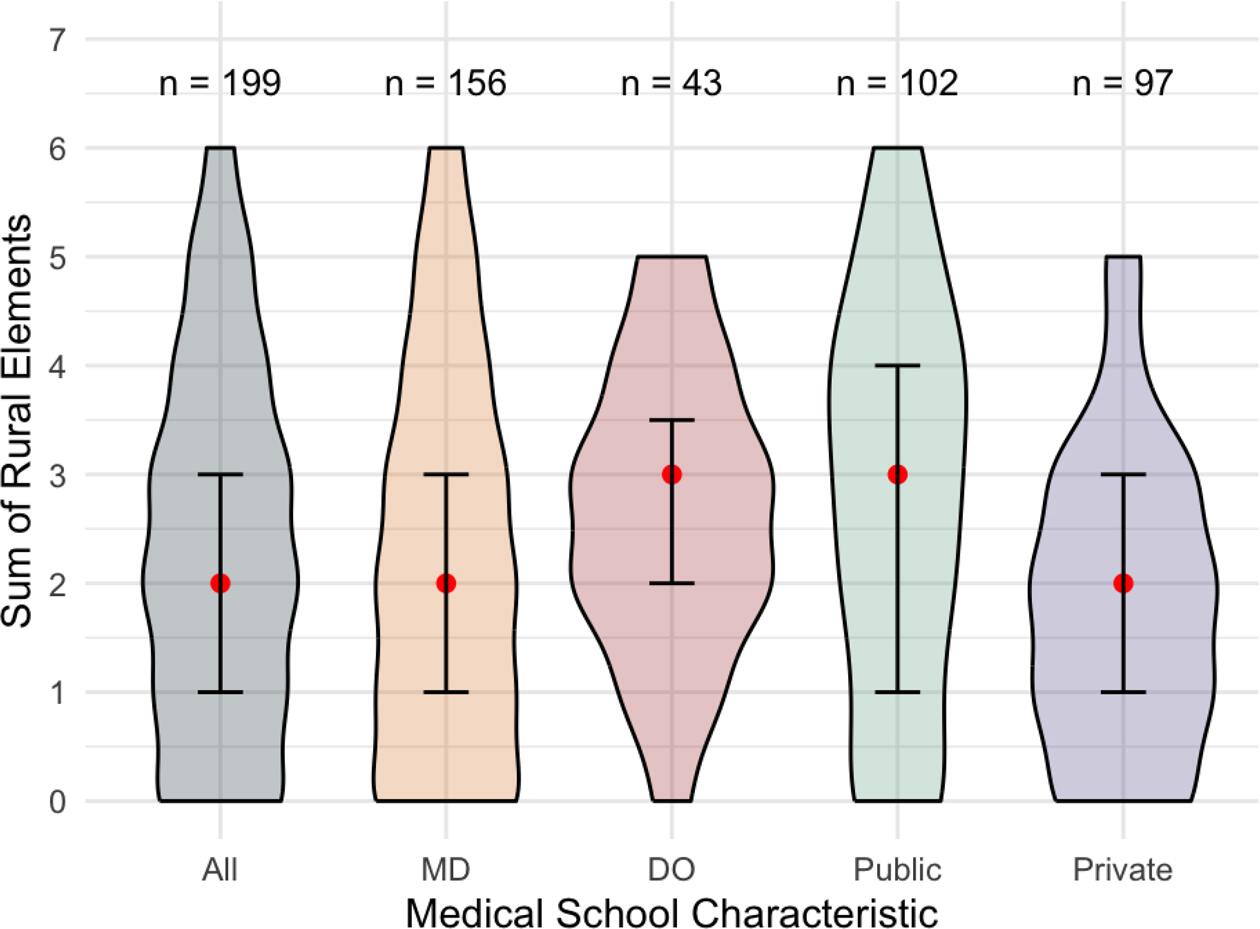
Results: Among 223 US medical schools, we identified 199 unique websites, of which 24% had a diversity statement including rural students; 30% of mission statements mentioned rural students or serving rural populations. Most schools (70%) offered rural rotations; 39% advertised rural-focused scholarships and 29% listed rural student organizations. Few schools (29%) had a rural pathway program and 12% reported rural representation through admission statistics. The median number of rural elements (scale: 0 to 7) amongst all schools was 2 (1, 3) and 23.1% of schools had zero elements. Public medical schools had more rural elements than private schools (Wilcoxon: 3 [1, 4] vs 2 [1, 3]; P<0.001).
Conclusion: Our assessment of medical school websites found low frequencies of content related to rural student recruitment and rural health care opportunities. These findings highlight opportunities for improving recruitment of rural students and training future rural physicians.
The Bureau of Health Workforce projects that rural America will have a 58% shortage in physicians by 2038.1 Promising strategies for attracting physicians to rural settings include increasing enrollment of medical students from rural areas—as they are more likely to pursue rural practice2,3—and introducing rural clinical experiences into curricula.2,4 However, only 5% of incoming allopathic medical students in 2017 were from a rural area, despite nearly 20% of the US population residing in rural regions.5 Furthermore, during the years 2002 through 2017, rural matriculants to medical school decreased 28% while urban matriculants increased 35%.5 This is despite almost half of rural high school students responding that they were contemplating health care careers in a recent survey study.6 This disconnect may be in part attributable to US medical schools having low rates of rural student recruitment strategies and rural curricular opportunities.7
Tools identified as important to recruitment of rural students include a school mission focused on serving rural or underserved populations as it shows institutional support to potential rural initiatives,8,9,10 opportunities for rotations in rural areas,11 rural premedical pipeline programs,5 scholarship opportunities,6 and rural student organizations.12 To understand the current academic medicine rural landscape, we performed an evaluation of medical school websites to assess frequencies of content related to rural student recruitment and rural health curricular opportunities.
We identified websites of all Association of American Medical Colleges13 and American Association of Colleges of Osteopathic Medicine14 affiliated medical schools. We analyzed each medical school’s webpage on seven variables: (1) diversity statements mentioning rural students, (2) mission statements mentioning rural students or serving rural regions, (3) rural clinical rotations, (4) rural scholarships, (5) rural student organizations, (6) rural premedical pathway programs, and (7) reporting rural admission statistics. The sum of these variables yielded a composite score for each website, with a minimum score of 0 and a maximum of 7.
To validate the clarity of the data dictionary developed for these variables, three independent data collectors applied the data dictionary to 10 randomly selected medical schools. The data collectors were blinded to one anothers’ analyses. Inconsistencies were identified and resolved though expanded instructions in the data dictionary.
Two independent data collectors searched for prespecified rural content on each website between July 12, 2024 and September 2, 2024. Discrepancies between data collectors were adjudicated by three additional study members. This study was a review of publicly available medical school webpages and did not require institutional review board oversight.
We collected and managed study data using REDCap electronic data capture tools hosted at the University of Michigan (UM1TR004404). We compared categorical variables using the χ2 test or Fisher’s exact test. The sums of rural elements are summarized by median and interquartile range and were compared by institutional factors with the Wilcoxon rank-sum test. Statistical tests were deemed to be significant when P<0.05, the prespecified alpha. We completed statistical analyses using R version 4.2.1.
Among 223 US medical school campus locations, we identified 199 unique institutional websites, with 24 campuses sharing a website with at least one other campus location. Regarding mission, 30% of schools had a mission statement mentioning rural students or serving rural populations and 24% had a diversity statement including rural students. Regarding experiences, 70% of schools offered rural rotations and 29% listed rural student organizations. Regarding recruitment, 39% of schools advertised rural-focused scholarships, 29% had a rural pathway program, and 12% reported rural representation through admission statistics.
The median number of rural elements (scale: 0 to 7) among all schools was 2 [1, 3] and 23.1% of schools had 0 elements. Allopathic and osteopathic medical schools had a similar number of rural elements (Wilcoxon: 2 [1, 3] vs 3 [2, 3.50]; P = 0.066; Figure 1). Public medical schools had more rural elements than private schools (Wilcoxon: 3 [1, 4] vs. 2 [1, 3]; P<0.001; Figure 1). Comparisons of individual website elements according to school characteristics are shown in Table 1.
Website element, % (n) |
All (n = 199) |
Allopathic (n = 156) |
Osteopathic (n = 43) |
P value |
Public (n = 102) |
Private (n = 97) |
P value |
Rural in DEI statement |
48 (24%) |
38 (24%) |
10 (23%) |
>0.999 |
29 (28%) |
19 (20%) |
0.196 |
Rural in mission statement |
59 (30%) |
41 (26%) |
18 (42%) |
0.073 |
38 (37%) |
21 (22%) |
0.024 |
Rural rotations |
149 (70%) |
102 (65%) |
37 (86%) |
0.015 |
76 (75%) |
63 (65%) |
0.189 |
Rural student organization |
57 (29%) |
49 (31%) |
8 (19%) |
0.146 |
35 (34%) |
22 (23%) |
0.097 |
Rural scholarships |
77 (39%) |
48 (31%) |
29 (67%) |
<0.001 |
66 (65%) |
56 (58%) |
0.388 |
Rural pathway program |
57 (29%) |
48 (31%) |
9 (21%) |
0.283 |
41 (40%) |
16 (17%) |
<0.001 |
Rural admissions Statistics |
23 (12%) |
20 (13%) |
3 (7%) |
0.428 |
17 (17%) |
6 (6%) |
0.037 |
Sum of elements: Median [Q1, Q3] |
2 [1, 3] |
2 [1, 3] |
3 [2, 3.50] |
0.066 |
3 [1, 4] |
2 [1, 3] |
<0.001 |
Our assessment of medical school websites found low frequencies of content related to rural student recruitment and rural health care opportunities. Nearly one in four websites had no rural elements.
Compared with prepandemic estimates,7 our results suggest there has been an increase in content related to rural student recruitment and rural pathway programs. This is encouraging, though suboptimal, given that retiring physicians who practiced in rural areas are being replaced by younger physicians at lower rates.15 Our study’s findings of low rural content on medical school websites as well as previous reports of low rates of medical students with rural backgrounds5 highlight opportunities for improvement in recruitment and programming.
Rural disparities in medical education cannot be addressed by medical schools alone given that students from rural communities attend college and apply to medical school at lower rates than their nonrural counterparts.5 Broad intervention is needed to help individuals from rural areas attain postsecondary education and pursue careers in medicine. For example, policies making medical education more affordable and creating more medical schools in rural areas have been suggested.2 However, it is essential that current medical schools work in tandem with these broader efforts in order to increase rates of medical students from rural backgrounds as they recruit the future physician workforce.
Our study has inherent limitations as a cross-sectional website analysis. Although we had two independent reviewers for each medical school’s webpages and an adjudication process, it is possible information was missed. We did not evaluate the accessibility of information that we collected. Medical school webpages may not always fully represent a medical school’s values or programs. Most notably, medical school webpages, specifically content related to diversity, equity, and inclusion, may have been changed since our data collection period. A study comparing the data from this study period to current website data may allow a more thorough investigation of this changing landscape and its impacts on rural student recruitment.
Medical school webpages have low frequencies of content related to rural student recruitment and opportunities to engage with rural health care, though they are increasing when compared to prepandemic estimations. Our findings highlight an ongoing need for academic medicine to continue to design innovative and effective solutions to improve recruitment of rural students and train future rural physicians.
The authors acknowledge Brian Lara, Tremayne Ansani, Le Nguyen, Abraham Raskind, Nikita Sanghavi, Ruth Reslar, and Daniel Hochester for their contributions to data acquisition for this project.
This project is supported by grant UM1TR004404 for the use of REDCap electronic data capture tools hosted at the University of Michigan Institute for Clinical & Health Research.
The authors have no conflicts of interest to report.
Use of Artificial Intelligence
We used Claude Sonnet and ChatGPT 4o for data analysis and debugging R code for summary statistics and the generation of Table 1. We used these AI tools for generating R code for creation of Figure 1 and for restructuring sentences, word suggestion, and grammar checks.
References
-
-
Walensky RP, McCann NC. Challenges to the future of a robust physician workforce in the United States.
N Engl J Med. 2025;392(3):286–295. doi:10.1056/NEJMsr2412784
-
MacQueen IT, Maggard-Gibbons M, Capra G, et al. Recruiting rural healthcare providers today: a systematic review of training program success and determinants of geographic choices.
J Gen Inter Med. 2018;33(2):191–199. doi:10.1007/s11606-017-4210-z
-
Hawes EM, Rodefeld L, Weinstein DF. Academic medicine and rural health system partnerships: enhancing education while advancing physician workforce priorities.
Acad Med. 2024;99(10):1065–1069. doi:10.1097/ACM.0000000000005753
-
Shipman SA, Wendling A, Jones KC, Kovar-Gough I, Orlowski JM, Phillips J. The decline in rural medical students: a growing gap in geographic diversity threatens the rural physician workforce.
Health Aff (Millwood). 2019;38(12):2011–2018. doi:10.1377/hlthaff.2019.00924
-
Bauer HH, Anderson CB, Hirko K, Wendling A. Barriers to college and health care careers among us students from a rural community.
PRiMER. 2019;3:10. doi:10.22454/PRiMER.2019.828405
-
Longenecker RL, Andrilla CHA, Jopson AD, et al. Pipelines to pathways: medical school commitment to producing a rural workforce.
J Rural Health. 2021;37(4):723–733. doi:10.1111/jrh.12542
-
Henderson MC, Green C, Chen C. What does it mean for medical school admissions to be socially accountable?
AMA J Ethics. 2021;23(12):E965–E974. doi:10.1001/amajethics.2021.965
-
-
Morley CP, Mader EM, Smilnak T, et al. The social mission in medical school mission statements: associations with graduate outcomes. Fam Med. 2015;47(6):427–434.
-
Rabinowitz HK, Diamond JJ, Markham FW, Wortman JR. Medical school programs to increase the rural physician supply: a systematic review and projected impact of widespread replication.
Acad Med. 2008;83(3):235–243. doi:10.1097/ACM.0b013e318163789b
-
-
-
-
Skinner L, Staiger DO, Auerbach DI, Buerhaus PI. Implications of an aging rural physician workforce.
N Engl J Med. 2019;381(4):299–301. doi:10.1056/NEJMp1900808



There are no comments for this article.