
Type 2 diabetes mellitus (T2DM) continues to rise in the United States, driven by obesity and associated metabolic risk factors.1,2 Glucagon-like peptide-1 receptor agonists (GLP-1 RA) have emerged as preferred agents due to their potent glucose-lowering, weight-reducing, and cardio-renal protective properties.3-6 Dulaglutide, exenatide, liraglutide, and semaglutide are widely prescribed, with utilization exceeding 70% of eligible patients.7 Beginning in 2022, national shortages and supply constraints affected multiple GLP-1 receptor agonists, including semaglutide and dulaglutide, leading to widespread challenges in medication access and continuity of care.8,9 Manufacturers halted promotions and limited patient assistance programs (PAP).10,11 Clinicians were forced to adopt various mitigation strategies—switching agents, maintaining suboptimal doses, or discontinuing therapy.12 A study in Australia reported a + 0.3% increase in HbA1c during shortages,13 yet comparable US data were lacking. Medication shortages present challenges for family medicine and ambulatory care clinicians responsible for the longitudinal management of chronic diseases. Understanding the real-world impact of GLP-1 RA shortages is essential for primary care teams responsible for longitudinal diabetes management and trainee education. This study evaluated changes in glycemic control and related outcomes among patients with T2DM in Northeast Ohio affected by the GLP-1 RA shortage.
LEARNER RESEARCH
Glycemic Outcomes Associated With GLP-1 Receptor Agonist Shortages in Type 2 Diabetes
Zhimin Fu, PharmD | Megan Adelman, PharmD, BCPS, BCGP | Jenna Garlock, PharmD, BCPS, MBA
PRiMER. 2026;10:33.
Published: 9/10/2026 | DOI: 10.22454/PRiMER.2026.826203
Introduction: Glucagon-like peptide-1 receptor agonists (GLP-1 RA) are integral in managing type 2 diabetes mellitus (T2DM) due to glycemic control, weight loss, and cardio-renal benefits. National shortages beginning in 2022 limited access to these medications. This study assessed the effect of GLP-1 RA shortages on hemoglobin A1c (HbA1c) and other outcomes.
Methods: We conducted a retrospective pre-post cohort study of patients with T2DM prescribed dulaglutide or semaglutide before March 2022 at Cleveland Clinic Akron General. The primary outcome was HbA1c change from preshortage to shortage periods. Secondary outcomes included prevalence of patients affected, weight change, and provider responses.
Results: Of 177 patients, 55 (31.1%) were affected. Median HbA1c increased by+0.4% (P<0.001), while weight decreased by –4.33 kg (95% CI –6.50 to –2.16, P<0.001).
Conclusion: The GLP-1 RA shortage adversely affected glycemic control, underscoring the need for improved management strategies during supply disruptions.
A retrospective cohort design was employed under Institutional Review Board approval (#24–1020). Patients aged ≥18 years with T2DM were identified through electronic health record (EHR) prescribing data from multiple Cleveland Clinic Akron General ambulatory clinics in Northeast Ohio. Inclusion required documentation of at least two ordered prescriptions for dulaglutide or semaglutide between March 2021 and March 2022 (preshortage period). Dispensing or pharmacy fill confirmation was not used for inclusion; rather, prescribing documentation in the EHR was used to indicate ongoing therapy prior to the shortage period. Exclusions comprised pregnancy, hospice care, active cancer, medication discontinuation secondary to medication intolerance, insurance changes or restrictions, or other clinical reasons, or absence of documented HbA1c values.
The primary outcome evaluated was change in HbA1c from preshortage to shortage among patients identified as impacted by the GLP-1 RA shortage (April 2022 – December 2023). For patients with multiple HbA1c values, the last available HbA1c prior to the shortage period (May 2021-May 2022) was used as the baseline value, and the highest HbA1c recorded during the shortage period was used for comparison. The highest HbA1c recorded during the shortage period was selected to quantify the maximum observed deterioration in glycemic control associated with the shortage. This approach was chosen because provider interventions occurred at variable time points during the study period, and use of the last available HbA1c could reflect recovery following intervention rather than the clinical impact of the shortage itself.
Secondary outcomes included the proportion of patients impacted, weight change, and documented provider interventions. Similar to the HbA1c, mean weight was compared between the preshortage and shortage periods using the last available weight prior to the shortage period as the baseline and the highest recorded weight during the shortage period. Secondary outcomes included changes in weight and documented provider interventions among patients identified as impacted by the GLP-1 RA shortage.
Separate subgroup analyses were conducted to evaluate differences in HbA1c change according to demographic and insurance characteristics. The prevalence of patients affected by the shortage was assessed across the entire study cohort. Documented provider interventions—indicating the patient was impacted by the drug shortage—were defined as actions taken to address GLP-1 RA access issues during the shortage, including switching to alternative antidiabetic agents, dose adjustments, or medication discontinuation. Patients could have more than one documented provider intervention during the shortage period. Therefore, intervention counts could exceed the total number of impacted patients. Medication discontinuation was defined as documentation in the EHR indicating therapy cessation or absence of continued GLP-1 RA prescribing during the shortage period after prior use. Discontinuations were classified as shortage related only when documentation indicated supply or access issues; those attributed to intolerance or other clinical or insurance reasons were excluded from the impacted group as noted above.
Statistical Analysis
Paired t tests assessed within-subject HbA1c and weight differences; independent t tests and analyses of variance (ANOVA) examined subgroup differences by sex, age (≥65 vs<65 years), race, insurance, and patient assistance program (PAP) status. Significance was set at P<0.05.
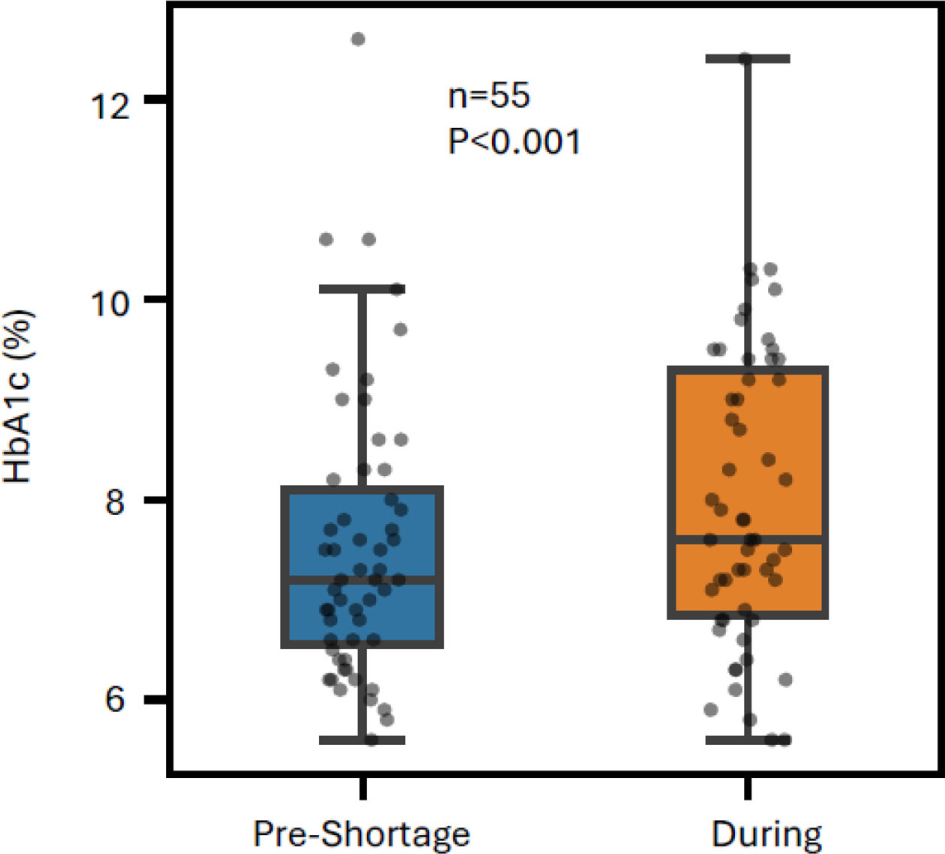
Among 177 reviewed patients, 55 (31.1%) were impacted by shortages. Mean age was 58.7 years (SD±11.2), 34.5% were male, and 83.6% were White. Common comorbidities included hypertension (81.8%), hyperlipidemia (83.6%), and obesity (89.1%). Most had private insurance (72.7%) and used metformin concomitantly (61.8%). Only one patient participated in a PAP program. Full demographic information is outlined in Table 1. HbA1c increased significantly by+0.5% (95% CI+0.23 to+0.74, P<0.001) from the preshortage to shortage period in those impacted by the shortage (n = 55; see Figure 1 and Table 2 for distribution of HbA1c changes) with median HbA1c rising from 7.3% (IQR 6.6 to 8.3) to 7.7% (IQR 6.8 to 9.2; P <0.001). Mean weight decreased by 4.33 kg among patients impacted by the shortage (95% CI –6.50 to –2.16, P<0.001; n = 55). Of affected patients, 27 (49.1%) switched to alternate agents, 16 (29.1%) temporarily discontinued therapy, and 19 (34.5%) remained on a lower dose. Common substitutions included semaglutide (Ozempic, 12/27, 44.4%), Tirzepatide (Mounjaro, 7/27, 25.9%), semaglutide (Rybelsus, 5/27, 18.5%), liraglutide (Victoza, 2/27, 7.4%), and exenatide (Bydureon, 1/27, 3.7%). Among patients who were switched to an alternative GLP-1 receptor agonist or GLP-1/GIP receptor agonist, the mean HbA1c change was+0.32%, and the median HbA1c change was+0.1%. Subgroup analyses by age, gender, race, and insurance showed no statistically significant differences in HbA1c change between groups (Table 3).
Characteristic |
N = 55 |
|---|---|
Age in years, mean (SD) |
58.65 (11.2) |
Gender, n (%) |
|
Male |
19 (34.5) |
Female |
36 (65.5) |
Race, n (%) |
|
White race |
46 (83.6) |
Black race |
8 (14.5) |
Asian race |
0 |
Unknown race or multiracial |
1 (1.8) |
Comorbidities, n (%) |
|
Chronic kidney disease |
3 (5.5) |
Congestive heart failure |
7 (12.7) |
Coronary artery disease |
5 (9.1) |
Hyperlipidemia |
46 (83.6) |
Hypertension |
45 (81.8) |
Obesity |
49 (89.1) |
Peripheral arterial disease |
4 (7.3) |
Stroke |
1 (1.8) |
PAP program enrollment, n (%) |
1 (1.8) |
Patient seen by an outpatient pharmacist, n (%) |
6 (10.9) |
Insurance status and types |
|
Medicare |
18 (32.7) |
Medicaid |
0 |
Private insurance |
40 (72.7) |
Concomitant diabetes medications |
|
Metformin |
34 (61.8) |
Insulin |
28 (50.9) |
Sulfonylurea* |
15 (27.3) |
SGLT2 inhibitor** |
12 (21.8) |
Pioglitazone |
3 (5.5) |
Sitagliptin |
0 |
*Sulfonylurea: glimepiride, glipizide
Abbreviations: PAP, patient assistance program; SD, standard deviation; SGLT2, sodium-glucose cotransporter 2
Change in HbA1c (%) |
Impacted patients (N = 55) (n, %) |
|---|---|
>3.0 |
1 (1.8) |
2.1–3.0 |
3 (5.5) |
1.6–2.0 |
5 (9.1) |
1.1–1.5 |
4 (7.2) |
0.6–1.0 |
9 (16.4) |
0.1–0.5 |
13 (23.6) |
0 |
2 (3.6) |
–0.1–0.5 |
14 (25.5) |
–0.6–1.0 |
2 (3.6) |
<–1.0 |
2 (3.6) |
Abbreviation: HbA1c, hemoglobin A1c
Subgroup |
HbA1c change mean (SD, 95% CI) |
P value |
|---|---|---|
Age |
||
≥65 years |
0.3056 (0.7605,–0.0836–+0.6947) |
.3200 |
<65 years |
0.5757 (0.9873,+0.2419–+0.9094) |
|
PAP |
||
Enrolled |
0.4000 (0, N/A) |
.9261 |
Not enrolled |
0.4889 (0.9364,+0.2309–+0.7469) |
|
Gender |
||
Male |
0.4421 (0.8113,+0.0403–+0.8439) |
.7977 |
Female |
0.5111 (0.9831,+0.1737–+0.8485) |
|
Race |
||
White, non-Black |
0.3681 (0.8325,+0.1236–+0.6125) |
.1105 |
Black |
1.1875 (1.2472,+0.1448–+2.2302) |
|
Unknown/multiracial |
0.1000 (0, N/A) |
|
Insurance |
||
Medicare |
0.3111 (0.8178,–0.1074–+0.7296) |
.4116 |
Commercial/private |
0.5325 (0.9714,+0.2179–+0.8471) |
|
Impacted group |
||
Switching antidiabetic agents |
0.3296 (0.8263,–0.0035–+0.6627) |
.4496 |
Discontinue GLP-1 RA |
0.7000 (1.0290,+0.1337–+1.2663) |
|
Staying on lower dose of GLP-1 RA |
0.5789 (1.0451,+0.0614–+1.0965) |
|
Abbreviations: CI, confidence interval; GLP-1 RA, glucagon-like peptide-1 receptor agonist; HbA1c, hemoglobin A1c; N/A, not applicable; PAP, patient assistance program; SD, standard deviation
This study demonstrated a clinically meaningful (median,+0.4%) increase in HbA1c among patients affected by GLP-1 RA shortages, confirming a detrimental impact on glycemic control. Although prior data from Australia suggested smaller increases (+0.3%),13 our findings indicate greater clinical significance. The wide variability suggests some individuals experienced severe disruptions. Although the median HbA1c increased from 7.3%–7.7%, indicating a modest shift in glycemic control across the cohort, individual responses varied considerably. Notably, 13 (23.6%) patients experienced HbA1c increases greater than 1.0%, suggesting that a subset of patients experienced clinically meaningful deterioration during the shortage period.
The shortage exposed gaps in clinicians’ preparedness for medication supply disruptions. Dose reductions and therapy discontinuations were commonly documented provider responses to the shortage, reflecting limited medication availability and challenges in maintaining intended treatment regimens. In addition to the direct clinical consequences, the shortage created substantial administrative burden for clinicians and healthcare systems, including increased prior authorization requests, formulary exception processes, appeals, and medication substitutions. While these outcomes were not formally measured in this study, they represent an important consequence of medication shortages and highlight an area of education for family medicine residents and ambulatory care clinicians. The 2025 ADA Standards of Care now acknowledge medication shortage management, recommending therapeutic substitution or reinitiation post-shortage, though evidence remains limited.14 While not included in the guidelines, there is available guidance for specifically managing the GLP-1 RA shortage and innovative approaches such as using alternative dosing strategies or extending the intervals between dosing.15 Updated guidance and clinical resources could better support prescribers in dose conversions and cross-agent transitions. Future medication shortages may also benefit from more standardized health-system approaches. Rather than relying solely on individual prescriber decision-making, protocolized pathways could incorporate factors such as baseline HbA1c, current GLP-1 RA potency, availability of alternative agents, and patient-specific risk factors to guide therapeutic substitutions. Multidisciplinary teams including pharmacists, primary care clinicians, endocrinologists, and population health specialists may be particularly well positioned to develop and implement these strategies. Such approaches could reduce variation in care, lessen administrative burden, and improve continuity of treatment during future shortages.
Interestingly, despite worsened glycemic control, average weight declined (–4.33 kg). This divergence may reflect residual metabolic effects of prior therapy16, continued partial dosing, or substitution with agents maintaining weight benefits ((e.g.) tirzepatide, liraglutide). Comparable international data reported smaller weight reductions (–1.6 kg),13 suggesting a more durable or heterogeneous effect in this cohort.
The broader implications of GLP-1 RA shortages extend beyond HbA1c changes. Interruptions may compromise long-term cardiovascular, renal, and metabolic outcomes, leading to higher healthcare utilization and reduced quality of life. Persistent or recurrent shortages highlight the fragility of the pharmaceutical supply chain and the necessity of proactive inventory monitoring, policy interventions, and clinician awareness through FDA shortage alerts.17 However, medication shortages represent only one component of the broader access challenges affecting GLP-1 RA therapies. Even in the absence of supply disruptions, patients may experience barriers related to medication cost increases, insurance formulary restrictions, etc. These factors can limit timely access to therapy or delay medication continuation, resulting in clinical effects like those observed during supply shortages. Acknowledging these additional barriers helps contextualize the findings of this study and underscores the need for comprehensive strategies addressing both medication supply and insurance-related access limitations to maintain continuity of diabetes care.
This study provides real-world U.S. data quantifying the clinical impact of GLP-1 RA shortages, combining glycemic and weight analyses across an ambulatory cohort. By capturing pre- and intra-shortage data, it offers practical insight into real-world prescribing adjustments.
However, several limitations exist. The single-center retrospective design may limit generalizability, and data were dependent on chart accuracy. The modest sample size (n = 55 impacted) may underrepresent broader regional effects. For example, based on the subgroup analysis, black patients (n = 8) experienced a larger mean increase in HbA1c during the shortage than White/Non-Black patients (n = 47); although this difference did not reach statistical significance (P = 0.111), the magnitude of the observed difference suggests a potentially clinically meaningful disparity that warrants further investigation in larger studies. Lifestyle and medication adherence data were unavailable and may confound HbA1c changes. Additionally, this study was limited to patients prescribed dulaglutide or semaglutide and did not evaluate the impact of shortages involving other GLP-1 receptor agonists, such as liraglutide or exenatide. As a result, the findings may not fully represent the effects of medication shortages across the entire GLP-1 receptor agonist class. Future multi-center studies with larger populations and longitudinal follow-up are warranted to assess sustained outcomes and recovery after shortage resolution.
The national GLP-1 RA shortage significantly worsened glycemic control among patients with T2DM in Northeast Ohio, with a mean HbA1c increase of 0.4%. Weight loss continued despite interruptions, likely reflecting residual pharmacologic effects. These findings have important implications for family medicine clinicians and trainees managing diabetes in ambulatory settings as it underscores the importance of proactive management, clinician education, and systemic strategies to mitigate drug shortage impacts on chronic disease outcomes.
This study was previously presented at the following venues:
– NEOMED 36th Annual Regional Scholarship Day, May 14, 2025, Rootstown, Ohio (poster)
– 2025 OCCP Spring Meeting, May 23, 2025,Warrensville Heights, Ohio (presentation with slides)
– Akron General Medical Center Scientific Session, June 4, 2025, Akron, Ohio (presentation with slides)
Approved by the Cleveland Clinic Institutional Review Board IRB #24-1020
The authors have no conflicts of interest to disclose.
Author Z.F. conducted data collection and analysis and drafted the manuscript. Authors M.A. and J.G. contributed to study design, data interpretation, and critical revision. All authors reviewed and approved the final manuscript.
References
-
Pathophysiology of type 2 diabetes mellitus. Int J Mol Sci. 2020;21(17):6275. doi:10.3390/ijms21176275
-
Double or hybrid diabetes: a systematic review on disease prevalence, characteristics and risk factors. Nutr Diabetes. 2019;9(1):33. doi:10.1038/s41387-019-0101-1
-
Diabetes management in chronic kidney disease: a consensus report by the american diabetes association (ADA) and kidney disease: improving global outcomes (KDIGO). Diabetes Care. 2022;45(12):3075–3090. doi:10.2337/dci22-0027
-
Cardiovascular disease and risk management: standards of care in diabetes—2025. Diabetes Care. 2025;48:S207–S238. doi:10.2337/dc25-S010
-
Chronic kidney disease and risk management: standards of care in diabetes—2025. Diabetes Care. 2025;48:S239–S251. doi:10.2337/dc25-S011
-
Obesity and weight management for the prevention and treatment of type 2 diabetes: standards of care in diabetes–2025. Diabetes Care. 2025;48:S167–S180. doi:10.2337/dc25-S008
-
Trends in glucagon-like peptide 1 receptor agonist use, 2014 to 2022. J Am Pharm Assoc (2003). 2024;64(1):133–138. doi:10.1016/j.japh.2023.10.002
-
Impact of semaglutide and dulaglutide shortages on Pharmaceutical Benefits Scheme prescriptions supplied for type 2 diabetes treatment. Aust J Gen Pract. 2024;53(1-2):57–61. doi:10.31128/AJGP/04-23-6814
-
FDA Drug Shortages. Accessed July 16, 2026. https://www.accessdata.fda.gov/scripts/drugshortages/default.cfm
-
Out of stock: A brief clinical reference for rough equivalency of glucagon-like peptide-1 (GLP-1) ± glucose-dependent insulinotropic polypeptide (GIP) receptor agonists for A1c and weight reduction in people with type 2 diabetes. J Diabetes. 2024;16(6):e13505. doi:10.1111/1753-0407.13505
-
Lilly Cares. Accessed July 16, 2026. https://www.lillycares.com/lilly-cares-application
-
Special report: potential strategies for addressing GLP-1 and Dual GLP-1/GIP receptor agonist shortages. Clin Diabetes. 2023;41(3):467–473. doi:10.2337/cd23-0023
-
The impact of GLP-1 receptor agonist shortages on glycaemic control: findings from an Australian specialist diabetes clinic. Diabetes Res Clin Pract. 2024;213:111740. doi:10.1016/j.diabres.2024.111740
-
Pharmacologic approaches to glycemic treatment: standards of care in diabetes—2025. Diabetes Care. 2025;48:S181–S206. doi:10.2337/dc25-S009
-
Switching between glucagon-like peptide-1 receptor agonists: rationale and practical guidance. Clin Diabetes. 2020;38(4):390–402. doi:10.2337/cd19-0100
-
Discontinuation and Reinitiation of Dual-Labeled GLP-1 receptor agonists among US adults with overweight or obesity. JAMA Netw Open. 2025;8(1):e2457349. doi:10.1001/jamanetworkopen.2024.57349
-
FDA Drug Shortage Notifications. Accessed July 30, 2026. https://www.fda.gov/drugs/drug-safety-and-availability/drug-shortages
Lead Author
Zhimin Fu, PharmD
Affiliations: Cleveland Clinic Akron General Akron, OH
Co-Authors
Megan Adelman, PharmD, BCPS, BCGP - Cleveland Clinic Akron General, Akron, OH
Jenna Garlock, PharmD, BCPS, MBA - Cleveland Clinic Akron General, Akron, OH
Corresponding Author
Megan Adelman, PharmD, BCPS, BCGP
Correspondence: Cleveland Clinic Akron General Akron, OH
Email: adelmam2@ccf.org
Fetching other articles... 
Loading the comment form...
Submitting your comment...

There are no comments for this article.