Introduction: The Council of Academic Family Medicine (CAFM) Educational Research Alliance (CERA) provides infrastructure and a streamlined process for multi-institutional educational research surveys within academic family medicine. This report outlines the methodology of the 2025 CERA Department Chair Survey, compares the demographics between actual and potential department chair survey respondents, and provides a summary of previous survey topics.
Methods: CERA issued a call for survey proposals from March 24, 2025 to May 4, 2025. Four proposals were accepted and questions were reviewed by five former department chairs. The omnibus survey combined the proposed question modules with standardized recurring demographic measures. We defined the sampling frame as all family medicine department chairs in the United States and Canada of Liaison Committee on Medical Education (LCME)-accredited medical schools as identified from CAFM member databases and prior CERA survey responses. The survey was conducted through SurveyMonkey from August 5, 2025 through September 15, 2025. We used Fisher's exact tests to compare demographics potential and actual survey respondents.
Results: Of 210 eligible department chairs, 97 received and completed the survey, yielding a 45.7% response rate. Comparison of potential and actual survey respondent demographics showed no statistically significant differences by race/ethnicity, gender, age, or geographic location.
Conclusions: The 2025 CERA Department Chair Survey achieved an acceptable response rate, and sample respondents were representative of the potential population. The methods described can inform future multi-institutional educational surveys seeking engaged participation and representative samples.
Launched in 2011, the Council of Academic Family Medicine (CAFM) Educational Research Alliance (CERA) provides infrastructure for survey-based scholarship in academic family medicine.1 Through collaboration among CAFM organizations (Society of Teachers in Family Medicine, Association of Departments of Family Medicine [ADFM], Association of Family Medicine Residency Directors, and NAPCRG), CERA streamlines survey administration, minimizes redundant requests, and connects emerging researchers with mentors to improve study design, analysis, and dissemination.2 Since inception, CERA has supported more than 200 peer-reviewed publications and 250 scholarly presentations, shaping departmental policy and educational practice.3
The CERA Steering Committee oversees this process. The committee includes four survey directors (Department Chair, Residency Program Director, Clerkship Director, and General Membership), a mentor director, and representatives from each CAFM member organization. The annual CERA Department Chair (DC) Survey offers a recurring view of leadership perspectives across family medicine departments in the United States and Canada. These CAFM member-submitted questions aim to inform institutional decision-making, identify gaps in leadership support, and guide professional development.
This report describes the methodology for the 2025 DC Survey, examines respondent representativeness compared to the known demographics of department chairs, and summarizes past survey topics.
CAFM members are invited annually to submit survey topics relevant to department chairs. Self-formed teams identify topics of interest and draft questions (maximum 10 per topic), which typically undergo peer review before a select number are included in the omnibus survey.4,5 For 2025, the call for proposals opened March 24, 2025, and closed May 4, 2025, yielding three submissions. Because submissions were below the target goal of at least four, the peer review process was omitted, and the DC Survey director reviewed each proposal for relevance and clarity. CERA steering committee members were encouraged to submit additional proposals, resulting in a fourth topic from a previously accepted team for another CERA survey to strengthen research topic diversity.
We paired each survey team with a volunteer CERA mentor to refine wording, response options, and flow. The DC survey director identified five former department chairs who volunteered to pretest survey questions for readability and comprehension; feedback informed iterative edits. The Institutional Review Board of the American Academy of Family Physicians approved the finalized omnibus survey on July 8, 2025.
Population
The target population includes all family medicine department chairs across the United States and Canada. Because no comprehensive email list exists, our survey sample includes family medicine department chairs listed in the ADFM database, supplemented by non-ADFM chairs identified through departmental websites and updated email contacts. These sources do not capture chairs from osteopathic schools. We identified 197 department chairs from Liaison Committee on Medical Education (LCME)-accredited US medical schools and 15 Canadian schools.
Survey invitations to identified department chairs were sent via SurveyMonkey (Momentive) with five reminder emails to nonrespondents between August 5, 2025 and September 15, 2025.6 One email bounced, and one recipient was no longer a chair, leaving a final sample of 210 chairs (195 US, 15 Canada).
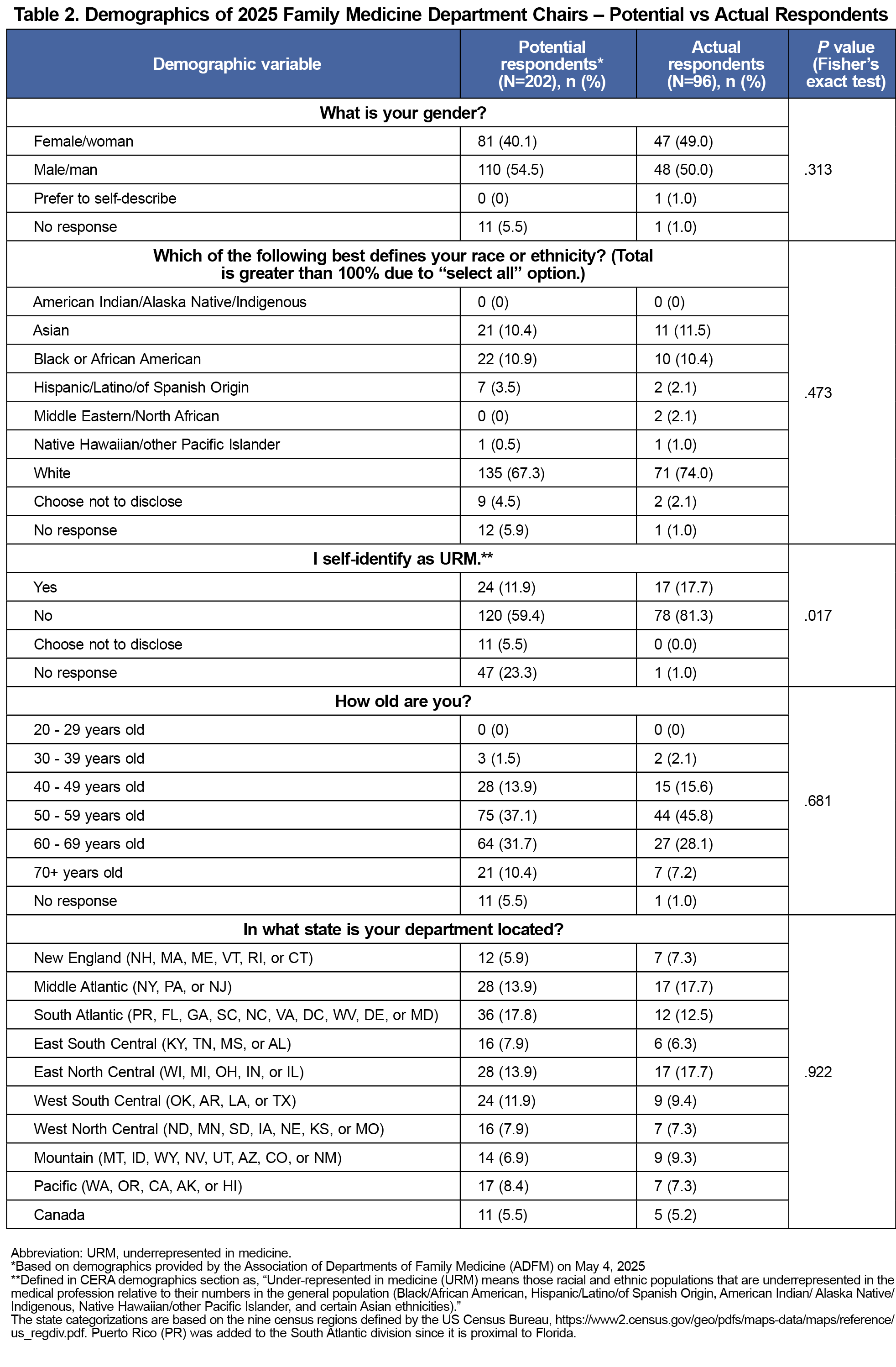
Demographic descriptors were drawn from the ADFM database on May 4, 2025. The standard demographic questions included in CERA are more extensive than what is provided in the ADFM database.7 Thus, the analysis focused on gender, race/ethnicity, self-identify as underrepresented in medicine (URM), age, and department location. Data were available for 202 of 210 potential respondents.
Analysis
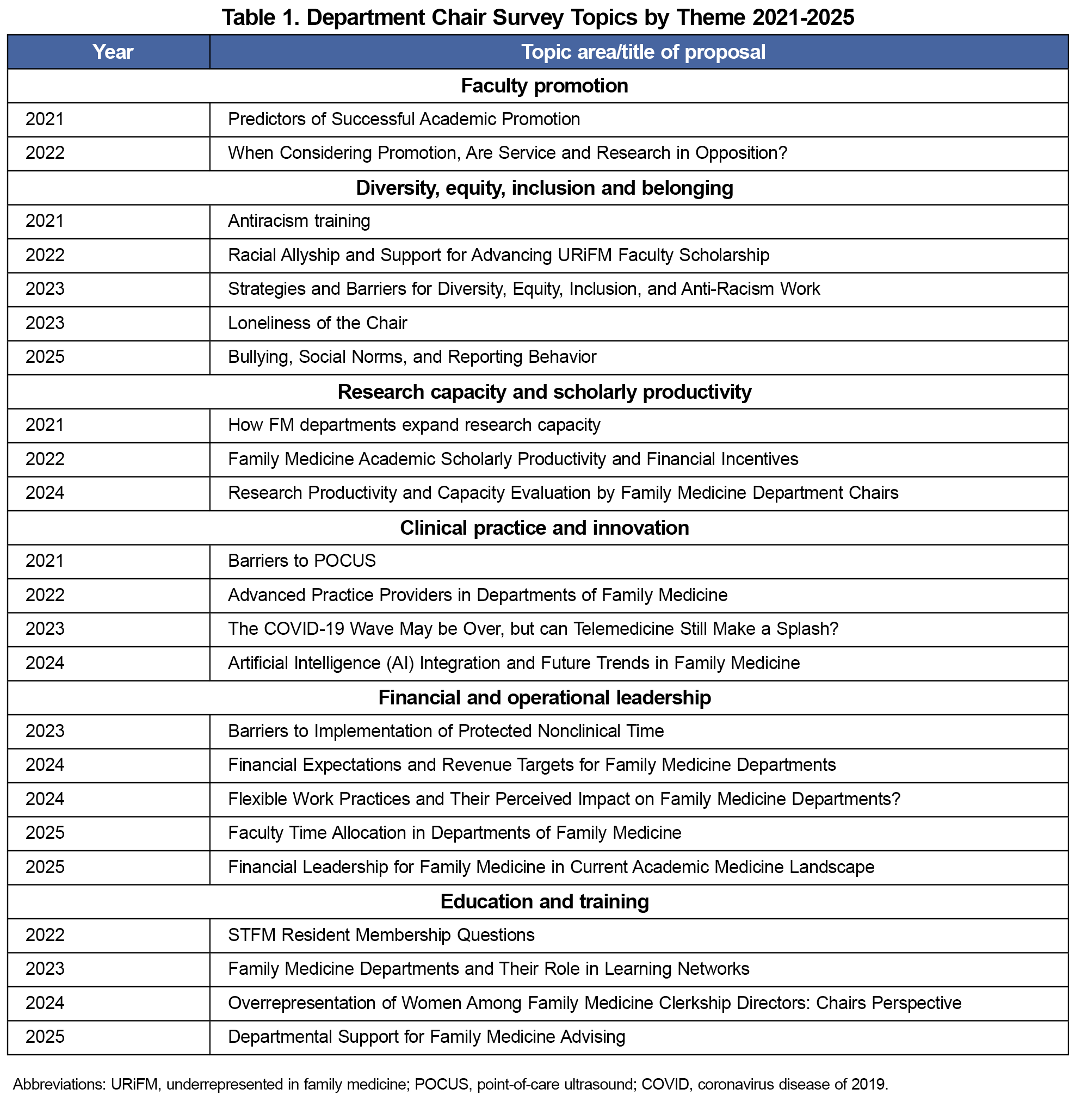
To guide future research and avoid duplication, the DC Survey director compiled topics from 2021-2024 and categorized them into themes. We compared demographic variable responses between potential and actual respondents using Fisher’s exact tests (α = 0.05). We excluded variables with no respondents and dropped all nonresponses from the analysis. Statistical significance was set at α = 0.05. We performed analyses using Stata 19 (Version 19).8
Table 1 summarizes the 23 topics covered by the DC surveys between 2021-2025; these topics are organized within six themes. The 2025 DC survey received fewer topic submissions (n=3) from CAFM members than the past 5 years (historical range: 5-15, median 8).
Out of 210 department chairs invited, 97 responded. We excluded one incomplete response, resulting in 96 usable responses and an overall response rate of 45.7% (96/210). No significant differences were found for gender, race/ethnicity, age, or location; however, self-identification as URM differed significantly between groups (Table 2).
The 2025 CERA DC Survey continues to identify timely topics in academic family medicine while avoiding duplication of prior questions. This year’s topics of financial leadership, medical student advising, protected faculty time, and concerns about unprofessional behavior align with historical themes yet introduce new dimensions, ensuring relevance for leadership decision-making. The survey respondents are broadly representative of the larger population of department chairs, and the response rate supports meaningful interpretation.
We found a significant difference in self-identification as URM between potential and actual respondents. This is most likely due to the high rate of missing demographic data among potential respondents (n=47, 23.3%) rather than true population variance.
Limitations include reliance on ADFM data, which may not reflect current demographic variable standards. Two survey respondents self-reported their race/ethnicity as Middle Eastern/North African while the population demographic variable recorded none. CERA does not update ADFM based on survey responses.
Another limitation is the constraints of the survey design. Each survey team is restricted to 10 questions per topic. Thus, it limits the ability to explore complex issues in detail. In this case, a decision was made to include a fourth survey topic from a team that had been accepted for a different CERA survey rather than allowing more questions for the three initial proposals.
Each survey team will have exclusive access to deidentified data for 120 days. Afterwards, CAFM members can access this data set on the CERA website for secondary data analysis.9 The CERA steering committee is exploring various methods of advertising the DC survey to prospective topic submitters to increase submissions and department chairs to increase response rates.
Expanding the sampling frame to include departments within Commission on Osteopathic College Accreditation institutions is a priority for CERA and the 2026 survey to ensure broader generalizability of findings.
Acknowledgments
Conflict Disclosure: Authors T.H., B.R., R.B. and M.M. are members of the CERA Steering Committee. Dr Moore reports receiving funding from National Institutes of Health, Agency for Healthcare Research and Quality's, Health Resources and Services Administration, and the Georgia State Department of Human Services.
References
- Shokar N, Bergus G, Bazemore A, et al. Calling all scholars to the council of academic family medicine educational research alliance (CERA). Ann Fam Med. 2011;9(4):372-373. doi:10.1370/afm.1283
- Paladine HL, Everard KM, Seehusen D, et al. A model for educational survey research. J Grad Med Educ. 2018;10(2):233-234. doi:10.4300/JGME-D-18-00031.1
- Society of Teachers of Family Medicine. CERA Publications and Presentations. Accessed October 14, 2025. https://www.stfm.org/publicationsresearch/cera/pasttopicsanddata/cerapublicationsandpresentations/
- Paladine HL, Biggs R, Moore MA. Protocol for the 2023 CERA Department Chair Survey. Primer Peer-Rev Rep Med Educ Res. 8:23. doi:10.22454/PRiMER.2024.812665
- Paladine HL, Reedy-Cooper A, Rankin WM, Moore MA. Protocol for the 2024 CERA Department Chair Survey. PRiMER Peer-Rev Rep Med Educ Res. 2025;9:11. doi:10.22454/PRiMER.2025.600324
- Zong Z. How Often Should You Use Email Reminders? SurveyMonkey. Accessed November 26, 2025. https://www.surveymonkey.com/curiosity/how-often-should-you-use-email-reminders/
- Society of Teachers of Family Medicine. CERA recurring demographic questions. Accessed October 14, 2025. https://www.stfm.org/publicationsresearch/cera/howtoapply/recurringquestions/
- StataCorp. Stata Statistical Software: Release 19. Published online 2025. Accessed January 21, 2026. https://www.stata.com/new-in-stata/
- Past Survey Data by Topic. Society of Teachers of Family Medicine. Accessed February 5, 2024. https://www.stfm.org/publicationsresearch/cera/pasttopicsanddata/pasttopiclist/



There are no comments for this article.