Faculty career advisors (FCAs) play a critical role in supporting medical students through the residency application process; however, preparation for advising during the Supplemental Offer and Acceptance Program (SOAP) remains limited. SOAP is a high-stakes, time-compressed process that requires rapid decision making and emotional support for unmatched students, yet it is often approached without formal faculty training. Given the disproportionate share of family medicine SOAP positions, this gap is particularly significant for faculty in the specialty. This article reframes SOAP advising as a concentrated and underrecognized opportunity for faculty development. Drawing on existing advising frameworks and the unique demands of SOAP, we describe how this experience requires faculty to integrate advanced advising, coaching, and mentorship skills under conditions of uncertainty, urgency, and emotional intensity. Key skills developed through SOAP advising include rapid situational assessment, crisis communication, career-discernment coaching, application reframing, and decision making under uncertainty. We further outline practical strategies to promote faculty growth, including structured pre-SOAP training, longitudinal peer mentorship, engagement with national preparatory resources, and post-SOAP debriefing and reflection. By recognizing SOAP as both a critical advising responsibility and a developmental experience, institutions can better prepare faculty and enhance their effectiveness.
While residency advising is a well-recognized responsibility of faculty at the undergraduate level, there is little training for faculty on how best to support students during the Supplemental Offer and Acceptance Program (SOAP). For many faculty career advisors (FCAs)—defined as a faculty member who advises a student on their specialty choice and preparation—SOAP advising occurs without formal preparation and is often undertaken urgently at the request of departmental chairs, student affairs leaders, or students themselves. Unlike longitudinal residency advising, SOAP unfolds under intense time pressure, emotional strain, and significant workforce implications. Family medicine is particularly affected. In 2026, amid declining fill rates reported by the National Resident Matching Program (NRMP), 16% of family medicine positions (899 of 5,491) were available in the SOAP, accounting for more than one-third of all SOAP vacancies.1
Heidelbaugh and colleagues2 have provided a foundational framework for advising throughout the residency application cycle leading up to Match. However, SOAP advising, as a natural part of the advising continuum for applicants who do not initially match, represents an intensified extension of this work. We propose that SOAP is a powerful and underrecognized faculty development experience that warrants explicit attention, preparation, and scholarly reflection.
Why SOAP Advising Matters for Faculty Development
The faculty experience of supporting an unmatched student through the SOAP process is both emotionally intense and highly time sensitive. For FCAs, SOAP advising serves as a concentrated stress test of advising capacity, requiring rapid integration of knowledge, emotional intelligence, and decision making under pressure when compared with routine residency advising. Despite this, the literature on SOAP advising remains limited, with existing work emphasizing the need for structured faculty development in this domain.3,4
Although many institutions provide general residency advising training for faculty, fewer offer targeted preparation for SOAP, likely because it involves a smaller subset of students and because of the stigma associated with it. However, for those who go unmatched, SOAP is a pivotal, often life-altering experience that may involve career redirection and is frequently accompanied by feelings of failure, uncertainty, and psychological distress.5 In this setting, faculty must simultaneously navigate the informational, emotional, and strategic dimensions of SOAP advising.
Faculty development in undergraduate medical education encompasses competencies such as learner assessment, career counseling, professional networking, and support of student well-being.6,7 In the SOAP context, these faculty skill sets become both compressed and amplified. Prior to the week of SOAP, faculty must identify students at risk of going unmatched and initiate challenging conversations to proactively prepare them for this possibility. If SOAP participation is needed, FCAs must then pivot quickly to assist students in redirecting both their residency and perhaps their specialty goals.
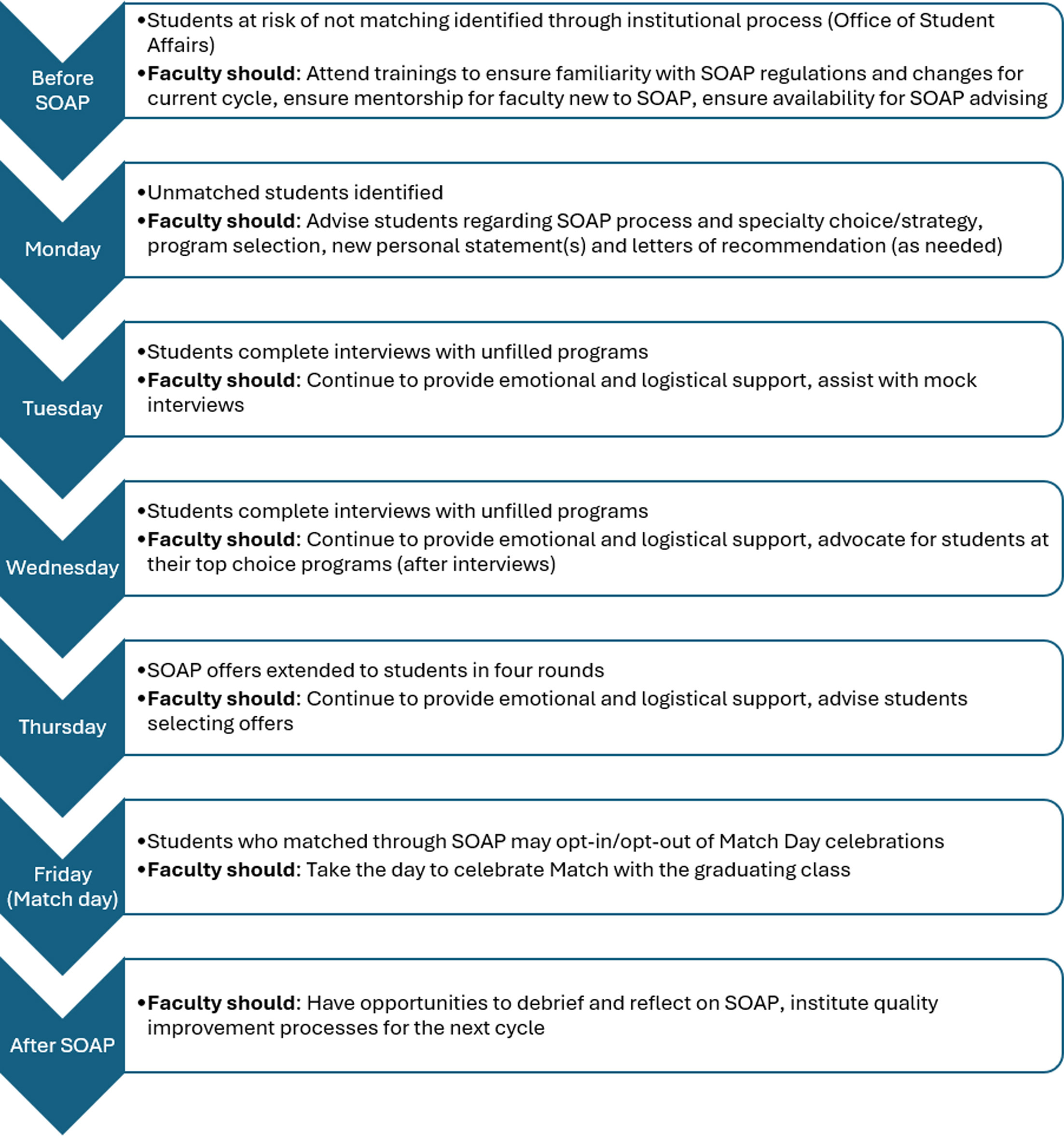
Figure 1 outlines the key functions of faculty advisors on each day of SOAP week. As described in advising frameworks, FCAs must fluidly shift between roles as advisors (providing accurate information), coaches (facilitating performance through feedback), and mentors (supporting professional identity formation and emotional resilience).8,9
Core Faculty Skill Set for SOAP
SOAP functions as an intensive developmental environment in which faculty rapidly refine high-level cognitive, interpersonal, and ethical skills that emerge dynamically across the SOAP timeline. Skills include rapid situational assessment, in which faculty synthesize academic metrics, application gaps, and specialty competitiveness to inform immediate strategy. Counseling distressed students requires faculty to engage in both crisis communication and hope stewardship, providing transparent information while preserving motivation and psychological safety by implementing coaching and supportive communication frameworks.8,9
Faculty also develop expertise in career-discernment coaching, particularly when students must reconsider specialty choice within hours. We draw on workplace learning and communities of practice as complementary frameworks to describe the faculty develop skills needed for this complex career advising. Table 1 summarizes key faculty skills needed for SOAP, how the skills can be mapped to Clinician Educator Milestones,10 context, and guiding questions for skill development.
Skill set |
Clinician educator milestone |
Situation |
Guiding questions for faculty |
SOAP process comprehension |
Administration 1: Administration Skills
Administration 2: Leadership Skills |
SOAP is a compressed match season into 4 days with a tight, well-defined timeline. |
What are the updates to the SOAP schedule and process this year? (reviewed NRMP SOAP website)?11 What is the SOAP process within your school? |
Coordination and communication |
Educational Theory and Practice 2: Professionalism in the Learning Environment
Educational Theory and Practice 10: Learning Environment |
Many people are involved in supporting students in SOAP |
Who is assigned to each role in SOAP support during the week? How will communication occur between units while preserving student privacy? |
Rapid situational assessment |
Education Theory and Practice 5: Performance Improvement and Remediation |
Monday morning is often chaotic, and the situation can be unclear |
Why is the applicant in SOAP? What are the academic, personal, or professional circumstances that led to this match outcome? |
Distress management |
Well-Being: Well-Being of Learners and Colleagues |
The emotional distress students have is comparable to a grief response |
What would be most helpful for the student—information, strategy, mental health support, or space to process? |
Establishment of psychological safety |
Educational Theory and Practice 10: Learning Environment |
Not matching makes a student extremely vulnerable. Building rapport and trust is paramount. |
What private space can be offered to the student? Who knows them well and can provide support? |
Career coaching |
Educational Theory and Practice 7: Learner Professional Development |
The student may be considering family medicine for the first time |
How can FM align with the student’s initial residency goals? Has the student reviewed AAFP Strolling Through the Match12 and the AAFP website? |
Stewardship of hope and expectations |
Educational Theory and Practice 7: Learner Professional Development |
There is a need to support while helping students maintain a realistic view of potential outcomes |
What were the students’ initial residency and future goals? How can their SOAP plan be reframed to align with these goals? |
Assessment of the student as SOAP candidate |
Universal Pillar 3: Recognition and Mitigation of Personal Perspectives and Assumptions
Educational Theory and Practice 3: Learner Assessment |
Competitiveness varies across specialties, necessitating a family medicine-specific assessment |
How likely is this applicant to match family medicine in SOAP, given NRMP Charting13 outcomes and past institutional experience? How might this student be (mis)judged by their application? Are there any “red flags” to address? |
Management of competing priorities |
Educational Theory and Practice 2: Professionalism in the Learning Environment |
There is a need to support students while also considering programs’ need for committed and sustainable placements |
Is the student intending to reapply in the next match cycle? Are there alternatives to FM residency? |
Review of application materials |
Educational Theory and Practice 4: Feedback |
Need for a new personal statement f and new letters of recommendation for family medicine |
Who can be called upon to help the student gather letters? Are core faculty on stand-by for Monday of SOAP week? Who will review the personal statement? |
Interview support |
Educational Theory and Practice 4: Feedback |
Assess communication skills and responses for family medicine |
What resources can students use to prepare for an interview? Who could provide a mock interview? |
Accessibility |
Universal Pillar 4: Commitment to Professional Responsibilities |
Students may need timely guidance at various points during the week |
Have you discussed when and how the student can reach you? Who is your backup if you’re unavailable? |
Applicant advocacy |
Educational Theory and Practice 2: Professionalism in the Learning Environment |
Once a student receives an interview offer, faculty may reach out to the program on their behalf |
What are the students’ top two programs? Who would be the strongest advocate for them? |
Process improvement |
Administration 3: Change Management
Universal Pillar 1: Reflective Practice and Commitment to Personal Growth |
Each SOAP experience should be reviewed to improve the process of student support |
What went well in SOAP this year? What could be revised for next year, and who is responsible for making that change? What feedback is offered by the student post-SOAP? |
Practical Recommendations for Faculty Development Through the SOAP
Longitudinal peer mentoring is a key element of development, allowing experienced advisors to guide newer faculty through the nuances of SOAP, share best practices, and model effective student support during a high-stakes period. Pre-SOAP preparation, whether facilitated through 1-on-1 mentoring or other institutional or organizational training, further enhances faculty readiness by explaining and reviewing NRMP policies, promoting effective communication strategies with students and residency programs, and enabling scenario-based planning. Each year, numerous preparatory webinars for the residency match process, including SOAP, are hosted by the NRMP and Association of American Medical Colleges. Both new and experienced SOAP advisors should make time to attend these sessions as key faculty development opportunities. Additional strategies include temporary workload redistribution, such as adjusting clinical shifts, shifting teaching schedules, or reducing administrative burdens during SOAP.
Implementation of these faculty development strategies may be constrained by several barriers. Many faculty advisors have competing clinical, teaching, research, and administrative responsibilities that limit their availability during the time-sensitive SOAP period. Institutions with fewer faculty resources or less developed advising infrastructures may also face challenges providing protected time, formal mentoring, or structured training. Additionally, variability in faculty familiarity with SOAP policies and advising practices may affect the consistency of support provided to students. Institutions should adapt these recommendations to their available resources and local advising structures.
Following SOAP, institutions should plan debriefing opportunities for faculty and staff. These sessions, hosted by the medical school’s office of student affairs or by individual departments or residency programs, create space for faculty to process experiences and identify areas for programmatic improvements for next year. Reflection also helps mitigate burnout by acknowledging the emotional intensity of supporting students through SOAP and identifying systematic areas for process improvement.
SOAP advising represents a uniquely intense and transformative context for real-world faculty development, one that deepens the skills utilized for high-quality career advising. As a high-stakes environment marked by uncertainty, urgency, and emotional complexity, SOAP compels faculty to integrate advanced advising, coaching, and mentorship skills. While these proposed faculty development benefits are presently conceptual, future empirical evaluation will be necessary to substantiate their long-term institutional impact.
Recognizing SOAP as a catalyst for professional growth reframes it from a reactive institutional obligation to a deliberate developmental opportunity. By investing in structured preparation, faculty peer mentorship, and reflective practices, institutions can leverage SOAP to strengthen advising programs and cultivate more skilled, adaptable advisors. Future educational scholarship should employ both pre- and postintervention designs to evaluate changes in faculty confidence and long-term advising competence following SOAP participation. Additionally, qualitative research is warranted to explore in depth the lived, nuanced experiences of participating faculty and to identify targeted pathways for institutional support.
The authors acknowledge Rebecca Cantone, MD, who contributed to the development of the original presentation that informed this manuscript.
This work was presented at the 2026 Society of Teachers of Family Medicine (STFM) Conference on Medical Student Education, Charlotte, NC, 2026, under the title “Supporting Students Through the SOAP Process.”
Conflict of Interest Statement
The authors declare no conflicts of interest. The views expressed in this manuscript are those of the authors and do not necessarily reflect the official policies or positions of their affiliated institutions.
Author Contribution Statement
All authors contributed to the conception and design of this work. Each author participated in drafting or critically revising the manuscript for important intellectual content. All authors approved the final version and agree to be accountable for all aspects of the work.
Artificial Intelligence Use Statement
The authors acknowledge the use of Microsoft Copilot for assistance with editing portions of the manuscript and abstract for clarity and conciseness. No artificial intelligence tools were used to generate original scholarly content or perform analyses; all authors take full responsibility for the integrity of the work.
References
-
-
Heidelbaugh JJ,
Gilbertson C,
Prunuske J.
Best practices for advising students for the NRMP match in family medicine.
PRiMER.
2025;9:43.
doi:10.22454/PRiMER.2025.716184
-
Bumsted T,
Schneider BN,
Deiorio NM.
Considerations for medical students and advisors after an unsuccessful match.
Acad Med.
2017;92(7):918–922.
doi:10.1097/ACM.0000000000001672
-
Royce CS,
Everett EN,
Craig LB,
et al.
To the Point: advising students applying to Obstetrics and Gynecology residency in 2020 and beyond.
Am J Obstet Gynecol.
2021;224(2):148–157.
doi:10.1016/j.ajog.2020.10.006
-
Morrissette A,
Morrissette M.
“The feeling of failure is immense”: a qualitative analysis of the experiences of unmatched residency applicants using Reddit.
Acad Med.
2023;98(5):623–628.
doi:10.1097/ACM.0000000000005120
-
Harris DL,
Krause KC,
Parish DC,
Smith MU.
Academic competencies for medical faculty.
Fam Med.
2007;39(5):343–350.
-
Mahan JD,
Kaczmarczyk JM,
Miller Juve AK,
et al.
Clinician educator milestones: assessing and improving educators’ skills.
Acad Med.
2024;99(6):592–598.
doi:10.1097/ACM.0000000000005684
-
Marcdante K,
Simpson D.
Choosing when to advise, coach, or mentor.
J Grad Med Educ.
2018;10(2):227–228.
doi:10.4300/JGME-D-18-00111.1
-
Taylor D,
Anderson K,
Dathatri S,
Klig JE,
Park H,
Fix M.
Medical student coaching in the U.S.: a national survey of clinical skills educators.
BMC Med Educ.
2025;25(1):1486.
doi:10.1186/s12909-025-08115-5
-
-
-
-



There are no comments for this article.