Introduction: Implicit biases, defined as unconscious attitudes influencing clinical decisions, can negatively affect patient care and contribute to health care disparities. Growth mindset—the belief that abilities can be developed through effort—encourages learners to view biases as modifiable rather than fixed. The mask expression project is an educational activity designed to foster growth mindset in first-year medical students and promote patient-centered care.
Methods: Three hundred five (305) first-year medical students completed the project during a service-learning course. Students wrote or drew on a paper mask template divided into two halves: one side challenged identified implicit biases; the other depicted actions to reduce biases during patient encounters. Students worked in groups of five or six to write reflection paragraphs. Course faculty analyzed 51 group reflections using conventional content analysis to categorize primary implicit biases and assess for growth mindset language.
Results: The most common patient characteristics toward which students identified implicit biases were health beliefs and choices (17.6%), homelessness (17.6%), obesity/overweight (15.7%), and socioeconomic status (15.7%). Strategies to minimize implicit biases included nonjudgmental listening, offering multiple treatment options, using translators, and connecting patients to community resources such as food banks. The majority of reflections included language consistent with growth mindset adoption.
Conclusion: The mask expression project provided first-year medical students with a creative approach to identifying implicit biases and developing mitigation strategies, while also fostering a growth mindset. Arts-based interventions have significant value in medical education and can be used longitudinally to reinforce patient care concepts and skills.
Implicit bias refers to unconscious attitudes or stereotypes that influence clinical decisions. Research has shown that physicians’ implicit biases related to race, socioeconomic status, age, and weight can negatively affect patient-provider communication, treatment decisions, and health outcomes.1,2 Addressing implicit bias early in medical training is therefore essential to developing equitable, patient-centered physicians.3
Growth mindset, a concept introduced by Carol Dweck, is the belief that one’s abilities and attributes can be developed through dedication and effort.4 In medical education, growth mindset has been associated with greater resilience and receptiveness to feedback—qualities critical to being a successful physician throughout training and practice.5 Growth mindset is particularly relevant to implicit bias education because it encourages learners to view biases as modifiable patterns that can be recognized and changed, rather than permanent character flaws.
Professional identity formation (PIF)—the process by which students adopt the values, beliefs, and behavioral conduct expected of the profession—provides a broader context for this work. Many medical schools have used mask-making as an arts-based activity to support PIF due to its symbolic relation to identity. One project analyzed how closely students’ actual self aligned with their aspirational self in various domains, such as communication skills.6 Another had students make two masks: one representing their sense of professional identity in the first year of medical school, and the other representing their sense of professional identity in the fourth year.7
Our faculty designed a mask-making project incorporating words, art, and group reflection to help first-year medical students identify implicit biases affecting patient-centered care and develop strategies to address them. We hypothesized that students would identify implicit biases interfering with patient-centered care, propose actionable mitigation steps, and demonstrate growth mindset adoption in their reflections.
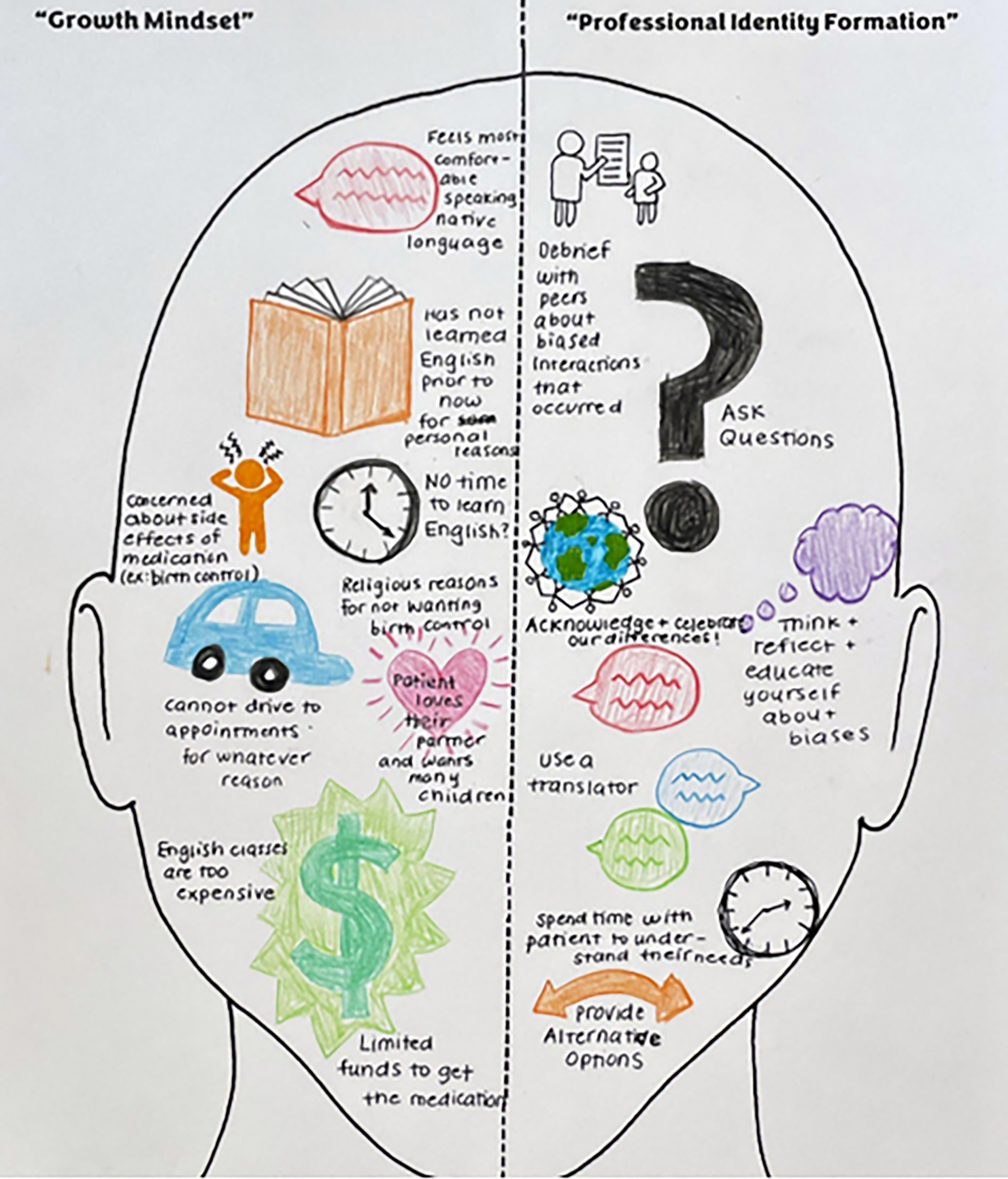
Faculty at Wayne State University School of Medicine (WSUSOM) developed the mask expression project in 2023 as a mandatory activity for all first-year medical students enrolled in the service-learning course. Students were individually asked to identify two implicit biases that could interfere with a medical provider’s ability to provide patient-centered care. Students then received a mask template divided into two labeled halves. The left side, labeled “Growth Mindset” prompted students to write statements and/or draw pictures that challenged their identified implicit biases, reflecting the concept that biases are not fixed and can be recognized and changed through deliberate effort. The right side, labeled “PIF” (professional identity formation), prompted students to write and/or draw actions they could take to reduce implicit biases during patient encounters, reflecting the integration of bias-reduction practices into their developing professional role (Figure 1).
Students were then assigned to 51 groups of approximately six each. Each group discussed the project and wrote a reflection paragraph summarizing what they learned about growth mindset, implicit biases, and how physicians should address implicit biases. Course faculty analyzed the deidentified reflection paragraphs using conventional content analysis to identify the primary implicit bias discussed in each reflection.8 Each paragraph was assigned one primary bias category based on the predominant topic. Faculty also reviewed each reflection for evidence of growth mindset language, defined as statements indicating implicit biases are not fixed and can be overcome through effort, based on Dweck’s framework.4 Frequencies and percentages were calculated using descriptive statistics. Because students worked in groups, results represent biases prioritized by groups rather than the frequency across all 305 individual students.
The Wayne State University Institutional Review Board determined that this project does not constitute human participant research as defined by the Common Rule (45 CFR 46) and FDA regulations and therefore does not require IRB oversight. Formal informed consent was not required.
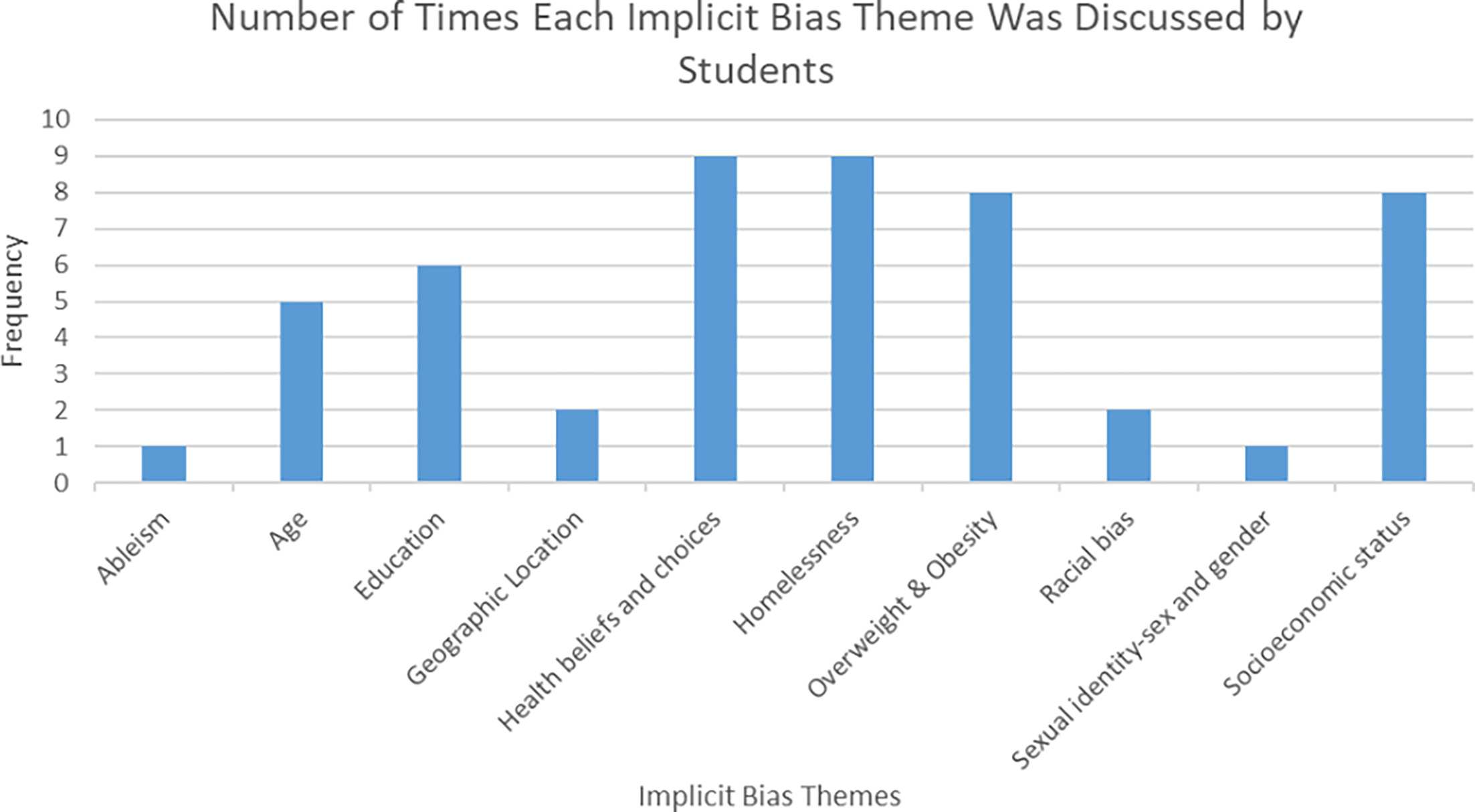
Three hundred five (305) first-year medical students completed the mask expression project, producing 51 group reflections. The most common patient characteristics toward which students identified implicit biases were health beliefs and choices (eg, assumptions about alternative medicine use, 17.6%), homelessness (17.6%), obesity/overweight (15.7%), socioeconomic status (15.7%), age (11.8%), and education level (11.8%; Figure 2).
Students proposed strategies to minimize implicit biases, including engaging in active and nonjudgmental listening, providing multiple treatment options, using translators, providing patients with reputable resources for health information, and connecting patients to community resources like food banks. While these strategies were not explicitly linked to specific biases in the group reflections, several logical connections are apparent, for example, translators and plain language for education-related biases, and community resources for socioeconomic biases.
Most group reflections included language consistent with growth mindset adoption, with students recognizing that implicit biases are unconscious but not permanent and can be addressed with awareness and deliberate effort.
Our project uniquely combined mask-making with structured reflection to address implicit bias and foster growth mindset, extending prior work that focused primarily on PIF and identity dissonance.7,9,10 The multimodal format, combining written and visual expression, may help students articulate unconscious thoughts through whichever medium is most comfortable, making it easier for both students to express their ideas and for faculty to interpret the meanings of their masks.
The presence of growth mindset language in reflections suggests the project may foster a growth-oriented perspective toward bias, helping students understand that implicit biases can be overcome even when they are unconscious. A growth mindset is critical to being a successful physician, as it provides motivation for overcoming challenges faced throughout training and practice.4,5 However, a single intervention is unlikely to produce lasting change without reinforcement; sustained training across the curriculum is needed to translate awareness into clinical practice.2,3
This study has several limitations. We were unable to directly determine whether students would implement their strategies to reduce implicit bias in clinical practice. Many strategies focused on external resources (food banks, translators) rather than internal reflexive practices, possibly reflecting first-year students’ limited clinical experience.11,12 We did not conduct a formal interrater reliability assessment for the content analysis. Future research should incorporate longitudinal follow-up to evaluate implicit bias and growth mindset during the later years of medical training and use more rigorous qualitative methodology.
This project was presented at the Generalists in Medical Education 45th Annual Conference, November 7-8, 2024 in Atlanta, Georgia.
Conflict of Interest Statement and Funding
The authors have no funding, financial relationships, or conflicts of interest to disclose.
References
-
Chapman EN, Kaatz A, Carnes M. Physicians and implicit bias: how doctors may unwittingly perpetuate health care disparities.
J Gen Intern Med. 2013;28(11):1504–1510. doi:10.1007/s11606-013-2441-1
-
Vela MB, Erondu AI, Smith NA, Peek ME, Woodruff JN, Chin MH. Eliminating explicit and implicit biases in health care: evidence and research needs.
Annu Rev Public Health. 2022;43(1):477–501. doi:10.1146/annurev-publhealth-052620-103528
-
Gonzalez CM, Lypson ML, Sukhera J. Twelve tips for teaching implicit bias recognition and management.
Med Teach. 2021;43(12):1368–1373. doi:10.1080/0142159X.2021.1879378
-
Dweck CS. Mindset: The New Psychology of Success. Random House; 2006.
-
Wolcott MD, McLaughlin JE, Hann A, et al. A review to characterise and map the growth mindset theory in health professions education.
Med Educ. 2021;55(4):430–440. doi:10.1111/medu.14381
-
Higgins R, Stuckey H, Snyder B, et al. Decoding the mask: identity in undergraduate medicaleducation.
MedEdPublish. 2024;14(1):1. doi:10.12688/mep.19713.1
-
Stephens MB, Bowen JL, McGinley EL, Rainey P. Organizing chaos: iterative professional identity formation through the lens of mask making.
PRiMER. 2020;4:10. doi:10.22454/PRiMER.2020.705788
-
Hsieh HF, Shannon SE. Three approaches to qualitative content analysis.
Qual Health Res. 2005;15(9):1277–1288. doi:10.1177/1049732305276687
-
Shapiro J, McMullin J, Miotto G, Nguyen T, Hurria A, Nguyen MA. Medical students’ creation of original poetry, comics, and masks to explore professional identity formation.
J Med Humanit. 2021;42(4):603–625. doi:10.1007/s10912-021-09713-2
-
Shapiro J, Youm J, Heare M, et al. Medical students’ efforts to integrate and/or reclaim authentic identity: Insights from a mask-making exercise. J Med Humanity.
-
Krishnasamy N, Hasamnis AA, Patil SS. Developing professional identity among undergraduate medical students in a competency-based curriculum: Educators’ perspective.
J Educ Health Promot. 2022;11(1):361. doi:10.4103/jehp.jehp_329_22
-



There are no comments for this article.