Introduction: The use of opioids for acute low-back pain (LBP) is considered low-value in most clinical scenarios. Understanding trends in low-value opioid utilization can inform interventions to support guideline-concordant care. This study evaluated the utilization of low-value opioids for acute LBP, and variation by rurality, payer, and sex, before and during the COVID-19 pandemic.
Methods: In this retrospective cohort study, we examined opioid claims from Virginia’s All-Payer Claims Database among adults with commercial, Medicare Advantage (MA), or Medicaid insurance during 2019–2021. We identified low-value opioid claims for acute LBP and quantified utilization rates per 1,000 patients. Heterogeneous difference-in-differences models generated incidence rate ratios (IRRs) stratified by rurality, payer, and sex to estimate differences between the observed (during-pandemic) and expected (prepandemic) rates.
Results: Among our cohort (n = 853,775), 73.9% of opioids utilized for acute LBP were low-value. Utilization rates declined from 155.0 prescriptions/1,000 patients in 2019 to 107.5 prescriptions/1000 patients in 2021 and were 20.0% lower during the pandemic than expected rates (marginal IRR: 0.80, P = 0.002). Utilization was higher in rural than nonrural areas (marginal IRR: 1.74, P<0.001) without pandemic effect interaction (IRR: 1.02, P = 0.604). The rural effect was smaller for MA beneficiaries (IRR: 0.75, P = 0.046), and larger among males (IRR: 1.25, P<0.001).
Conclusions: The decline in low-value opioid utilization for acute LBP was accelerated during 2020–2021. Utilization was consistently higher in rural than nonrural areas. Findings highlight the need for targeted interventions and policy to reduce low-value opioid utilization, especially in rural areas to ensure equitable, high-value care for acute pain.
Acute low back pain (LBP) is common in ambulatory care and contributes substantially to health care utilization and disability in the United States.1-4 Clinical management of acute (pain lasting<30 days) LBP is often inconsistent with evidence-based guidelines,5-8 which generally recommend against opioids as first-line treatment for acute LBP.9,10,11 Because of the short- and long-term risks associated with opioids,12,13 reducing low-value opioid utilization for acute LBP can help clinicians deliver guideline-concordant care and improve patient safety.
While opioid utilization in the United States has declined since 2010, the use of low-value opioids for acute LBP has not declined proportionally.5,8,14,15 Rural areas face barriers such as a lack of access to providers of nonpharmacological pain treatments (eg, educational programs, exercise routines, or psychological treatments),11 contributing to higher opioid utilization.16,17 Opioid utilization varies by rurality and payer,16-18 but whether similar variation exists for acute LBP remains unclear. Early in the COVID-19 pandemic, the use of opioids for acute LBP increased while nonpharmacologic therapy for acute LBP declined.6,7,15 Understanding trends and the impact of the COVID-19 pandemic can inform initiatives to promote equitable, guideline-concordant care in ambulatory settings, where acute pain is commonly treated.19
We conducted a difference-in-differences (DiD) analysis of insurance claims from the Virginia All-Payer Claims Database (VA-APCD) to evaluate low-value opioid utilization for acute LBP before and during the first two years of the COVID-19 pandemic and to explore demographic variation in this utilization.
This retrospective cohort study evaluated the utilization of opioids for acute LBP during January 1, 2019 through December 31, 2021. The Institutional Review Board of Carilion Clinic determined that this project did not meet the definition of human subjects research.
Data
From the VA-APCD, we established a cohort of adults (aged>18 years) continuously enrolled with commercial, Medicare Advantage (MA), or Medicaid payers for>12 months (during 2019–2021). From this cohort, we identified opioid prescription claims occurring within 28 days of a new LBP diagnosis. Historical look-back processes for certain diagnostic and procedural codes and prescription history were used to rule out chronic pain, related surgery, certain neurological conditions, and identify new acute versus chronic opioid prescriptions.20 Using the Milliman MedInsight Health Waste Calculator (HWC),20 we categorized claims as low-value based on established guidelines, as described elsewhere (Supplementary Tables S1-S4).5,8-10,15,21 We classified any cases where a prescription of nonsteroidal anti-inflammatory drugs (NSAIDS) was made within a lookback period from the opioid prescription date as appropriate rather than low-value. We calculated population-averaged rates of low-value utilization per 1,000 patients. Rurality was classified using United States Department of Agriculture Rural-Urban Commuting Area codes (4–10 = rural).22
Statistical Analysis
We fit a DiD Poisson regression model comparing observed rates of low-value opioid utilization for acute LBP during the pandemic (March 2020-December 2021) versus expected rates (predicted based on trend data from January 2019–February 2020). As demographic variation in pandemic impact was expected, we analyzed interactions for rurality, payer, and sex with pandemic timeframe effect (DiD effect) in the model. Regression results were expressed as incidence rate ratios (IRR). All statistical analyses were performed in R software version 4.3.1 (R Project for Statistical Computing) with a significance level of .05.
Our cohort included 853,776 patients (mean age 59.0 years [SD: 10.7]; 56.4% female; 11.6% rural; 13.8% Medicaid; Table 1). Demographic characteristics remained relatively stable during 2019–2021, except for Medicaid enrollment, which increased from 9%–18% between 2019 and 2021.
|
Number of patients (%) |
Characteristic |
2019
N = 832,084
N (%) |
2020
N = 818,474
N (%) |
2021
N = 910,769
N (%) |
Overall
N = 853,776
N (%) |
Rurality |
Rural |
96,359 (11.6) |
98,690 (12.1) |
102,414 (11.2) |
99,154 (11.6) |
Nonrural |
735,725 (88.4) |
719,784 (87.9) |
808,355 (88.8) |
754,621 (88.4) |
Payer |
Commercial |
311,741 (37.5) |
274,036 (33.5) |
302,991 (33.3) |
296,256 (34.7) |
Medicaid |
78,280 (9.4) |
109,184 (13.3) |
165,662 (18.2) |
117,709 (13.8) |
Medicare advantage |
442,064 (53.1) |
435,254 (53.2) |
442,116 (49.5) |
331,121 (38.8) |
Age (years) |
18–39 |
162,114 (19.5) |
164,712 (20.1) |
207,257 (22.8) |
178,028 (20.9) |
40–64 |
253,915 (30.5) |
247,322 (30.2) |
284,440 (31.2) |
261,892 (30.7) |
65–79 |
316,364 (38.0) |
306,892 (37.5) |
317,757 (34.9) |
313,671 (36.7) |
80+ |
99,691 (12.0) |
99,548 (12.2) |
101,315 (11.1) |
100,185 (11.7) |
Sex |
Female |
470,304 (56.5) |
461,076 (56.3) |
512,326 (56.2) |
481,235 (56.4) |
Male |
361,780 (43.5) |
357,398 (43.7) |
398,443 (43.8) |
372,540 (43.6) |
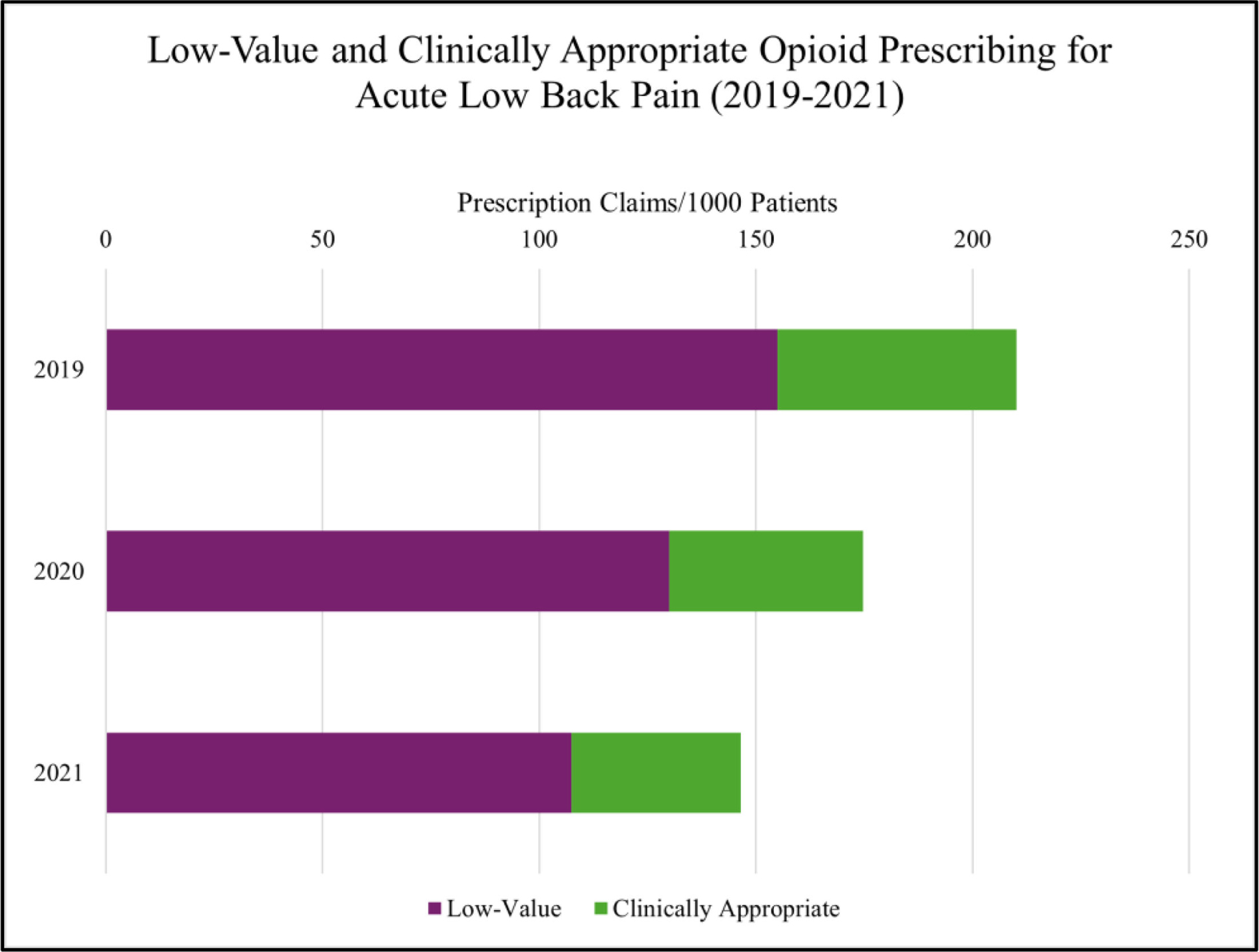
Of the 1,338,371 opioid claims analyzed, 989,056 (73.9%) were categorized as low-value throughout 2019–2021 (Supplementary Tables S5-S6). The rate of low-value opioid utilization for acute LBP declined in the overall cohort from 155.0 prescriptions per 1,000 patients in 2019, to 130.0 in 2020, and 107.5 in 2021 (Figure 1).
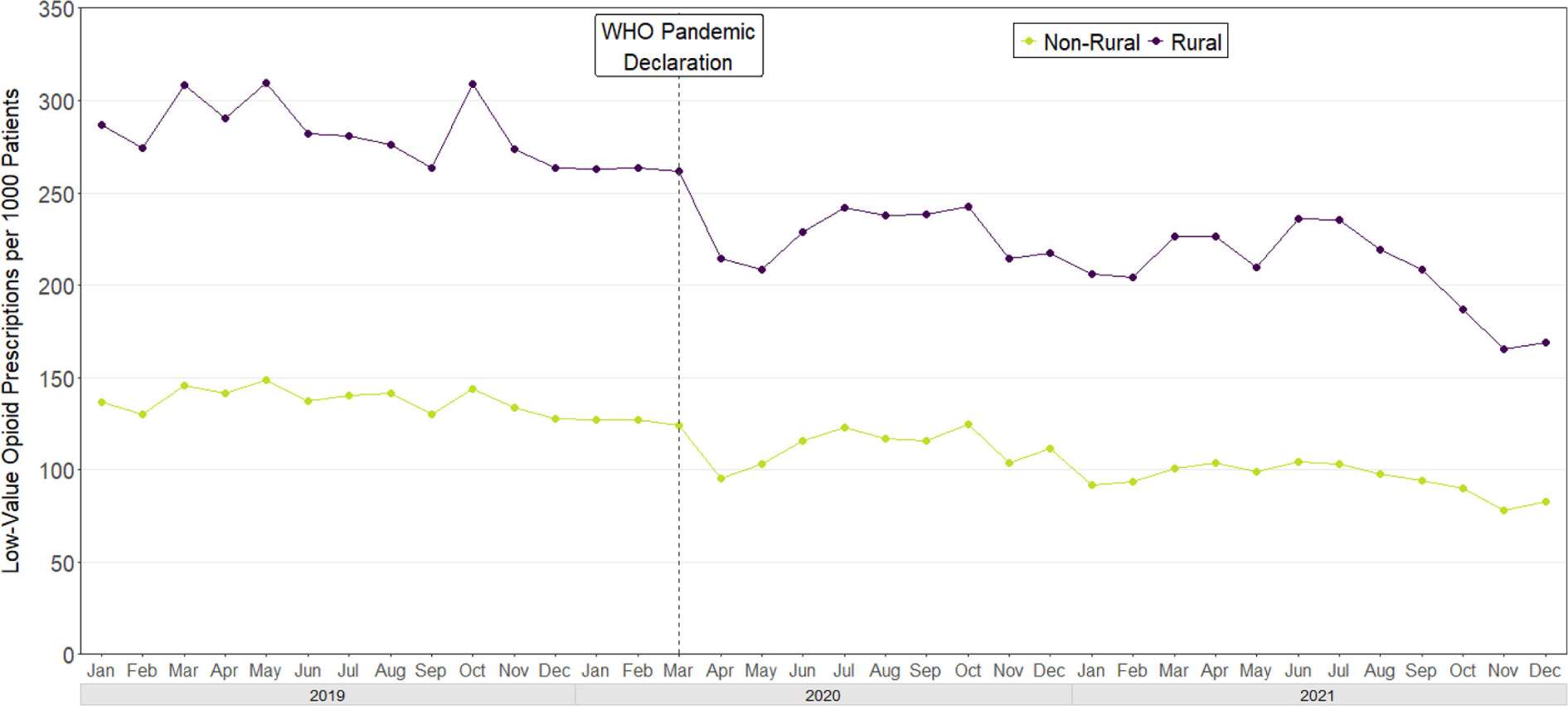
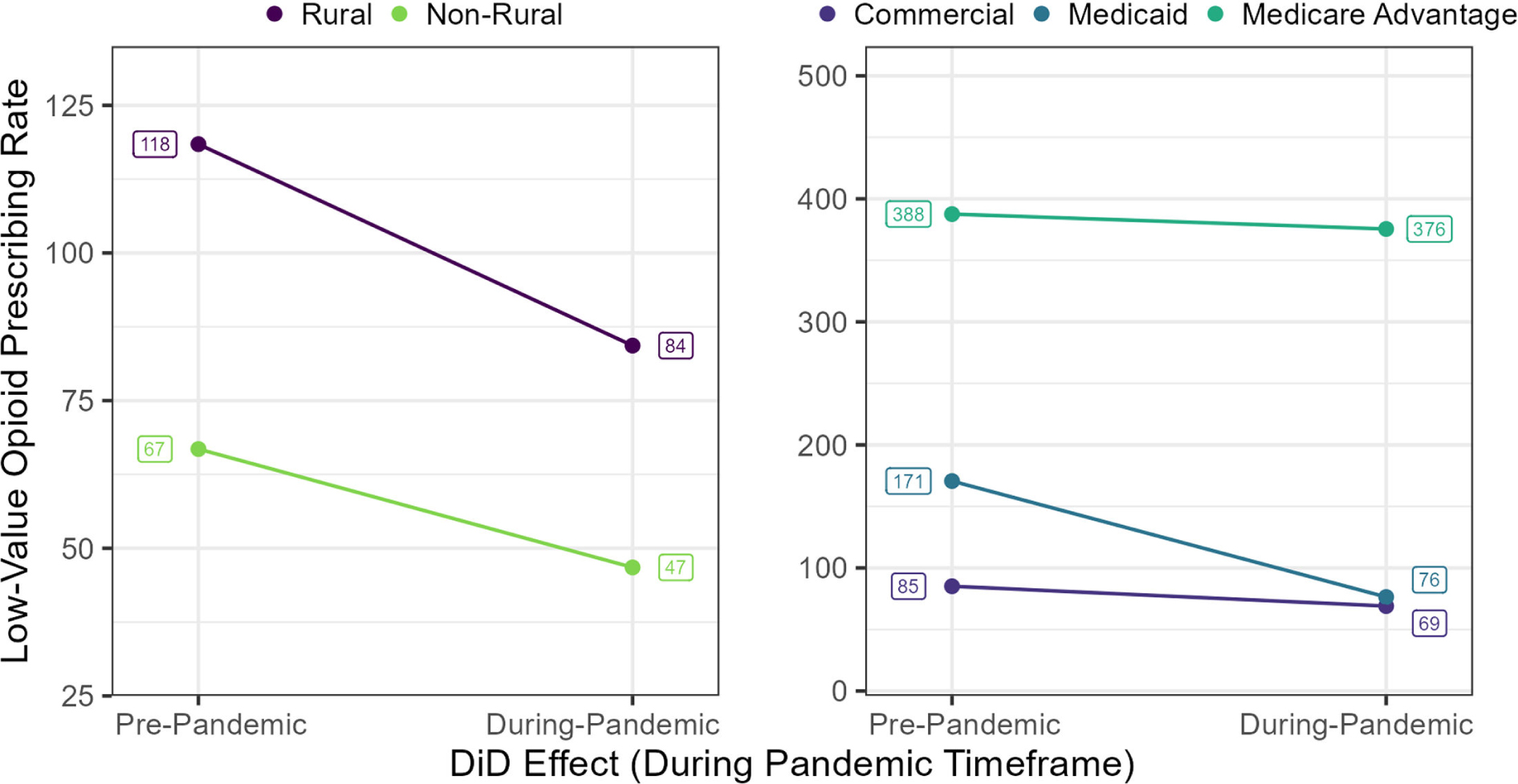
Relative low-value opioid utilization for acute LBP remained significantly higher in rural than nonrural areas during 2019–2021 (marginal IRR: 1.80 [95% CI: 1.29–2.33]; Figure 2). The difference between rural and nonrural utilization was smaller for MA beneficiaries (IRR: 0.75 [95% CI: 0.56–0.99]) and larger among males (IRR: 1.25 [95% CI: 1.10–1.43]). The decline was 21.8% in rural areas versus 24.1% in nonrural areas; however, the interaction effect of rurality on low-value opioid utilization remained consistent before and during the pandemic (IRR: 1.02 [95% CI: 0.95–1.09]; Table 2, Figure 3).
Term |
Total
IRR (95% CI) |
Low-value
IRR (95% CI) |
Clinically appropriate
IRR (95% CI) |
DiD (false) vs a |
1.0 |
1.0 |
1.0 |
DiD (true) |
0.775 (0.672, 0.895), P<0.001 |
0.796 (0.687, 0.921), P = 0.002 |
0.721 (0.619, 0.839), P<0.001 |
Rurality (nonrural) vs a |
1.0 |
1.0 |
1.0 |
Rurality (rural) |
1.696 (1.247, 2.307), P<0.001 |
1.738 (1.297, 2.329), P<0.001 |
1.576 (1.067, 2.329), P = 0.022 |
DiD x rurality (nonrural) vs b |
1.0 |
1.0 |
1.0 |
DiD x rurality (rural) |
1.022 (0.961, 1.086), P = 0.490 |
1.017 (0.954, 1.085), P = 0.604 |
1.035 (0.962, 1.115), P = 0.354 |
Payer (Commercial) vs a |
1.0 |
1.0 |
1.0 |
Payer (Medicaid) |
2.069 (1.581, 2.708), P<0.001 |
1.992 (1.504, 2.639), P<0.001 |
2.255 (1.727, 2.944), P<0.001 |
Payer (MA) |
4.951 (3.847, 6.370), P<0.001 |
5.268 (4.104, 6.762), P<0.001 |
4.085 (3.100, 5.384), P<0.001 |
DiD x payer (Commercial) vs b |
1.0 |
1.0 |
1.0 |
DiD x payer (Medicaid) |
0.554 (0.484, 0.635), P<0.001 |
0.552 (0.477, 0.639), P<0.001 |
0.562 (0.470, 0.671), P<0.001 |
DiD x payer (MA) |
1.201 (1.075, 1.342), P = 0.001 |
1.195 (1.068, 1.337), P = 0.002 |
1.218 (1.059, 1.401), P = 0.006 |
Rurality X payer (Commercial) vs c |
1.0 |
1.0 |
1.0 |
Rurality X payer (Medicaid) |
0.985 (0.671, 1.444), P = 0.937 |
1.012 (0.693, 1.478), P = 0.950 |
0.928 (0.595, 1.446), P = 0.740 |
Rurality X payer (MA) |
0.754 (0.557, 1.021), P = 0.068 |
0.747 (0.561, 0.994), P = 0.046 |
0.774 (0.523, 1.144), P = 0.199 |
Sex (F) vs a |
1.0 |
1.0 |
1.0 |
Sex (M) |
0.750 (0.677, 0.830), P<0.001 |
0.729 (0.653, 0.813), P<0.001 |
0.810 (0.717, 0.915), P<0.001 |
Rurality X sex (F) vs c |
1.0 |
1.0 |
1.0 |
Rurality X sex (M) |
1.216 (1.073, 1.379), P = 0.002 |
1.253 (1.097, 1.431), P<0.001 |
1.119 (0.952, 1.316), P = 0.173 |
Compared with commercial enrollees, MA and Medicaid beneficiaries had significantly greater rates of low-value opioid utilization for acute LBP prepandemic (IRR: 5.27 [95% CI: 4.10–6.76]; IRR: 1.99 [95% CI: 1.50–2.64], respectively). Average low-value opioid utilization rates were lower during the pandemic than pre-pandemic (marginal IRR: 0.80 [95% CI: 0.69–0.92]). This association varied by payer. The pandemic-associated reduction in low-value opioid utilization was larger among Medicaid beneficiaries (IRR: 0.55 [95% CI: 0.48–0.64]) and smaller among MA beneficiaries (IRR: 1.20 [95% CI: 1.07–1.34]; Table 2, Figure 3). Complete model results are shown in Supplementary Table S7.
Most opioids utilized for acute LBP among this large Virginia cohort were characterized as low-value throughout 2019–2021. Low-value opioid utilization for acute LBP declined more quickly during the COVID-19 pandemic than it had before the pandemic. This pattern of decline differs from the increases in low-value opioid utilization reported by others earlier in the pandemic6,23 and may be due to shifts in patient care-seeking, how health care was delivered (eg, telemedicine), or in clinician prescribing, as was suggested for other health services.15,24,25,26
Rural disparities in low-value opioid utilization for acute LBP remained consistent throughout 2019–2021. These results suggest that pandemic disruptions influenced low-value opioid utilization, but not enough to influence drivers of rural variation; similar patterns are reported for low-value use of nonsteroidal anti-inflammatory drugs.26 A focus on rural-specific contributors to low-value opioid utilization is warranted, in addition to efforts to expand access to pain management, alternative pain treatments, and telemedicine in rural communities.16,17,26,27
Payer-level variations in low-value opioid utilization and pandemic impact may be due to differences in the characteristics or behaviors of the covered populations or payer programs.24,28 For example, a larger pandemic-associated reduction in low-value utilization among Medicaid beneficiaries could have been impacted by the Addiction and Recovery Treatment Services (ARTS)29 program through Virginia Medicaid (ie, a program that expanded access to a comprehensive continuum of addiction treatment services in rural areas, especially), which could have had implications for other payers.30
Limitations to this study include that our data set does not include all payers or uninsured patients, this analysis did not adjust for missing claims, which could underestimate commercial claims, and that we analyzed filled opioid prescriptions, which may not have mirrored clinician prescribing patterns. In addition, Medicaid expansion began in Virginia in 2019, resulting in an increased Medicaid population during the study period. While we accounted for payer differences in the model, the large one-time increase could have biased results. The HWC algorithm does not account for all clinical nuance. For example, the use of over-the-counter NSAIDS may be factored into clinical decision making but is difficult to track consistently using claims data.
Taken together, this study highlights interactions between rurality and payers that may inform interventions to reduce low-value use of opioids. Additionally, these results demonstrate that examination of pre-postpandemic differences can uncover latent factors that affect low-value prescribing.
This study was supported in part by Smarter Care Virginia (a Virginia Center for Health Innovation initiative funded by Arnold Ventures) and Carilion Clinic’s Research Acceleration Program.
Preliminary results were accepted at regional conferences for the Virginia Rural Health Association, November 15-16th, 2023, Blacksburg, VA; and the Appalachian Studies Association, March 7-9, 2024, Cullowhee, NC, as well as the annual meeting for the North American Primary Care Research Group (NAPCRG), November 19-24, 2024 in Quebec, Canada. An abstract from the NAPCRG presentation was published in conference proceedings as:
Turner JK. Low-Value Opioid Prescribing Trends for Acute Low-Back Pain in Rural Virginia Between 2019-2021. Ann Fam Med. 2024; 22(Supplement 1)7171. https://doi.org/10.1370/afm.22.s1.7171
Michelle Rockwell is presently also employed by the Virginia Center for Health Innovation. All other researchers report that they have no conflicts of interest.
References
-
Ferreira ML, de Luca K, Haile LM, et al. Global, regional, and national burden of low back pain, 1990–2020, its attributable risk factors, and projections to 2050: a systematic analysis of the Global Burden of Disease Study 2021.
The Lancet Rheumatology. 2023;5(6):e316–e329. doi:10.1016/S2665-9913(23)00098-X
-
Fatoye F, Gebrye T, Ryan CG, Useh U, Mbada C. Global and regional estimates of clinical and economic burden of low back pain in high-income countries: a systematic review and meta-analysis.
Front Public Health. 2023;11:1098100. doi:10.3389/fpubh.2023.1098100
-
Kamal KC, Alexandru DO, Kamal D, et al. Managing low back pain in primary care.
Curr Health Sci J. 2020;46(4):396–404. doi:10.12865/CHSJ.46.04.11
-
Kosloff TM, Elton D, Shulman SA, Clarke JL, Skoufalos A, Solis A. Conservative spine care: opportunities to improve the quality and value of care.
Popul Health Manag. 2013;16(6):390–396. doi:10.1089/pop.2012.0096
-
Mafi JN, Reid RO, Baseman LH, et al. Trends in low-value health service use and spending in the US Medicare Fee-for-Service Program, 2014-2018.
JAMA Netw Open. 2021;4(2):e2037328. doi:10.1001/jamanetworkopen.2020.37328
-
Levine DM, Samal L, Neville BA, et al. The association of the first surge of the COVID-19 Pandemic with the High- and low-value outpatient care delivered to adults in the USA.
J Gen Intern Med. 2022;37(15):3979–3988. doi:10.1007/s11606-022-07757-1
-
Rikin S, Perez HR, Zhang C, et al. Changes in Outpatient Opioid Prescribing During the COVID-19 Pandemic: An Interrupted Time Series Analysis.
J Prim Care Community Health. 2022;13:21501319221076926. doi:10.1177/21501319221076926
-
Reid RO, Mafi JN, Baseman LH, Fendrick AM, Damberg CL. Waste in the medicare program: a national cross-sectional analysis of 2017 low-value service use and spending.
J Gen Intern Med. 2021;36(8):2478–2482. doi:10.1007/s11606-020-06061-0
-
Dowell D, Ragan KR, Jones CM, Baldwin GT, Chou R. Prescribing opioids for pain - the new CDC clinical practice guideline.
N Engl J Med. 2022;387(22):2011–2013. doi:10.1056/NEJMp2211040
-
Shaw E, Braza DW, Cheng DS, et al. American academy of physical medicine and rehabilitation position statement on opioid prescribing.
PM R. 2018;10(6):681–683. doi:10.1016/j.pmrj.2018.05.004
-
Qaseem A, McLean RM, O’Gurek D, Batur P, Lin K, Kansagara DL. Clinical Guidelines Committee of the American College of Physicians; Commission on Health of the Public and Science of the American Academy of Family Physicians. Nonpharmacologic and pharmacologic management of acute pain from non–low back, musculoskeletal injuries in adults: a clinical guideline from the American College of Physicians and American Academy of Family Physicians.
Ann Intern Med. 2020;173(9):739–748. doi:10.7326/M19-3602
-
Stevans JM, Delitto A, Khoja SS, et al. Risk Factors associated with transition from acute to chronic low back pain in US patients seeking primary care.
JAMA Netw Open. 2021;4(2):e2037371. doi:10.1001/jamanetworkopen.2020.37371
-
Perry A, Krawczyk N, Samples H, et al. Opioid dose, duration, and risk of use disorder in Medicaid patients with musculoskeletal pain.
Pain Med. 2026;27(1):4–14. doi:10.1093/pm/pnaf077
-
Mafi JN, McCarthy EP, Davis RB, Landon BE. Worsening trends in the management and treatment of back pain.
JAMA Intern Med. 2013;173(17):1573–1581. doi:10.1001/jamainternmed.2013.8992
-
Rockwell M, Epling J, Michaels K, Russell K, Bortz B. Utilization of 15 low value services within primary care of a southwest virginia health system in 2019. : NAPCRG 49th Annual Meeting — Abstracts of Completed Research 2021; April 1, 2022. doi:10.1370/afm.20.s1.2915
-
García MC, Heilig CM, Lee SH, et al. Opioid prescribing rates in nonmetropolitan and metropolitan counties among primary care providers using an electronic health record system - United States, 2014-2017.
MMWR Morb Mortal Wkly Rep. 2019;68(2):25–30. doi:10.15585/mmwr.mm6802a1
-
Baker MB, Liu EC, Bully MA, et al. Overcoming barriers: a comprehensive review of chronic pain management and accessibility challenges in rural America.
Healthcare (Basel). 2024;12(17):1765. doi:10.3390/healthcare12171765
-
Barnett ML, Linder JA, Clark CR, Sommers BD. Low-Value Medical Services in the Safety-Net Population.
JAMA Intern Med. 2017;177(6):829. doi:10.1001/jamainternmed.2017.0401
-
Henschke N, Kamper SJ, Maher CG. The epidemiology and economic consequences of pain.
Mayo Clin Proc. 2015;90(1):139–147. doi:10.1016/j.mayocp.2014.09.010
-
-
-
Economic Research Service. USDA ERS - Rural-Urban Commuting Area Codes. US Department of Agriculture.
-
Lee B, Yang K-C, Kaminski P, et al. Substitution of nonpharmacologic therapy with opioid prescribing for pain during the COVID-19 Pandemic.
JAMA Netw Open. 2021;4(12):e2138453. doi:10.1001/jamanetworkopen.2021.38453
-
Czeisler MÉ, Marynak K, Clarke KEN, et al. Delay or avoidance of medical care because of COVID-19-related concerns - United States, June 2020.
MMWR Morb Mortal Wkly Rep. 2020;69(36):1250–1257. doi:10.15585/mmwr.mm6936a4
-
Haileamlak A. The impact of COVID-19 on health and health systems.
Ethiop J Health Sci. 2021;31(6):1073–1074. doi:10.4314/ejhs.v31i6.1
-
Rockwell MS, Grubb C, Turner JK, et al. Disproportionate High-Risk Nonsteroidal Anti-inflammatory Drug (NSAID) Prescribing in Rural Virginia.
Primary Care Research. doi:10.1101/2025.01.03.25319965
-
Oyler DR, Slavova S, Freeman PR, et al. Broadband internet subscription rates and opioid prescribing via telemedicine during the COVID-19 pandemic.
J Rural Health. 2022;38(4):900–907. doi:10.1111/jrh.12653
-
Arfken CL, Tutag Lehr V. Commercial and public payer opioid analgesic prescribing policies: a case study.
Subst Abuse Treat Prev Policy. 2021;16(1):4. doi:10.1186/s13011-020-00340-z
-
-



There are no comments for this article.