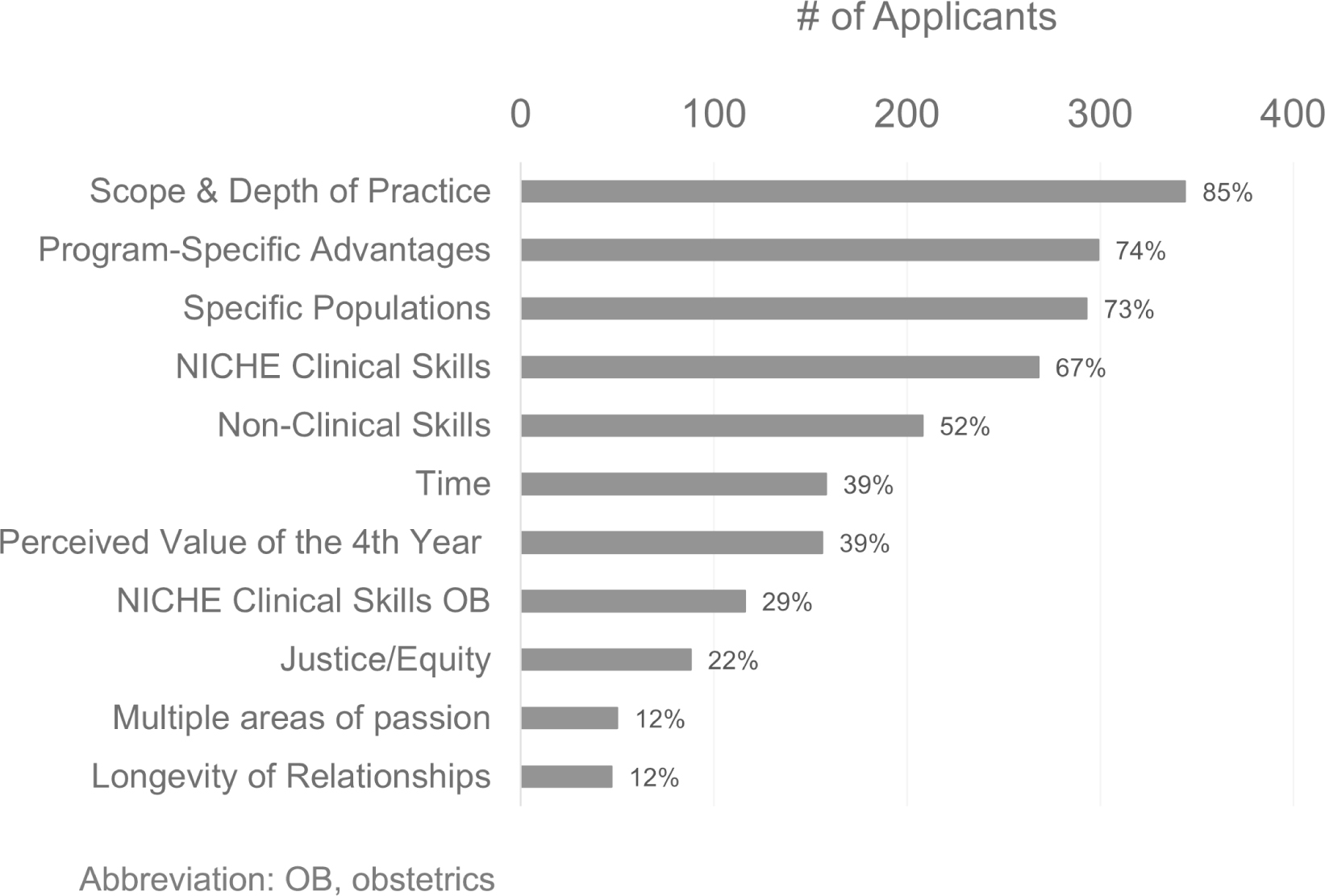
Justice/health equity |
Lastly, the emphasis on social justice and health equity at OHSU is an incredible teaching tool. Learning at a program that acknowledges and attempts to correct the systemic biases in medicine would prepare me to be part of a medical practice that helps to diminish the effects of these biases. |
I believe strongly that access to health care is a human right, and collaboration with other health sectors in formulating policies that are tailored toward catering to the health care needs of marginalized populations is important to me. . . . Health policies related to health disparities are ever-changing, and learning how to apply these earlier on during residency fits into my long-term postresidency goals. |
I am drawn to the program’s emphasis on health equity and its health equity curriculum, which promotes justice for underserved patient populations, developing authentic relationships using cultural competency and providing education on implicit bias and inequalities to reduce racial and socioeconomic barriers. |
It is important to me to hold space for others, treat every patient with respect and dignity, and to always come from a holistic and trauma-informed perspective. Your program will give me the proper tools to achieve this mission. |
Multiple areas of passion |
There are several different areas of concentration of family medicine that I am interested in, such as global health, adolescent medicine, and women’s health/FM OB. By having more opportunities to explore each area in depth, I will be able to decide which aspects I hope to gain additional training or possibly fellowship. |
While I am not averse to fellowship training, I am not even certain what the most suitable program would be, given many of the above interests have separate fellowships. A 4 year program enables me to give each of these interests appropriate time and consideration. in medical school, there are many courses I wish I could take, but there just aren’t enough weeks. . . . I wanted to replicate the [medical school] experiences as a resident with more autonomy. |
Scope and depth of practice |
A 4 year program would allow for me to experience broad-spectrum medicine—the intersectionality of all types of medicine ranging from but not limited to geriatrics, pediatrics, reproductive health, preventative medicine, and gender-affirming care. Exposure to these practices over a 4 year residency training period means being more prepared to care for a wide range of patients postresidency training. |
My primary goal as a future family medicine physician is to be a full-spectrum provider who is able to provide comprehensive care to any patient who walks into my clinic. The 4 year curriculum at OHSU seems to have the goal of creating the exact type of physician I hope to become. One extra year of training on my career timeline is nothing compared to the lifetime of benefit that could be gained in a single additional year of residency education. |
I find OHSU’s 4 year program compelling as it would allow time for solid clinical training as well as skill-building outside of strictly clinical settings. From MAT training to behavioral pediatrics to the health equity curriculum and leadership, advocacy and research opportunities, OHSU ’s program would allow me to explore a wide breadth of topics that are crucial to providing ethical and comprehensive care for my future patients. Additionally, the extra year of training would allow me to form more robust relationships with my patients, mentors, and colleagues, and more deeply explore research topics and advocacy initiatives that would shape my future career. |
I feel confident that I will have the time to be trained to competency (rather than being rushed to just get exposure) for many core procedures and practices. |
Specific populations |
OHSU’s 4 year family medicine residency would strongly prepare me for my career goal of working in a rural critical access hospital. As a rural physician, it is essential to have strong residency training to prepare for independence in a remote environment. In rural communities, you are often without access to specialists. Four years of training at OHSU would allow me to see a larger patient volume and a greater range of pathologies. The additional year of training at OHSU would also allow me to complete elective rotations that I might not have time for in a 3 year program. I am particularly interested in OHSU’s electives in Native health and global health. |
While I plan to practice full-scope family medicine following residency, I do have interests in particular subfields that warrant a specific focus during residency. Specifically, I hope to receive training in gender-affirming care, adolescent medicine, HIV care, and geriatrics. An additional year offers the chance to do rotations and other experiences within those areas and thus achieve confidence in my ability to provide excellent care to patients. |
I entered medicine with a strong desire and motivation to change the status quo. My goal is to become a full-spectrum family medicine physician who provides excellent care to marginalized and underserved communities and improves health inequity in those areas. However, there are countless ways this can look in practice. One of the many beautiful parts of family medicine is that most things are within scope, which benefits me since I have many interests and passions, including procedures, transgender health, behavioral health, addiction medicine, and rural medicine. A 4 year program would allow me to receive complete full-spectrum training, explore my passions, develop my leadership skills, and still enjoy and thrive in my training experience. |
When I learned that the 4 year training curriculum exists, I was elated. The OHSU curriculum in particular creates more time for training in women’s health, pediatrics, and geriatrics. Having the additional exposure is important for me to understand the biological uniqueness inherent to each of these populations and to apply this understanding to clinical decisions. |
Longevity of relationships |
I am focused on longevity and continuity of care within whatever community I practice, and I believe that this program will give me the best training to do this. An additional year of training will allow for me to establish bonds with patients and their families, and that is the most exciting aspect. |
I am interested in OHSU’s 4 year program because I want my career to be one of longitudinal relationships with my patients in systems designed for that purpose. A 4 year program allows for more time getting to know my patients and more experience working with them on chronic problems over time. |
Nonclinical skills |
A 4 year curriculum would not only allow me To further expand my medical knowledge and experience in the areas I am most interested in but will also give me the space to develop my leadership and advocacy skills. To be clear, a 4 year residency does not create subspecialists, but creates a family physician who is even more well-rounded and prepared to serve in any setting or community they might encounter. |
I like the idea of having dedicated time to explore other interests that will not diminish from the core components of family medicine training. Additionally, spending time working with community partners, contributing to the health equity and social justice team, and building leadership skills through the leadership training curriculum are all valuable experiences that will cultivate me into an agent for change in the community that I strive to be in my career as a family medicine physician. |
Integrating a longitudinal capstone project throughout all 4 years would afford me the opportunity to further develop my public health and research tool kits in the setting of comprehensive and innovative clinical training. |
OHSU’s 4 year curriculum allows for the time, space, and flexibility for me to craft a robust, comprehensive tool belt before embarking on my future as a family physician. From the varied clinical responsibilities and clinic-first model to the ability to choose an area of concentration and pursue a capstone project, I have confidence that after 4 years at OHSU, I will not only be a competent clinician, but a capable and knowledgeable advocate, public health practitioner, and researcher. |
I am interested in training at OHSU because it is an exceptional research institution with a dedication to primary care training, which I believe is a unique combination well-suited to my interests. In a 3 year family medicine residency, it is difficult to find time for research projects. Additionally, it is particularly difficult to gain experience in grant and proposal writing—which of course are crucial parts of the process. I am excited by OHSU ’s 4 year program because it could provide me with invaluable research opportunities and mentorship early on so I can hit the ground running as a busy attending. |
Time |
I also appreciate the thoughtfulness put into this curriculum that aims to help residents have a good work-life balance. Mental and physical wellness is something that I have found to be vital to my ability to care for others. |
I appreciate that this institution focuses on resident’s clinical development while providing an atmosphere supporting our physical and mental well-being. This supportive environment gives residents the opportunity to engage with the community and with one another. This, I believe, will make us more compassionate and empathetic to the needs of others. Furthermore, this supportive environment together with the additional year of study permits us to tailor the opportunities you provide to our own medical interests to forge ourselves into the practitioners we wish to be. |
OHSU’s 4 year program is ideal because it creates the opportunity to experience not only the breadth of family medicine within multiple settings but also the freedom and time to dive deep into certain areas. The 4 year program provides greater opportunity to pursue my multiple passions—such as obstetrics, adolescent medicine, and lactation—with more depth than I would in a 3 year program and perhaps even explore new passions. |
Attending a 4 year residency program would also allow me to explore the different aspects of family medicine and find what concentration I am most drawn to. I want to be able to take the time to find what area of family medicine I excel at and what areas my skills are best applicable to. |
Perceived value of the fourth year |
I am eager to be a part of a forward-thinking residency program that values innovation through a 4 year training model. |
I was also very interested in the extra year, and the resident I spoke to shared that she felt that the fourth year gave her extra confidence in her clinical practice as well as leadership skills. |
In my residency application process, I have sought out 4 year residency programs, particularly OHSU’s program, for a number of reasons. One is that family medicine requires a tremendously broad scope of knowledge, particularly for those who, like myself, hope to practice full-spectrum family medicine. As such, I hope to engage in the most holistic and comprehensive training possible, in order both to have a strong foundation in full-spectrum practice and to explore areas of concentration. I love that at OHSU, there is no trade-off between core skills and areas of concentration and that there is even time built in for residents to explore and produce scholarly work in their areas of interest. |
Throughout my education and training journeys, I have operated with the belief that more education and exposure are worth the time. |
A career in which I am more confident in my medical decisions would definitely be worth an additional year of training. |
The elective time, which remains protected within a 4 year curriculum, then further allows trainees to explore their unique interests. |
Program-specific advantages |
I am also impressed by the ingenuity of the areas of concentration, electives, and longitudinal courses offered and how residents can customize their own curriculum. I would take full advantage of this. |
I like the ability to choose an area of concentration on the backdrop of full-spectrum training. |
I say that because the program uniquely offers training in a wide spectrum of settings including a federally qualified health center, rural health center, academic health center, community clinic, and a vertically integrated health system. |
My fourth year of residency will potentially allow me to, for instance, gain more experience practicing in rural Oregon, do additional rotations with the IMPACT addiction medicine service, attain full competence at performing C-sections and other obstetrical procedures, and learn how to prescribe puberty blockers for transgender children, all things I may not have significant exposure to in my first 3 years. Your family medicine residency will empower me to fulfill my mission of providing a wide variety of medical services to marginalized communities in the Pacific Northwest. |
By training through OHSU’s 4 year family medicine residency, I would have increased flexibility to explore my own interests and improve my ability to handle challenging cases within primary care, hospitalist medicine, and obstetrics. |
Niche skills |
With its 4 year program, OHSU family medicine residency is uniquely positioned to fully prepare me for whatever career path I choose to take. My passions within medicine include working with underserved populations, palliative care, and addiction medicine, and I will be able to gain more experience in all of these areas through OHSU’s program. I also enjoy working in both an outpatient and inpatient setting, and I’m confident that with a 4 year program, I would be fully equipped to work in either a hospital or clinic. |
The 4 year curriculum—and the home institution with all its resources and specialties—would allow me to explore my interests within family medicine further before deciding on a potential fellowship. For example, I would have extra time in sports medicine and orthopedics or a dedicated palliative care rotation. |
I am very passionate about hospital medicine, clinic medicine, refugee health, addiction medicine, and care for LGBTQIA + individuals. Although a 3 year program could make me competent in these areas, I believe that a 4 year program allows me to practice medicine at a level that I believe all family medicine physicians should practice. |
One of the many beautiful parts of family medicine is that most things are within scope, which benefits me since I have many interests and passions, including procedures, transgender health, behavioral health, addiction medicine, and rural medicine. A 4 year program would allow me to receive complete full-spectrum training, explore my passions, develop my leadership skills, and still enjoy and thrive in my training experience. |
My diverse clinical interests include inpatient medicine, medical education, addiction medicine, HIV care, and women’s health. I strongly desire training that will allow me to continue exploring my varied interests. OHSU’s 4 year program offers this flexibility, yet ensures broad, thorough training that would prepare me to practice confidently in a variety of settings. |
One of the things I love most about family medicine, its breadth, is also one of the things that scares me the most about it. There are many areas of family medicine that I hope to master, including reproductive health, HIV medicine, and inpatient medicine. While many programs offer the opportunity for additional training in one of these areas, I know that it will be challenging to get all of the skills I want within the confines of the rest of my training. Having an additional year of training will help me build my knowledge and confidence in each of these areas to be able to practice in them without reservation after graduation. |
Niche clinical skills—obstetrics |
Many 3 year programs leave residents feeling like they have inadequate obstetric knowledge coming out of residency. An additional year with more obstetric experience will ensure that I have the confidence to practice rural obstetrics. |
Your program will expose me to the breadth of family medicine and offers enough time for me to explore the depths of my interest in preventative and addiction medicine, women’s, perinatal, and children’s care. |
The extra time built into the program will not only allow me to build strong relationships with a diverse community, but also concentrate on women’s health. I believe that providing holistic care to women during, before, and after pregnancy improves multigenerational family outcomes, thereby elevating the overall health of a population. The increased exposure to full-spectrum maternity care will provide a strong foundation for me to educate, counsel, and care for a broader range of obstetric patients. |
I am very attracted to the strong OB and procedural training that OHSU offers and by the possibility of gaining and refining additional skills and confidence in a fourth year of training. Hearing that some residents can graduate residency with enough surgical OB experience to be credentialed in some hospitals without the need for a special fellowship was another big draw for me. |
My dream is to become a full-scope family physician with C-section privileges who can serve a medically underserved rural community while continuing to teach and mentor the next generation of medical students and residents. In order to best serve a rural community, I believe I need to be able to be fully competent and prepared to encounter the whole gamut of family medicine. Given the wide breadth of the field of family medicine, I believe that the fourth year is necessary in order for me to achieve the competence and confidence to be a family medicine physician after graduating. |



There are no comments for this article.