Community-engaged research (CEnR) is a participatory approach that foregrounds community priorities and applies research results to community action. CEnR embodies shared decision-making by including community partners’ values, preferences, and experiences within the research process. CEnR projects can help medical student learners acquire skills in conducting needs assessments and more fully appreciate the social determinants of health and challenges faced by communities. CEnR does not prescribe specific methods for addressing research questions. Rather, it is a collaborative approach with community members that begins by codetermining the research topic, levels of engagement for all partners, and positionality. CEnR uses participatory methodologies and unique approaches to knowledge cultivation while creating space for dialogue to build relationships and trust. The purpose of this article is to provide a brief introduction to CEnR principles, identify additional resources and tools, and share ways of managing some of the challenges of conducting CEnR.
Community-engaged research (CEnR) is a participatory approach that foregrounds community priorities and strengths, establishes long-term community commitments, and applies research results to community action.1 CEnR is an approach that recognizes the frequent exclusion of marginalized groups from research and involves these communities in knowledge production useful for their lives. It is focused on developing close-working interpersonal relationships, often with communities historically and contemporarily marginalized. Embodying shared decision-making, the CEnR researcher listens deeply to solicit partners’ values, preferences, and experiences; incorporates those perspectives into the research process; and shares knowledge and results with community members so they can make the best decisions to advance their goals. The importance of meaningful and impactful community engagement is widely recognized in medicine to improve the health of communities and health care outcomes.2,3 With its emphasis on relevance, rigor, and reach, CEnR is useful for communities, educators, practitioners, and policymakers.4
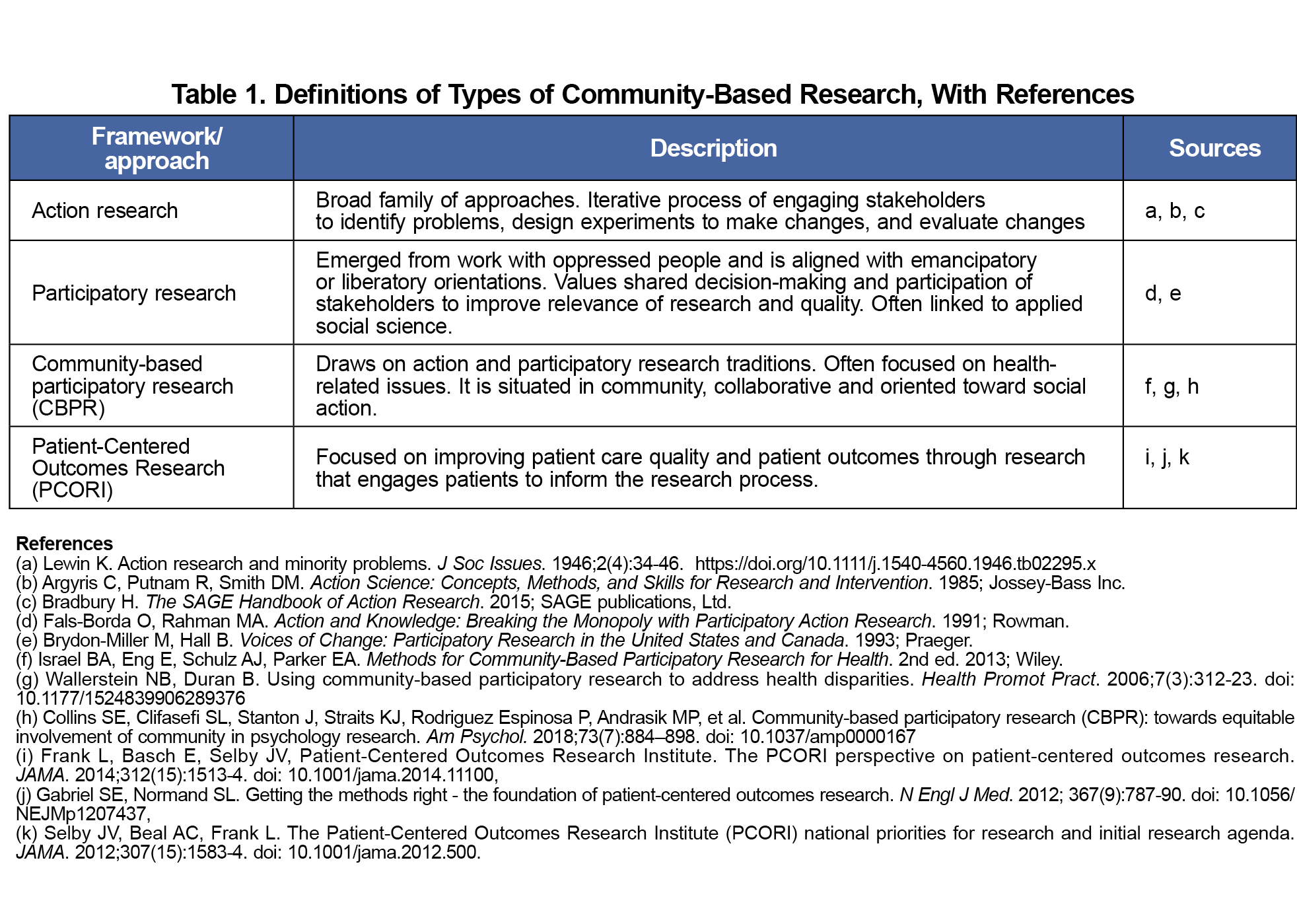
CEnR, an umbrella term, incorporates various research traditions (Table 1).5–7 CEnR principles and practices vary based on the researcher, their discipline, community-partner preferences, the project, level of collaboration, data sharing, and trust. To orient practitioners new to CEnR, this article reviews CEnR principles, identifies additional resources for knowledge generation, and shares ways of managing unique challenges of CEnR in practice.
CEnR Within University Systems
In contrast to research on or about communities, CEnR produces knowledge with community groups to promote transformative change and, when possible, challenge oppressive power and hierarchical structures. However, as CEnR has become institutionalized in university settings, its social justice orientation may be lost within institutional logics. Universities, while rhetorically endorsing CEnR, structurally disadvantage it through reward systems, funding mechanisms, and hierarchies that privilege individual productivity, grant revenue, and traditional scholarship over collective, justice-oriented knowledge production.8,9 CEnR is routinely classified as “service,” a distinction that undermines its scholarly legitimacy and penalizes those whose primary approach to research involves CEnR.6 These problems can prevent building long-term research relationships that foster equity and ensure marginalized groups are included in knowledge production, thus rendering transformative CEnR untenable.
Despite these impediments, researchers in university settings successfully conduct CEnR.10 Scholars sustain rigorous CEnR through communities of practice that share strategies to buffer against institutional pressures and combat professional isolation.11 For example, in our feminist CEnR group, we collectively troubleshoot bureaucratic barriers, and develop language that helps uphold community priorities while meeting university demands. Bell and Lewis also offer a framework to advocate for CEnR-supportive institutional changes.8
For medical educators, CEnR projects can enable learners to acquire public health skills (eg, conducting needs assessments) and lead to an appreciation of the social determinants of health and empathy toward the challenges faced by local communities through collaborative, bidirectional learning.12-15 US medical schools must provide support for service learning and community projects under Liaison Committee on Medical Education (LCME) standards Element 6.6.16 CEnR medical student curricular examples are available from several sources.17-20
CEnR is an approach, and as such does not prescribe the use of specific methods. For each project, the chosen research method should reflect the best way to answer the research question in the specific community context and may include surveys, focus groups, or observations. For example, researchers investigating and addressing nutritional issues raised by a community would partner with community members to identify (a) what nutrition issues community members want to address; (b) what methods community members would like to use in studying and addressing said issues; (c) how community partners would like to be involved in data collection and analysis; and (d) how the research findings should be disseminated. What is essential in CEnR is involvement of community partners as co-collaborators throughout the research process. Throughout this research collaboration, community partners decide what is researched and how that research is conducted.
Selecting an Approach to Knowledge Generation
Engagement can occur at various depths and decision points. Tools have been created to clarify levels of engagement and align methodological choices appropriately. These include Degree of Collaboration Abacus Tool,21 Ladder of Citizen Participation,22 IAP2 spectrum of public participation,6 and Continuum of Community Engaged Research.23 Several publications also provide examples of where, how, and when to apply CEnR approaches.6,24 For example, Vaughn et al suggest pairing the stage of the research partnership with specific methods.6
In CEnR, the research methods used are varied and include quantitative (eg, surveys), qualitative (eg, interview, focus group), and mixed methods. Moreover, CEnR may employ creative approaches to knowledge generation, such as art-based methods (eg, photography,25 drawing,26 poetry, or drama27), participatory design (eg, metaphorical tools, river of life28), and asset or strengths mapping. Employing various research methods when collaborating with the community offers different ways to examine the complex issues communities face. In CEnR, method selection should be made by all partners collaboratively.6
Identifying one’s positionality (ie, the connection between a researcher's personal identities, experiences, and context that shape their perspective, and consequently, their research) is fundamental to CEnR. Recognizing one’s positionality and its relationship to the research process requires ongoing self-reflection due to the interpersonal and egalitarian nature of CEnR.29 In publications, written reflexivity and positionality statements situate authors for readers in the context of each research project and are increasingly required by journals. These statements should not be performative; they are highly important signals to the reader. Additionally, ongoing reflexivity is a significant component of CEnR that goes below the surface. Dr Olmos-Vega et al offer a useful guide to reflexivity.30
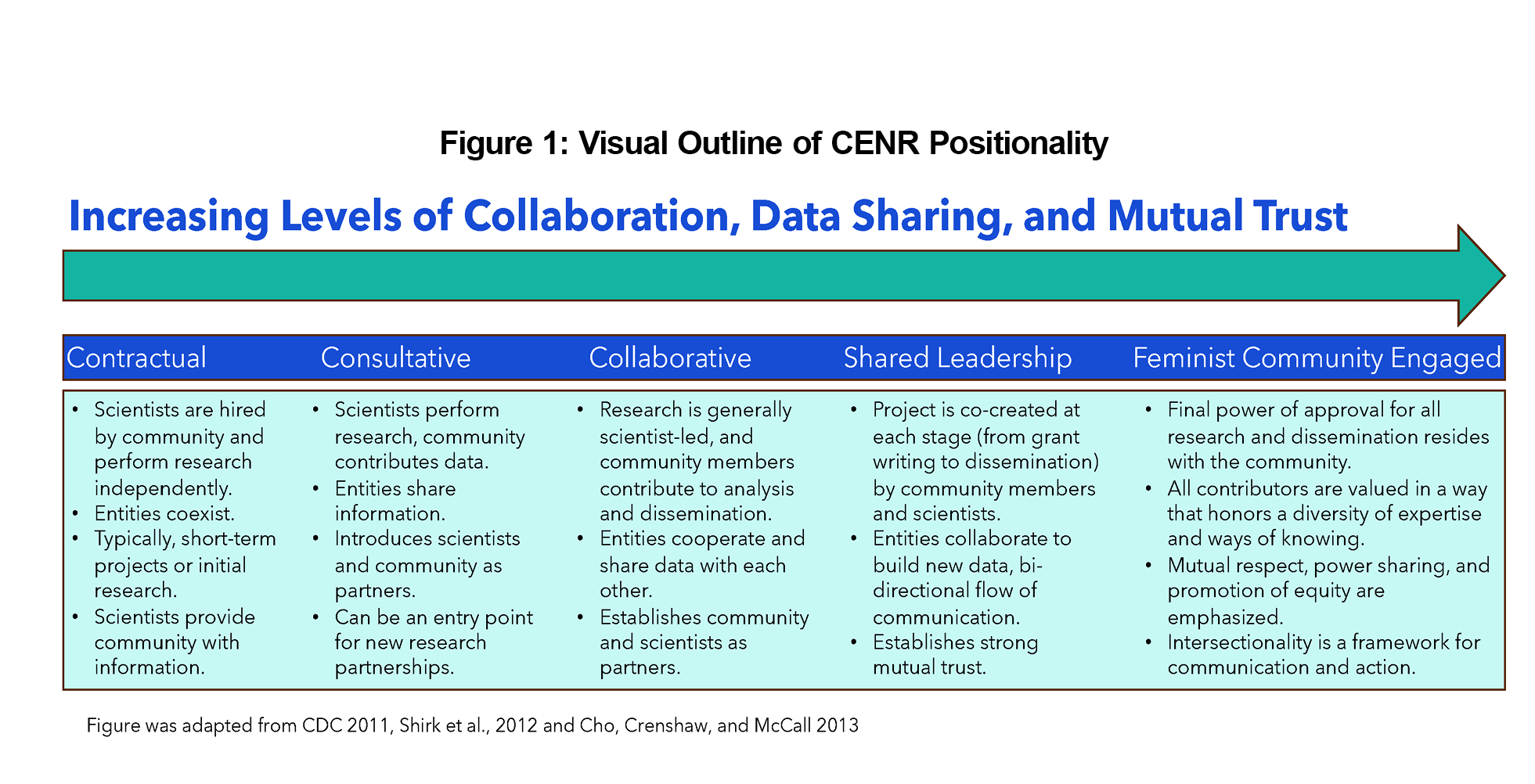
In our CEnR community of practice, established amid COVID-19 pandemic disruptions, we clarified our shared positionality as feminist community-engaged researchers (Figure 1). Drawing from multiple sources, we understand feminist community engagement is “an approach to knowledge production that emphasizes intersectionality, raises critical consciousness, fosters equitable partnerships, and is grounded in social and historical context with the goal of supporting actions that upend oppressive power relations to promote social justice, equity, and/or liberation.”31
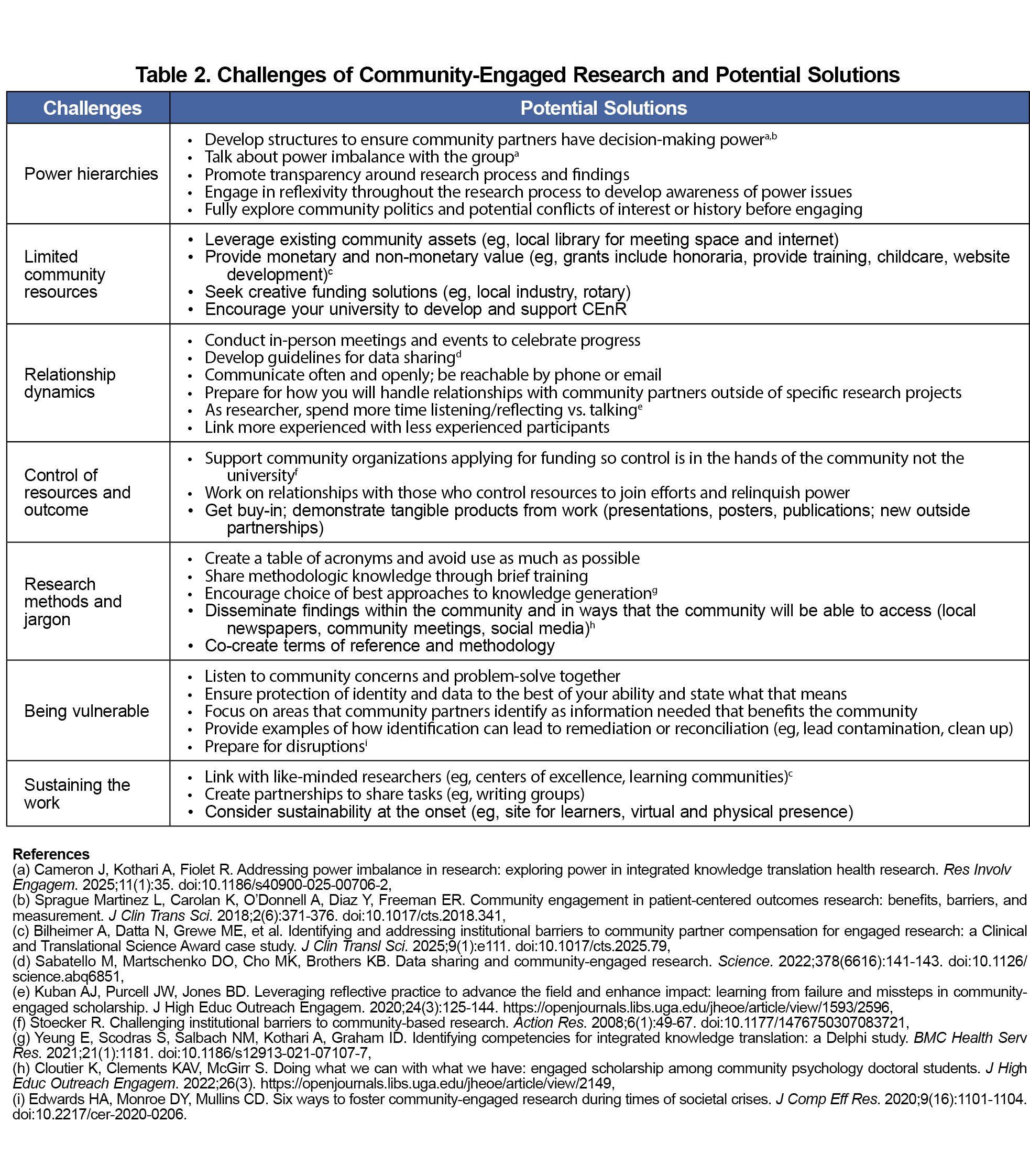
CEnR is inherently relational, which takes time and comes with challenges. Time spent with community partners is not just about projects; it’s also about developing trust and building relationships. Using dialogue to clarify roles, define expectations, and manage conflict is critical.32 Because communities are diverse and voices vary in strength, CEnR must acknowledge power and structural differences among partners. Communities have existing relational dynamics and potential conflicts that researcher partners must navigate and that may shift due to the presence of a new partner. Table 2 highlights some of these challenges and offers potential solutions. Illustrative quotes of challenges can be found in the Appendix.
Power hierarchies cannot always be overcome due to existing relationships and community politics.29 However, participatory methodologies and dialogue helps build relationships and trust. Since discrepancies in timelines and bureaucracy for funders and partners often pose significant challenges and create inequities for community partners,33 it is critical to engage community partners early in the research process, allowing the partnership to build the flexibility needed for successful CEnR.
CEnR is an approach to research that uses a social justice orientation to jointly engage community members in research processes, aligning with their needs, strengths, and interests. There are certainly institutional, interpersonal, and logistical challenges to conducting CEnR. However, through centering community-members’ desires and goals, there is significant value in the knowledge produced as it prioritizes community-members’ questions and respects their dignity and agency, thereby strengthening and fostering community health and well-being.
Acknowledgments
Conflict of Interest Statement: None of the authors have any conflict of interest to report. All authors contributed to inception, and preparation of the manuscript for publication.
References
- Wallerstein N. Engage for equity: advancing the fields of community-based participatory research and community-engaged research in community psychology and the social sciences. Am J Community Psychol. 2021;67(3-4):251-255. doi:10.1002/ajcp.12530
- National Academy of Medicine. Assessing Meaningful Community Engagement. Accessed February 2, 2026. https://nam.edu/our-work/programs/leadership-consortium/assessing-meaningful-community-engagement/
- Cohn E, McCloskey DJ, Berman L, et al. Agency for Toxic Substances and Disease Registry (U.S.); Centers for Disease Control and Prevention (U.S.); National Institute of Health (U.S.); NIH National Center for Advancing Translational Sciences; NIH National Institute of Environmental Health Sciences. Principles of Community Engagement, 3rd edition. 2025; Centers for Disease Control and Prevention. Accessed May 13, 2026. https://stacks.cdc.gov/view/cdc/251390.
- Balazs CL, Morello-Frosch R. The three Rs: how community-based participatory research strengthens the rigor, relevance, and reach of science. Environ Justice. 2013;6(1):9-16. doi:10.1089/env.2012.0017
- Flicker S, Savan B, McGrath M, Kolenda B, Mildenberger M. “If you could change one thing...” What community-based researchers wish they could have done differently. Community Development Journal. 2008;43(2):239-253. 253. doi:10.1093/cdj/bsm009.
- Vaughn LM, Jacquez F. Participatory research methods – choice points in the research process. J Particip Res Methods. 2020;1(1). doi:10.35844/001c.13244
- Frabutt JM, Graves KN. The language and methods of community research. In: Beckman M, Long JF, eds. Community-Based Research: Teaching for Community Impact. 2016; Stylus Publishing, LLC.
- Bell M, Lewis N Jr. Universities claim to value community-engaged scholarship: so why do they discourage it? Public Underst Sci. 2023;32(3):304-321. doi:10.1177/09636625221118779
- Weerts DJ, Sandmann LR. Building a two-way street: challenges and opportunities for community engagement at research universities. Rev Higher Educ. 2008;32(1):73-106. doi:10.1353/rhe.0.0027
- Bilheimer A, Datta N, Grewe ME, et al. Identifying and addressing institutional barriers to community partner compensation for engaged research: A Clinical and Translational Science Award case study. J Clin Transl Sci. 2025;9(1):e111. doi:10.1017/cts.2025.79
- Cutforth N. The journey of a community-engaged scholar: an autoethnography. Quest. 2013;65(1):14-30. doi:10.1080/00336297.2012.727369
- Essa-Hadad J, Murdoch-Eaton D, Rudolf MCJ. What impact does community service learning have on medical students’ appreciation of population health? Public Health. 2015;129(11):1444-1451. doi:10.1016/j.puhe.2015.05.009
- Yigletu S, Kosinski KC, Kuah A, Alfaro K, Holmes AC, Tendulkar SA. Collaboration toward one collective goal: a mixed-methods study of short-term learning outcomes and long-term impacts among students participating in an undergraduate Community-Based Participatory Research (CBPR) Course. Front Public Health. 2021;9:694840. doi:10.3389/fpubh.2021.694840
- Kovaric K, Luk J. Impact of a service learning curriculum that emphasizes bidirectional learning on medical students' professional identity formation. Med Sci Educ. 2024;35(1):371-379. doi:10.1007/s40670-024-02202-w. eCollection 2025 Feb.
- Mennin S, Petroni-Mennin R. Community-based medical education. Clin Teach. 2006;3(2):90-96. doi:10.1111/j.1743-498X.2006.00093.x
- Hash R, Barzansky B. Which LCME accreditation expectations support quality and safety in global health immersion experiences for medical students? AMA J Ethics. 2019;21(9):E766-E771. doi:10.1001/amajethics.2019.766
- Khazanchi R, Keeler H, Strong S, et al. Building structural competency through community engagement. Clin Teach. 2021;18(5):535-541. doi:10.1111/tct.13399
- Gimpel N, Kindratt T, Dawson A, Pagels P. Community action research track: community-based participatory research and service-learning experiences for medical students. Perspect Med Educ. 2018;7(2):139-143. doi:10.1007/S40037-017-0397-2
- Redman RM, Reinsvold MC, Reddy A, et al. A successful model for longitudinal community-engaged health research: the 2040 Partners for Health Student Program. Fam Pract. 2017;34(3):341-346. doi:10.1093/fampra/cmx025
- Hennen B. Demonstrating social accountability in medical education. CMAJ. 1997;156(3):365-367. PMID:9033418
- Doberneck DM, Dann SL. The Degree of Collaboration Abacus Tool. J High Educ Outreach Engagem. 2019;23(2):93-107. Accessed May 12, 2026. https://openjournals.libs.uga.edu/jheoe/article/view/1453
- Arnstein SR. A ladder of citizen participation. J Am Inst Plann. 1969;35(4):216-224. doi:10.1080/01944366908977225
- Key KD, Furr-Holden D, Lewis EY, et al. The continuum of community engagement in research: a roadmap for understanding and assessing progress. Prog Community Health Partnersh. 2019;13(4):427-434. doi:10.1353/cpr.2019.0064
- Duea SR, Zimmerman EB, Vaughn LM, Dias S, Harris J. A guide to selecting participatory research methods based on project and partnership goals. J Particip Res Methods. 2022;3(1). doi:10.35844/001c.32605
- Li S, Gulley J, Booty M, Firchow B, McGladrey ML. Using photovoice to improve engagement in community health assessments addressing behavioral health. J Behav Health Serv Res. 2025;52(2):213-230. doi:10.1007/s11414-024-09885-4
- Literat I. “A pencil for your thoughts”: participatory drawing as a visual research method with children and youth. Int J Qual Methods. 2013;12(1):84-98. doi:10.1177/160940691301200143
- Salisbury J. Doctoral thesis, 2021. Community-engaged theatre audiences. Accessed November 22, 2025. https://utoronto.scholaris.ca/items/12297a42-f544-42e5-a4e1-9cd0f5bdcf81.
- Engage for Equity. Partnership River of Life Activity. Accessed November 22, 2025. https://engageforequity.org/tool_kit/river-of-life/.
- Wilson E, Kenny A, Dickson-Swift V. Ethical challenges in community-based participatory research: a scoping review. Qual Health Res. 2018;28(2):189-199. doi:10.1177/1049732317690721
- Olmos-Vega FM, Stalmeijer RE, Varpio L, Kahlke R. A practical guide to reflexivity in qualitative research: AMEE Guide No. 149. Med Teach. 2022;45(3):1-11. doi:10.1080/0142159X.2022.2057287
- Wentworth C, Doberneck DM, Barnes-Najor JV, Smith M, Hirsch J, Reid MR. Feminist community engagement disrupted: pathways for boundary spanning and engagement during disruption. J High Educ Outreach Engagem. 2024; 28(3):59-71. https://openjournals.libs.uga.edu/jheoe/article/view/3558
- Ortiz K, Nash J, Shea L, et al. Partnerships, processes, and outcomes: a health equity–focused scoping meta-review of community-engaged scholarship. Annu Rev Public Health. 2020;41(1):177-199. doi:10.1146/annurev-publhealth-040119-094220
- Stoecker R. Challenging institutional barriers to community-based research. Action Res. 2008;6(1):49-67. doi:10.1177/1476750307083721



There are no comments for this article.